Witnesses in the northeastern Iranian city of Shahrud have told Iran International that at least 200 people were killed over two days of protests, alleging they died at the hands of security forces.
The witnesses reported the deaths occurred on Thursday and Friday, Jan. 8 and 9.
One witness said Ibn Yamin Street was bloodstained on the night of Jan. 19, with visible signs of heavy clashes across the area.
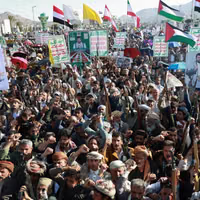
Videos sent to Iran International showed people in Shahrud, in Semnan province, chanting “This is the final battle, Pahlavi will return” as they gathered in the streets on Friday night, Jan 9.
Vignettes of horror on Iran's streets were trickling past a state-imposed internet blackout, as eyewitnesses described to Iran International the widespread killing and blinding of protestors with live fire and the denial of medical care to survivors.
Street protests which burst forth on Dec. 28 citing economic grievances quickly morphed into calls for the downfall of the nearly 50-year-old theocracy.
Authorities deployed deadly force to largely quell the unrest in the bloodiest crackdown on demonstrations since the 1979 Islamic Revolution.


Vignettes of horror on Iran's streets were trickling past a state-imposed internet blackout, as eyewitnesses described to Iran International the widespread killing and blinding of protestors with live fire and the denial of medical care to survivors.
Street protests which burst forth on Dec. 28 citing economic grievances quickly morphed into calls for the downfall of the nearly 50-year-old theocracy.
Authorities deployed deadly force to largely quell the unrest in the bloodiest crackdown on demonstrations since the 1979 Islamic Revolution.
Accounts of the violence which unfolded on Iran's streets at its height on Jan. 8-10 were related to Iran International on Monday and shed light on killing which authorities have acknowledged claimed the lives of thousands but according to medics and government officials total at least 12,000, according to Iran International.
Karaj: wounded protestors shot in Taleghani Square
In Karaj, west of Tehran in north-central Iran, an eyewitness said security forces fired directly at protesters during demonstrations on Jan. 9 in Taleghani Square, killing and wounding a number of people.
The witness said forces deliberately shot dead some wounded protesters and blocked others from reaching hospitals.
Gorgan and Shahin Shahr: snipers on rooftops
In Gorgan, in northeastern Iran, an eyewitness said security forces fired at protesters from the rooftop of Panj Azar Hospital on Jan. 9, adding that a 15-year-old girl was directly targeted and killed.
Separate eyewitness accounts from Shahin Shahr, in Isfahan province in central Iran, said armed forces fired at protesters from the rooftops of public buildings, including a haberdashery bazaar, the education department building, the municipality and the Negarestan building on the nights of Jan. 8 and Jan. 9.
Qazvin: hospitals filled with bodies and wounded
In Qazvin, in northwest Iran, an eyewitness said more than 1,000 people were killed in the city over three nights of protests from Jan. 8 to Jan. 10.
The witness said hospitals were filled with bodies and wounded people within two hours of direct gunfire by security forces on the evening of Jan. 8, adding that the blood on the floors of some medical centers lapped up to exit doors.
Behbahan: eye injuries, machine gun deployment
At least 40 people, and possibly up to 50, suffered eye injuries, a medical worker in Behbahan, in Khuzestan province in southwest Iran, told Iran Iran International. Use of buckshot which has blinded protestors has been reported in previous waves of deadly violence.
The source said vehicles equipped with machine guns were stationed in the city and fired at people on Jan. 8 and Jan. 9.
Hashtgerd: young child shot on sight
In Hashtgerd, west of Tehran in Alborz province, police fired on a family accompanied by a young child on Friday, Jan. 9, a local source told Iran International.
According to the source, a six- or seven-year-old child was seriously injured and suffered heavy bleeding after being hit in the leg by pellets.
The child’s mother said the family was not chanting slogans while leaving their home, but police opened fire as soon as they saw them, according to the source.
Shahroud: protestor shot through the heart
A 31-year-old protester identified as Matin Montazerzohur was killed after being shot by security forces on the evening of Jan. 8 during protests in the city of Shahroud, in northeastern Iran, local sources told Iran International.
Eyewitnesses said he had travelled from Gorgan to Shahroud with friends to take part in the protests and remained in contact with his family until around 8 p.m.
Hours later, his friends informed his family that he had been shot.
The source said the bullet struck him in the chest and ripped through his heart.
His body was returned to his family after four days, on Jan. 12, and transferred to Gorgan. He was buried the following day without a ceremony. Sources said he was self-employed, worked in bodybuilding and had planned to migrate to Turkey.
Isfahan: summonses and pressure on striking shopkeepers
In Isfahan, in central Iran, local sources told Iran International said the Revolutionary Guards intelligence unit summoned shopkeepers who joined strikes and blocked the bank accounts of some of them.

Iranians across generations increasingly see migration not as a dream but as an escape from a future that feels out of reach, a survival strategy driven by economic collapse, shrinking opportunities, and a sense of confinement they say follows them both at home and abroad.
Ahead of International Migrants Day, Iran International asked its audience to submit messages responding to questions about migration: the challenges, opportunities, and lessons it has brought, and whether – if they could go back – they would choose migration again.
Many respondents described leaving Iran not as a free decision but as a reaction to conditions they say have stripped away the possibility of a normal life.
One respondent rejected the term “migration” outright, writing that leaving Iran was “an escape from the prison of the mullahs’ regime” and “the prison of the Islamic Republic government.”
Another, a 51-year-old specialist doctor, said that if he had known how bad conditions would deteriorate and how far the status of doctors would fall, he would “definitely” have considered emigrating.
Some contrasted today’s crises with memories of a more prosperous past, citing Canada as one of the top destinations for Iranians and arguing that “the conditions Canada has today, we had in our country 50 years ago, with every comfort and excellent facilities.”
Others described migration through direct comparisons between life inside and outside Iran, focusing on differences in standards of living, prices, and the quality of goods.
Youth without prospects
Younger voices described a generation stuck between an unlivable economy at home and closed doors abroad, as the rial’s collapse and soaring prices erase prospects for housing, cars, further study, and family life.
One 35-year-old who once studied in Spain but was forced back as the euro jumped from 4,000 to about 130,000 rials said life in Iran has become “hell,” that he suffers severe depression, and that “we young people in Iran no longer have any motivation to continue.”
He said the exchange-rate shock effectively closed the path to migration and spoke of an economic dead end and an inability to buy a home, continue studying, or build a future – an outcome he said led to “severe depression.”
Several respondents said they would migrate “without a second’s hesitation” if they had the money, while others said they were planning to move to the UK or Nordic countries.
Some emphasized that money is central to the decision, saying they cannot afford to migrate even though they want to.
Others, unable to leave, spoke of holding university degrees while working as street vendors and pleaded for their voices to reach the world, saying the youth have been the main victims of the current system – in line with reports of rising anxiety and hopelessness among Iran’s educated middle class.
Among the messages, regret and longing featured prominently.
Several respondents said that if they could return to the past, they would have migrated decades earlier to secure their children’s futures.
One said waiting for “promises” had ended in what he called “valleys of misery.”
Internal migration also appeared in the accounts, with moves from smaller towns to major cities described by some as improving children’s education and quality of life – though others said such moves would only be truly desirable if resources and opportunities were distributed more evenly across the country.
“In 2001, I migrated within the country to a bigger city and, despite the initial difficulties, I am very satisfied. It had a profound impact on my children’s education and other aspects,” one respondent said.
No easy way back
Those who did leave described the shock of adapting to new countries but also the relief of everyday freedoms, like going out with friends without fearing that police or security forces will stop them or harass women over hijab.
Others said migration, while an opportunity for some, was experienced by many as coercion, a forced choice, and an escape from daily crises under the shadow of the Islamic Republic, while for another group it remained an unattainable dream that grows more distant under economic and political pressure.
“I’ve wanted to leave for many years, but from what I’ve heard, many people have died on the way. Going illegally has many troubles, and there’s always the risk of being deported,” another respondent said.
One said that seeing officers mistreat women fuels fantasies of violent revenge, yet concern for family holds them back, another sign of the psychological toll of living under constant pressure.
Some who had migrated described it as a difficult path with no return.
“Migration is not a good thing; it’s a hard experience. As for me, I’m never going back,” one respondent said.

Iran’s latest gasoline price hike is weighing on daily life well beyond fuel costs, pushing up food prices, transport fares and medical expenses and adding strain to already stretched household budgets, citizens said in messages to Iran International.
A three-tier gasoline pricing system, including sales at 50,000 rials per liter, took effect nationwide from the early hours of Saturday.
The move was followed by further devaluation of Iran’s rial, with the US dollar trading at a record high of 1.3 million rials on Sunday.
Iran International asked its audience how the change was affecting living costs and received a wave of responses describing what many called a new economic shock.
A retired bank employee said that the impact was immediate. “Before gasoline became more expensive, my pension might last half the month. Now it probably won’t even cover 10 days. Living expenses no longer match a retiree’s income."
Others pointed to parallel increases in unrelated costs. One citizen said a natural gas bill jumped from 520,000 rials (40 cents) to 32 million rials ($25), while another complained that some basic goods had already vanished from shops.
“Because of the gasoline price hike, Pakistani and Indian rice couldn’t be found in stores today,” one message read.
Inflation fears and shrinking food baskets
Many respondents said higher fuel prices were feeding directly into inflation, particularly for food and medicine. “It affects everything. Tables get smaller and medicine becomes several times more expensive,” one citizen wrote.
The warnings come as pressure on patients has already intensified following the removal of preferential currency rates for some imported medicines.
On Saturday, Hadi Ahmadi, a board member of Iran’s Pharmacists Association, said many patients were buying only parts of their prescriptions or abandoning purchases altogether due to rising prices.
Several messages also pointed to increases in staple foods, including rice, bread, eggs and dairy products, even before the gasoline hike was formally announced.
Drivers and fuel-dependent workers hit hardest
Drivers and those whose livelihoods depend on fuel said they were among the hardest hit. A ride-hailing company driver wrote that higher gasoline prices had made it impossible to keep working because income no longer covered expenses. Others reported sharp rises in taxi and freight fares.
Some respondents framed the issue as a broader structural crisis. “When gasoline becomes more expensive, everything automatically follows,” one reader wrote. “Wages are paid in rials, but expenses are in dollars,” reads another message.
The hike has revived memories of November 2019, when a sudden fuel price increase triggered nationwide protests and a deadly crackdown.
Since then, fuel pricing has remained one of Iran’s most sensitive economic issues, with many citizens now warning that the latest changes are shrinking household budgets further and pushing more families closer to the poverty line.

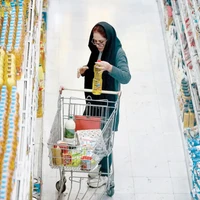
Iranians report rising prices and sporadic shortages of everyday goods and groceries, making it harder to cover basic needs and put food on the table, according to messages sent to Iran International.
Iran International asked ordinary shoppers in Iran to share their experiences of price hikes, the falling value of money, and the daily affordability challenges they face. A series of videos, audio clips, and text messages show mounting hardships.
Relentless price increases and runaway inflation have pushed families to the brink, forcing many to fight to survive rather than live any kind of normal life.
Their messages describe thinning shelves, collapsing purchasing power, and a growing sense that while ordinary people sink deeper into hardship, only profiteers and those connected to power continue to thrive.
“Everything is expensive and people are exhausted from all this inflation. There are no sales, businesses are dead. Only a miracle can save us from this situation,” one message said.
“In Iran, the government doesn’t care about these problems. Right now there is no business. Even if you work 24 hours a day, you’ll still come up short at the end of the month – unless you earn 3 million tomans (about $25) a day, which almost no one does, perhaps only 10% of the population,” another message said. Average Iranian income is about 100 to $150 per month.
Purchasing power
Local media tracking shows that in the past year, food prices in Iran have risen by an average of more than 66%.
Bread and grains are up 100%, fruits and nuts 108%, vegetables 69%, beverages 68%, fish and seafood 52%, and dairy products like milk, cheese and eggs 48%.
“Small retailers are either shut down or semi-closed because prices rise daily and the purchasing power of the middle class and the poor has completely collapsed. Only profiteers and those connected to the corrupt government benefit,” one message said.
“Prices for food, clothing, medicine, doctor visits, car parts – everything – are extremely high. Ninety percent of people fight just to survive, not to live.”
Daily rise
Other messages said conditions worsened after the 12-day war with Israel in June and the subsequent return of UN sanctions.
“I swear I haven’t bought red meat for a year. Same with chicken. After the 12-day war, I lost my job and my wife and children left me,” one message said.
Based on the accounts, some families have eliminated dairy except for cheese, stopped buying seasonal clothing, and cut out snacks entirely.
Dining out, visiting coffee shops, and even holding family gatherings have all but disappeared. For many, buying birthday gifts for children is no longer possible.
“This is our situation as a semi-affluent family above the poverty line. I can’t even imagine what life is like for those below it,” another message said.