File photo: A construction worker looks on at a building site in Iran
The International Monetary Fund forecast Tuesday that Iran’s economy would shrink 7.6% in 2026, a worse outlook than for its main Middle Eastern rivals amid the war, with Saudi Arabia and the UAE facing smaller contractions and Israel and Turkey expected to grow.
The IMF's latest World Economic Outlook revised Iran's forecast downward from a 5.4% contraction projected in July. The economy is now expected to shrink for a second consecutive year, following an estimated 0.9% decline in 2025.
The IMF expects the economies of the Middle East and Central Asia to contract by 0.3% this year, a sharp reversal from the 1.9% growth it forecast in April.
Several countries in the region face deeper contractions than Iran, with the IMF forecasting declines of 16.7% in Kuwait, 16% in Iraq, 15.6% in Qatar and 11.3% in Bahrain.
Saudi Arabia and the United Arab Emirates are expected to see smaller contractions of 3.3% and 3.9%, respectively. Others are projected to grow, including Egypt by 5.1%, Israel by 4.5%, Oman by 4.1%, and Jordan and Turkey by 2.7% each.
The deterioration in most regional countries reflects renewed military exchanges and prolonged disruption to shipping through the Strait of Hormuz, while Iran faces the additional pressure of the US naval blockade.
Iran's projected contraction nevertheless stands out, reflecting restrictions on its oil exports and an economy already weakened by years of sanctions and structural problems.
‘Deep recession’
Iranian government data presents a similarly bleak picture.
The Statistical Center of Iran reported last month that GDP contracted 10% in spring 2026 compared with the same period a year earlier, the sharpest quarterly decline in 15 years.
Even excluding oil, the economy shrank 4.6%, showing that the downturn extended well beyond the energy sector.
Oil and gas production fell 26.4% from a year earlier, while industry and mining contracted 14.7% and services 4.8%. Agriculture was the only major sector to expand, growing 2.3%.
Exports of goods and services fell nearly 36% and imports declined almost 15%. Household consumption dropped 4%, indicating a further weakening of domestic demand and purchasing power.
The figures contrast sharply with the global outlook, with the IMF expecting growth of just over 3% worldwide in 2026.
Officials offer rosier picture
Senior Iranian officials have continued to offer far more optimistic assessments.
Central Bank Governor Abdolnaser Hemmati told state television last week that inflationary pressures had eased during the summer and that the government had prevented the economic collapse predicted by Washington.
Former Labor Minister Hojjat Abdolmaleki went further in recent remarks that drew mockery on Iranian social media, saying inflation was effectively Iran's only economic problem.
“If you put high prices aside, you have no other economic problems,” he said.
Pressure on oil exports
Iran loaded no crude oil or condensate onto tankers throughout September, according to data from commodities intelligence firm Kpler, the first full month without loadings since the 1979 Islamic Revolution.
Washington has described its economic campaign as an effort to deprive Tehran of its remaining sources of revenue.
On October 8, the US Treasury imposed sanctions on 17 vessels and associated companies it identified as part of Iran's remaining shadow fleet.
Treasury Secretary Scott Bessent said the administration would continue targeting those facilitating Iranian oil sales.
The combination of the IMF forecast and Iran's own economic data points to a recession extending well beyond the country's energy sector.
How much deeper it becomes will depend in large part on the duration of the war, the blockade and Tehran's ability to restore oil exports.
نام «دریای کاسپین» روی نقشه در یکی از برنامههای صداوسیما
Iranian state television has begun referring to the country’s northern sea as Caspian in Persian, a departure from the customary Khazar, after airing claims that the older familiar name serves alleged Israeli ambitions in the Caucasus.
Caspian takes its name from the Caspians, an ancient people who lived along the sea’s southwestern shores in modern Iran. Khazar refers to the Khazars, a medieval Turkic people whose state lay to the north and northwest of the sea and whose ruling elite adopted Judaism.
It remains unclear whether Iran’s state broadcaster has issued a formal directive to change its terminology across programs. However, the name change brings attention to competing arguments over history and national identity.
Supporters of Caspian describe it as a restoration of Iranian heritage, while opponents say Khazar is itself a deeply rooted geographical name whose use does not endorse the people it originally described.
State TV’s website features a segment from IRGC-affiliated Ofogh channel’s “War Headquarters” program with commentator and academic Ahmad Kazemi under the title “The Zionists’ plot to change the name of the Caspian Sea to Khazar.”
In remarks also shared by the IRGC-affiliated Fars News, Kazemi portrayed the use of Khazar as supporting an Israeli historical claim.
“By using the non-Iranian word Khazar today, we are effectively helping Israel’s thesis that seeks to prove the existence of a Jewish empire in the Caucasus,” he said.
The name Caspian Sea in Persian on another Iranian state TV program aired on Tuesday Oct. 13 , 2026.
Kazemi said people outside Iran mocked Iranians for using what he described as a foreign name while others used Caspian. He described the Caspians as an Iranian people who had lived across areas stretching from Kashan to Mazandaran and the Caspian coast.
His remarks did not provide evidence of an Israeli effort to influence the sea’s Persian name.
An appeal to Iranian heritage
For English-speaking audiences, the distinction can be easy to miss: the body of water is already called the Caspian Sea in English. The question is what Iranians should call it in Persian.
Campaigns to replace Khazar predate the television material. A petition addressed to the parliament speaker, the head of state broadcasting and the education minister calls for Caspian to be used in official sources, describing it as an authentic Iranian name.
Mohammad Ebrahim Zarei, then acting head of Iran’s Research Institute of Cultural Heritage and Tourism, also proposed using Caspi or Caspian at an annual gathering of Iranian archaeologists in 2025, arguing that it was the older name.
Caspian derives from the Caspians, an ancient people who lived along the sea’s southwestern shores. Encyclopedia Iranica identifies them in ancient sources while noting uncertainties about their precise location and linguistic background.
Khazar, meanwhile, derives from the medieval Khazars, whose state lay to the north and northwest of the sea. The name has been used in regional geographical writing for centuries.
The sea has also been known in Iran as the Mazandaran Sea, a name previously used in official contexts. During Mohammad Khatami’s presidency, a 2002 naming decision standardized Khazar for domestic use and Caspian for foreign texts and international agreements.
That policy favored an already established name over alternatives such as Mazandaran, rather than introducing Khazar for the first time.
Objections to replacing Khazar
Political geographer Pirouz Mojtahedzadeh offers a different argument, saying established geographical names should not be changed because of political, ethnic or religious objections to their origins.
He argued that abandoning Khazar over alleged Israeli claims to the region would accept the premise of those claims rather than challenge them. He also warned that changing the sea’s name would undermine Iran’s opposition to attempts to rename the Persian Gulf.
“Would you not, in practice, have justified and endorsed Arab efforts to change the geographical name of the Persian Gulf?” he asked supporters of replacing Khazar.
More recently, objections to the campaign have appeared on the website of the Islamic Revolution Documents Center.
In an August article, Arash Nasiri challenged the argument that the Khazars’ ethnic origins, military history or association with Judaism justified abandoning the name.
Some Khazar rulers adopted Judaism, but treating the entire population as uniformly Jewish oversimplified the historical record, he wrote.
Nasiri also argued that using a geographical name did not mean endorsing the conduct or beliefs of the people from whom it originated. Khazar had become an established part of Persian usage, extending beyond its association with a medieval people.
Caspian was historically valid, he wrote, but presenting the choice as “Iranian Caspian” versus “foreign Khazar” reduced a complex history to a political distinction.
Surveillance footage shows people in a queue right before the moment of an attack at King Khalid International Airport in Riyadh, Saudi Arabia, October 10, 2026, in this screengrab from a handout video. Saudi Ministry of Media
The deadly attacks on Riyadh’s main airport mirror Iranian warnings to disrupt regional air travel in response to US sanctions, analysts say, while serving the Houthis’ own goal of pressuring Saudi Arabia over its support for rival forces in Yemen.
A Houthi missile strike on Riyadh’s King Khalid International Airport on Saturday killed 13 people and injured more than 300, according to Saudi authorities. A follow-up attack on Sunday killed one and wounded 11 others, prompting officials to extend flight suspensions on Monday.
Among the dead were an Indian national traveling with his family for Umrah, an Egyptian flight attendant and a Saudi pilot. Footage released by Saudi authorities shows passengers waiting inside a terminal before an explosion sends them fleeing through smoke and debris.
The attacks came weeks after Tehran warned it would disrupt regional aviation if US sanctions isolated Iranian airlines. No public evidence has established that Iran ordered the strikes, but analysts said they were consistent with its threats.
Yemeni-American analyst Fatima Abo Alasrar described the escalation as part of a familiar pattern in which Tehran seeks to export its economic hardship to its neighbors.
"Just as the United States said that it's going to conduct Operation Economic Outcast and impose sanctions on Tehran, Tehran is also doing economic outcast for Saudi Arabia through this pressure," said Abo Alasrar, a scholar at Ideology Machine.
A combination picture shows surveillance footage of people in a queue right before the moment of an attack (top), and people reacting amid smoke at the moment of an attack (bottom), at King Khalid International Airport in Riyadh, Saudi Arabia, October 10, 2026, in these screengrabs from a handout video.
Tehran's aviation threats
Senior Iranian officials issued the warnings as Washington intensified its economic campaign against Tehran.
US Treasury Secretary Scott Bessent recently announced measures aimed at shutting Iranian airlines out of global airspace, warning foreign airports, ground crews and fuel suppliers that aiding Iranian carriers would trigger exclusion from the dollar-based financial system.
"If they land, you cannot provide them with fuel, you cannot provide them with landing services, you cannot sell them tickets, or you will be knocked out of the dollar system," Bessent said.
Tehran responded with direct threats.
"If Iran cannot fly and receive airport services, no country in the region will have that possibility either," Mohammad Mokhber, an adviser to Iran’s supreme leader, wrote on social media.
Mohsen Rezaei, secretary of Iran’s Supreme National Security Council, similarly warned that neighboring airports would be forced to shut down if they complied with US restrictions.
Behnam Ben Taleblu, Iran Program director at the Foundation for Defense of Democracies, placed the subsequent airport attacks within Tehran’s broader efforts to recover regional influence.
"This is a game of cross-domain escalation," he told Iran International.
"We can't forget that the strategic backdrop is Iran losing leverage in the Persian Gulf and Strait of Hormuz and trying to gain it back via proxy."
Surveillance footage shows smoke and fire as people react at the moment of an attack at King Khalid International Airport in Riyadh, Saudi Arabia, October 10, 2026, in this frame from a handout video. Saudi Ministry of Media
Iran has played a major role in developing the Houthis’ military capabilities since the group seized Yemen’s capital, Sanaa, in 2014.
A 2024 United Nations report found that the Houthis’ transformation into a powerful military organization was made possible by weapons transfers, training and technical assistance from the Islamic Revolutionary Guard Corps’ Quds Force, Lebanon’s Hezbollah and Iraqi specialists.
In July, Reuters reported that Iran had flown IRGC commanders, military advisers and missile- and drone-related equipment into Yemen during the current war, according to sources familiar with the transfers.
Tehran has repeatedly denied supplying the Houthis with weapons, while the group maintains that it makes its own military decisions."
The battle for Bab al-Mandab
The airport attacks coincide with military setbacks for the Houthis along Yemen’s Red Sea coast, where Saudi-backed government forces have recaptured territory near the strategic Bab al-Mandab Strait.
Abo Alasrar said the Houthis have an immediate objective of their own: forcing Riyadh to reconsider its support for Yemen’s internationally recognized government.
"The Houthis have both Tehran's intentions and their own aims on the ground," she said.
In her assessment, a sustained government advance toward Hodeidah, a major port on Yemen’s western coast, could threaten Houthi access to the sea and restrict routes used to move weapons and military components into their territory.
Losing their remaining coastal access could leave the Houthis effectively landlocked, a development Abo Alasrar described as a worst-case scenario for both the group and Tehran.
While Riyadh has strong incentives to de-escalate, she warned that concessions intended to secure a short-term settlement could allow the Houthis to rebuild their military capabilities.
Restoring access to airports or coastal territory, she argued, could reopen routes for smuggling missile components and other military supplies, setting the stage for another round of escalation.
A battle for public opinion
The killing and endangering of civilians in Saudi Arabia also risk undermining the Houthis’ efforts to portray themselves as defenders of Muslims, Abo Alasrar said.
"It exposed the hypocrisy of the Houthis, who have continuously been saying death to America, death to Israel, but then they're lobbing the missiles towards Muslim population," she said.
Images of passengers fleeing explosions have also become part of an information war unfolding alongside the military confrontation.
"The Saudi news channel Al Arabiya has adopted an unusually graphic approach, broadcasting harrowing footage of explosions and destruction reportedly inside Riyadh airport," Middle East political analyst and journalist Mohamed Fahmy told Iran International.
Fahmy said footage of the attacks, along with social media clips of Crown Prince Mohammed bin Salman offering condolences to a slain pilot’s father, appeared intended to prepare Saudis for further confrontation and reinforce confidence in the kingdom’s leadership.
Increased firepower alone was unlikely to end the confrontation, he said. A durable outcome would require deterrence, intelligence cooperation, political engagement and a military strategy for ending Yemen’s civil war.
Diplomacy amid escalation
Even as the Houthis continue their attacks, Tehran has sought to present itself as a potential diplomatic intermediary.
Iranian Foreign Minister Abbas Araghchi spoke with his Saudi counterpart, Prince Faisal bin Farhan, on Sunday about the conflict.
A senior Houthi official subsequently claimed that Saudi Arabia had considered proposals for a temporary ceasefire, although the group rejected them.
Fahmy said Tehran’s diplomatic outreach allows it to project an image of regional engagement while distancing itself from the actions of its armed partners.
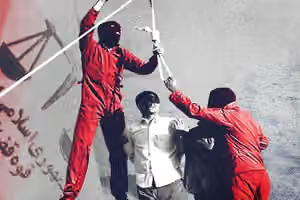
Amnesty International on Tuesday condemned Iran’s execution of five men in cases linked to the January protests within one week and called for coordinated international pressure on Tehran to halt further executions.
The five men were Ali Hemmati Sistanian, Alireza Raisi, Alireza Sepahi, Majid Nikandish and Siavash Jamshidi Kheirabadi. They were executed between September 30 and October 5.
“The arbitrary executions of these five young men serves as another chilling reminder of how the Iranian authorities weaponize the death penalty,” Diana Eltahawy, Amnesty’s deputy regional director for the Middle East and North Africa, said.
Amnesty said the cases followed a recurring pattern in which defendants were denied lawyers during interrogations, allegations of torture were not investigated and televised confessions were used as evidence in trials before Revolutionary Courts.
Five executions in six days
Alireza Raisi and Alireza Sepahi were executed in Isfahan on October 5 over the Alikhani Square case, a mass prosecution stemming from clashes during the January 8 protests in the city.
Iran’s judiciary said defendants in the case were accused of offenses including blocking roads, damaging property, arson and involvement in the deaths of four members of the security forces.
Amnesty said Sepahi had reported prolonged solitary confinement, beatings and electric shocks while in detention and had been denied access to a lawyer during the investigative stage.
Majid Nikandish and Ali Hemmati Sistanian were executed in Mashhad on September 30 over protests there on January 8. Amnesty said televised confessions obtained while the men lacked access to lawyers were later used against them.
Siavash Jamshidi Kheirabadi was executed in Shahr-e Kord on October 3 after being convicted of charges including moharebeh, or “waging war against God,” over accusations that he fired a weapon during protests.
Amnesty calls for international pressure
Amnesty said at least 34 people have been executed in cases related to the January protests and warned that scores of others remain at risk of politically motivated executions.
The group called for coordinated diplomatic pressure on Tehran to halt further executions and urged the UN Security Council to refer the situation in Iran to the International Criminal Court.
A protest over the name of a newly created county in central Iran turned violent after security forces moved to disperse demonstrators, with videos sent to Iran International capturing gunfire, tear gas and injured protesters.
The gathering took place on Sunday in Meymeh, a city in Isfahan province, where residents have objected to the new administrative district being named “Meymeh and Vazvan” rather than simply “Meymeh.”
Videos received by Iran International show demonstrators in the streets, tear gas in the area and people with bloodied clothing receiving medical treatment. Gunshots can also be heard, although it was not immediately clear what type of ammunition was used.
The number of people injured or detained remains unclear.
Local dispute over county name
Residents of Meymeh had campaigned for around two decades for their district to be upgraded to county status. The government eventually approved the change but in August 2024 named the new county Meymeh and Vazvan, combining the names of two cities.
Some Meymeh residents argue that their city’s historical identity should be reflected in the county name and have repeatedly called for the decision to be reversed. Officials have said the name should also recognize Vazvan.
The dispute culminated in Sunday’s street protest shortly before the new county administration was due to begin operating.
Footage showed some protesters carrying Islamic Republic flags and portraits of late Supreme Leader Ali Khamenei, underscoring the local nature of the dispute rather than an explicitly anti-government demonstration.
Security presence increases
The protest continued into the evening before security forces intervened and fired tear gas, according to videos and information received by Iran International.
Witnesses told Iran International that several protesters were wounded and detained, including some who were later taken into custody at hospitals. Iran International could not independently establish the number of arrests or verify the circumstances of each reported injury.
Reports from Meymeh on Tuesday indicated an increased security presence following the confrontation.