Iran by far the world's most prolific executioner per capita - UN experts

Iran uses the death penalty to silence its people and has by far the world’s highest execution rate per capita, UN experts said Friday, calling for an immediate halt to executions.
They said Iranian law still allows the death penalty for consensual same-sex relations and for some religious offenses, including apostasy.
“Iran’s death penalty is used to silence dissent, with broadly defined national security offences recasting peaceful activity as a threat,” the experts said.





Jurors at Woolwich Crown Court were taken through photographs, messages and phone records documenting communications among the three defendants and between Mostafa Sepahvand and two men in Iran.
Sepahvand, 41, Farhad Javadi Manesh, 46, and Shapoor Qalehali Khani Noori, 57, have all pleaded not guilty to charges under Britain’s National Security Act 2023.
Prosecutors say they gathered information for Iranian intelligence to prepare for serious violence against at least one target, with Sepahvand expected to carry out an attack and the others helping to plan it.
Locations and social media
In an exchange on December 19, 2024, Sepahvand received a postcode from a UK mobile number and forwarded it to Javadi Manesh, the court heard.
The prosecutor told jurors the postcode identified the location of Volant Media, Iran International’s parent company. Sepahvand also forwarded the telephone number from which he had received it.
Messages from December 24 showed Sepahvand sending Javadi Manesh a photograph of Hosseini, a link to his Instagram account and information about Iran International’s website.
In one message, Sepahvand wrote: “go to insta and you will see both the dog and the car”.
The prosecution also reminded jurors of a video Noori had sent to Sepahvand showing a park where Hosseini walked his dog, Niko. Other messages referred to the dog’s name and a blue Volkswagen.
Jurors were shown photographs recovered from Noori’s phone depicting Malthouse Court in Brentford from several angles, taken from inside a car.
Prosecutors had previously told the court that Iran International journalist Mojtaba Pourmohsen lived there between 2019 and 2023, but the defendants appeared unaware he had moved.

Money and contacts in Iran
The prosecution examined records of Sepahvand’s communications with Mostafa Ghorbani and another contact saved as “Amin Mostafa’s Friend”, both in Iran.
The exchanges included discussions about transferring money to Sepahvand and references to an account in his name at the Workers Welfare Bank.
Jurors also heard messages concerning Sepahvand’s court case in Iran. In one, Ghorbani wrote: “haji says your case will be fine”.
Sepahvand sent Ghorbani two Iranian court documents concerning vehicles linked to him. The documents included instructions to impound the vehicles and arrest Sepahvand if he was found driving them.
Shortly after sending the documents, Sepahvand called Ghorbani and the two spoke for nearly a minute and a half, according to the records presented to the jury.
In later exchanges, Sepahvand complained that nothing had happened with his case. The logs showed repeated attempts to reach Ghorbani, including unanswered calls in early January.
Prosecutors previously said Sepahvand wanted help resolving an Iranian criminal conviction, which they consider relevant to his motivation. Jurors were told not to treat the conviction itself as evidence against him.
A police witness was questioned about the dates, times and durations of calls and messages recorded in the logs, rather than asked to draw conclusions about their significance.
Defendants dispute prosecution’s account
According to the prosecution’s account of his defense, Sepahvand accepts conducting surveillance for Iran but says he feared the consequences of refusing and deliberately did a poor job. Prosecutors reject that account.
Javadi Manesh and Noori accept visiting locations and taking photographs and videos but say they did not know they were assisting Iranian intelligence, according to the prosecution.
Haalvsh, which covers developments in Sistan and Baluchestan, said more than 12 personnel were killed or wounded overall between Wednesday evening and Thursday evening in Nikshahr, Nosratabad, Faryab and Jalq, but cautioned that the final toll could be higher because some casualties had not yet been identified.
The People's Fighters Front took responsibility for the attacks in Nikshahr, Nosratabad and Jalq, according to Haalvsh. The alliance, announced in late 2025, includes several Baluch armed groups, among them Jaish al-Adl. The group had not taken responsibility for the killing in Faryab.
Nikshahr and Nosratabad attacks
In the Nikshahr area, Haalvsh said two vehicles carrying military personnel were attacked. Mohammadreza Okati was killed and five others were wounded, according to the outlet, which identified the wounded as Ali Najafi, Mohammadreza Hosseini, Mojtaba Mir and two others identified by the surnames Keikha and Iranmanesh.
Haalvsh said those casualties were taken to Mohammad Rasoulallah Hospital in Nikshahr, while other wounded personnel were evacuated by helicopter to medical facilities in Chabahar, Konarak and Iranshahr. It said it had not established their number or identities.
Iran's army separately confirmed on Thursday that Okati was killed when personnel from its 88th Armored Division came under fire while traveling for a shift change, but said three people were wounded.
In the Nosratabad area near Zahedan, Haalvsh said at least three security personnel were killed and two wounded when gunmen attacked a police commando patrol on the Lakhshak road. It identified two of those reported killed as Vahid Enayat and Abbas Aghaei.
Iranian police had earlier confirmed only Enayat's death, saying officers returned fire and that several attackers were wounded before fleeing.
Police major killed in Faryab
In Faryab, Haalvsh reported that Major Mehdi Jamshidi was shot dead while traveling in a private vehicle in the center of the county.
The outlet said Jamshidi was struck by seven bullets. It also cited reports that he had been among police personnel present during a confrontation involving women and other protesters in the village of Pashmuki in June.
The People's Fighters Front had not issued a statement taking responsibility for Jamshidi's killing, Haalvsh said.
Jalq police headquarters attacked
The fourth attack targeted the police command headquarters in Jalq, the administrative center of Golshan County, on Wednesday evening.
Haalvsh said the People's Fighters Front announced that its fighters had used a mine, rocket-propelled grenades and other weapons in the attack and said six police personnel were hit.
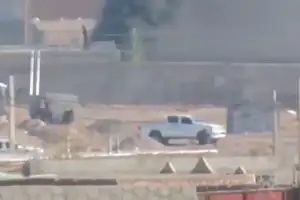
Videos obtained by Haalvsh showed heavy gunfire around the facility and at least one support vehicle being targeted, according to the outlet. Haalvsh said it had not independently established the final number or identities of those killed or wounded. IranWire also reported an explosion and gunfire around the police facility.
Attacks follow weeks of violence
The latest incidents follow a series of attacks on Iranian security forces in the southeast. Earlier this week, gunmen attacked two military vehicles in Bampur, while last week a roadside attack near Zahedan and clashes in Rask and other areas produced further casualties.
Official Iranian accounts and reports from Haalvsh have repeatedly differed over casualty numbers in recent attacks. Haalvsh said the toll from the four latest incidents should therefore be treated as provisional, particularly because some wounded personnel were transferred to hospitals outside the areas where the attacks occurred.
The source said three of the five factions covered by the plan had completed agreed handovers, but had not surrendered their entire arsenals. The process instead focused on heavy and specialized weapons and dismantling separate military headquarters.
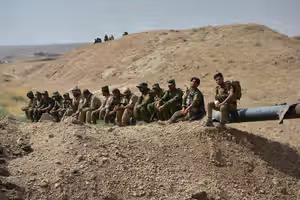
The Popular Mobilization Forces, which the report said formally operates under Iraq’s commander-in-chief, had received the weapons and military headquarters covered by the agreements. It had also begun integrating faction members and severing their previous political and administrative affiliations, according to the source.
Drones placed under PMF structure
The new drone unit is intended to absorb the factions’ unmanned-aircraft capabilities into official state structures rather than leave them under independently run organizations, the source told Erem News.
But the source stressed that the agreements “do not mean complete disarmament.” Instead, they involve transferring specialized weapons and reorganizing armed formations within the PMF.
Erem News said effective control over those military capabilities would depend on completing the integration process and establishing the chain of command responsible for authorizing their use. The report did not identify the three factions that had completed the handover.
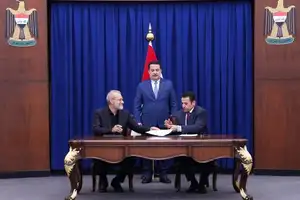
Government seeks changes to PMF leadership
A political source close to Iraq’s Coordination Framework told Erem News that the government was also seeking amendments to the law governing the PMF, including limiting the term of its chairman to two years and bringing professional officers from the regular military into senior posts.
The proposal would directly affect the position of current PMF chairman Falih al-Fayyadh, according to the report. The source said the plan faced opposition within the Coordination Framework, particularly from Nouri al-Maliki’s State of Law coalition, which wanted any changes tied to a broader political agreement.
Two factions continue to resist
Erem News said Kataib Hezbollah and Harakat al-Nujaba remained opposed to surrendering their weapons, while other factions had accepted the principle of integration into state security institutions.
Zaidi has set June 30, 2027, as the deadline for completing the weapons-control plan and has said decisions on war and peace belong exclusively to Iraq’s constitutional authorities. According to the political source, he has also told Coordination Framework leaders that he intends to continue implementing the plan even if political agreement on some of its details stalls.
The source said Zaidi warned that failure by groups with armed wings to meet agreed commitments could expose Iraq to security, economic and political consequences, including additional sanctions or pressure, while adding that the prime minister still favored negotiations over a direct military confrontation with factions resisting the plan.