Tehran uses French student protests to deflect from its own repression

Clément Therme
Visiting lecturer, Paris School of International Affairs (PSIA)
Visiting lecturer, Paris School of International Affairs (PSIA)
Tehran has seized on protests by French high school students to accuse Paris of repression, seeking to obscure its own treatment of young Iranians by turning the language of human rights against one of its Western critics.
Internationally, Tehran seeks to weaken the authority of European criticism. Domestically, the diplomatic spat reassures supporters that Western governments also face rejection. Neither objective requires solidarity with the students themselves; both depend on repurposing their grievances in defense of the regime. As during the Yellow Vest movement, Tehran answers criticism of its own repression by accusing its critics of hypocrisy.
France’s treatment of demonstrators deserves scrutiny on its own merits, but Tehran’s professed concern for young people contrasts sharply with its conduct at home. UN investigators have found that Iran’s repression of protests included crimes against humanity. Human Rights Watch and Amnesty International have also reported an IRGC recruitment campaign accepting children as young as twelve, with Amnesty documenting armed children serving at checkpoints and on patrols.
Meanwhile, many young Iranians are asserting their independence not only through protest but through everyday choices about clothing, relationships, music and celebration. Their efforts to build lives beyond the authorities’ ideological control challenge the assumption that political domination produces genuine consent. Tehran claims to speak for French high school students; it should begin by listening to young Iranians who aspire to build their own lives.

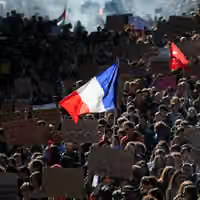


Tehran has seized on protests by French high school students to accuse Paris of repression, seeking to obscure its own treatment of young Iranians by turning the language of human rights against one of its Western critics.
On October 6, Iran summoned French ambassador Pierre Cochard over the crackdown on high school demonstrations in France. The following day, Paris summoned Iran’s ambassador, accusing Iranian authorities of spreading disinformation through official Foreign Ministry accounts.
The diplomatic exchange reveals how the Islamic Republic appropriates the language of rights while denying those rights at home. It is also a struggle over the meaning of protest and who can claim to defend it.
Tehran seeks to reposition itself as an accuser, turning scrutiny away from its own security apparatus and toward a government that has condemned Iranian repression.
Internationally, Tehran seeks to weaken the authority of European criticism. Domestically, the diplomatic spat offers supporters reassurance that Western governments also face rejection. Neither objective requires solidarity with the students themselves; both require their images and grievances to be repurposed in defense of the regime.
This tactic has precedent. During the Yellow Vest movement, Ali Khamenei condemned French police violence, while a small group of regime supporters gathered outside the French embassy in Tehran.
Some wore yellow vests and placed candles and photographs of injured French protesters outside the embassy. Their placards denounced police violence but also carried an explicitly ideological message: “If only the French people had an Imam Khomeini!”
A statement read at the gathering invoked France’s reception of Khomeini at Neauphle-le-Château forty years earlier and portrayed Emmanuel Macron’s government as cruel and despotic.
At the same time, Iranian authorities were cracking down on protests by pensioners, workers, teachers and students. Then, as now, the tactic allowed Tehran to answer criticism of its own repression by accusing its critics of hypocrisy. Human rights become an arena for diplomatic one-upmanship rather than obligations owed to citizens.
France’s conduct must, of course, be scrutinized on its own merits. Injuries to demonstrators, particularly minors, demand independent investigation and accountability. But the evidence concerning Iran is substantial.
In March 2024, the UN Independent International Fact-Finding Mission concluded that violations committed during the repression of “Woman, Life, Freedom” included crimes against humanity.
Its findings encompassed murder, imprisonment, torture, rape and other sexual violence, persecution and enforced disappearance. The mission documented the involvement of state institutions and security forces, undermining attempts to portray the violence as a series of isolated excesses.
On September 17, 2026, the same mission reported that Iranian authorities had also committed crimes against humanity during the crackdown on protests that began in late December 2025 and continued into January.
Generation Z played a crucial role in “Woman, Life, Freedom” following Mahsa Amini’s death in September 2022. Schoolgirls removing their headscarves, teenagers challenging clerical authority and young women demanding control over their bodies exposed the limits of decades of ideological education.
The state had sought to reproduce loyalty. Instead, many young people asserted their right to determine how they would live.
Young Iranians mobilized again in the protests that began in late 2025, bringing another generation raised entirely under the Islamic Republic into confrontation with the state. Their rejection of its prescribed norms challenges the assumption that political control necessarily produces ideological consent.
The authorities’ response combines repression with continued recruitment into structures of loyalty. The Basij, under Revolutionary Guards command, provides a network for ideological discipline and security mobilization.
Human Rights Watch and Amnesty International have reported that an IRGC recruitment campaign accepts children as young as twelve, with Amnesty documenting children carrying weapons and serving at checkpoints and on patrols.
This goes beyond patriotic rhetoric: it places children directly in harm’s way. The state invokes the protection of young people abroad while drawing children into its military apparatus at home.
Yet Iranian youth cannot be divided neatly between those who serve the regime and those who confront it. Many seek simply to build lives apart from official Iran. Their resistance is not limited to protest: it also finds expression in everyday acts—choosing what to wear, loving, dancing, listening to music, nurturing friendships and keeping parts of their lives beyond the authorities’ control.
This has produced a form of what might be called “secular separatism”: an attempt to shield personal life from the regime’s ideological grip.
Within social, cultural and emotional circles, and spaces of celebration, another, fragile society is taking shape, though access to it inevitably varies with resources and social background.
Joy itself can become a way of asserting autonomy. Under a regime that glorifies martyrdom and encourages citizens to denounce one another, the simple acts of enjoying life and pursuing happiness acquire political meaning.
Tehran claims to speak for French high school students. It should begin by listening to young Iranians who aspire to build their own lives.
The problem facing Iran’s oil industry is not just sanctions or a shortage of investment. It is a question of governance: who makes decisions, who signs contracts, who receives the money and, ultimately, who is accountable?
Iran’s oil industry is more than a collection of wells, pipelines and refineries. What turns those assets into an industry is an integrated chain of reservoir expertise, production planning, engineering, safety, financing, sales and accountability.
That chain has been badly fragmented. In the past two decades, especially under President Mahmoud Ahmadinejad, projects have been handed to military institutions, shares and assets transferred to pension funds and quasi-state bodies, and even oil cargoes used to cover budget shortfalls in organizations outside the Oil Ministry.
Unless a future Iran addresses that fragmentation, billions of dollars in investment and the most advanced technology could simply reproduce the old disorder on a larger scale.
From privatization to quasi-state ownership
The Ahmadinejad government accelerated the sale of state assets in the name of privatization, but much of the process did not produce an independent private sector.
Academic Kevan Harris has described the process as a form of pseudo-privatization: assets and privileges moved from one part of the state to pension funds, foundations, affiliated companies and military institutions without producing genuinely competitive markets, transparent ownership or public accountability.
In oil and gas, the Oil Ministry and its subsidiaries lost some of their practical authority over contractors, projects, procurement and, at times, the sale of oil.
One of the starkest examples was the decision to give oil cargoes to Iran’s police force to sell. Esmail Ahmadi-Moghaddam, then commander of Iran’s police, acknowledged in 2014 that during Ahmadinejad’s presidency the force had been given two oil cargoes to sell, with some of the proceeds intended to cover a salary shortfall.
The budgets of the police, ministries or pension funds should be recorded in the state budget and paid through the treasury, not financed by giving individual institutions a company, refinery, oilfield or oil cargo. Such arrangements erase the boundaries between owner, policymaker, client, contractor and seller.
Khatam al-Anbiya: one name, a network of interests
Khatam al-Anbiya Construction Headquarters is the economic and engineering arm of the Islamic Revolutionary Guard Corps, but it should not be understood as a conventional, integrated company.
It serves as an umbrella over numerous holdings, affiliated companies and subcontractors. Reuters reported in 2015 on the extensive network of companies linked to the IRGC and the difficulty of identifying their ultimate owners. A “contract with Khatam,” therefore, did not necessarily mean a clear chain of command, auditing and responsibility.
Under Ahmadinejad, the network received major contracts without effective competition. In 2011, Reuters reported that two pipeline contracts, each worth $1.3 billion, had been awarded to Khatam. Development of phases 15 and 16 of the South Pars gas field had also been awarded to the organization.
The result was multiple centers of power, allowing projects to be divided among different entities and responsibility to become diluted along the chain.
The consequences were technical as well as financial. Oil production requires reservoir engineers, drilling specialists, safety personnel and procurement departments to work under common standards and a coherent system.
Fragmenting projects among institutions with different missions and unclear accountability also fragments expertise and decision-making.
‘One sheikh in Bahrain, forty sheikhs in Iran’
I saw something of this problem during my own time working for Shell in the Netherlands.
I once asked the Dutch manager responsible for Iran why Shell had ended its activities in the country. I remember the essence of his answer like this: “We went to Bahrain because there we dealt with one sheikh; in Iran, we had to deal with forty sheikhs.”
Khatam might formally be the contracting party on a project, he explained, but another unit within the same network could then say it was responsible for security along part of the pipeline and demand a separate payment.
His point, as I understood it, was that instead of one accountable client, a foreign company could find itself dealing with multiple centers making separate demands for payment.
This is my recollection of an unrecorded conversation, not documentary evidence explaining Shell’s departure from Iran. The public record points principally to sanctions and political pressure: Reuters reported in 2008 that Shell withdrew from a planned Iranian gas project amid US pressure.
But sanctions and domestic disorder are not mutually exclusive explanations. Sanctions raised the cost of entering Iran; multiple centers of power raised the cost of staying.
The conversation illustrated the problem: when the contractual counterparty is known but the number of parties making demands is not, neither the true cost of a project nor responsibility for it can easily be calculated.
The Baku lesson
Another experience may offer a useful lesson for Iran’s future.
While working for BP, I travelled to Baku on a short assignment concerning contractor-selection models. An Azerbaijani colleague described how the country had used foreign partnerships after the collapse of the Soviet Union to modernize technology and develop its domestic workforce.
Azerbaijan did not hand its oil industry to BP. Under a production-sharing agreement signed in 1994, BP became operator of the Azeri, Chirag and deepwater Gunashli fields, while Azerbaijan’s state oil company SOCAR remained the principal domestic partner.
More important for Iran was the emphasis on local capacity. Training technicians, developing local suppliers and progressively replacing foreign personnel with Azerbaijani workers became part of the project. BP says it now directly employs around 2,380 Azerbaijani citizens, while Azerbaijanis have made up around 90% of its professional workforce in the country.
The lesson is not that Iran should hand management of its oil industry to BP. It is that an international operator can be selected for a particular project, targets set for training and localization, and domestic personnel left with greater technological knowledge and experience.
An architecture for Iran’s oil industry
Rebuilding Iran’s oil industry should begin with rebuilding its institutions, not redistributing the spoils.
Oil and gas should remain public assets. Parliament should establish the legal and financial framework, the government determine energy policy, and an independent professional regulator oversee licensing, safety, reservoir protection and environmental standards.
The referee must also be separated from the player. The National Iranian Oil Company should operate as a commercial and technical enterprise rather than simultaneously acting as regulator, client, partner, supervisor and arbiter of disputes.
Military and non-specialist institutions should gradually be removed from the industry. The process should be legal, audited and phased so existing projects are not abandoned.
Specific fields, refineries and infrastructure projects could instead be offered through transparent international tenders. Foreign companies could compete to operate or participate in individual projects, but no company or country should acquire a monopoly over the industry.
Contracts should be time-limited and contain measurable requirements for costs, production, environmental standards, Iranian employment and technology transfer, with extensions dependent on independent assessments rather than political connections.
Contracts, ownership, payments, costs, production and project revenues should generally be public, with auditing independent of the Oil Ministry, NIOC and contractors.
Contracts, ownership, payments, costs, production and project revenues should generally be public, with auditing independent of the Oil Ministry, NIOC and contractors.
Iran will also have to reassemble its human capital. Specialists inside the country, Iranian oil professionals abroad and a younger generation of engineers should be connected through a national program of training and succession. Foreign contractors should be required to build Iranian counterpart teams, not foreign islands inside the industry.
Rebuilding trust
Iran will need foreign investment and technology to restore production and modernize its refineries. But the need for capital should not be confused with surrendering sovereignty.
A homeowner can hire international architects and contractors without handing them ownership of the house. A future Iranian government can similarly benefit from competition among foreign companies while keeping ownership of resources, policymaking and ultimate authority in Iranian hands.
Iran’s oil can become a national asset again only when every contract has an accountable party, every project an auditable account and every decision a clearly defined legal authority.
The answer to the problem of “forty sheikhs” is not to create a new sheikh, Iranian or foreign. It is to build a single, transparent and professional system in which no commander, foundation, ministry or foreign company stands above the law.
Four years after Mahsa Amini’s death, the deepest legacy of Woman, Life, Freedom may be that Iran cannot simply be returned to the society it was before September 2022.
Four years have passed since Zhina Mahsa Amini, a 22-year-old woman who had travelled to Tehran to visit family, died after being detained by the morality police.
She could never have imagined how her name would appear on walls, streets and university campuses, or on the lips of millions of Iranians, or how three simple words, “Woman, Life, Freedom,” would become one of the most enduring slogans in Iran’s modern history.
The story of 2022 is not only the story of a slogan. It is the story of the price thousands paid to break through the wall of fear.
Zhina’s death on September 16, 2022, sparked protests across Iran. Human rights organizations documented live ammunition and pellet fire, mass arrests, torture, sexual violence and the killing of protesters. HRANA later recorded protests in all 31 provinces, 160 cities and 143 universities, and reported at least 530 people killed, including 68 children and teenagers.
Nika Shakarami and Sarina Esmailzadeh were both sixteen. Kian Pirfalak was nine, remembered for “In the name of the God of the rainbow” and the small boat he built with his own hands. Khodanour Lojei, a 27-year-old Baluch man, lives on in videos of him dancing, alongside the haunting image of him with his hands tied to a pole and water placed before him while in detention.
Their stories were different, but each became part of the collective memory of Woman, Life, Freedom.
Then came the gallows. Mohammad Mehdi Karami, a 22-year-old karate champion, was executed after being sentenced in connection with the fortieth-day commemoration for Hadis Najafi. Seyed Mohammad Hosseini, who worked at a poultry farm and taught martial arts to disadvantaged children for free, was executed the same day; human rights reports say his confessions were obtained under torture. Majidreza Rahnavard, executed only 23 days after his arrest, asked before his death that people not cry at his grave but celebrate and play happy music.
These names are reminders that behind every statistic was a family.
The repression did not end with the street protests. Students, schoolchildren, journalists, artists, athletes and activists were arrested. Families sometimes went weeks or months without news. Some detainees appeared in televised “confessions” that human rights organizations said were tainted by torture. Families seeking the truth about those killed also faced pressure. Others eventually left Iran after imprisonment, threats and persecution, carrying the cost of the uprising into exile, lost careers, interrupted education and separation from family.
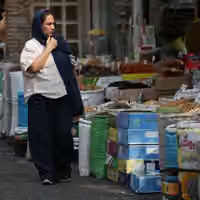
And yet one of the movement’s deepest legacies is visible in an ordinary scene: a woman walking down an Iranian street without compulsory hijab.
The state responded with fines, vehicle seizures, arrests, flogging, business closures, cameras and surveillance. But women’s defiance continued. Four years after Zhina’s death, a woman without compulsory hijab is no longer the exceptional image it was in September 2022; it has become part of Iran’s social reality.
That is also where the connection to Dey 1404 (December 2025 and January 2026) becomes important.
The new protests began amid the collapse of the currency, inflation and protests by Tehran bazaar merchants, but quickly moved beyond economic demands. According to HRANA data cited in a UK government report, by January 27 at least 656 gatherings had been recorded in 201 cities across all 31 provinces, compared with 160 cities during the 1401 protests.
There are no reliable data to compare total participation, but the later uprising was documented across more cities and had a far higher reported toll. By March 2026, HRANA had recorded information on more than 7,000 people killed and more than 53,000 arrested in connection with the Dey and Bahman protests, far above the Iranian government’s figures.
HRANA described the confirmed cases as the minimum it could verify, with thousands more still awaiting review. Internet shutdowns, pressure on families and the lack of independent access inside Iran made the full scale harder to establish.
But the difference was not only scale. The society that entered January 2026 was not the same society that had existed before September 2022.
Iranians had lived through a national experience of disobedience, broken taboos, solidarity, bullets, prison, executions, migration and grief.
Abolfazl Hajizadegan’s research on “The Lives of Dey,” based on the social-media traces of 957 of those killed, found people from widely different professions and backgrounds, from baristas, repair workers and sports coaches to lawyers, professors, filmmakers and musicians.
The uprising also entered families in ways that made the breadth of the upheaval painfully visible.
Mehdi Shafiei, 44, and his 18-year-old son Mani were killed in Eslamshahr less than two hours apart. In Bushehr, 37-year-old nurse Mansoureh Heydari and her husband, Behrouz Mansouri, were both killed, leaving behind two children. Elsewhere, fathers and daughters were arrested together.
This does not mean that the 1401 and 1404 uprisings were identical, or that all protesters shared one ideology, leader or vision of Iran’s future. Their immediate triggers were different. But something had changed in society’s relationship with fear.
Repression continued, but the memory of disobedience could not simply be erased. Hajizadegan’s research suggests that those who came into the streets in 1404 did not acquire their anger overnight. Their earlier posts showed dissatisfaction and protest stretching back through previous protest waves, including the November 2019 protests and the 2022 uprising.
Dey 1404 was therefore not simply the explosion of an economic crisis. It was part of a longer accumulation of experience. Perhaps this is one of the most important legacies Woman, Life, Freedom left behind: not a single organization or leadership, but a social experience of the possibility of saying “no.”
The government’s response in Dey 1404 was severe. From January 8, the internet was almost completely shut down. Amnesty International reported widespread killings, mass arrests, enforced disappearances, torture and systematic pressure on victims’ families.
Yet behind every new number was another life: Hamid Mahdavi, Mohammad Jabbari, Mehdi and Mani, Mansoureh and Behrouz, just as Nika, Sarina, Kian and Khodanour had been lives, not statistics, four years earlier.
From September 2022 to January 2026, the names and faces changed and the sparks were different, but each chapter left something for the next: memory, wounds, language, courage and sometimes hope.
Zhina is not only the name of a young woman, and Woman, Life, Freedom is not merely the name of a few months of protest. It became part of the social and political language of a generation that paid an extraordinarily heavy price and emerged with a different understanding of choice, dignity and the possibility of standing firm.
Zhina and thousands of others killed in Iran’s protest movements are no longer with us. But something of them remains: in the hair of a woman who chooses not to cover it; in a mother who refuses to let her child’s name be erased; in a father who rejects the official account of his son’s death; in a family that dances at a loved one’s grave despite threats; and in a generation that has not abandoned its questions about freedom, dignity and the future.
Repression can empty the streets for a time, but it cannot erase what a generation has lived through.
Journalists are not supposed to become the story. We are usually on the other side of it. Someone lives through an event and we write about it. Someone is gone and we report their passing. A crisis unfolds and we try to find the right words to tell its story.
But sometimes life reverses the roles. The narrator becomes the subject of the story.
Today, Farahnaz Espad, one of Iran International’s finest news anchors, died of cancer at the age of 37. Hearing the news, I found myself thinking of Reza Haghighatnejad, an editor at RFE/RL’s Radio Farda and one of Iran’s most accomplished political journalists, who also died of cancer in 2022.
Perhaps because I see a bitter similarity in their fates. Two Iranian journalists; two young, talented and hardworking people whose lives were deeply bound up with Iran — with its news, its people, their concern for what was happening to it, and their hope that perhaps tomorrow life for Iranians might be a little better than it is today.
Both developed cancer far from Iran, and both died far from home.
I remember Farahnaz for her calm. For a dignity that even illness could not take from her. There was an unassuming humility and kindness in the way she carried herself, the kind some people bring into every room without even trying. She was hopeful. She was calm.
She wanted to go back to work.
Perhaps “going back to work” sounds like a small wish. But for Farahnaz, work was not merely a job. She wanted to stand in front of the camera again, read the news from Iran, begin her day with Iran and end it with Iran. Illness had kept her away from the newsroom, but it had not severed the thread connecting her to her professional life.
Reza’s death a few years ago was a reminder of much the same thing.
Reza was one of those journalists for whom Iran was never merely the subject of his work. Iran was his abiding concern — something he read about, wrote about, researched and worried about. He lived in exile, but much of his mind and his work remained in the country where he could no longer continue his professional life.
Even after death, his fate remained bitter. Reza died of cancer in Berlin at the age of 45. His body was sent to Iran so he could be buried in the soil he came from. But security forces seized his body after it arrived, preventing his family from saying goodbye to him as they wished and from burying him in his hometown.
Sometimes I think exile, for an Iranian journalist, is more than geographical distance.
One day, you begin working as a journalist in Tehran, Shiraz, Isfahan or another city, with the simple idea that you will write about the society in which you live. Then a day comes when, to continue doing that same work, you have to leave your country. Your desk moves. Your newsroom moves. The language spoken on the street you walk down every morning changes. Your home changes. Your friends scatter. Years pass.
But the subject of your work does not change.
It is still Iran.
You wake up in a city thousands of kilometers from Tehran, and the first thing you read is news from Iran. You spend your day immersed in the crises, protests, elections, prisons, hopes and disappointments of people you may not have seen in person for years. You talk about the future of a country when you yourself do not know when you will be able to return to it without fear.
It is a strange contradiction: sometimes you spend most of your years away from your homeland while devoting most of your professional life and your thoughts to that same homeland.
Farahnaz and Reza were like that. And I do not want to remember them only through their illness and death. Cancer was the final chapter of their lives; it was not the whole book.
What came before mattered more: curiosity, work, concern, hope, friendship, laughter, long hours in the newsroom, stories written and read, questions asked, and that essential belief every journalist carries — that knowing the truth, telling it and understanding it more deeply still matters.
But there is something in both their stories that I find deeply painful.
They were people who thought about Iran, worked on Iran and wanted a better life for the people of Iran. Yet they themselves were denied one of the most basic possibilities of an ordinary life: to live at “home,” to work there, to grow old there and one day, when the time came, to close their eyes in their own country, surrounded by family and memories.
That should not be something one has to wish for.
Staying in your homeland should not be a privilege.
Exile should not be the price of journalism.
No one should have to choose between their profession and their country simply for speaking and writing.
And perhaps that is why today, as I write the news of Farahnaz’s death, I am not grieving only the loss of a friend and colleague. I grieve for a generation of Iranian journalists who packed their bags, built homes in other cities, spoke about their homeland from distant studios and newsrooms, and spent years of their lives waiting for an Iran they might one day be able to return to freely.
Some of them never got to see that day.
Reza did not.
Neither did Farahnaz.
A journalist is meant to bear witness to history, not become a victim of geography. A journalist is supposed to tell the news, not have their illness or death in exile become a headline written by their colleagues.
But sometimes that is exactly what happens.
Today we read Farahnaz’s name in the news, just as we read Reza’s a few years ago. And behind those two names, for me, one simple wish remains:
That one day Iran will be a place where its journalists can stay; where they can ask questions, write, make mistakes, write again, live, grow old — and not be forced away from “home” to do the work they love.
A day when an Iranian journalist’s share of their homeland is more than having it as the subject of their stories.
Until that day, we are left with the memory of those who are gone — and with stories that, this time, contrary to our professional habit, we have to write about the storytellers themselves.
May the memory of Farahnaz Espad and Reza Haghighatnejad live on.
In the Persian classic Shahnameh, Ferdowsi tells the story of Zahhak, the usurper king who is kissed on each shoulder by Ahriman, the spirit of evil, and finds two black snakes growing from the wounds.
Cut them off and they grow back. The only way to keep them quiet is to feed them, every day, with the brains of two young men. Zahhak reigns for a thousand years on a diet of sacrificed youth, propped up not by loyalty but by appetite.
The story has always worked as a parable for Iranian tyranny. What I think it misses, applied to the Islamic Republic today, is the arithmetic. Ali Khamenei did not build two snakes. He built three.
The Artesh, Iran’s conventional army, was the first snake, inherited from the Shah and never fully trusted. The IRGC was the second, created in 1979 specifically because the revolution did not trust the first. The Basij was folded into the IRGC as its third head.
It is worth remembering that all three answer, on paper as much as in practice, to a single neck. The Iranian constitution names the Supreme Leader as Commander-in-Chief of the Armed Forces in their entirety, Artesh, IRGC and Basij alike. There is no independent chain of command outside the Supreme Leader’s authority for a general to retreat into. Politicians and Western commentators in both London and Washington keep waiting for one of these heads to turn on the body. They’re waiting for the wrong signal, because they’re analysing 1979, not 2026.
When the Shah’s generals stood aside in February 1979, they did so because the Artesh of that era was a conscript institution led by officers who owed their careers to a monarch, not a movement, and who had no ideological stake in what came next. That Artesh is not today’s Artesh.
Ali Khamenei spent decades solving exactly that problem. Senior appointments in today’s Artesh are subject to security and ideological vetting tied to the Supreme Leader’s military apparatus. The Middle East Forum has documented how senior promotions require approval from the Supreme Leader’s office following scrutiny of an officer’s security and ideological background. The men at the top of the Artesh are appointees of the system, not survivors of it.
This is why this month’s move to complete the integration of the Armed Forces General Staff with the Khatam al-Anbiya Central Headquarters matters more than it has been given credit for. Mojtaba Khamenei, who inherited a system his father spent more than four decades constructing, has now moved to formalise a process of centralisation that had earlier been discussed but was not visibly underway in operational terms.
The lesson learned from 2025 and the Twelve-Day War, according to Iran’s own state reporting, was that redundant command structures slow decision-making. The latest restructuring is intended to reduce that redundancy and further narrow the distinction between the operational command of the Artesh and the IRGC. The underlying logic is clear: the system has little interest in preserving institutional space in which one military arm might begin to think or act independently of the others.
I would also gently push back on those looking for salvation in Iran’s reformists. Pezeshkian’s presidency provides a civilian face and international cover for the negotiating track, and that function matters. But it is not independence.
Ghalibaf is a former senior IRGC commander who has spent decades inside the Islamic Republic’s political and security establishment. Araghchi is a capable diplomat entrusted with representing Tehran in negotiations. Both men operate inside the system’s tolerances, not outside them. Reading their willingness to negotiate as evidence of a moderate faction pulling against a hardline one mistakes tactics for structure.
When Iran has had to cede ground, at Bürgenstock or Islamabad, it has ceded it in the way a company reprices a product: reluctantly, and only as far as survival requires. Ghalibaf gets attacked by the influential ultra-hardline Paydari Front for talking to Americans, and he absorbs it, because someone in the system has to run the diplomatic track.
None of this means the system is stable in the way it looks stable. Ali Khamenei is dead. His son, who has still not been seen or heard in public, inherited the office by appointment and is still consolidating the very apparatus his father designed. The strain is real. But strain inside a structure is not the same as a fracture between its parts. The three heads bicker over how much brain they are fed and by whom, not over whether to keep feeding.
So when I hear commentary asking whether this is the moment the Artesh finally breaks from the regime, or whether Ghalibaf represents the pragmatic wing that might yet reform the system from within, I think of Zahhak.
Nobody in that story is saved by one of the snakes deciding it has had enough. The snakes do not turn on the king. The rupture comes from outside the machinery of the court: Kaveh the blacksmith rises first, turning private grievance into public revolt, rallying the people and creating the conditions for Fereydun’s return. Fereydun then defeats Zahhak and binds him at Damavand. Until that structure itself breaks, all three snakes answer to the same shoulders.