US pressure hits Iranians harder than rulers, 68% in poll say
More than two-thirds of respondents to an Iran International Instagram poll said the Trump administration's pressure on the Islamic Republic is hurting ordinary Iranians more than the authorities.
The October 8 poll drew more than 56,000 responses, with 68% saying ordinary people bear the greatest burden of US pressure. Another 23% said both the public and the government suffer, while 9% believed the authorities are affected most. Men accounted for approximately 76% of respondents and women for 24%.
The largest age group was 25 to 34, representing about 38% of participants, followed by those aged 35 to 44 at 29%. Respondents aged 18 to 24 and 45 to 54 each accounted for 12%.
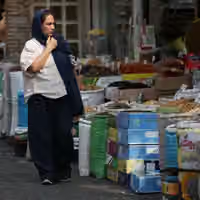
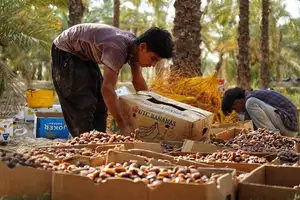
A woman walks past sacks of nuts, dried fruits and other goods at a market in Iran.
More than two-thirds of respondents to an Iran International Instagram poll said the Trump administration’s pressure on the Islamic Republic is hurting ordinary Iranians more than the authorities.
More than 56,000 people took part in the October 8 poll, with 68% saying ordinary people bear the greatest burden of US pressure. Another 23% said both the public and the government suffer, while 9% said the authorities are affected most.
Men accounted for approximately 76% of respondents and women for 24%.
The largest age group was 25 to 34, representing about 38% of participants, followed by those aged 35 to 44 at 29%. Respondents aged 18 to 24 and 45 to 54 each accounted for 12%.
Thousands of comments accompanying the poll reflected differing views on the economic consequences of US pressure, the Islamic Republic's responsibility for worsening living conditions and whether external pressure could bring political change.
Rising prices dominate concerns
The most common concern among respondents who believed ordinary Iranians were suffering most was the deterioration in daily living conditions.
Many cited rising prices, declining purchasing power, shrinking incomes and the growing financial burden on low-income households.
Others pointed to difficulties accessing medicine and medical treatment, arguing that people with fewer financial resources were particularly vulnerable to economic restrictions.
"Only ordinary people are being crushed under the pressure," one respondent wrote.
Several participants argued that even when US measures target the Islamic Republic, their economic consequences ultimately reach households through higher prices and reduced access to essential goods.
Officials seen as insulated from hardship
Another recurring theme was the perceived gap between the living standards of ordinary Iranians and those of government officials.
Some respondents argued that access to wealth, foreign currency, privileged positions and state resources allowed officials and their associates to avoid some of the hardships experienced by the wider population.
"The main burden falls on the people. The government would even be happy to see people becoming poorer every day," one respondent wrote.
Other participants said the Islamic Republic also suffers from economic restrictions through reduced revenues and limited access to financial resources, but can pass some of those costs on to the public.
For these respondents, the issue was not simply whether sanctions hurt the government or the public, but how the economic burden was distributed.
Economic hardship versus hopes for political change
The sharpest disagreement concerned whether the immediate economic costs of US pressure could be justified by the prospect of political change.
Some respondents acknowledged that ordinary Iranians were suffering but considered the hardship acceptable if it weakened the Islamic Republic or helped bring about a different political system.
"People will endure it because this suffering is worth it for a free Iran tomorrow," one wrote.
Others questioned whether worsening economic conditions would produce meaningful political change.
They argued that household finances could deteriorate far more quickly than external pressure could affect the country's political leadership.
A woman shops at a market selling nuts, dried fruits and spices in Iran.
Several respondents held both US policies and the Islamic Republic's economic management responsible for the hardships facing Iranians.
Some likened sanctions to a painful medical treatment, reflecting a willingness among certain supporters of external pressure to accept short-term suffering in pursuit of longer-term political goals.
Others rejected that calculation, arguing that the prospect of political change remained uncertain while the immediate costs to families were already evident.
A divided view of US pressure
Although 68% of respondents believed ordinary Iranians were bearing the greatest burden, their answers did not necessarily show opposition to all forms of US pressure.
Some viewed the economic consequences as unacceptable, while others regarded them as a painful but potentially necessary means of weakening the Islamic Republic.
Likewise, respondents who believed the government was suffering most did not necessarily dismiss the economic difficulties facing households.
Reports that the Islamic Republic sent $200 million to Lebanon's Hezbollah have drawn anger from Iranians struggling with rising living costs, low wages and medicine shortages, according to messages sent to Iran International.
Citizens accused the authorities of prioritizing financial support for regional allies over the needs of Iranians, contrasting the reported payment with their own incomes, government subsidies and mounting household expenses.
In messages, several people described struggling to afford basic necessities, while others questioned why the Islamic Republic was directing resources abroad during Iran's economic crisis.
Hezbollah payments dwarf Iranian wages
"You give each Hezbollah family 8 billion rials, but deposit a 5000,000-rial food allowance for each Iranian and then take even that back a few hours later. This country's money belongs to its people, not Hezbollah," one citizen said.
Another compared the payments with compensation given to Iranian soldiers.
"A soldier who spent eight months under missile fire with no way to escape received seventy million rials in combat pay. Then you gave Hezbollah 8 billion rials from our money," the citizen said.
Reuters reported on October 7, citing two people with direct knowledge, that Hezbollah received $200 million from Iran in September and planned initial payments of $3,000 per family, prioritizing approximately 50,000 families displaced by the war.
The reported transfer has been disputed by Washington. The US State Department disputed the reported transfer. Spokesperson Tommy Pigott accused Hezbollah of trying to “save face with fake stories about cash influxes from Iran”, saying the group “can claim whatever it wants, but the money is not there”.
Pigott said Tehran was suffering under a US blockade of its oil exports and that Washington would continue targeting Hezbollah's finances through sanctions while supporting the Lebanese government's efforts to rebuild the country's south.
At an exchange rate of approximately 2.67 million rials per dollar on Iran's open market, $3,000 amounts to roughly 8 billion rials.
A teacher in Tehran with 18 years of experience compared the payments with his annual salary.
"My salary for an entire year is about 3 billion rials, yet you gave 8 billion rials of our money to the Lebanese," the teacher said.
A local government employee with 29 years of service and a master's degree said his total monthly income was 350 million rials.
Citizens in Neyshabur and Malard also criticized the reported payments, saying the Islamic Republic was directing national resources toward allied groups abroad while Iranians faced poverty and declining purchasing power.
Islamic Republic officials have not formally confirmed the reported $200 million transfer, and the US government has rejected the account.
"Hezbollah has been decimated and caused misery for hundreds of thousands of innocent Lebanese. It is now trying to save face with fake stories about cash influxes from Iran," US State Department spokesperson Tommy Pigott said in a statement. "It can claim whatever it wants, but the money is not there."
Families sell belongings to afford basic necessities
Several citizens described the financial pressures facing their families, including difficulties paying for medicine, food and other essentials.
One person said her husband and son had been forced to sell their mobile phones to cover household expenses, contrasting the family's financial difficulties with the reported funding for Hezbollah.
Another described the rising cost of medication for her father.
"I bought just three blood pressure and heart medications for my father, and they cost 85 million rials. I didn't have enough money to buy the rest of his medicines. Insulin is also unavailable. Previously, these medicines did not even cost 5 million rials," the citizen said.
Other citizens described struggling to afford food and household expenses despite receiving government subsidies and food vouchers.
One person said the authorities treated modest increases in food assistance as a financial burden while continuing to spend substantial sums supporting allied groups in Lebanon.
Anger over Islamic Republic's spending priorities
Some calculated how many Iranian households could benefit from the reported $200 million payment, arguing that the money could help tens of thousands of families struggling with living expenses.
One person directed criticism at Supreme Leader Mojtaba Khamenei over the allocation of national resources.
"You have abandoned your own nation and are giving the Iranian people's money to the Lebanese. It is not your father's inheritance. Charity begins at home," the citizen said.
Another questioned the priorities of President Masoud Pezeshkian and his deputy, saying their public emphasis on serving Iranians conflicted with the financial support directed toward Hezbollah.
The citizen also expressed concern that such funding could contribute to continued armed conflict and civilian deaths.
Several others described the reported payment as part of the Islamic Republic's longstanding policy of financing allied armed groups across the Middle East.
Reuters reported in June that Hezbollah was awaiting additional financial support from Iran after suffering heavy losses in its war with Israel.
The US Treasury Department previously said Iran had transferred over $1 billion to Hezbollah during the first 10 months of 2025.
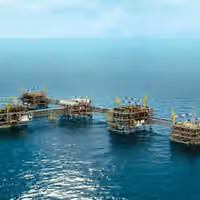
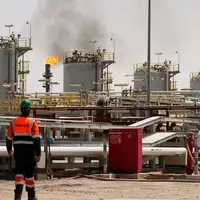
File photo of workers at an industrial facility in Iran.
Workers across several sectors in Iran say employers are delaying or splitting wage payments, cutting benefits and warning staff they could lose their jobs for protesting, as inflation and rising living costs deepen pressure on households.
Messages sent to Iran International by employees at companies spanning the automotive, energy, pharmaceutical and aviation industries describe wages arriving weeks or months late, with some workers saying they have taken second jobs to cover everyday expenses.
Several employees said their salaries were being paid in installments rather than on schedule. Others described losing workplace benefits or being told to resign if they objected to payment delays.
Delayed wages and disappearing benefits
Two workers at Megamotor, a subsidiary of automaker Saipa, criticized the company's wage and benefit payments in messages to Iran International.
Salary payments became irregular after the 40-day war, one worker said.
“We are suffering greatly and do not know how we can provide for our families.”
Another Megamotor employee said some wages and benefits, including overtime and meal allowances, were no longer being paid to workers, while managers and supervisors continued to receive overtime and other benefits.
Low pay at Saipa Yadak has forced most employees to work for the Snapp ride-hailing service from the afternoon until late at night, an employee of the auto-parts company said.
Some of the company's resources are spent on government ceremonies or large payments to senior managers, the employee added.
Workers at Bahman Motor are also facing financial and psychological pressure, an employee of the automaker said.
The company has declined to make payments to employees even as it continues constructing new industrial buildings, according to the employee.
File photo of workers carrying out construction and maintenance work in Iran.
The accounts come as Iran's economic problems have deepened in recent months alongside the Islamic Republic's regional policies, tighter sanctions and a sharp decline in the value of the national currency.
Rapid inflation and declining purchasing power have increased pressure on household budgets and made basic goods harder to afford for a broad section of the population.
Iran International reported in August that workers at mines and companies had gone months without receiving wages.
Workers say complaints put jobs at risk
Employees at other companies described wages being divided into installments and said challenging the delays could put their jobs at risk.
Salaries at Imen Tak Pishro in Jajrud are paid in installments and employees who object are warned they could be dismissed, one worker told.
Another employee previously told Iran International that their employer paid three months of overdue salaries in two installments.
Mapna has not paid workers at 25 power plants for 40 days, an employee of the company said.
At pharmaceutical company Arya Tinagen, salaries remained unpaid 11 days into the month, an employee said.
“The company has cut all employee benefits, from meals to the monthly benefit card. If we complain, they tell us to resign and leave.”
Messages in recent days have also described overdue wages, unpaid insurance contributions and warnings of dismissal across a range of workplaces.
An employee at Yasuj University of Medical Sciences said at the time that staff had gone three months without salaries and were warned they could lose their jobs if they pursued their demands.
Second jobs and unemployment fears
For some workers, irregular wages and rising living costs have made additional employment a necessity. For others, the concern is whether their main job will survive at all.
An employee at Ata Airlines said inflation, the rising exchange rate and aviation sanctions had led the carrier to cut jobs.
The airline had previously borrowed billions of tomans in an effort to avoid dismissing employees, according to the worker.
Employees at Kish Air said they had been instructed not to report for work until further notice and had not received a year's worth of performance-related payments.
Concerns extend beyond individual companies.
Large numbers of factories at the Shamsabad industrial estate have shut down, one person familiar with employment conditions there told Iran International.
The person said they had filled out around 50 job applications for factories in the industrial estate without receiving an offer.
The accounts follow broader signs of concern about employment. In an Iran International survey published in August, 92% of respondents said they had witnessed unemployment among people around them.
A woman walks past a person using an ATM outside a Bank Saderat branch in Iran.
Iran’s deepening isolation is drawing divided reactions from Persian-language social media users, with some welcoming US pressure to weaken the country’s rulers and others warning that ordinary people will bear the cost without producing political change.
The posts reviewed by Iran International reflect individual online reactions and are not representative of public opinion in Iran. But they show how the growing economic pressure is being interpreted by people arguing both for and against the blockade.
That pressure has intensified as the US naval blockade sharply curtailed Iran’s oil exports, a major source of foreign currency. Iranian crude loadings fell from about 2 million barrels per day in March to roughly 220,000-255,000 in August, according to shipping data cited by Reuters.
“Great. An air and sea blockade, then a land blockade, will lead to the government’s fall,” one Persian-language social media user wrote.
“The economic blockade is choking it,” another wrote.
Support for continued pressure has also appeared on Reddit. “I said months ago that the blockade is a good strategy,” one commenter wrote, expressing hope that US President Donald Trump would maintain it.
Another user in the discussion described maintaining the pressure as “Great for Iran.”
Taken together, the posts illustrate a view among supporters of the blockade that restricting trade and government revenue could weaken the Islamic Republic’s ability to withstand domestic pressure.
One user argued that the blockade could erode the authorities’ ability to administer and control the country by reducing oil revenue, weakening internal cohesion and increasing economic pressure.
“The blockade is not the objective, but the instrument,” he wrote, arguing that the aim was to increase pressure until the authorities struggled to maintain stability and manage the economy.
Others say ordinary Iranians will pay
Other users rejected the idea that economic isolation would bring political change and warned that the greatest burden would instead fall on the public.
“I don’t know of an example in history where sanctions and an economic blockade caused a revolution. Ordinary people just suffer,” one user wrote on X.
Another said prolonged isolation could strengthen corruption and preferential access, leaving politically connected people better placed to profit from shortages while the wider population becomes poorer.
“This situation could continue for years,” the user wrote, adding that the authorities could blame worsening economic conditions on the blockade.
For others, the consequences are already visible far beyond politics and trade.
“You can’t leave the country by air or sea. All the language exams have sanctioned us. Eighty percent of online games are restricted for Iranians. You can’t even create a Gmail account,” another person wrote on Instagram.
“It’s as though the project to erase Iranians from the face of the earth has officially begun,” the user added.
Dark humor over growing isolation
The restrictions have also prompted sarcasm directed at official assertions of resilience.
After Turkish Airlines suspended its Iran flights until at least March 2027, one commenter ironically invoked a familiar phrase in Iranian political rhetoric: “America can’t do a damn thing.”
“They just keep announcing victories one after another,” another wrote with laughing emojis.
A longer sarcastic comment mocked rhetoric about missiles, drones and military strength before concluding: “If the blockade continues, soon we’ll have to eat grass.”
Economic hardship also featured in discussions on Reddit. One commenter said half their monthly salary went on groceries and food and the other half on rent, leaving them dependent on savings. Another described paying 15 million rials for a kilogram of cold cuts and pickles.
The rial has fallen sharply during the economic squeeze, trading at more than 2.3 million to the dollar in September.
Iran’s official minimum monthly wage is about 166 million rials, worth roughly $71 at that exchange rate, meaning the purchase described by the commenter would amount to about 9% of a minimum-wage worker’s basic monthly pay.
Social media users in Iran say their phone lines have been cut off after posting political content or liking posts on Instagram, extending a practice previously reported among political activists and journalists.
Messages received by Iran International describe SIM cards being blocked without warning, demands for written pledges and difficulty finding out which authority can restore service.
The reports include a 70-year-old woman in Tehran who said she was summoned several times after posting a WhatsApp story supporting the Pahlavi dynasty. Her SIM card was blocked, and she was eventually required to sign a pledge not to publish similar content again.
The woman said she does not have an Instagram account and is not otherwise active on social media.
The use of SIM card blocking to pressure social media users has been reported before. On September 12, Iran International reported that political and civil activists in several cities had lost access to their phone lines without prior notice and had been unable to resolve the restrictions.
Phone lines blocked without warning
Other citizens said their phone lines were disconnected after they liked political posts on Instagram. Many said they received no explanation or advance notice.
One person told Iran International that his sister and brother-in-law had moved to Finland about three years ago, but his sister’s Hamrah-e Aval SIM card, which he had kept in Iran, was deactivated “by order of the cyber police.”
Another Iranian wrote to Iran International that all his phone lines had been blocked for two months.
“I went to the telecommunications office, and they said it was on the prosecutor’s orders. No matter which authority I approach, they won’t tell me what I’m supposed to do,” he wrote.
He said he was directed to call a number that he later learned belonged to the Revolutionary Guards’ Intelligence Organization.
“I’ve called many times, and no one answers. My entire life has been paralyzed,” he added.
A Tehran resident responding to his account said his SIM card had also been blocked in February or March and that he had gone to a prosecutor’s office in the capital to seek its restoration.
Written pledges
Iran International has previously reported that some citizens had their SIM cards blocked after publishing content critical of the Islamic Republic online.
Some were referred to the prosecutor’s office’s cyberspace division or Gerdab to seek restoration of service. In certain cases, they said they were required to sign written pledges to refrain from further critical activity.
Several families of people killed in the January 2026 crackdown in Iran have also said their SIM cards were blocked in recent weeks without notice after they shared information about their loved ones.
Daily life disrupted
Reports received by Iran International describe how SIM card blocking has disrupted citizens’ daily lives.
Many said mobile phones and phone lines are essential for everyday activities and that losing access can disrupt banking, ride-hailing and other online services.
Citizens also said they had received no clear explanation for why their lines were blocked or how to have them restored.
They described confusion and severe disruption to their lives, saying the restrictions had been imposed without judicial proceedings.