• العربية
  • فارسی
BrandBrand
  • Iran Insight
  • Politics
  • Economy
  • Analysis
  • Special Report
  • Opinion
  • Podcast
  • Live TV
  • Iran Insight
  • Politics
  • Economy
  • Analysis
  • Special Report
  • Opinion
  • Podcast
  • Live TV
  • Theme
  • Language
    • العربية
    • فارسی
  • Iran Insight
  • Politics
  • Economy
  • Analysis
  • Special Report
  • Opinion
  • Podcast
  • Live TV
All rights reserved for Volant Media UK Limited
volant media logo

Iran lawmaker threatens regional states with strikes on airports, infrastructure

Oct 9, 2026, 20:53 GMT+1

Countries in the region aligned with the United States are under surveillance and within striking range, with their airports and infrastructure facing possible attacks, Iranian lawmaker Ebrahim Rezaei warned in an X post Friday.

“Security for everyone or for no one. Oil sales for everyone or for no one. Infrastructure for infrastructure. Airports for airports,” wrote Rezaei, a member of parliament's National Security and Foreign Policy Committee.

Rezaei warned what he called America's “51st states” in the region to watch their conduct, claiming Iran had updated its targets and was more prepared than before for any scenario.

Most Viewed

From talks to war: Tehran sees the gap narrowing
1
ANALYSIS

From talks to war: Tehran sees the gap narrowing

2
VOICES FROM IRAN

Iran's reported $200 million Hezbollah aid angers cash-strapped citizens

3

Iran turns on Pakistan as Saudi defense pact takes effect

4
ANALYSIS

Three years after October 7, Iran pays the price of miscalculation

5
EXCLUSIVE

Hezbollah recruitment network in Iran exposed, four safe houses identified

Banner
Banner

Spotlight

  • 'Three golden weeks': Trump’s no-strike pledge fuels calls in Iran to act first

    'Three golden weeks': Trump’s no-strike pledge fuels calls in Iran to act first

  • J’Accuse! Tehran defends French students, silences Iranian youth
    OPINION

    J’Accuse! Tehran defends French students, silences Iranian youth

  • US pressure hits Iranians harder than rulers, 68% in poll say
    VOICES FROM IRAN

    US pressure hits Iranians harder than rulers, 68% in poll say

  • Saudi Aramco hires US firm to upgrade shared oil field as Iran lags behind

    Saudi Aramco hires US firm to upgrade shared oil field as Iran lags behind

  • Iran looks for escape routes as US sanctions close in
    INSIGHT

    Iran looks for escape routes as US sanctions close in

  • China shifts to Iraqi oil: is Iran using old workaround to beat US blockade?
    ANALYSIS

    China shifts to Iraqi oil: is Iran using old workaround to beat US blockade?

Banner
Banner
•
•
•

More Stories

Iran executed over 2,000 people in past year, rights group says

Oct 9, 2026, 20:04 GMT+1
100%

Iran executed at least 2,003 people over the past year, a 29% increase from the previous period, rights group HRANA reported Friday, as UN experts warned that Tehran uses capital punishment to silence dissent and instill fear.

The report was released on October 9, on the eve of World Day Against the Death Penalty. Its figures cover October 10, 2025, through October 8, 2026.

The toll was the highest in 10 reporting periods, up from 1,553 the preceding year and 505 in 2016–2017. HRANA compiled its findings from 1,857 reports and said restrictions on independent monitoring may leave some executions undocumented.

According to HRANA, murder charges accounted for 57.56% of executions and drug offenses for 36.25%. About 95% of executions were not announced by official sources, while only 5% were officially reported.

Nine executions took place in public, while six other people received sentences calling for public executions. Among those executed were 47 women and four people who had been under 18 at the time of their alleged offenses.

Political executions and January protests

HRANA documented 69 political or security-related executions during the reporting period, including 35 cases linked to the January 2026 protests. Twenty-nine people were executed on charges of moharebeh, or enmity against God, alone or alongside other accusations.

Another 29 political or security-related executions occurred in April and May 2026 alone.

HRANA also documented 369 televised confessions connected to the January protests that it said had been extracted under torture. It cited the cases of Amirhossein Hatami, executed at 18, and Saleh Mohammadi, charged at 18 and executed at 19.

A separate Iran International review published on October 6 identified at least 70 executions in political and security cases between January 7 and October 5, averaging nearly two a week.

  • Iran executes nearly two people a week since January protests

    Iran executes nearly two people a week since January protests

Of those, 35 were linked to the January protests, nine to the 12-day and 40-day wars, and 26 to other political and security cases.

The review also identified at least 194 people facing death sentences in political and security cases, including 113 arrested in connection with the January protests. Among those facing execution were 13 women and at least seven people who were under 18 at the time of their alleged offenses.

The review found that 44 of the 70 executions had taken place in Karaj and Isfahan. It cautioned that the figures represented verified cases rather than the full scale of executions and death sentences.

In an accompanying statement, HRANA said judicial authorities and Revolutionary Courts accelerated proceedings against political prisoners and protesters following the January demonstrations.

The group said death sentences were issued and carried out after grossly unfair trials, extending repression from the streets into courtrooms and prisons and threatening protesters with death.

HRANA's monthly figures show 1,075 executions since the start of 2026, including 334 in January and 282 in February.

UN experts warn of repression

UN human rights experts on Friday described Iran as the world's most prolific executioner per capita and called for an immediate halt to executions.

“Iran’s death penalty is used to silence dissent, with broadly defined national security offences recasting peaceful activity as a threat,” the experts said.

They warned that prosecutions of people arrested during the January 2026 protests involved torture, enforced disappearances, sexual violence, coerced confessions and denial of access to lawyers.

A UN fact-finding mission previously concluded that the killing of thousands of protesters in January amounted to crimes against humanity.

The UN experts also said executions for drug offenses often targeted low-level couriers from impoverished and marginalized communities. They criticized Iran's qisas system, under which a defendant's ability to pay blood money can determine whether a death sentence is carried out.

HRANA said executions following unfair trials violated Article 6 of the International Covenant on Civil and Political Rights and called for an immediate halt. The UN experts also urged Tehran to commute death sentences and review cases against fair-trial standards.

J’Accuse! Tehran defends French students, silences Iranian youth

Oct 9, 2026, 18:07 GMT+1
•
Clément Therme
100%
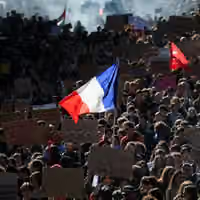
The French flag is hoisted during protests in Nantes, October 8, 2026.

Tehran has seized on protests by French high school students to accuse Paris of repression, seeking to obscure its own treatment of young Iranians by turning the language of human rights against one of its Western critics.

On October 6, Iran summoned French ambassador Pierre Cochard over the crackdown on high school demonstrations in France. The following day, Paris summoned Iran’s ambassador, accusing Iranian authorities of spreading disinformation through official Foreign Ministry accounts.

The diplomatic exchange reveals how the Islamic Republic appropriates the language of rights while denying those rights at home. It is also a struggle over the meaning of protest and who can claim to defend it.

Tehran seeks to reposition itself as an accuser, turning scrutiny away from its own security apparatus and toward a government that has condemned Iranian repression.

Internationally, Tehran seeks to weaken the authority of European criticism. Domestically, the diplomatic spat offers supporters reassurance that Western governments also face rejection. Neither objective requires solidarity with the students themselves; both require their images and grievances to be repurposed in defense of the regime.

This tactic has precedent. During the Yellow Vest movement, Ali Khamenei condemned French police violence, while a small group of regime supporters gathered outside the French embassy in Tehran.

Some wore yellow vests and placed candles and photographs of injured French protesters outside the embassy. Their placards denounced police violence but also carried an explicitly ideological message: “If only the French people had an Imam Khomeini!”

A statement read at the gathering invoked France’s reception of Khomeini at Neauphle-le-Château forty years earlier and portrayed Emmanuel Macron’s government as cruel and despotic.

At the same time, Iranian authorities were cracking down on protests by pensioners, workers, teachers and students. Then, as now, the tactic allowed Tehran to answer criticism of its own repression by accusing its critics of hypocrisy. Human rights become an arena for diplomatic one-upmanship rather than obligations owed to citizens.

France’s conduct must, of course, be scrutinized on its own merits. Injuries to demonstrators, particularly minors, demand independent investigation and accountability. But the evidence concerning Iran is substantial.

In March 2024, the UN Independent International Fact-Finding Mission concluded that violations committed during the repression of “Woman, Life, Freedom” included crimes against humanity.

Its findings encompassed murder, imprisonment, torture, rape and other sexual violence, persecution and enforced disappearance. The mission documented the involvement of state institutions and security forces, undermining attempts to portray the violence as a series of isolated excesses.

On September 17, 2026, the same mission reported that Iranian authorities had also committed crimes against humanity during the crackdown on protests that began in late December 2025 and continued into January.

Generation Z played a crucial role in “Woman, Life, Freedom” following Mahsa Amini’s death in September 2022. Schoolgirls removing their headscarves, teenagers challenging clerical authority and young women demanding control over their bodies exposed the limits of decades of ideological education.

The state had sought to reproduce loyalty. Instead, many young people asserted their right to determine how they would live.

Young Iranians mobilized again in the protests that began in late 2025, bringing another generation raised entirely under the Islamic Republic into confrontation with the state. Their rejection of its prescribed norms challenges the assumption that political control necessarily produces ideological consent.

The authorities’ response combines repression with continued recruitment into structures of loyalty. The Basij, under Revolutionary Guards command, provides a network for ideological discipline and security mobilization.

Human Rights Watch and Amnesty International have reported that an IRGC recruitment campaign accepts children as young as twelve, with Amnesty documenting children carrying weapons and serving at checkpoints and on patrols.

This goes beyond patriotic rhetoric: it places children directly in harm’s way. The state invokes the protection of young people abroad while drawing children into its military apparatus at home.

Yet Iranian youth cannot be divided neatly between those who serve the regime and those who confront it. Many seek simply to build lives apart from official Iran. Their resistance is not limited to protest: it also finds expression in everyday acts—choosing what to wear, loving, dancing, listening to music, nurturing friendships and keeping parts of their lives beyond the authorities’ control.

This has produced a form of what might be called “secular separatism”: an attempt to shield personal life from the regime’s ideological grip.

Within social, cultural and emotional circles, and spaces of celebration, another, fragile society is taking shape, though access to it inevitably varies with resources and social background.

Joy itself can become a way of asserting autonomy. Under a regime that glorifies martyrdom and encourages citizens to denounce one another, the simple acts of enjoying life and pursuing happiness acquire political meaning.

Tehran claims to speak for French high school students. It should begin by listening to young Iranians who aspire to build their own lives.

Teenage boy dies in custody after beating by Iran's Basij forces, source says

Oct 9, 2026, 16:29 GMT+1
•
Pooya Jahandar
100%
Omid Ghanouni

A 17-year-old boy died in custody in Iran’s Isfahan province after the IRGC’s paramilitary Basij forces beat him during his arrest and a judge refused his father’s plea for hospital treatment, a source familiar with the case told Iran International.

Omid Ghanouni, from Arjanak village in Khansar county, died during judicial questioning at the Khansar courthouse on Tuesday, October 6, less than 24 hours after his arrest, according to the source.

He was detained on Monday evening, following a verbal dispute with a Basij member. Basij forces severely beat him with rifle butts before handing him over to police, the source said.

Ghanouni spent the night at Vist police station and was taken to the courthouse the following morning.

Father’s plea for hospital treatment rejected

During questioning, Ghanouni was suffering from severe abdominal pain and was visibly unwell, according to the source.

His father, who was at the courthouse, asked judicial officials to allow his son to be taken to hospital. He even offered to remain in custody in his son’s place so the teenager could receive treatment.

The judge rejected the request and questioning continued, the source said. Ghanouni then collapsed from his chair and died at the courthouse. His body was subsequently taken to Khansar’s Fatemiyeh Hospital.

Medical staff at the hospital identified internal bleeding as the cause of death, according to the source, who also described extensive bruising and injuries on the teenager’s body and face.

The source said there had been obstruction in the process of referring his body for forensic examination.

100%
A funeral notice for 17-year-old Omid Ghanouni, who died in custody in Iran’s Isfahan province on October 6, 2026.

Iran International has not yet obtained an official forensic report or independent medical records confirming the cause of death.

Ghanouni was buried in his home village on Thursday, October 8. His family has come under pressure to remain silent about the circumstances of his death, the source said.

Family demands answers

On Friday, Ghanouni’s family gathered outside Vist police station to demand answers from officials.

“Officers arrested him outside the house on Monday, October 5, and on Tuesday, October 6, the Khansar courthouse handed me my son’s body,” his mother told officers. “Tell me what happened to my son.”

No official explanation from judicial or police authorities about the cause of his death was available at the time of publication.

The case follows other deaths in or after custody reported by Iran International in recent months.

Those include the deaths of Ali Hashemi and Akbar Mohammadi in Isfahan’s Dastgerd prison, Taghi Salimi in Amol prison and Arash Tolou Sheikhzadeh following arrest and interrogation in Mashhad. Reporting on those cases has included allegations of torture, denial of medical care and uncertainty over the causes of death.

In a separate case, Pejman Sourani, a 33-year-old man from Najafabad in Isfahan province, was killed on October 3 following a confrontation with government supporters at the Aminabad petrol station and a beating by security forces, according to information previously reported by Iran International.

Forensic officials identified blows to the head as the cause of Sourani’s death, according to the reporting on his case.

Iran turns on Pakistan as Saudi defense pact takes effect

Oct 9, 2026, 15:23 GMT+1
•
Maryam Sinaiee
100%
Military vehicles travel along a road during what Saudi-backed Yemeni government forces say was an advance against the Iran-backed Houthis, near Dhubab, Taiz Governorate, Yemen, in this still image taken from video released October 5, 2026.

Iran has sharpened its criticism of a Saudi Arabia-Pakistan-Turkey defense pact after it became operational, warning against intervention in Yemen and questioning Pakistan’s role as a mediator between Tehran and Washington.

The trilateral pact entered its operational phase on October 5 following an escalation in Houthi missile and drone attacks on Saudi infrastructure. Turkey and Pakistan said they had begun taking measures to support Saudi Arabia.

Under arrangements discussed by the three countries, Pakistani and Turkish forces are expected to provide military, technical and intelligence support to Saudi Arabia, including defensive capabilities inside the kingdom. Officials have said the forces will not take part in offensive operations in Yemen.

Iranian Foreign Ministry spokesman Esmail Baghaei, asked on Sunday about reports that tens of thousands of Pakistani troops could be deployed to Saudi Arabia, said: “We have also heard this rumor, and we hope it is not true.”

“The countries of the region are well aware that any intervention in the Yemen issue could have undesirable consequences for the region,” he added, expressing hope that pacts such as the Mecca agreement would not be used “against the interests and welfare of the Muslim community.”

The Saudi Arabia-Turkey-Pakistan defense pact, signed in August in Mecca, stipulates that an attack on any one of the three countries will be treated as an attack on all three.

‘Begging for security’

Foreign Minister Abbas Araghchi, without directly referring to the pact, called on neighboring countries to pursue “self-reliance” and a policy based on “genuine brotherhood.” He also said such agreements would not constrain Iran.

Several lawmakers dismissed the pact as largely symbolic. Ahmad Bakhshayesh, a member of parliament’s National Security and Foreign Policy Commission, called it a “paper and political pact.”

Sharper criticism came from committee member Ebrahim Rezaei.

“The Saudis should know that a paper agreement with Turkey and Pakistan will not bring them security, just as years of one-sided milking of the Americans did not bring them security,” he wrote on X. “Correct your policies so that you do not have to beg others for security.”

That tone has hardened as the pact has moved into its operational phase.

Alaeddin Boroujerdi, a member of parliament’s National Security and Foreign Policy Committee, said Thursday that Turkish and Pakistani involvement in the Saudi conflict with Ansarullah, as the Houthis are formally known, would neither weaken the group nor restrict its ability to operate in the Bab al-Mandeb Strait.

“The entry of Pakistan and Turkey will definitely work to their own detriment,” he told ISNA. “They should learn from history ... Saudi Arabia once had a coalition with a large number of countries, but after seven years of war in Yemen, it was defeated.”

‘Regional intervenor’

Iranian criticism has focused more heavily on Pakistan than Turkey, in large part because of Islamabad’s prominent role in mediating between Tehran and Washington.

Lawmaker Ahmad Naderi wrote on X that “Pakistan’s entry alongside Saudi Arabia into the war against the people of Yemen … shows that Pakistan should no longer be considered a mediator but a regional intervenor.”

The Tabnak news website went further, saying Iran viewed the deployment of Pakistani forces to Saudi Arabia as a threat to its security and “will not tolerate Pakistan’s military presence for military operations in the Yemen war.”

It also warned that Pakistan’s increasingly overt alignment with Saudi Arabia could heighten sectarian tensions at home and bring instability to the Iranian-Pakistani border.

Conservative commentator Hassan Hanizadeh similarly accused Saudi Arabia of seeking to create a religious divide, describing a recent meeting in Riyadh involving Saudi, Pakistani and Turkish officials as a sign of “the formation of a Shiite-Sunni polarization in the region.”

Boroujerdi pointed to potential domestic opposition in Pakistan, saying its people were “revolutionary, Muslim and highly sensitive to such issues” and that Islamabad would not have an easy path if it entered the war.

‘Alliance against the oppressed?’

Iranian state media have adopted a more confrontational tone as the pact has become operational, while giving extensive coverage to warnings from Houthi officials directed at Turkey and Pakistan.

Tasnim described the development as “Turkey and Pakistan join the Saudi war against the Yemeni people,” while Nour News, which is close to Iran’s Supreme National Security Council, asked: “Mecca alliance or alliance against the oppressed people of Yemen?!”

In a Thursday commentary, Tasnim warned that if Ankara and Islamabad participate in attacks on Yemen, “they may be directly harmed through attacks on their ships, interests and perhaps even their own territory.”

UK court hears how alleged Iran spy operation targeted Iran International

Oct 9, 2026, 13:07 GMT+1
100%
Court sketch from Woolwich Crown Court. Credit: SWNS/Julia Quenzler

Men accused of spying for Iran exchanged information about Iran International’s offices and presenter Kambiz Hosseini, while one defendant discussed money transfers and his legal troubles with contacts in Iran, a London court heard.

Jurors at Woolwich Crown Court were taken through photographs, messages and phone records documenting communications among the three defendants and between Mostafa Sepahvand and two men in Iran.

Sepahvand, 41, Farhad Javadi Manesh, 46, and Shapoor Qalehali Khani Noori, 57, have all pleaded not guilty to charges under Britain’s National Security Act 2023.

Prosecutors say they gathered information for Iranian intelligence to prepare for serious violence against at least one target, with Sepahvand expected to carry out an attack and the others helping to plan it.

Locations and social media

In an exchange on December 19, 2024, Sepahvand received a postcode from a UK mobile number and forwarded it to Javadi Manesh, the court heard.

The prosecutor told jurors the postcode identified the location of Volant Media, Iran International’s parent company. Sepahvand also forwarded the telephone number from which he had received it.

Messages from December 24 showed Sepahvand sending Javadi Manesh a photograph of Hosseini, a link to his Instagram account and information about Iran International’s website.

In one message, Sepahvand wrote: “go to insta and you will see both the dog and the car”.

The prosecution also reminded jurors of a video Noori had sent to Sepahvand showing a park where Hosseini walked his dog, Niko. Other messages referred to the dog’s name and a blue Volkswagen.

Jurors were shown photographs recovered from Noori’s phone depicting Malthouse Court in Brentford from several angles, taken from inside a car.

Prosecutors had previously told the court that Iran International journalist Mojtaba Pourmohsen lived there between 2019 and 2023, but the defendants appeared unaware he had moved.

  • Three Iranians spied on Iran International journalists in UK, prosecutors say

    Three Iranians spied on Iran International journalists in UK, prosecutors say

  • UK police charge man over Iran-linked foreign intelligence offence

    UK police charge man over Iran-linked foreign intelligence offence

  • Two Iranians charged over foiled plot targeting Manchester Jews

    Two Iranians charged over foiled plot targeting Manchester Jews

Money and contacts in Iran

The prosecution examined records of Sepahvand’s communications with Mostafa Ghorbani and another contact saved as “Amin Mostafa’s Friend”, both in Iran.

The exchanges included discussions about transferring money to Sepahvand and references to an account in his name at the Workers Welfare Bank.

Jurors also heard messages concerning Sepahvand’s court case in Iran. In one, Ghorbani wrote: “haji says your case will be fine”.

Sepahvand sent Ghorbani two Iranian court documents concerning vehicles linked to him. The documents included instructions to impound the vehicles and arrest Sepahvand if he was found driving them.

Shortly after sending the documents, Sepahvand called Ghorbani and the two spoke for nearly a minute and a half, according to the records presented to the jury.

In later exchanges, Sepahvand complained that nothing had happened with his case. The logs showed repeated attempts to reach Ghorbani, including unanswered calls in early January.

Prosecutors previously said Sepahvand wanted help resolving an Iranian criminal conviction, which they consider relevant to his motivation. Jurors were told not to treat the conviction itself as evidence against him.

A police witness was questioned about the dates, times and durations of calls and messages recorded in the logs, rather than asked to draw conclusions about their significance.

Defendants dispute prosecution’s account

According to the prosecution’s account of his defense, Sepahvand accepts conducting surveillance for Iran but says he feared the consequences of refusing and deliberately did a poor job. Prosecutors reject that account.

Javadi Manesh and Noori accept visiting locations and taking photographs and videos but say they did not know they were assisting Iranian intelligence, according to the prosecution.