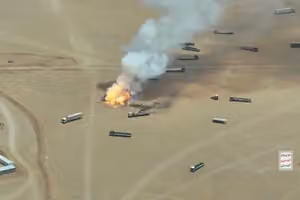
The United States and Israel bombed Iranian bridges that could be rebuilt in 48 hours and spared those that would take years. Iran International has mapped the network they tested: 670 rail bridges and 380 tunnels that carry Iran's missiles, its army and its trade.
In the war that began on February 28 and ended with a ceasefire in April, strikes on rail and road bridges became one of the most conspicuous tactics of the American and Israeli campaign, and one that continued after the guns were supposed to have stopped. In the 12-day war of June 2025, attacks on bridges had been rare. This time three distinct patterns emerged.
The first came on the night of April 7, when six rail bridges were struck. Four of them, placed on a map of the national railway, severed Tehran's connection to the network and so to the northwest, the northeast, the south, the southeast and the southwest of the country.
The second was the attack on the bridges at Bandar Khamir, on the coast opposite the Strait of Hormuz, which cut the east-west road along the Persian Gulf with no effective alternative.
The third was the strike on the Aq Tekeh Khan rail bridge in Golestan province and the B-1 road bridge near Karaj, whose logistical importance was limited compared with the main routes but whose symbolic weight was not.
The pattern in what was hit is as telling as what was not. Unlike Iraq during the eight-year war of the 1980s, which went after the piers of the Qotur, Tele-Zang and Pol-e Siah bridges and put them out of use for years, the American and Israeli strikes chose smaller structures that could be repaired: Moghimabad, Yahyaabad, Chaharbagh and their like. Even B-1, the only large bridge struck, kept its piers. When Iraq destroyed the piers of the Qotur bridge in the 1980s, the repair took close to ten years. Almost every bridge struck this year was back in service within days, patched with prefabricated concrete culverts.
The damage was light but the strikes were a reminder of how exposed Iran's logistics are in the parts of the network that serve both military and civilian purposes, which is most of it.
Iran International's mapping shows that along the 25 principal roads that connect nearly every known missile production and assembly center and every "missile city" to one another, and that serve the bases of the Revolutionary Guards' and the regular army's ground forces, there are about 800 bridges and 90 large tunnels. On the national railway there are 670 bridges and 380 large tunnels, counting only structures with a deck longer than 30 meters.


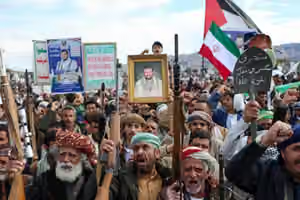
Iranian weapons and growing supplies of Chinese dual-use components have helped Yemen's Houthis expand their territory and strengthen their ability to threaten shipping through the Red Sea, the Wall Street Journal reported.
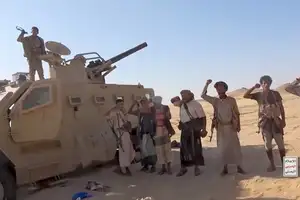
The Iran-backed group has seized Red Sea islands and expanded along Yemen's mainland coast in recent weeks, including taking the port city of Mokha, according to the report. It has also asserted control over the Bab al-Mandeb Strait, a key route for global trade and energy shipments.
The Houthis, estimated to have about 350,000 fighters, had prepared for the offensive for months, moving weapons and thousands of troops toward Mokha in August and using their control of telecommunications networks to monitor opponents, the Journal said.


Iranian technology at the core
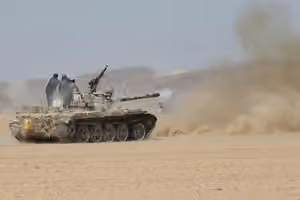
The Houthis lack a conventional navy but use Iranian-designed missiles, explosive drones, sea mines, armed fast boats and drone boats to project power along Yemen's coast.
Their arsenal includes ballistic and cruise missiles, anti-ship weapons and drones drawing heavily on Iranian technology and components, according to the report.
Around 2015, Iran's Quds Force began sending components for Iranian-designed missiles and drones and dispatched trainers to help the Houthis build weapons themselves, the Journal said.
The assistance helped turn the group into a force capable of attacking Saudi oil infrastructure, disrupting Red Sea shipping and threatening US forces.
China becomes another supply source
"The Houthis now have a new source for the supplies they need to launch their attacks: China," the Journal reported.
Chinese companies are supplying dual-use goods that can serve civilian and military purposes, including components important to Houthi drone programs, according to UN reports and arms experts cited by the newspaper.
The shift comes as traditional Iranian smuggling routes have faced greater disruption. For years, Iran's Revolutionary Guards used small fishing boats to move arms, drone components and missile parts to the Houthis, but many shipments have been intercepted by US forces and Yemeni groups opposed to the Houthis.


Red Sea threat grows
The Houthis have also used Djibouti as a transit point for weapons and traded small arms with al-Shabaab in Somalia, according to UN reports cited by the Journal.
Since announcing a blockade on Saudi shipping on July 20, the group has struck seven vessels in the Red Sea and one in the Gulf of Aden, the report said. Four of the ships were Saudi-flagged.
The Houthis have also targeted Saudi energy infrastructure with missiles and drones, although Riyadh has reported no damage from those attacks.
The Basij has long maintained a presence in Iran's high schools and universities. Its growing visibility among much younger children is drawing attention to a new front in the Islamic Republic's effort to shape a generation that has repeatedly challenged its authority.
As millions of students returned to classrooms this month, Iran's paramilitary Basij appeared prominently in elementary schools as authorities rolled out an education campaign infused with military and ideological messaging.
Iran's Education Ministry announced over the summer that material related to the recent war and the country's military and nuclear capabilities would be incorporated into educational content.
The push comes at a precarious moment for the Islamic Republic, following war, economic turmoil and nationwide unrest—and four years after schoolgirls became some of the youngest and most visible participants in the Woman, Life, Freedom uprising.
“Iran is obviously right now at sort of a crossroads,” historian Arash Azizi told Iran International, as the Islamic Republic struggles to command the loyalty of generations born decades after the 1979 revolution.
“We're talking about much younger people, people under 13,” Azizi said, adding that the Basij had some involvement in primary schools during the early years after the revolution, but considerably less in recent decades.
The memory of Woman, Life, Freedom
Historian Shahram Kholdi said the increased attention to schools cannot be separated from what happened inside them four years ago.
“We should remember that during the Woman, Life, Freedom movement we saw a huge wave of solidarity with this movement, especially in girls' schools in Iran,” he said.
The nationwide protests in January served as another warning. “It was again a wake-up call, harkening back to Woman, Life, Freedom, that they have to control schools,” Kholdi said.
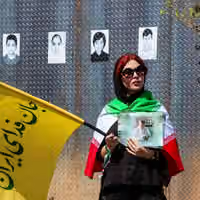
After the death of Mahsa Jina Amini in morality police custody in September 2022, protests spread into schools.
Videos showed schoolgirls removing their headscarves, chanting against the Islamic Republic and removing or defacing images of its leaders. Some were barely teenagers.
The protests turned schools into one of the most visible arenas of youth opposition to the Islamic Republic.
Kholdi argues that the significance of a Basij presence extends beyond ideological instruction. Schools can provide authorities with greater visibility into students and, through them, their families at a time of considerable social and economic discontent.
The Basij's role in policing students also has a history. Kholdi recalled his own high-school years, when Basij members searched students' backpacks each morning for what he described as “contraband cultural material.”
What stands out now, he said, is how far down the age ladder the attention appears to be moving.
The Islamic Republic's concern about losing younger Iranians predates the latest unrest and war. In a January 2025 interview with Iran International, Iran specialist Holly Dagres said the establishment was already looking beyond an increasingly alienated Generation Z.
“They've been actually looking at the next generation, which is Gen Alpha,” she said.
‘North Korea scenario’
Azizi sees the push into younger age groups as part of a broader argument within the establishment over how to respond to a society that has moved away from some of the ideological positions that have defined the Islamic Republic.
“The regime has been trying to sort of bolster its base amongst the youth because it's lost them and it knows they're the future,” Azizi said.
One tendency, he said, favors a return to a more rigid and intensely ideological state—what he described as a “North Korea scenario”—drawing on mass mobilization of its remaining supporters to reinforce mandatory hijab and Islamist social rules.
In that vision, the Basij becomes an instrument not only for building support but for imposing what Azizi called “societal submission.”
But he said such an approach carries its own risk.
“If the regime wants to go toward bringing back Iran to the 1980s and then North Korea,” Azizi said, such policies could “lead to more social protests and social resistance.”
That tension is now reaching further into Iran's classrooms.
During Woman, Life, Freedom, schoolgirls who had spent their entire lives under the Islamic Republic turned some of those classrooms into places of protest. Four years later, the children entering elementary school belong to an even younger generation.
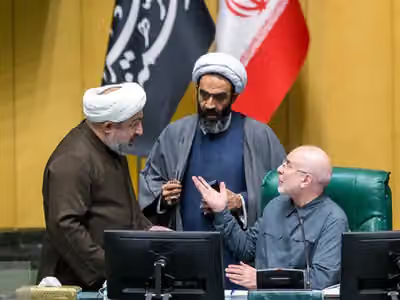
The spread of Starlink could deliver the “final nail in the coffin” of Iran’s ability to control cyberspace, Deputy Communications Minister Mohammad Hafez Hakami said Wednesday, even as authorities seek to suppress the technology through arrests, seizures and criminal penalties.
Hakami said Starlink had fundamentally changed that equation. “Our control over cyberspace is no longer based on our domestic network. It is based on Starlink,” Hakami said.
He said officials had warned for more than two years that wider use of the satellite internet service could eventually render existing methods of controlling communications ineffective, but had failed to produce an adequate policy response.
“I sometimes joke that we might as well turn the Ministry of Communications and the Supreme Council of Cyberspace into amusement parks, because they will no longer serve any purpose,” Hakami said.
Iran has repeatedly restricted internet access during periods of unrest. Hakami said the government’s response has grown progressively more restrictive, from blocking a single platform in 2017 to shutting down internet access during the 2019 protests, blocking two major platforms after the 2022 protests and ultimately disconnecting the entire network during the bloody crackdown on nationwide protests in January 2026.
Starlink poses a challenge to that approach because its terminals connect to satellites rather than relying on Iran’s domestic telecommunications network.
Hakami said even measures such as mandatory mobile phone registration could become ineffective with Direct-to-Cell technology, which allows ordinary mobile phones to connect directly to satellites.
“I don’t want to create ‘Starlink-phobia,’ but nothing will remain of our ability to control cyberspace,” he said.
Arrests and seizures
Iranian authorities have intensified their crackdown on Starlink as its use has expanded. Iran’s Economic Security Police said in August that authorities had seized 997 Starlink devices and related equipment and arrested 163 people during the four months through July. Police also impounded 15 vehicles carrying the equipment.
The crackdown has extended to individual users and sellers. Two men from Bukan were sentenced to two years in prison each for buying and selling Starlink equipment.
Iran also criminalized unlicensed satellite internet equipment under legislation adopted in 2025. The law prohibits the use, possession, purchase, sale and import of devices such as Starlink and provides for prison terms and confiscation. It permits the death penalty for specified activities involving the equipment when carried out for espionage or to confront the state and the perpetrator is deemed an enemy force.
Amnesty International said Iran’s Intelligence Ministry announced in March that “hundreds” of Starlink devices had been seized. The rights group said authorities had portrayed the use of alternative satellite connections as potential espionage or collaboration with hostile states and threatened users with prosecution.
Death after Starlink-related arrest
The crackdown has also been linked to a reported death in custody.
Hesam Alaeddin, a 40-year-old man detained in Tehran over his alleged use of Starlink equipment to bypass an internet blackout, died after he was severely beaten by government agents, a source familiar with the case told Iran International in May.
Alaeddin had gone to a hospital to check on his brother, Hamid, who had been shot during protests, when some of his electronic devices were seized, according to the source.
A week later, he went to retrieve the devices and was arrested. Agents took him to his home for questioning and a search, where they severely beat him with various objects and he died, the source said. Authorities concealed his death and continued to treat him as a living detainee before eventually telling his family to collect his body.
Amnesty International later documented Alaeddin’s death but said the precise timing and circumstances remained unclear. The rights group said his arrest was connected to an investigation involving his brother and alleged possession of a Starlink device.
Despite the enforcement campaign, Hakami said Starlink had already reached a significant level of use in Iran and questioned whether existing policies could keep pace with the technology.
“Tell me: What policy have we adopted to protect the country against Starlink?” he said.
Continued contacts between Tehran and Washington, mediated by Qatar and Pakistan, have intensified debate inside Iran over whether diplomacy can still produce a deal despite President Donald Trump’s rejection of Tehran’s latest proposal and what should happen if it fails.
Foreign Minister Abbas Araghchi, speaking before leaving New York on Tuesday, rejected suggestions that Tehran had agreed to nuclear concessions, saying Iran’s immediate focus was the Strait of Hormuz.
Despite Trump’s rejection of the Iranian proposal, Araghchi said he had told Qatari mediators that Tehran would wait for an official US response through them.
The reformist newspaper Shargh said Araghchi’s remarks carried an important message: Tehran did not want its return to diplomacy to be interpreted in Washington as a retreat from its nuclear positions.
The dispute is increasingly about whether that diplomatic opening can produce an agreement before pressure gives way to another round of escalation.
An opening, but on whose terms?
President Masoud Pezeshkian reiterated on Wednesday that his government was seeking to bring the Islamabad understanding to fruition. He did not comment directly on Trump’s rejection of Iran’s proposal.
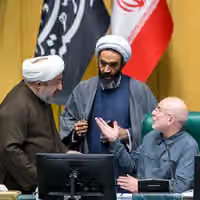
Parliament Speaker Mohammad-Bagher Ghalibaf, meanwhile, responded sharply to Trump’s recent statements, warning that Iran would retaliate against further military action.
“In a region where we do not sell oil, no one will sell oil, and if our security is not ensured, no infrastructure will be safe,” he said.
“The main issue in the coming days will not be whether Iran and the United States are talking to each other, but whether they can move from exchanging messages to an implementable formula,” Shargh wrote.
It said a US response meeting at least some of Tehran’s conditions could lead to more serious negotiations, while failure to find such a formula would return the dispute to “a logic of pressure and confrontation.”
Etemad, another reformist daily, raised a different concern: that the Strait of Hormuz could lose value as an Iranian bargaining tool the longer the confrontation continues.
It argued that if the blockade, restrictions on Iranian oil exports and pressure on Iran’s commercial networks become entrenched, Washington could increasingly rely on economic pressure rather than further large-scale military action.
Former Iranian diplomat Kourosh Ahmadi made a similar argument in Shargh, saying Iranian officials should recognize that “diplomacy is an arena of give-and-take” rather than expect progress while offering almost no concessions.
Trump’s rejection of Tehran’s proposal, he argued, showed that the dispute was increasingly about “who sets the negotiating ground and who will be forced to put more concessions on the table to get out of pressure.”
If diplomacy fails
Hardline voices have pushed in the opposite direction, warning officials against interpreting continued diplomacy as evidence that Iran should compromise.
Political analyst Mehdi Kharatian rejected arguments that the Strait of Hormuz was losing its effectiveness as leverage.
“Do not be deceived by those who these days are flooding you with false and biased reports about the ineffectiveness of oil and the Strait,” he wrote, accusing such voices of implicitly advocating surrender to the United States.
He also warned officials against sending what he described as excessive signals of willingness to negotiate, arguing that doing so could encourage Trump to resume military action.
The possibility of another confrontation was also raised by IRGC spokesman Hossein Mahdavi, who told state television that Iran was already at war. He said the United States was unlikely to launch attacks on the same scale or with the same capabilities as before.
But he added: “In the world of war, everything is possible.”
Mahdavi also claimed Iranian forces continued to target vessels attempting to transit the Strait of Hormuz and that the United States had recently refrained from responding.
The conservative Khorasan newspaper raised the possibility of Iran launching pre-emptive attacks if negotiations over the nuclear issue fail.
It argued that Iran could resort to a “Plan B” aimed at seizing the initiative before its adversaries complete their intelligence and logistical preparations, potentially triggering a period of intensified warfare before the US midterm elections.
The competing prescriptions emerging in Tehran reflect a debate that has moved beyond whether communication with Washington should continue. What the opposing camps increasingly share is a sense that the current diplomatic opening may not remain open indefinitely.
British Prime Minister Andy Burnham said on Wednesday there are “strong indications” Iran played a role in a suspected plot near RAF Fairford airbase used by US forces to carry out strikes on the Islamic Republic.
“But of course, it remains an ongoing, complex and serious police investigation,” he told BBC. “We are working closely with our colleagues in the United States of America.”
Five British men in their 20s were arrested on suspicion of terrorism and explosives offenses after three white vans were found near the base.
Police recovered petrol but found no viable explosives, and all five suspects were later released on bail as the investigation continued.
The base is home to the US Air Force’s 501st Combat Support Wing and also serves as a forward operating site for Air Force Global Strike Command.
Fairford has supported major US military operations, including the 1991 Persian Gulf War, the 2003 invasion of Iraq and this year’s US-Israeli strikes on Iran.
US Secretary of State Marco Rubio subsequently said a foreign state was involved, without naming it, while President Donald Trump said the men had planned "big damage."
Iran has denied involvement. Iran’s Revolutionary Guards (IRGC) said in July that bases used for attacks on Iranian territory could be considered legitimate targets.
Before Burnham’s remarks, British authorities had not publicly linked the incident to Iran, though counter-terrorism police said they were investigating possible foreign state involvement, including whether proxies may have been “knowingly or unknowingly working on behalf of a foreign state.”
Police said Tuesday that petrol, but no improvised explosive device, was found in the vans used by the men. They also defended releasing the suspects on bail after criticism, including from Trump.
The Times reported that one suspect called emergency services shortly before his arrest, with investigators considering whether the incident was surveillance, a “dry run” or an attempt to send a message to the British government.
Britain said in January that its services had tracked more than 20 potentially lethal Iran-backed plots over the previous year targeting dissidents, journalists and members of the Jewish community.
In June, 24 Western governments accused Iran’s IRGC intelligence apparatus, the Quds Force and Iran’s intelligence ministry of plotting attacks in Europe, North America and Australia, including against Iranian dissidents and Jewish and Israeli interests.