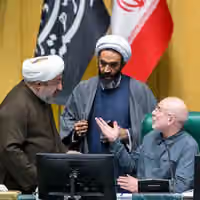
Rasaei said during an online parliamentary session on Sunday that Ghalibaf, former president Hassan Rouhani, President Masoud Pezeshkian and the Secretariat of the Supreme National Security Council had filed complaints against several lawmakers.
He said one of those complaints had resulted in a 10-month prison sentence against him. Rasaei described the ruling as “non-legal” and “political,” but said he would report to prison to serve the sentence.
Rasaei was elected third in Tehran in the parliamentary election three years ago, when around 80 percent of eligible voters in the capital boycotted the election.
He is the first sitting lawmaker to be sent to prison during his term in office.
The complaint dates to before Rasaei was elected to parliament and concerns a case brought by Ghalibaf against the weekly 9 Dey, where Rasaei was managing director. The complaint followed an article published in January 2024 under the headline “Ghalibaf’s Manipulation of Parliamentary Documents.”
The judiciary announced on Monday that Rasaei had appeared at Tehran’s Special Clerical Court and was sent to the clerics’ section of Evin Prison the same day to begin serving his sentence. According to the judiciary’s statement, Rasaei had more than 18 months to resolve the case by apologizing to Ghalibaf.
Rasaei’s positions are closely aligned with those of the Paydari Party and former nuclear negotiator Saeed Jalili.
Hardliners react to the sentence
Rasaei’s supporters have accused Ghalibaf of “silencing the voices of critics” and criticized him for pursuing the complaint against Rasaei rather than focusing on the country’s economic and security problems.
Figures associated with these groups and their media outlets also attacked Mohseni-Ejei. The criticism has spilled over into some recent nightly pro-government gatherings.
Mohammad-Manan Raeisi, a Qom lawmaker who headed Saeed Jalili’s presidential campaign in the city two years ago, sharply criticized Ghalibaf and other officials and warned of a possible popular backlash against them.
“I doubt that, under these circumstances, people will allow you to appear in any mosque, gathering, public square or religious ceremony, and you may face a popular backlash,” he wrote.
Meysam Nili, managing director of the Raja News website and a figure associated with the Paydari Party, accused the judiciary of injustice and political bias, claiming that a “coup” was being organized against media and political figures belonging to the faction.
Hardline social media user Mohsen Maghsoudi, referring to arguments in favour of negotiations with the United States, wrote: “When it is possible to negotiate with the killer of the martyred Imam (Ali Khamenei) in the national interests and still talk about negotiations despite receiving insult, humiliation and aggression, why can’t we, in order to preserve unity, drop a three-year-old complaint over the headline of a weekly newspaper so that a revolutionary representative does not go to prison and hundreds of thousands of people’s votes do not become ineffective for 10 months?”
Other conservatives push back
Other conservative figures have sharply criticized the controversy generated by Rasaei’s supporters and the hardline groups.
The IRGC-affiliated Tasnim news agency published an article headlined “On Mr Rasaei’s Strange Fallacies!” and described his objections to the ruling as “slander against a judicial ruling.”
Tasnim said Rasaei had effectively challenged the validity of the ruling by describing it as “strange” and “contrary to procedure,” while accusing the judiciary of political conduct by calling the ruling “political and non-legal.” The agency characterized his statements as criminal.
The Tabnak website published a video showing hardliners chanting in support of Rasaei and against Ghalibaf at one of the nightly gatherings. It called them “infiltrators” and said a small number of people were using the gatherings to “advance factional objectives.”
The conservative Khorasan newspaper said Rasaei’s refusal to apologize had led the court to conclude that he was not only unrepentant about the allegations he had made against Ghalibaf, but was also refusing to resolve the case and defying a judicial order.
Mojtaba Zarei, a member of parliament’s National Security and Foreign Policy Committee, wrote that turning a judicial case into a political and media confrontation during wartime would only deepen divisions among political forces.
Deepening confrontation
Hardliners have stepped up attacks in recent days against political rivals who support resolving the dispute with the United States through negotiations and returning to the Islamabad understanding.
They have gathered outside the home of former President Hassan Rouhani, whom they accuse of being subservient to the West, and called for him and his former foreign minister, Mohammad-Javad Zarif, to be prosecuted.
They also chanted against President Masoud Pezeshkian and called him an “infiltrator” as he returned from New York, where he attended the UN General Assembly. Hardliners have also registered an impeachment motion against Foreign Minister Abbas Araghchi over his meeting with Steve Witkoff, US President Donald Trump’s special envoy for Iran, and launched an online campaign calling for Pezeshkian’s removal.