Saudi, US foreign ministers discuss Hormuz security, Yemen

Saudi Foreign Minister Prince Faisal bin Farhan met US Secretary of State Marco Rubio in Washington on Monday to discuss security and freedom of navigation through the Strait of Hormuz.
The two discussed regional developments and Yemen and stressed the importance of maritime security and freedom of navigation through the Strait of Hormuz and Bab al-Mandab, the Saudi Foreign Ministry said in a post on X.
They also reaffirmed support for diplomatic efforts to address regional crises, according to the ministry.








Iran International has obtained exclusive information and documents indicating that Mostafa Ahadi, a senior official in the IRGC Intelligence Organization, runs the organization’s corruption network in the sale of Iran’s oil.
Over the past two months, Iran International has published three separate reports naming the trustees — oil brokers trusted by the Islamic Republic to sell Iran’s sanctioned oil — who have failed to return billions of dollars in oil proceeds to the country.
On September 28, Judiciary Chief Gholamhossein Mohseni-Ejei criticized delays in handling cases involving trustees with outstanding debts and called for swift rulings. Iran International has obtained a confidential Supreme National Security Council document in which the council’s deputy for economic affairs confirms that oversight bodies alter the trustees’ debt figures according to their own interests, inflating some debts and understating others.
The council’s deputy has asked the Ministry of Intelligence and the IRGC Intelligence Organization to report on the missing funds. The letter makes it easier for IRGC Intelligence, the principal organization implicated in the corruption surrounding oil sales, to gain access to the case.
Trustees’ case returns to IRGC Intelligence
Two informed sources in the Oil Ministry and an oversight body told Iran International that the Supreme Audit Court and the General Inspection Organization are currently pursuing the trustees’ cases. But through the maneuvering of a senior security official and an order from the Supreme National Security Council, the case has effectively returned to the IRGC Intelligence Organization.
That senior security official, whose photograph Iran International is publishing for the first time, is Mostafa Ahadi. He is now deputy head of Unit 600 of the IRGC Intelligence Organization, having previously served as its deputy for economic affairs. Through his positions in IRGC Intelligence and the Supreme National Security Council over the past decade, Ahadi has had a firm grip on Iran’s oil sales.
Several months ago, Brigadier General Mehdi Sayyari appointed Ahadi deputy head of Unit 600. Sayyari served for years as deputy head of the IRGC Intelligence Organization and became acting head of one of the country’s most important security organizations following the killing of Majid Khademi.
In the late 2010s, when responsibility for selling oil under sanctions was assigned to the Supreme National Security Council, Ahadi joined the council as deputy for economic affairs. Without his security background becoming known to international organizations, he attended two BRICS summits, in Russia and Brazil.
His involvement in Iran’s oil trade is so extensive that he even accompanies Oil Ministry officials on visits to oil terminals on Kharg Island.
While serving on the Supreme National Security Council, Ahadi sent his former deputy, Mohammad Javad Bavand, to the council’s cover committee as a representative of IRGC Intelligence, ostensibly to oversee sanctioned oil sales. His principal responsibility, however, was to secure profits from corruption in the oil trade for the IRGC Intelligence network.
Bavand, who served as a special assistant to the oil minister for oil sales during Ebrahim Raisi’s administration, returned to the role about four months ago. According to a General Inspection Organization document first published by Iran International, he assigned the sale of a large 86-million-barrel oil consignment to four trustees with outstanding debts, including Mohammad Hadi Momenin.
Bavand’s close ties to Mohammad Hadi Momenin
Iran International has obtained exclusive information indicating that the relationship between the two extends well beyond this corruption case.
A General Inspection Organization document published by Iran International revealed that the sale of 86 million barrels of Iran’s oil had been assigned to four trustees with outstanding debts.
Six years ago, Mohammad Hadi Momenin was arrested on suspicion of disrupting the foreign exchange system. He had received hundreds of millions of dollars in preferential foreign currency to import machinery for the paper industry and had failed to return the funds. At the time, Mohammad Javad Bavand used his influence to have the case closed. Momenin, who was a shareholder in Mahan Industries and Mines Development Holding, then appointed Bavand to a management position as his representative. Gardeshgari Bank is the holding company’s principal shareholder.
On Monday, September 28, Hadi Ghavami, the parliamentary representative for Esfarayen, told a plenary session: “The trustees who took oil out of the country also stole $300 million, equivalent to 69 trillion tomans, from Gardeshgari Bank, and under these circumstances, the Central Bank has given them a credit line with a 45 percent penalty.”
In June 2020, Momenin was arrested again on allegations of financial corruption and disrupting the foreign exchange system, but his case was once more closed with Bavand’s help. An investigator’s report quoted Momenin as saying that he had used his employees to register numerous shell companies in China, Taiwan, Singapore and the United Arab Emirates. The companies existed for between three and 14 months.
Another part of the case revealed that Momenin’s holding company had received large loans from Mellat Bank, Refah Bank, Karafarin Bank, Bank of Industry and Mine, Saman Bank and Middle East Bank, yet none of the banks had filed a complaint against him.
In July, the Central Bank published a list of major bank debtors showing that Mohammad Hadi Momenin owed Karafarin Bank 743 billion tomans.
Two informed sources in the Oil Ministry and an oversight body told Iran International that Ahmad Baharvandi, who became Karafarin Bank’s chief executive five years ago, was in fact an associate of Bavand within IRGC Intelligence. Both men studied at Imam Sadiq University. Mostafa Ahadi also studied there and was a member of the university’s student Basij organization.
At Bavand’s request, Baharvandi did not pursue Momenin’s 743-billion-toman debt. In turn, Momenin took Bavand on a trip to China.
Mohammad Hadi Momenin was a member of the Ministry of Intelligence’s oil sales corruption network known as Shayan, which failed to return $2 billion in oil proceeds.
Secret IRGC meeting held to counter reporting on trustee corruption
After Bavand returned to the Oil Ministry, Momenin became his trusted trustee for oil sales despite a warning from the General Inspection Organization. Over the past month, following the publication of investigative reports, Momenin and Bavand have found themselves back in the headlines against their wishes.
Mostafa Ahadi, the godfather of the IRGC Intelligence corruption network, used his new position to address the problem. Two informed sources in the Oil Ministry and an oversight body told Iran International that a secret meeting was held two weeks ago at the IRGC’s media headquarters. Those present included Abdullah Zeighami, also known as Brigadier General Moshfegh, Bavand and Ahadi.
The meeting’s objective was to prevent media coverage of trustee corruption. One result was the removal of reports about the scandal from Mehr News Agency, which is affiliated with the Islamic Propagation Organization, and Hamshahri, a newspaper owned by Tehran Municipality.
At the same time, Ahadi used the Supreme National Security Council to return responsibility for the trustees’ cases to IRGC Intelligence so that the security organization’s cycle of profits from oil sales would continue.
Iran’s rapidly narrowing international air connections are forcing travelers onto longer and costlier routes while adding friction with neighboring states, as Tehran pressures regional governments over flight restrictions.
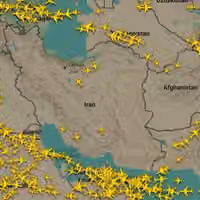
Flight-monitoring data from Flightradar24 indicate that US aviation sanctions have reduced Iran’s international flights by about half in one week. Almost all of Iran’s international flights over the past month have been operated by Iranian airlines, as foreign carriers have largely stopped flying to the country.
The latest restrictions reach beyond Iranian airlines themselves. Airports, fuel suppliers, ground handlers, ticket sellers and other companies providing services to sanctioned carriers can risk US penalties, giving businesses in third countries an incentive to stop handling Iranian flights.
Iranian-operated flights to the United Arab Emirates, Oman, Georgia and Azerbaijan have been suspended or sharply restricted, while Iranian carriers remain barred from Iraqi airports despite a limited resumption of services by Iraq’s national airline. Flights to China and Russia continue, while services to several other destinations, including Turkey and Afghanistan, have remained available.
For passengers trying to reach countries no longer served directly, that increasingly means flying through cities such as Istanbul, Islamabad, Kabul, Beijing, Dushanbe, Yerevan or Moscow before continuing to their destinations.
The detours can add hours or even days to journeys and substantially increase costs.
Turkey has become one of the most important remaining gateways. Iran Air flights between Tehran and Istanbul were still operating Monday, according to flight-tracking data, although Mahan Air has already suspended its Turkey services and Turkish Airlines has no Iran flights scheduled before March 2027.
Turkey Today reported Monday, citing two sources, that the remaining Iranian flights to Turkey were expected to be suspended in early October. No formal announcement of a complete suspension has yet been made.
Longer routes, higher costs
Mahan, a 42-year-old Iranian who has lived and worked in the United Arab Emirates for years and regularly travels to Tehran to visit her elderly mother, said her latest return journey to Dubai showed how quickly the restrictions were changing ordinary travel.
With direct options unavailable, she flew from Iran to Armenia on Sunday, spent the night at a hotel in Yerevan and continued to Dubai the following day.
Including the hotel and transportation in Armenia, she said the journey cost almost three times what she previously paid to travel between Iran and the UAE.
The trip was also more stressful, she said, because the hotel arranged for her was a considerable distance from the airport.
Other passengers she encountered had taken an even more difficult route. They told her they had traveled overland from Iran to the Armenian border and then continued roughly 400 kilometers by bus to Yerevan.
They described carrying luggage through crowded border areas and struggling to find transportation for the long journey from the crossing to the Armenian capital.
Najaf becomes test case
Iraq has emerged as one of the clearest examples of the complications created by Washington’s aviation pressure because of the volume of religious and family travel between the two countries.
Baghdad airport stopped accepting flights operated by Iranian airlines on September 22. Iranian aviation authorities initially sought to redirect some Baghdad-bound services to Najaf, one of Shiite Islam’s most important pilgrimage centers.
Najaf airport then suspended all flights to and from Iran on September 25, cutting off the alternative route and affecting large numbers of Iranian pilgrims traveling to Najaf and nearby Karbala.
The Iraqi government subsequently opened direct talks with Washington for exemptions from US Treasury measures. Prime Minister Ali al-Zaidi’s office said it was seeking exemptions allowing travel for medical treatment, education, religious visits and other civilian purposes.
Reuters reported Monday that the Trump administration was preparing a one-month waiver allowing Iraqi Airways to carry Shia pilgrims between Najaf and Iran, with a more permanent exemption potentially following. The proposed waiver applies specifically to the Iraqi national carrier.
Iraq’s state news agency later reported that Iraqi Airways had resumed flights between Najaf and Iranian airports.
Iran, however, disputed reports that Iran-Najaf flights had broadly resumed. Civil Aviation Organization spokesman Majid Akhavan said Tehran had received no official communication authorizing a resumption and said Iranian airlines remained unable to restart the route.
The two accounts refer to different operators: the Iraqi announcement concerned Iraqi Airways, while the Iranian statement addressed the ability of Iranian carriers to return to Najaf. Iraqi media also reported Monday that the ban on Iranian airlines remained in force even as Iraqi Airways resumed flights to Iranian airports.
The distinction gives Baghdad a way to restore at least some pilgrimage traffic without immediately reopening its airports to sanctioned Iranian carriers.
The disruption had already created political pressure in Iraq. Demonstrations were held in Baghdad and Najaf against the suspension, while Iranian officials warned that restrictions on air links could affect the broader relationship between the two neighbors.
Alaeddin Boroujerdi, a member of Iran’s parliamentary National Security Committee, pointed to Iraq’s reliance on Iranian electricity and gas and warned that policies obstructing bilateral ties could have consequences in other areas.
Iranian website Rouydad24 described the flight dispute as a test of relations between Tehran and Baghdad, noting Iran’s role in Iraq’s energy supplies and its past support in the fight against Islamic State.
Tehran warns its neighbors
The aviation restrictions have also produced increasingly sharp warnings from Iranian political figures toward governments cooperating with Washington.
Mohsen Rezaei, secretary of Iran’s Supreme National Security Council, warned regional countries last week that if Iranian aircraft were prevented from flying, airports elsewhere in the region could also be unable to operate.
The council’s secretariat later sought to distance itself from interpretations that Iran was threatening military attacks on regional airports, saying military retaliation over the flight restrictions was not on the agenda.
Mohammad Mokhber, an adviser to Supreme Leader Mojtaba Khamenei, nevertheless issued a separate warning Friday.
“Alignment with America in implementing hostile policies will remain in the memory of the Iranian people,” Mokhber wrote on X.
“Flights in the region are either free for everyone or for no one,” he added. “If Iran cannot fly or receive airport services, no country in the region will have this possibility either.”
The remarks prompted support from some hardline social-media users, including calls for Tehran to impose a no-fly zone over the Persian Gulf or threaten airlines serving neighboring countries.
Others criticized the approach. Amir Abbasi, an X user, compared the aviation warnings with previous Iranian threats to prevent other countries from exporting oil if Tehran was unable to do so.
“Perhaps these threats have a domestic use, but a crisis cannot be solved with slogans,” he wrote.
Hardline Iranian lawmaker Hamid Rasaei was transferred to Evin Prison on Sunday to begin a 10-month sentence stemming from a complaint by Parliament Speaker Mohammad Bagher Ghalibaf, Iran’s judiciary said Monday.
Mizan, the judiciary’s news agency, said a final ruling by the Special Court of Clergy’s appeals court convicted Rasaei of “publishing falsehoods with intent to harm others.” He was transferred on September 27 to Evin’s ward for clerics to serve the sentence, Mizan said.
The case dates to early 2024, when Rasaei was not an MP but editor-in-chief of the hardline weekly 9 Dey. Parliament’s legal representative referred a complaint to prosecutors on February 3, 2024, over an article alleging “manipulation by Ghalibaf in parliamentary documents.”
The case also involved a video posted on Rasaei’s Telegram channel in which he described Ghalibaf as a “parliamentary dictator.” Rasaei was acquitted over that remark but convicted over the allegation concerning parliamentary documents.
Rasaei said the headline was based on remarks by another lawmaker, but the court rejected that defense, ruling that the alleged manipulation of parliamentary documents had not been established.
The court also ordered Rasaei to publish a correction on the front page of 9 Dey using the same typeface and headline size, although the weekly has not been published for the past two years.
Fars reported that Rasaei was asked during the proceedings to apologize over the article but refused, saying he saw no reason to apologize and stood by his position.
Rasaei called the ruling “non-legal and political” in parliament but said he would comply because it was a legal judgment. He also argued that the 10-month term was excessive, saying a first-time offender convicted of publishing falsehoods should have received the minimum sentence of 91 days.
Because Rasaei is a cleric, the case was handled by the Special Prosecutor’s Office for Clergy and later the Special Court of Clergy.
Rasaei, now a Tehran lawmaker, has long been identified with the Islamic Republic’s ultraconservative wing and was formerly a member of the Paydari Front. He has said he left the party more than a decade ago because of disagreements with members of its central council, while acknowledging continued ideological closeness to it.
His conflict with Ghalibaf reflects a broader struggle within Iran’s conservative establishment. Rasaei and other ultraconservative lawmakers have repeatedly challenged Ghalibaf over his control of parliament and his role in negotiations with Washington, accusing him of crossing leadership red lines and making excessive concessions.
That confrontation intensified after Iran’s agreement with the United States. Rasaei accused Ghalibaf of backing an arrangement that prevented Tehran from retaliating for the killing of Ali Khamenei and said the deal could pave the way for a “bloodless coup.” Other Paydari-aligned and ultraconservative lawmakers have mounted similar attacks on the speaker.
Rasaei has simultaneously been a persistent opponent of President Masoud Pezeshkian and Iran’s reformist factions. He has attacked Pezeshkian over negotiations with the United States, questioned his political fitness and previously compared him to Abolhassan Banisadr, Iran’s first president, who was removed from office by parliament in 1981.
His politics therefore place him in conflict both with reformists and with more negotiation-minded conservative rivals such as Ghalibaf, highlighting divisions within the establishment over diplomacy with Washington, the use of military leverage and control of parliament.
Iranian reformists are helping sustain Washington’s pressure campaign by signaling that sanctions and other coercive measures are pushing Tehran toward negotiations and concessions, the IRGC-affiliated Fars news agency argued Monday.
In a commentary titled Reformists' Game in Trump's Sanctions Pressure Puzzle, Fars said Washington looks for political and social effects inside Iran whenever it applies economic, military or diplomatic pressure, and accused reformists of providing precisely the response US policymakers hope to see.
It argued that calls for negotiations under pressure, suggestions that Iran should suspend nuclear activities, support for what some reformists have termed an “honorable peace,” and doubts about the usefulness of measures such as closing the Strait of Hormuz all send Washington the message that pressure is working.
“When the other side sees that external pressure is also turning into a domestic political demand for retreat and concessions, it naturally has greater motivation to maintain and even intensify that pressure,” the commentary said.
Fars drew a distinction between the military and economic fronts, arguing that direct US military action had encountered Iranian resistance and failed to achieve its objectives, while Washington continued to see sanctions and economic pressure as effective because their impact was quickly reflected in domestic calls for compromise.
The outlet said this created a cycle in which each new US measure was reinforced by political arguments inside Iran that the country had little choice but to negotiate or relinquish some of its leverage. Iranian society and the economy ultimately bear the cost of that cycle, it said.
Fars also accused reformists of constructing a “false dichotomy” between war and peace by presenting themselves as supporters of negotiations while portraying their opponents as advocates of violent confrontation. It argued that negotiations were only one tool of foreign policy and invoked the establishment's longstanding formulation that diplomacy and the “field” — a term commonly used for military and regional power — should complement one another.
The commentary comes amid an increasingly public dispute over the scope of negotiations with Washington.
IRGC-affiliated outlets and hardline lawmakers have criticized Foreign Minister Abbas Araghchi's contact with US envoy Steve Witkoff in New York, questioning whether he was authorized to hold direct discussions.
At the same time, Major General Yahya Rahim Safavi, a military adviser to Iran's supreme leader, has said the government has been given room to pursue negotiations.
The dispute therefore extends beyond whether Tehran should negotiate at all, focusing increasingly on how talks should be conducted, what concessions Iran can offer and whether military, nuclear and maritime leverage should be maintained alongside diplomacy.
Iran’s rial fell to another record low on Monday, with the dollar reaching 2.45 million rials as economic and military pressures persisted and efforts took shape for possible new indirect talks with the United States.
Mediators are expected to hold separate talks with the United States and Iran on Monday or Tuesday over an amended version of a seven-day proposal Tehran presented on the sidelines of the UN General Assembly, sources briefed on the negotiations told Reuters.
Iranian Foreign Minister Abbas Araghchi and Qatari mediators remained in the United States for the discussions, an official briefed on the negotiations said.
The diplomatic effort comes with divisions visible inside Iran over negotiations and the country’s nuclear policy, while military officials continue to warn about another confrontation with Washington.
Diplomacy meets resistance at home
A group of serving and former Iranian officials called Monday for an immediate halt to cooperation under the Nuclear Non-Proliferation Treaty and withdrawal from the pact “as soon as possible.”
“Continued membership in this treaty is not in the country’s interest, and we call for withdrawal from it as a strategic necessity,” the signatories said.
Former intelligence minister Heydar Moslehi and other former officials from the administrations of Ebrahim Raisi and Mahmoud Ahmadinejad signed the statement alongside serving lawmakers.
Hardline newspaper Kayhan also criticized Iran’s diplomatic approach, saying officials had shown excessive enthusiasm for negotiations during President Masoud Pezeshkian’s visit to New York and sent Washington “a signal of weakness.”
Supreme Leader Mojtaba Khamenei, meanwhile, emphasized Iran’s military position, describing the country as the “world’s top power” according to what he called “divine calculations” and saying enemy forces had been pushed back from waters near Iran.
Military pressure centers on Hormuz
Iranian officials continued to point to the Strait of Hormuz in their warnings to Washington.
“We are acting with authority in the northern Arabian Sea and east of the Strait of Hormuz, and we will not let anyone pass. On the other side, our IRGC brothers are also standing firm,” army deputy coordinator Habibollah Sayyari said.
Lawmaker Salar Velayatmadar said Iran could close the Strait of Hormuz and Bab al-Mandab if the United States launched another attack.
Rial falls under trade and oil pressure
The economic backdrop to the negotiations has also deteriorated, with the US dollar listed at 2.45 million rials on Iran’s open market Monday.
Iranian businesses are facing higher costs in trade with neighboring Iraq as banks tighten checks and anti-money-laundering requirements, head of the Iran-Iraq Joint Chamber of Commerce, said.
The main danger was not a complete halt in trade but a gradual loss of Iran’s share of the Iraqi market, Jahangbakhsh Sanjabi Shirazi, said.
Washington is also seeking to restrict Iran’s oil income more. Iran could have “nothing left to trade for anything” within two weeks after completing its remaining oil deliveries to China, US Treasury Secretary Scott Bessent said Sunday.
About 15 million barrels remained out for delivery, Bessent estimated.
Pressure on Iranian financial operations extends into Europe. Italy’s central bank told Iran International on Monday that the Rome branch of Iran’s Bank Sepah has remained under special administration since October 2025 following the European Union’s adoption of restrictive measures against Iran.
The weakening rial and growing obstacles to trade are adding to Iran’s economic pressure, while warnings over Hormuz and recent military exchanges keep the risk of renewed conflict hanging over the country and the region.