• العربية
  • فارسی
Brand
  • Iran Insight
  • Politics
  • Economy
  • Analysis
  • Special Report
  • Opinion
  • Podcast
  • Live TV
  • Iran Insight
  • Politics
  • Economy
  • Analysis
  • Special Report
  • Opinion
  • Podcast
  • Live TV
  • Theme
  • Language
    • العربية
    • فارسی
  • Iran Insight
  • Politics
  • Economy
  • Analysis
  • Special Report
  • Opinion
  • Podcast
  • Live TV
All rights reserved for Volant Media UK Limited
volant media logo

Bessent thanks Iran’s neighbors for helping US pressure campaign

Sep 27, 2026, 02:14 GMT+1

US Treasury Secretary Scott Bessent thanked Turkey, Oman and the United Arab Emirates, as well as the UK, for taking steps to restrict Iranian banking and aviation links, saying Washington’s economic pressure campaign was “delivering results.”

Bessent said the measures followed the launch of Operation Economic Outcast, under which the Treasury imposed sanctions targeting Iran’s financial and aviation sectors and dispatched teams to press other countries to take action.

He said Turkey and Oman had stopped Mahan Air flights, while the UAE had halted flights by Iranian airlines. The UAE confirmed this week that it had suspended Iranian airline flights, citing US sanctions.

Most Viewed

Iran rules out nuclear concessions even if US accepts Hormuz proposal
1

Iran rules out nuclear concessions even if US accepts Hormuz proposal

2
ANALYSIS

US and Iran want a deal, but neither wants to move first

3
INSIGHT

Pezeshkian’s Fox News nuclear overture draws hardline backlash

4
OPINION

Iran’s oil industry has too many masters

5
PODCAST

Trump may be buying time on Iran until after the midterms

Banner
Banner

Spotlight

  • Iran’s oil industry has too many masters
    OPINION

    Iran’s oil industry has too many masters

  • Iran wrong to expect midterms to restrain Trump, former US official says

    Iran wrong to expect midterms to restrain Trump, former US official says

  • Trump may be buying time on Iran until after the midterms
    PODCAST

    Trump may be buying time on Iran until after the midterms

  • Pezeshkian’s Fox News nuclear overture draws hardline backlash
    INSIGHT

    Pezeshkian’s Fox News nuclear overture draws hardline backlash

  • US and Iran want a deal, but neither wants to move first
    ANALYSIS

    US and Iran want a deal, but neither wants to move first

  • Rushdie returns to the fatwa that nearly cost him his life

    Rushdie returns to the fatwa that nearly cost him his life

Banner
Banner
•
•
•

More Stories

Iran’s oil industry has too many masters

Sep 27, 2026, 00:36 GMT+1
•
Mehdi Moslehi
100%
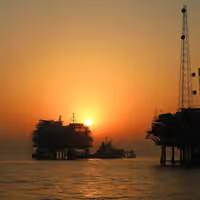
The P4 offshore platform at Iran’s Reshadat oil field in the Persian Gulf, June 2026

The problem facing Iran’s oil industry is not just sanctions or a shortage of investment. It is a question of governance: who makes decisions, who signs contracts, who receives the money and, ultimately, who is accountable?

Iran’s oil industry is more than a collection of wells, pipelines and refineries. What turns those assets into an industry is an integrated chain of reservoir expertise, production planning, engineering, safety, financing, sales and accountability.

That chain has been badly fragmented. In the past two decades, especially under President Mahmoud Ahmadinejad, projects have been handed to military institutions, shares and assets transferred to pension funds and quasi-state bodies, and even oil cargoes used to cover budget shortfalls in organizations outside the Oil Ministry.

Unless a future Iran addresses that fragmentation, billions of dollars in investment and the most advanced technology could simply reproduce the old disorder on a larger scale.

From privatization to quasi-state ownership

The Ahmadinejad government accelerated the sale of state assets in the name of privatization, but much of the process did not produce an independent private sector.

Academic Kevan Harris has described the process as a form of pseudo-privatization: assets and privileges moved from one part of the state to pension funds, foundations, affiliated companies and military institutions without producing genuinely competitive markets, transparent ownership or public accountability.

In oil and gas, the Oil Ministry and its subsidiaries lost some of their practical authority over contractors, projects, procurement and, at times, the sale of oil.

One of the starkest examples was the decision to give oil cargoes to Iran’s police force to sell. Esmail Ahmadi-Moghaddam, then commander of Iran’s police, acknowledged in 2014 that during Ahmadinejad’s presidency the force had been given two oil cargoes to sell, with some of the proceeds intended to cover a salary shortfall.

The budgets of the police, ministries or pension funds should be recorded in the state budget and paid through the treasury, not financed by giving individual institutions a company, refinery, oilfield or oil cargo. Such arrangements erase the boundaries between owner, policymaker, client, contractor and seller.

Khatam al-Anbiya: one name, a network of interests

Khatam al-Anbiya Construction Headquarters is the economic and engineering arm of the Islamic Revolutionary Guard Corps, but it should not be understood as a conventional, integrated company.

It serves as an umbrella over numerous holdings, affiliated companies and subcontractors. Reuters reported in 2015 on the extensive network of companies linked to the IRGC and the difficulty of identifying their ultimate owners. A “contract with Khatam,” therefore, did not necessarily mean a clear chain of command, auditing and responsibility.

Under Ahmadinejad, the network received major contracts without effective competition. In 2011, Reuters reported that two pipeline contracts, each worth $1.3 billion, had been awarded to Khatam. Development of phases 15 and 16 of the South Pars gas field had also been awarded to the organization.

The result was multiple centers of power, allowing projects to be divided among different entities and responsibility to become diluted along the chain.

The consequences were technical as well as financial. Oil production requires reservoir engineers, drilling specialists, safety personnel and procurement departments to work under common standards and a coherent system.

Fragmenting projects among institutions with different missions and unclear accountability also fragments expertise and decision-making.

‘One sheikh in Bahrain, forty sheikhs in Iran’

I saw something of this problem during my own time working for Shell in the Netherlands.

I once asked the Dutch manager responsible for Iran why Shell had ended its activities in the country. I remember the essence of his answer like this: “We went to Bahrain because there we dealt with one sheikh; in Iran, we had to deal with forty sheikhs.”

Khatam might formally be the contracting party on a project, he explained, but another unit within the same network could then say it was responsible for security along part of the pipeline and demand a separate payment.

His point, as I understood it, was that instead of one accountable client, a foreign company could find itself dealing with multiple centers making separate demands for payment.

This is my recollection of an unrecorded conversation, not documentary evidence explaining Shell’s departure from Iran. The public record points principally to sanctions and political pressure: Reuters reported in 2008 that Shell withdrew from a planned Iranian gas project amid US pressure.

But sanctions and domestic disorder are not mutually exclusive explanations. Sanctions raised the cost of entering Iran; multiple centers of power raised the cost of staying.

The conversation illustrated the problem: when the contractual counterparty is known but the number of parties making demands is not, neither the true cost of a project nor responsibility for it can easily be calculated.

The Baku lesson

Another experience may offer a useful lesson for Iran’s future.

While working for BP, I travelled to Baku on a short assignment concerning contractor-selection models. An Azerbaijani colleague described how the country had used foreign partnerships after the collapse of the Soviet Union to modernize technology and develop its domestic workforce.

Azerbaijan did not hand its oil industry to BP. Under a production-sharing agreement signed in 1994, BP became operator of the Azeri, Chirag and deepwater Gunashli fields, while Azerbaijan’s state oil company SOCAR remained the principal domestic partner.

More important for Iran was the emphasis on local capacity. Training technicians, developing local suppliers and progressively replacing foreign personnel with Azerbaijani workers became part of the project. BP says it now directly employs around 2,380 Azerbaijani citizens, while Azerbaijanis have made up around 90% of its professional workforce in the country.

The lesson is not that Iran should hand management of its oil industry to BP. It is that an international operator can be selected for a particular project, targets set for training and localization, and domestic personnel left with greater technological knowledge and experience.

An architecture for Iran’s oil industry

Rebuilding Iran’s oil industry should begin with rebuilding its institutions, not redistributing the spoils.

Oil and gas should remain public assets. Parliament should establish the legal and financial framework, the government determine energy policy, and an independent professional regulator oversee licensing, safety, reservoir protection and environmental standards.

The referee must also be separated from the player. The National Iranian Oil Company should operate as a commercial and technical enterprise rather than simultaneously acting as regulator, client, partner, supervisor and arbiter of disputes.

Military and non-specialist institutions should gradually be removed from the industry. The process should be legal, audited and phased so existing projects are not abandoned.

Specific fields, refineries and infrastructure projects could instead be offered through transparent international tenders. Foreign companies could compete to operate or participate in individual projects, but no company or country should acquire a monopoly over the industry.

Contracts should be time-limited and contain measurable requirements for costs, production, environmental standards, Iranian employment and technology transfer, with extensions dependent on independent assessments rather than political connections.

Contracts, ownership, payments, costs, production and project revenues should generally be public, with auditing independent of the Oil Ministry, NIOC and contractors.

Contracts, ownership, payments, costs, production and project revenues should generally be public, with auditing independent of the Oil Ministry, NIOC and contractors.

Iran will also have to reassemble its human capital. Specialists inside the country, Iranian oil professionals abroad and a younger generation of engineers should be connected through a national program of training and succession. Foreign contractors should be required to build Iranian counterpart teams, not foreign islands inside the industry.

Rebuilding trust

Iran will need foreign investment and technology to restore production and modernize its refineries. But the need for capital should not be confused with surrendering sovereignty.

A homeowner can hire international architects and contractors without handing them ownership of the house. A future Iranian government can similarly benefit from competition among foreign companies while keeping ownership of resources, policymaking and ultimate authority in Iranian hands.

Iran’s oil can become a national asset again only when every contract has an accountable party, every project an auditable account and every decision a clearly defined legal authority.

The answer to the problem of “forty sheikhs” is not to create a new sheikh, Iranian or foreign. It is to build a single, transparent and professional system in which no commander, foundation, ministry or foreign company stands above the law.

Iran wrong to expect midterms to restrain Trump, former US official says

Sep 26, 2026, 19:20 GMT+1
•
Kambiz Tavana
100%
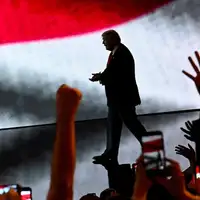
President Trump at the Republican National Midterm Convention in Dallas, September 10, 2026.

Tehran is making a “total miscalculation” if it believes the US midterm elections will constrain President Donald Trump’s actions against Iran, former senior US official Morgan Ortagus told Iran International.

Ortagus pointed to Trump’s first term, when Democrats took control of the House in the 2018 midterms but his administration continued its “maximum pressure” campaign against Tehran and ordered the 2020 killing of Qasem Soleimani.

“Any fallacy that they have that President Trump is going to limit his decision-making authority… based off a change in the Congress is a miscalculation by a regime who still fundamentally does not understand this president.”

Congressional debate over war powers was “healthy for our democracy,” Ortagus said, but did not change the president’s authority “to take any action against Iran that he deems necessary for the safety and the security of the American people.”

Ortagus, who held senior roles in both Trump administrations, said the United States has been in a conflict with the Islamic Republic “not for seven months, but for 47 years,” and argued that economic pressure alone would not have prevented the current military confrontation.

She described Trump’s first-term maximum pressure campaign as “incredibly effective,” but said it was interrupted during Joe Biden’s presidency and has amounted to less than four years in total.

“Sanctions are not a silver bullet,” she said. “Sanctions are a tactic. They’re a way in which you pursue a larger strategy.”

That strategy, she said, should prevent Iran from obtaining a nuclear weapon, cut funding to its proxy groups and stop Tehran from becoming “the next North Korea,” with missiles capable of threatening US bases, regional states and the American homeland.

Ortagus said Trump ordered military action beginning in June last year because Iran was “intransigent” in negotiations and “weeks away from getting a nuclear weapon.” The president had given Tehran a deadline, she said, and Iranian leaders may have believed he was bluffing.

“They learned pretty quickly that he wasn’t.”

Asked whether the campaign would have happened without a closely aligned Israeli government, Ortagus said it would have. Israeli operations had “complemented” US action, she said, but “these have been American decisions and American decisions alone.”

She cited Trump’s decision to order the killing of Soleimani in 2020 as an example of an action he took “by himself.”

On diplomacy, Ortagus said Trump had “always… extended the hand of diplomacy” during both administrations.

“It’s the regime that keeps rejecting that hand.”

She was skeptical that an agreement signed with Iranian officials in New York would hold if the real decision-makers remained in Tehran, echoing Secretary of State Marco Rubio’s doubts about the authority of Iran’s UN delegation.

100%
Former senior US official Morgan Ortagus in an interview with Iran International's Kambiz Tavana in Washington DC on September 24, 2026.

“What you have to do is to make the thugs in the IRGC understand that everything, their livelihoods, everything that they possess, is going to be put at risk,” Ortagus said.

Trust was not the issue, she added. The question was what mechanisms Washington would establish “so they know… if you backtrack on this, there actually will be a consequence.”

She said she did not see how any future arrangement could work “without some sort of American verification process.”

Hezbollah and Lebanon

Ortagus rejected the argument that Hezbollah should be accepted as part of Lebanon’s social and political fabric.

“Bullshit,” she said.

She said the group was led by the Islamic Revolutionary Guard Corps, had been “indoctrinated, trained, equipped and brainwashed” by Tehran and had dragged Lebanon into “perpetual war,” with Shia communities among the main victims.

President Joseph Aoun and Prime Minister Nawaf Salam had been “very clear,” she said, that Hezbollah must be disarmed and that Lebanon cannot have “a parallel state within a state.”

Dismantling that structure would take time, Ortagus added.

“It wasn’t created overnight, and it won’t be expunged overnight.”

Ortagus said the Abraham Accords had endured the turmoil since October 7, pointing to a meeting of Accords countries on the sidelines of the UN General Assembly this week.

By contrast, she said a Mecca-centered regional alignment “looks pretty weak right now,” after Houthi attacks on Saudi Arabia, including toward holy sites, drew no meaningful response from its signatories.

“Anybody who does that and says they speak in the name of Islam are the worst hypocrites imaginable,” she said.

She declined to discuss current private exchanges between Riyadh and Washington but warned against seeking security through accommodation with Tehran.

“Pacifying this regime is not going to protect you in the long run,” she said. “It will buy you time. It might be a temporary salve, but it won’t heal the wound.”

Ortagus also described the current blockade of Iran as a harder form of enforcement than previous sanctions.

“Nothing’s coming in, and nothing’s going out.”

Asked about the broader US endgame, she listed four goals: preventing Iran from obtaining a nuclear weapon; curbing its ballistic missiles, drones and conventional arms; cutting funding to proxy groups; and supporting the Iranian people.

A final conversation about Iran

Ortagus closed the interview by recounting an unpublished story about the late Senator Lindsey Graham.

In January, she said, she had “Make Iran Great Again” hats overnighted to Graham at Mar-a-Lago so he could give one to Trump on the golf course.

She said she spoke to Graham an hour or two before his death, and that their last conversation was about Iran.

“He never stopped believing in the people of Iran,” she said.

Iran upholds death sentence for Red Crescent worker after coerced confession

Sep 26, 2026, 11:21 GMT+1
•
Pooya Jahandar
100%
Mozhdeh Hashemi Bazargani

Iran's Supreme Court has upheld the death sentence of Mozhdeh Hashemi Bazargani, a 27-year-old Red Crescent worker who said in a recording from Qazvin prison that interrogators beat her until her teeth broke and made her sign a confession, a source told Iran International.

Hashemi Bazargani was denied a lawyer of her own choosing throughout the proceedings, the source said. She is held in Qazvin Central Prison, in the city 150 kilometers west of Tehran, and is accused of sending the location of a military site to "the enemy," a charge she has denied.

In an audio message from prison earlier this year, she said security agents raided her home at 2:30 in the morning on April 4, cutting through the door with a metal grinder. She had been living with her elderly, ailing mother.

After her arrest, she said, she was beaten with a pipe and a baton on the head, neck and shoulders during long interrogations, breaking two teeth and leaving her with dizziness, shortness of breath and heart problems. No doctor came to examine her despite visible bruising and injuries, and her requests to be taken to the coroner's office to document the beating went unanswered.

Interrogators pressed her to confess, she said. "They pin a thousand charges on me. They force me: whatever we tell you, you have to write it down and sign it."

She said they beat her while she was blindfolded and cut her interrogation answers into a video presenting her as a terrorist. The charges put to her included espionage and receiving money from abroad. The confession footage was broadcast on Qazvin's provincial state television channel.

She also rejected the accusation of taking any money.

Her physical and mental condition is poor, the source told Iran International. Under the pressure of detention she has suffered seizures and lost consciousness several times, and was hospitalized before being returned to prison after a partial recovery.

In her message she also spoke of her mother in the town of Alvand, near Qazvin, who she said had been left with no one to care for her.

Iran's judiciary has issued sentences ranging from long prison terms to death against dozens of people this year on charges of espionage, sending information abroad or contact with hostile states, many of them arrested after the January protests.

Confessions broadcast on state television have repeatedly been described by defendants and their families as obtained under torture, and Revolutionary Court trials in such cases are closed to public scrutiny of the evidence.

Prosecutors target Tehran play over scene between male and female actors

Sep 26, 2026, 10:18 GMT+1
100%

Tehran prosecutors have opened a criminal case against a theater company after a spectator's phone video showed an actress resting her head against an actor's chest on stage, in a scene the production says depicts a brother and sister.

Mizan, the judiciary's news agency, said prosecutors acted over what it called behavior that violated social norms and standards of propriety during Tehran Paris Tehran / Bridge, staged at Tehran's Book Garden, a cultural complex in the north of the city.

The play is directed by Saeed Dashti and written by Sina Shafiei and stars Fatemeh Masoudifar, Mehrdad Sedighian, Amir Jafari and Sina Saei.

The scene

The footage shows Masoudifar leaning her head toward Sedighian's chest as he appears to touch her head. Physical contact between unrelated men and women in public is policed in the Islamic Republic under religious rules the state enforces, and the stage has not been exempt.

Fars News Agency, affiliated with the Revolutionary Guards, criticized the scene and said the larger problem was what it described as the gradual erosion of the boundaries governing artistic freedom and public conduct.

"It seems there is no supervision over theater stages," Fars wrote.

100%

Production blames camera angle

The company said on Saturday the controversy rested on a "misunderstanding" and that the video did not show the true distance between the actors.

The images were filmed at a tight angle on a spectator's phone, it said, which created a misleading impression. It added that it had changed the actors' positions on stage to avoid further misunderstanding.

The two characters in the scene are brother and sister, the production said, and the contact comes at a moment of crisis in the story.

Other artists face legal action

The case comes amid other recent judicial measures involving artists and public events over compliance with the Islamic Republic’s social and religious restrictions.

An appeals court in Qom on Friday upheld sentences against singer Parastoo Ahmadi and seven musicians and others involved in the “Caravanserai Concert.” Each was sentenced to 74 lashes, a two-year ban on audiovisual and musical activity and a two-year travel ban.

The case stemmed from a concert filmed at the historic caravanserai in Qom in December 2024 and later posted on YouTube. Ahmadi performed without the mandatory hijab alongside male musicians. The lower court said the performance and its online publication had violated public morality and religious and legal norms. The appeals court rejected the defendants’ challenge and made the ruling final.

Trump may be buying time on Iran until after the midterms

Sep 26, 2026, 03:24 GMT+1
•
Negar Mojtahedi
100%
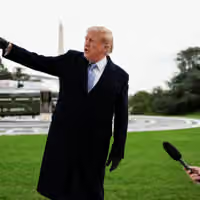
US President Donald Trump speaks to reporters in front of the Marine One

President Donald Trump may be putting off a difficult choice over Iran until after the US midterm elections, a former senior US diplomat told Iran International.

Trump used his address to the United Nations General Assembly this week to call for Iran's “complete economic isolation,” while saying he believed a deal could come after the November midterm elections.

Iranian President Masoud Pezeshkian, meanwhile, said Tehran would not surrender to US pressure but remained open to diplomacy.

The two sides held their first indirect talks in months on the sidelines of the UN gathering but remained far apart on how to end the war, including over Iran’s conditions for reopening the Strait of Hormuz.

Ludovic Hood, a senior fellow at the Hudson Institute who spent two decades as a US diplomat and previously served as special adviser for the Middle East to Vice President Mike Pence, told Iran International's Eye for Iran that the approaching elections may help explain the current pause.

“We have elections coming up in America that I think have partly bounded President Trump’s willingness to be more confrontational at this point in time,” Hood said.

He described the conflict as a “standoff” with “more chapters to be written,” saying Trump could face a decision over whether to escalate again after the midterms or as the United States enters the new year.

“He may seek to escalate again militarily,” Hood said.

Potential targets could include commercial and economic assets inside Iran owned by or directly linked to the Islamic Revolutionary Guard Corps, he said, if Trump chooses to intensify the campaign.

Pressure without political change

Iran has suffered major military losses while contending with a US naval blockade and an expanding sanctions campaign. Yet nearly seven months into the war, those pressures have not produced fundamental political change in Tehran.

Hood cautioned against assuming that battlefield losses automatically translate into political change. Instead, he pointed to the cumulative impact of declining revenues, sanctions, domestic discontent and potential strains within the institutions responsible for protecting the state.

He described the Islamic Republic as “about as vulnerable as it’s been in 47 years,” pointing in particular to questions about the government's ability to continue paying salaries, including those of security forces.

“To me, a fifth uprising is a question of when, not if,” he said.

Hood said some people advising Trump have made the case that the collapse of the Islamic Republic is possible, while emphasizing that he was not predicting whether or when that would happen.

Washington has continued tightening economic pressure even as negotiations resumed in New York. New US restrictions on Iran's aviation sector have contributed to the loss of international routes, with additional Iraqi destinations restricting Iranian connections this week.

Saudi Arabia and the United Arab Emirates are also urging Washington to maintain sanctions and the naval blockade rather than make concessions prematurely, according to a Wall Street Journal report.

Both governments nevertheless oppose further US military escalation, according to the report.

  • Iran threatens regional air travel as US sanctions cut its flight links

    Iran threatens regional air travel as US sanctions cut its flight links

Hood said the significance of Washington's economic campaign lies not simply in announcing additional sanctions, but in enforcing existing measures and steadily reducing the resources available to Tehran.

Despite the resumption of diplomacy in New York, no breakthrough has emerged. A senior Iranian official told Reuters this week that the two sides remained far apart.

That leaves Washington confronting a larger question: whether the pressure already imposed can fundamentally alter Tehran’s behavior, or whether the current pause will ultimately give way to another round of military escalation.

The answer may become clearer after November—when both Washington and Tehran appear to believe the political calculus could change.