Iran court upholds flogging sentences for singer Parastoo Ahmadi, band members

An appeals court in the holy Iranian city of Qom has upheld the convictions of singer Parastoo Ahmadi and seven other musicians and organizers over her December 2024 online concert, in which she performed without the mandatory hijab and sang solo, Tehran-based Ham-Mihan newspaper reported.
Ahmadi and the others were sentenced to 74 lashes, a two-year travel ban and a two-year ban on audiovisual activities. The ruling was declared final and enforceable, according to the report.



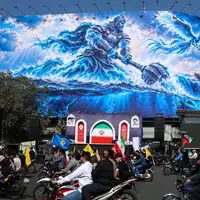




Among the images of the first day of the school year on September 23 were mothers who had dropped their daughters at the gate with their own hair uncovered, beside girls wearing the maghnaeh, the fitted hood that covers the hair, neck and shoulders and has been part of the girls' uniform in Iranian schools for four decades.
The scene is not new to the Islamic Republic. In the oral histories of women who remember the first years after the 1979 revolution, the same picture appears: mothers who still left the house without a headscarf, walking daughters who had to cover for school, because school was where the new state was making the rule stick first.
In the Islamic Republic's early years, compulsory hijab was established first in the spaces the state controlled most directly, government offices and schools, and only afterward extended to the street and the whole of public life.
Today the rules in schools and offices remain, and the law on compulsory hijab has not been repealed or even amended. But outside those spaces, part of the female population has been living differently for some time. This time, society has moved ahead of the rules.
Before the hood became the uniform
This summer an image of two designs for girls' school uniforms from 1979, first published by the popular weekly Javanan-e Emrooz, circulated again. Neither design includes the maghnaeh that later became a fixed part of the girls' uniform.
That interval did not last. In 1980, as the new state Islamized government offices and institutions, the dress code for schoolgirls changed too. For the 1980-81 school year, the requirement became a long-sleeved smock, loose trousers and a headscarf. In 1983, appearing in public without what the state called "sharia hijab" was made a crime.
The note to Article 638 of the Islamic Penal Code later became the legal basis for action against women who appear in public without the hijab the state requires.
So the history of compulsory hijab cannot be read from the street alone. School and office were among the first places it was enforced, and only later did the requirement settle across public space.
The regulation and the mandatory hood
In schools, much of that structure still stands. Article 85 of the schools' executive regulation, adopted in 2021, says students' clothing should be "simple, beautiful, varied, neat and cheerful," appropriate to Islamic-Iranian culture and identity, social custom, the student's age and the climate. The choice of style and color is left to each school's council, with the participation of the student council.

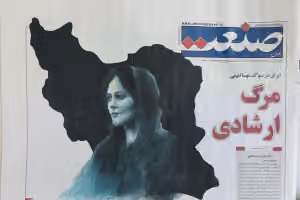
But the note to the same article fixes the range for girls. A female student's dress is either "chador, manteau, trousers and maghnaeh" or "manteau, trousers and maghnaeh," the chador being the full-length cloak and the manteau the long coat worn over trousers.
The chador is not compulsory. The maghnaeh is. The regulation provides no option for a girl to attend school with her hair uncovered.
The requirement begins in primary school. A girl of six or seven may walk to the gate hand in hand with a mother whose hair is uncovered, and must then cover her own to go in.
The distance between society and the rules can hardly be seen more clearly than in those few meters.
The fight reaches the uniform itself
This year the argument over girls' dress did not stop at the hood. The uniform itself made news.
On the eve of the new term, a message circulated about a girls' primary school in Saadat Abad, an affluent district in northwest Tehran, saying pupils would wear a shirt or blouse with trousers in place of the usual smock or manteau. Because the school is state-run, the message spread widely and reached state television.
The education office for Tehran's District 2 denied it, saying the images being shared had nothing to do with that school's uniform.
So the case cannot be treated as a confirmed change to a state school's uniform. But that such a report could circulate about a state school, and that the ministry felt obliged to answer it, shows the argument over girls' dress has reached the definition of the uniform itself.
Official policy has not moved. This year's directives asked schools to avoid unnecessary changes to the design and color of uniforms.
The result is a split. Outside school, the way women dress has changed quickly in recent years. Inside it, the manteau, trousers and maghnaeh of the official regulation remain exactly where they were.
Today's girls are not the girls of 1980
The most important difference between the two identical pictures may be the girls themselves.
The dress rules of 1980 were imposed on a society in which the Islamic Republic was still building its political, educational and cultural institutions. Today the same rules have to be enforced on a generation whose experience of how women around them dress is entirely different.
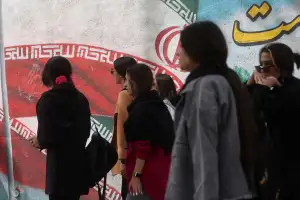
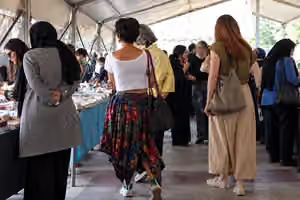
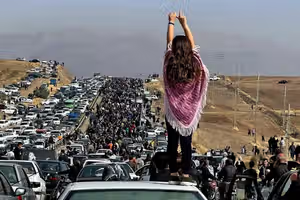

The protests of 2022 carried that difference into the schools. Among the most repeated images of the Woman, Life, Freedom uprising were teenage girls in school uniform who had taken off their hoods, in the schoolyard, the classroom and the street.
Reports of action against students over hijab followed. Amnesty International recorded the account of a 17-year-old who, after being seen with her hair uncovered on the school's cameras, was suspended and threatened with being reported to the security agencies.
That is a different experience from 1980. A student today may see bareheaded women on her way to school in the morning, be dropped off by a bareheaded mother, put on the hood to enter, and take it off again when school lets out.
For part of this generation, the maghnaeh is no longer a continuation of how they dress outside. It is a rule that applies on entering a controlled space, and stops applying on leaving it.
The law has not moved
None of this social change has become legal change.
The note to Article 638 still makes it a crime for a woman to appear in public without sharia hijab. Article 85 still lists the maghnaeh as part of a girl's dress.
The law known as Protection of the Family through the Promotion of the Culture of Chastity and Hijab, passed in December 2024, which would have widened the punishments and the means of enforcing compulsory hijab considerably, is not being implemented for now. Its suspension did not repeal the laws that came before it.
So what has happened in Iran's streets is not, in law, hijab becoming optional. The law has not recognized a right to choose. Part of society has made a different choice in practice.
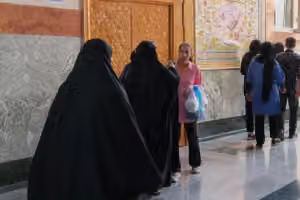

A woman without a headscarf in Iran today is not uncovered because the law gave her that right. The law can still treat what she is doing as a crime, even if it is not enforced at every time and in every place.
The administrative structure behind hijab policy has not gone either. The budget for the Iranian year that began in March 2025 set aside 2.592 trillion rials, about $1.1 million at market rates, for the Headquarters for Enjoining Good and Forbidding Evil, the state body charged with policing public morality, for which hijab has been a principal concern. That is roughly the annual minimum wage of 1,300 workers.
In the budget for the year that began this March, the line was written differently: 6.284 trillion rials, about $2.7 million, in a single shared allocation for three bodies, the headquarters, Soureh University, which is run by the state's Islamic propaganda organization, and the Islamic Propagation Coordination Council, which organizes official rallies. Because the shares are not separated, the full figure cannot be described as the headquarters' budget, still less as a hijab budget.
The education ministry and other state bodies also retain duties under the existing law on dress. The retreat of enforcement in parts of public space has not removed the law, the institutions or the money behind it.
In 1980, the bareheaded mother was walking her daughter toward a rule that would soon reach her too. In 2026 she walks her daughter toward the last place the rule still holds. The picture has not changed. Its direction has. The few meters between her uncovered hair and her daughter's hood are no longer the distance between two generations, but between a society that has changed and a law that still says it hasn't.
“If Iran cannot fly and receive airport services, no country in the region will have that possibility either,” supreme leader adviser Mohammad Mokhber wrote in a post on Friday. He did not explain how Tehran would enforce the threat.
His remarks echoed Supreme National Security Council secretary Mohsen Rezaei, who warned Wednesday that neighboring airports would be unable to operate if they cooperated with Washington’s campaign. Rezaei also warned neighboring countries against joining further US military action.
Airports in Najaf, Erbil and Sulaymaniyah have suspended flights to and from Iran, further narrowing air links with Iraq following restrictions at Baghdad airport. Najaf’s suspension took effect at 2 a.m. Friday until further notice, closing an alternative Iranian authorities had considered for diverted Baghdad-bound services.

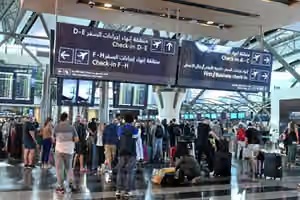
Flights to Baghdad and Muscat were canceled on September 23. Iraqi aviation sources told Reuters that Baghdad’s suspension followed government instructions; Iranian aviation spokesman Majid Akhavan said Tehran was discussing Muscat’s restrictions with Oman.
The UAE suspended Iranian airlines’ flights Thursday, explicitly citing US sanctions. Azerbaijan halted services by Iranian carriers Tuesday, while affected airlines stopped flying to Georgia from September 21.
A Tehran-Dushanbe flight also turned back Thursday after Turkmenistan denied permission to cross its airspace. Mahan Air suspended Turkey and Oman services; travel agencies said it had lost ground-handling access in Turkey.
Washington sanctioned 36 aviation-related targets on September 8, including 27 carriers it described as Iran’s remaining unsanctioned airlines and three Turkey-based companies accused of serving Mahan. Treasury says Iranian aviation networks transport weapons, military personnel and illicit cargo.
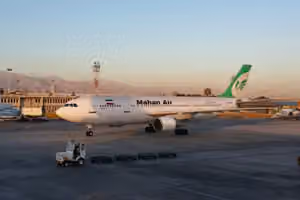
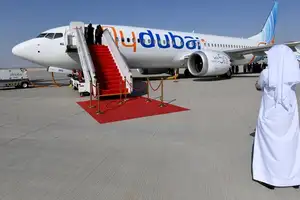
Treasury Secretary Scott Bessent warned that foreign airports, fuel suppliers, ground handlers and ticket sellers servicing sanctioned carriers risked US penalties, including exclusion from the dollar system. He said Iranian airlines would effectively lose international operations from September 23.
Those measures do not automatically close foreign airspace. Their effect depends on governments and service providers, and some flights continued. Bloomberg reported at least six departures Wednesday to destinations including Bangkok, Phuket, Shanghai and Kabul.
Foreign carriers have separately withdrawn services. Turkish Airlines told Iran International it had no Iran flights scheduled before March 2027, with no guaranteed restart. Earlier Iranian announcements of continuing Istanbul flights referred to other carriers.
Emirates no longer serves Tehran. Lufthansa and Austrian suspended Iran flights through October 24, while Qatar Airways cited airspace restrictions and tentatively listed November 29 for resumption. Those dates remain uncertain.
Four travel agencies contacted September 21 reported unavailable services across several other routes. Some Pegasus bookings were subsequently canceled, although booking-platform listings were not guarantees of operation.
The disruption affects family visits, business and pilgrimage to Najaf and Karbala. Agencies described travelers flying to Turkey, then taking roughly 17 hours by bus to Van and another 16–17 hours onward to Tehran, excluding border delays.
The UAE also barred Bank Melli branches from Iran-related transactions Wednesday, including trade finance and transfers.
Rezaei linked the aviation warning to Tehran’s broader negotiating position, giving Washington four to five days to accept conditions already sent to mediators before talks or Hormuz’s reopening. He did not list them, saying Foreign Minister Abbas Araghchi would convey them again in New York, and presented control of the strait as negotiating leverage.