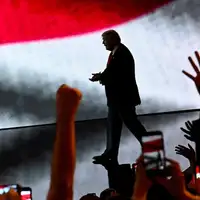
President Trump at the Republican National Midterm Convention in Dallas, September 10, 2026.
Tehran is making a “total miscalculation” if it believes the US midterm elections will constrain President Donald Trump’s actions against Iran, former senior US official Morgan Ortagus told Iran International.
Ortagus pointed to Trump’s first term, when Democrats took control of the House in the 2018 midterms but his administration continued its “maximum pressure” campaign against Tehran and ordered the 2020 killing of Qasem Soleimani.
“Any fallacy that they have that President Trump is going to limit his decision-making authority… based off a change in the Congress is a miscalculation by a regime who still fundamentally does not understand this president.”
Congressional debate over war powers was “healthy for our democracy,” Ortagus said, but did not change the president’s authority “to take any action against Iran that he deems necessary for the safety and the security of the American people.”
Former senior US official Morgan Ortagus in an interview with Iran International's Kambiz Tavana in Washington DC on September 24, 2026.
Ortagus, who held senior roles in both Trump administrations, said the United States has been in a conflict with the Islamic Republic “not for seven months, but for 47 years,” and argued that economic pressure alone would not have prevented the current military confrontation.
She described Trump’s first-term maximum pressure campaign as “incredibly effective,” but said it was interrupted during Joe Biden’s presidency and has amounted to less than four years in total.
“Sanctions are not a silver bullet,” she said. “Sanctions are a tactic. They’re a way in which you pursue a larger strategy.”
That strategy, she said, should prevent Iran from obtaining a nuclear weapon, cut funding to its proxy groups and stop Tehran from becoming “the next North Korea,” with missiles capable of threatening US bases, regional states and the American homeland.
Ortagus said Trump ordered military action beginning in June last year because Iran was “intransigent” in negotiations and “weeks away from getting a nuclear weapon.” The president had given Tehran a deadline, she said, and Iranian leaders may have believed he was bluffing.
“They learned pretty quickly that he wasn’t.”
Asked whether the campaign would have happened without a closely aligned Israeli government, Ortagus said it would have. Israeli operations had “complemented” US action, she said, but “these have been American decisions and American decisions alone.”
She cited Trump’s decision to order the killing of Soleimani in 2020 as an example of an action he took “by himself.”
On diplomacy, Ortagus said Trump had “always… extended the hand of diplomacy” during both administrations.
“It’s the regime that keeps rejecting that hand.”
She was skeptical that an agreement signed with Iranian officials in New York would hold if the real decision-makers remained in Tehran, echoing Secretary of State Marco Rubio’s doubts about the authority of Iran’s UN delegation.
“What you have to do is to make the thugs in the IRGC understand that everything, their livelihoods, everything that they possess, is going to be put at risk,” Ortagus said.
Trust was not the issue, she added. The question was what mechanisms Washington would establish “so they know… if you backtrack on this, there actually will be a consequence.”
She said she did not see how any future arrangement could work “without some sort of American verification process.”
Hezbollah and Lebanon
Ortagus rejected the argument that Hezbollah should be accepted as part of Lebanon’s social and political fabric.
“Bullshit,” she said.
She said the group was led by the Islamic Revolutionary Guard Corps, had been “indoctrinated, trained, equipped and brainwashed” by Tehran and had dragged Lebanon into “perpetual war,” with Shia communities among the main victims.
President Joseph Aoun and Prime Minister Nawaf Salam had been “very clear,” she said, that Hezbollah must be disarmed and that Lebanon cannot have “a parallel state within a state.”
Dismantling that structure would take time, Ortagus added.
“It wasn’t created overnight, and it won’t be expunged overnight.”
Ortagus said the Abraham Accords had endured the turmoil since October 7, pointing to a meeting of Accords countries on the sidelines of the UN General Assembly this week.
By contrast, she said a Mecca-centered regional alignment “looks pretty weak right now,” after Houthi attacks on Saudi Arabia, including toward holy sites, drew no meaningful response from its signatories.
“Anybody who does that and says they speak in the name of Islam are the worst hypocrites imaginable,” she said.
She declined to discuss current private exchanges between Riyadh and Washington but warned against seeking security through accommodation with Tehran.
“Pacifying this regime is not going to protect you in the long run,” she said. “It will buy you time. It might be a temporary salve, but it won’t heal the wound.”
Ortagus also described the current blockade of Iran as a harder form of enforcement than previous sanctions.
“Nothing’s coming in, and nothing’s going out.”
Asked about the broader US endgame, she listed four goals: preventing Iran from obtaining a nuclear weapon; curbing its ballistic missiles, drones and conventional arms; cutting funding to proxy groups; and supporting the Iranian people.
A final conversation about Iran
Ortagus closed the interview by recounting an unpublished story about the late Senator Lindsey Graham.
In January, she said, she had “Make Iran Great Again” hats overnighted to Graham at Mar-a-Lago so he could give one to Trump on the golf course.
She said she spoke to Graham an hour or two before his death, and that their last conversation was about Iran.
“He never stopped believing in the people of Iran,” she said.
Iran's Supreme Court has upheld the death sentence of Mozhdeh Hashemi Bazargani, a 27-year-old Red Crescent worker who said in a recording from Qazvin prison that interrogators beat her until her teeth broke and made her sign a confession, a source told Iran International.
Hashemi Bazargani was denied a lawyer of her own choosing throughout the proceedings, the source said. She is held in Qazvin Central Prison, in the city 150 kilometers west of Tehran, and is accused of sending the location of a military site to "the enemy," a charge she has denied.
In an audio message from prison earlier this year, she said security agents raided her home at 2:30 in the morning on April 4, cutting through the door with a metal grinder. She had been living with her elderly, ailing mother.
After her arrest, she said, she was beaten with a pipe and a baton on the head, neck and shoulders during long interrogations, breaking two teeth and leaving her with dizziness, shortness of breath and heart problems. No doctor came to examine her despite visible bruising and injuries, and her requests to be taken to the coroner's office to document the beating went unanswered.
Interrogators pressed her to confess, she said. "They pin a thousand charges on me. They force me: whatever we tell you, you have to write it down and sign it."
She said they beat her while she was blindfolded and cut her interrogation answers into a video presenting her as a terrorist. The charges put to her included espionage and receiving money from abroad. The confession footage was broadcast on Qazvin's provincial state television channel.
She also rejected the accusation of taking any money.
Her physical and mental condition is poor, the source told Iran International. Under the pressure of detention she has suffered seizures and lost consciousness several times, and was hospitalized before being returned to prison after a partial recovery.
In her message she also spoke of her mother in the town of Alvand, near Qazvin, who she said had been left with no one to care for her.
Iran's judiciary has issued sentences ranging from long prison terms to death against dozens of people this year on charges of espionage, sending information abroad or contact with hostile states, many of them arrested after the January protests.
Confessions broadcast on state television have repeatedly been described by defendants and their families as obtained under torture, and Revolutionary Court trials in such cases are closed to public scrutiny of the evidence.
Tehran prosecutors have opened a criminal case against a theater company after a spectator's phone video showed an actress resting her head against an actor's chest on stage, in a scene the production says depicts a brother and sister.
Mizan, the judiciary's news agency, said prosecutors acted over what it called behavior that violated social norms and standards of propriety during Tehran Paris Tehran / Bridge, staged at Tehran's Book Garden, a cultural complex in the north of the city.
The play is directed by Saeed Dashti and written by Sina Shafiei and stars Fatemeh Masoudifar, Mehrdad Sedighian, Amir Jafari and Sina Saei.
The scene
The footage shows Masoudifar leaning her head toward Sedighian's chest as he appears to touch her head. Physical contact between unrelated men and women in public is policed in the Islamic Republic under religious rules the state enforces, and the stage has not been exempt.
Fars News Agency, affiliated with the Revolutionary Guards, criticized the scene and said the larger problem was what it described as the gradual erosion of the boundaries governing artistic freedom and public conduct.
"It seems there is no supervision over theater stages," Fars wrote.
Production blames camera angle
The company said on Saturday the controversy rested on a "misunderstanding" and that the video did not show the true distance between the actors.
The images were filmed at a tight angle on a spectator's phone, it said, which created a misleading impression. It added that it had changed the actors' positions on stage to avoid further misunderstanding.
The two characters in the scene are brother and sister, the production said, and the contact comes at a moment of crisis in the story.
Other artists face legal action
The case comes amid other recent judicial measures involving artists and public events over compliance with the Islamic Republic’s social and religious restrictions.
An appeals court in Qom on Friday upheld sentences against singer Parastoo Ahmadi and seven musicians and others involved in the “Caravanserai Concert.” Each was sentenced to 74 lashes, a two-year ban on audiovisual and musical activity and a two-year travel ban.
The case stemmed from a concert filmed at the historic caravanserai in Qom in December 2024 and later posted on YouTube. Ahmadi performed without the mandatory hijab alongside male musicians. The lower court said the performance and its online publication had violated public morality and religious and legal norms. The appeals court rejected the defendants’ challenge and made the ruling final.
US President Donald Trump speaks to reporters in front of the Marine One
President Donald Trump may be putting off a difficult choice over Iran until after the US midterm elections, a former senior US diplomat told Iran International.
Trump used his address to the United Nations General Assembly this week to call for Iran's “complete economic isolation,” while saying he believed a deal could come after the November midterm elections.
Iranian President Masoud Pezeshkian, meanwhile, said Tehran would not surrender to US pressure but remained open to diplomacy.
The two sides held their first indirect talks in months on the sidelines of the UN gathering but remained far apart on how to end the war, including over Iran’s conditions for reopening the Strait of Hormuz.
Ludovic Hood, a senior fellow at the Hudson Institute who spent two decades as a US diplomat and previously served as special adviser for the Middle East to Vice President Mike Pence, told Iran International's Eye for Iran that the approaching elections may help explain the current pause.
“We have elections coming up in America that I think have partly bounded President Trump’s willingness to be more confrontational at this point in time,” Hood said.
He described the conflict as a “standoff” with “more chapters to be written,” saying Trump could face a decision over whether to escalate again after the midterms or as the United States enters the new year.
“He may seek to escalate again militarily,” Hood said.
Potential targets could include commercial and economic assets inside Iran owned by or directly linked to the Islamic Revolutionary Guard Corps, he said, if Trump chooses to intensify the campaign.
Pressure without political change
Iran has suffered major military losses while contending with a US naval blockade and an expanding sanctions campaign. Yet nearly seven months into the war, those pressures have not produced fundamental political change in Tehran.
Hood cautioned against assuming that battlefield losses automatically translate into political change. Instead, he pointed to the cumulative impact of declining revenues, sanctions, domestic discontent and potential strains within the institutions responsible for protecting the state.
He described the Islamic Republic as “about as vulnerable as it’s been in 47 years,” pointing in particular to questions about the government's ability to continue paying salaries, including those of security forces.
“To me, a fifth uprising is a question of when, not if,” he said.
Hood said some people advising Trump have made the case that the collapse of the Islamic Republic is possible, while emphasizing that he was not predicting whether or when that would happen.
Washington has continued tightening economic pressure even as negotiations resumed in New York. New US restrictions on Iran's aviation sector have contributed to the loss of international routes, with additional Iraqi destinations restricting Iranian connections this week.
Saudi Arabia and the United Arab Emirates are also urging Washington to maintain sanctions and the naval blockade rather than make concessions prematurely, according to a Wall Street Journal report.
Both governments nevertheless oppose further US military escalation, according to the report.
Hood said the significance of Washington's economic campaign lies not simply in announcing additional sanctions, but in enforcing existing measures and steadily reducing the resources available to Tehran.
Despite the resumption of diplomacy in New York, no breakthrough has emerged. A senior Iranian official told Reuters this week that the two sides remained far apart.
That leaves Washington confronting a larger question: whether the pressure already imposed can fundamentally alter Tehran’s behavior, or whether the current pause will ultimately give way to another round of military escalation.
The answer may become clearer after November—when both Washington and Tehran appear to believe the political calculus could change.
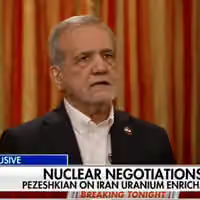
Iranian hardliners have intensified attacks on President Masoud Pezeshkian after he signalled nuclear flexibility and backed negotiations with Washington in a Fox News interview.
Conservative officials and media outlets had largely welcomed Pezeshkian’s speech to the UN General Assembly on Wednesday, but his comments to Fox News a day later provoked a sharp backlash from hardliners.
Pezeshkian said Iran was prepared to reduce its level of uranium enrichment, dilute its existing stockpile of uranium enriched to 60% and allow international verification as part of efforts to ease tensions over its nuclear program.
He also said Tehran wanted a possible agreement before the US midterm elections in November and denied that Iran had a plan to assassinate US President Donald Trump.
The contrasting reactions underscored a problem confronting Pezeshkian and Foreign Minister Abbas Araghchi: declarations of defiance can command broad support within Iran’s political establishment, but the concessions involved in actually reaching an agreement with Washington are proving considerably more contentious.
“Mr. Pezeshkian, don't spout nonsense about nuclear matters and uranium!” wrote hardline activist Mohammad-Hossein Chavoshi.
“We supported you when you spoke the truth, and we'll do it again; but if you step out of line, we'll deal with you accordingly. We will not give up the nuclear issue.”
But some defended Pezeshkian’s position.
“Did he say we should abandon the nuclear program?” one user wrote. “He is talking about 60% enrichment. Should we have constant war, remain under siege and have no money?
“Go to a large pharmacy and see what the shortage of medicine is like, not to mention the state of businesses and the market. Nobody is saying we should surrender. We can move forward thoughtfully.”
Araghchi’s plan
The backlash has not been confined to Pezeshkian. Foreign Minister Abbas Araghchi has faced sustained attacks from hardliners since presenting an Iranian proposal to the US through intermediaries on Tuesday.
The proposal sets out a phased, one-week process for implementing commitments, after which direct or indirect talks on a broader agreement could resume, according to Araghchi.
He said at a press conference on the sidelines of the UN General Assembly that Iran was ready to begin implementing the plan as soon as Washington agreed to it and that negotiations on the nuclear issue would resume after the Strait of Hormuz was reopened at the end of the seventh day.
According to Araghchi, one of the conditions is US agreement on a maritime passage arrangement through the Strait of Hormuz that has been agreed between Iran and Oman.
Although Mohsen Rezaei, secretary of Iran’s Supreme National Security Council, confirmed in a television interview on Saturday that Araghchi had been authorized to convey Iran’s conditions to the US through intermediaries in New York, criticism of the foreign minister has continued.
On Wednesday, hardline parliamentarian Amir-Hossein Sabeti said he had registered an impeachment motion against Araghchi through parliament’s system.
Warnings of wider conflict
At the same time, political and military figures have stepped up warnings of escalation if US pressure continues.
Ahmad Alamolhoda, the Friday prayer leader in Mashhad, said Friday that Iran had new weapons that would be used in the event of another US attack. He said Iran could expand the geographical range of attacks against US forces as far as the Indian Ocean.
IRGC spokesman Hossein Mohebbi similarly said Iran was prepared to enter new stages of confrontation with the US and could respond to another attack by “changing the geography of the conflict, using new equipment and weapons, and selecting different targets.”
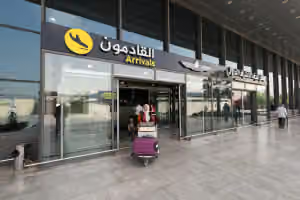
The warnings have increasingly extended to neighboring countries as restrictions on Iranian aviation have tightened. Iranian flights to Najaf, Iraq, were cancelled Friday, further narrowing the country’s remaining international connections.
Rezaei warned regional countries earlier this week that if they barred Iranian flights in cooperation with Washington, flights from their own airports could also be stopped.
Mohammad Mokhber, an adviser and aide to Supreme Leader Mojtaba Khamenei, sharpened that warning Friday.
“Flights in the region are either free for everyone or for no one,” he wrote on X. “If Iran is unable to fly and receive airport services, no country in the region will have this possibility either.”
The competing messages highlight the difficulty facing Tehran as contacts with Washington resume: Pezeshkian and Araghchi are outlining the concessions and sequencing that a negotiated settlement could require, while hardline political and security figures emphasize Iran’s ability to widen the confrontation.