Araghchi met Witkoff at US request to convey Hormuz terms - Iran state TV
Iranian Foreign Minister Abbas Araghchi met US envoy Steve Witkoff on the sidelines of the UN General Assembly in New York “at the insistence of the American side,” Iran’s state broadcaster said Tuesday.
The broadcaster, citing an unnamed source, said Tehran agreed to the meeting so Araghchi could convey Iran’s conditions for reopening the Strait of Hormuz.
Montenegro will extradite Iranian-Turkish hacker Amir Barati to the United States, where he faces charges over a sweeping cyber campaign that US prosecutors say stole research and data for Iran’s Revolutionary Guards and other entities.
The High Court in Podgorica approved Barati’s extradition under a simplified procedure and notified Montenegro’s Justice Ministry, local newspaper Vijesti reported Tuesday.
“The Ministry of Justice has informed the US Department of Justice,” Justice Minister Bojan Božović told the newspaper, adding that the remaining procedures would be carried out with police.
Barati, 39, was arrested on June 25 while visiting the coastal Montenegrin town of Kotor, in an operation involving local police and the FBI. He holds both Iranian and Turkish citizenship.
His extradition brings US authorities closer to putting on trial a man whose hacking career Iran International previously traced from underground cyber groups to alleged work for Iran’s Intelligence Ministry.
US prosecutors last month named Barati among 17 people charged over their alleged work with the Tehran-based Mabna Institute, which the Justice Department says conducted hacking operations for Iranian government entities, including the IRGC.
The Justice Department alleges the group targeted more than 100,000 professors and compromised about 8,000 accounts at 144 US universities and 178 universities abroad between 2013 and 2017. More than 31 terabytes of academic data and intellectual property were stolen, according to prosecutors.
Barati specifically helped track spearphishing campaigns, exchange credentials from compromised accounts, prepare lists of targets, conduct network reconnaissance and craft phishing messages, prosecutors said.
He faces seven counts, including conspiracy to commit computer intrusions and wire fraud, computer fraud, wire fraud and aggravated identity theft. The indictment remains allegations, and Barati is presumed innocent unless convicted.
‘Kinglet’
An Iran International investigation published after his arrest traced Barati’s hacking career much further back.
Born in Mashhad in 1986, Barati founded the Iran Black Hats Team in his early twenties and later co-founded Digital Boys Underground Team, operating online under the alias “Kinglet.”
Archived records reviewed by Iran International linked the groups to hundreds of attacks on academic, commercial and government websites, including systems associated with NASA, Microsoft, MIT and the US military.
His relationship with Iran’s security establishment appears to have shifted after his arrest by the Intelligence Ministry in 2010.
Multiple sources familiar with his activities told Iran International that authorities subsequently recruited Barati rather than pursuing him, turning him into an intelligence asset.
Court records reviewed by Iran International showed that a one-year prison sentence against him was never enforced despite reaching the enforcement stage. Iran International could not independently verify claims that the Intelligence Ministry intervened to protect him.
Barati left Iran for Turkey in 2021. He later obtained Turkish citizenship and changed both his first and last names through a Turkish court.
Sources told Iran International he subsequently avoided travelling to Europe until June, when he was arrested while on holiday in Montenegro despite travelling under his new identity.
The Justice Department’s August indictment later publicly confirmed Barati’s alleged role in the Mabna network for the first time, resolving a question raised after his arrest over how his case was connected to the long-running IRGC-linked university hacking campaign.
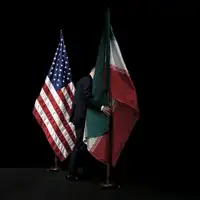
A staff member removes the Iranian flag from the stage during the Iran nuclear talks in Vienna, Austria July 14, 2015.
Iranian President Masoud Pezeshkian's presence in New York this week could provide an opportunity to revive diplomacy with the United States, but the path to any direct engagement is unclear as both sides continue to mix offers of a deal with threats of further escalation.
US President Donald Trump's speech at the UN General Assembly on Tuesday contained little indication of a change in his pre-UNGA position.
He urged other countries to join Washington in economically isolating Iran, while saying he expected the two sides to reach an agreement after the US midterm elections.
Trump framed his choice as whether to reach a deal that could help Iran rebuild and become a “great nation,” or “annihilate” the Islamic Republic to prevent it from waging war again. The stark alternatives illustrate a potential problem for renewed diplomacy.
Pezeshkian has himself offered different emphases on his way to New York. Before leaving Tehran, he said he would firmly defend Iran's positions and highlight what Tehran regards as its unfair treatment. But Iranian officials have also signalled an interest in reviving diplomacy with Washington through intermediaries.
The question surrounding his visit is therefore less whether Iran is communicating with the United States than how visible that diplomacy can become.
Tehran has already conveyed proposals through mediators, while Pezeshkian has referred to the need to “accept the enemy's call for peace.”
Iranian officials say Pezeshkian does not plan to meet Trump, despite the US president saying he would be open to one. A public handshake or sit-down would carry considerable political risk for Pezeshkian at home.
Hardliners have accused him of conceding too much to Washington, his authority over war policy is contested, and the position of the new Supreme Leader, Mojtaba Khamenei, remains uncertain. Lower-level or mediated contacts avoid some of the symbolism surrounding a presidential encounter.
The circumstances are markedly different from previous UN gatherings at which speculation about a US-Iranian handshake became an annual ritual.
The two countries are now engaged in a direct war, although there is a historical precedent for an Iranian president attending the General Assembly during direct military confrontation with Washington.
Ali Khamenei attended the General Assembly as Iran's president in September 1987, when US and Iranian forces were confronting each other in the Persian Gulf. During his visit, US forces attacked and seized the Iran Ajr after saying they observed it laying mines in international waters.
Pezeshkian has been among the strongest advocates of diplomacy within Iran's senior leadership, arguing that it would be better to end the war while Iran still “enjoys power and dignity.” His allies increasingly link that argument to Iran's worsening economy.
The reformist daily Shargh argued on Monday that engagement should not be confused with capitulation, warning of the costs of shutting the door on diplomacy while inflation soars and Iran's international connections deteriorate.
The problem in New York may therefore be less an absence of communication than the contradictory messages surrounding it.
Trump is offering Tehran the prospect of rebuilding after a deal while threatening its destruction without one; Pezeshkian must demonstrate resistance at home while leaving room for diplomacy abroad.
Such ambiguity can create room for negotiation, but it can also make it harder for either side to judge what the other is prepared to accept.
The question this week may not be whether contacts take place, but how far either government can afford to let them become public.
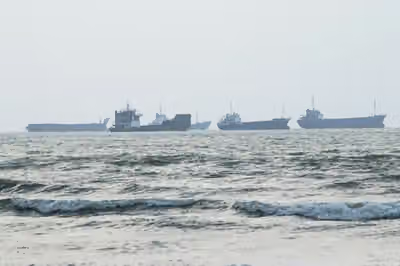
FILE PHOTO: Vessels near the Strait of Hormuz, as seen from Musandam, Oman, August 31, 2026.
An Iranian parliamentary committee has approved provisions allowing authorities to seize 20% of the cargo or its value from ships violating Iran’s rules for passage through the Strait of Hormuz and temporarily detain the vessels until the penalty is paid.
Hassan Qashqavi, spokesperson for parliament’s National Security and Foreign Policy Committee, said on Tuesday the panel approved Articles 13, 14 and 15 of the proposed Strategic Action Plan for the Security and Development of the Strait of Hormuz.
The measures are part of a broader push by parliament to establish a permanent Iranian regulatory system for the strategic waterway. The committee last month approved a provision allowing Tehran to charge authorized vessels for navigation, environmental, insurance and security services, as well as refueling in special circumstances and other services. The fees could be collected in rials or another currency designated by Iran.
Under Article 13, vessels passing through the strait outside the regulations set by the proposed law would face penalties under Iran’s Islamic Penal Code, in addition to the seizure of 20% of their cargo or an equivalent amount based on its value. The vessel could be temporarily detained until the penalty is paid.
The bill would also require Iran’s judiciary to establish specialized branches staffed by judges and experts in maritime and international law to handle cases arising from the legislation, according to Qashqavi.
Article 14 would impose Grade 5 criminal penalties on individuals or legal entities whose actions or omissions prevent the full or timely implementation of the law, unless a more severe punishment applies.
A provision attached to the article says any bilateral or multilateral international agreement concerning the Strait of Hormuz must comply with several articles of Iran’s constitution governing treaties, national security and the division of state powers.
Article 15 would require the Armed Forces General Staff, directly or through the Defense Ministry, to report to parliament’s National Security and Foreign Policy Committee every three months on implementation of the law.
The legislation has developed from a series of proposals introduced after the war began in February, with Iranian lawmakers seeking to turn Tehran’s wartime restrictions on shipping into a lasting framework for managing Hormuz.
Earlier provisions considered by parliament include restrictions on vessels linked to the United States, Israel and other countries Tehran considers hostile, as well as requirements for ships to obtain Iranian authorization or coordinate their movements with Iranian authorities.
The proposed fees have become one of the most contentious elements. Iran has argued that ships can be charged for security and other services it provides, while Oman has proposed a regional arrangement under which shipping companies could make voluntary contributions to fund navigation, environmental protection and search-and-rescue services. Tehran has resisted proposals that would prevent it from exercising substantial oversight of both inbound and outbound traffic.
The International Maritime Organization has opposed mandatory tolls, saying transit through international straits should remain unimpeded and free of charges simply for passage. International law does, however, allow charges for specific services actually provided to vessels, a distinction Tehran has sought to emphasize by describing its proposed payments as service fees rather than a transit toll.
The bill has not yet become law. Provisions approved by parliamentary committees must still clear the full parliament and receive approval from the Guardian Council.
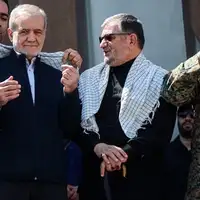
President Masoud Pezeshkian waves as he boards his plane in Tehran before departing for New York on September 22, 2026.
Iranian hardliners spent the day before President Masoud Pezeshkian left for the UN General Assembly talking publicly about nuclear weapons, leaving the treaty that restrains them, and preparing for a long war with the United States.
The statements came within hours of each other, from MPs, a Tehran city council official and military figures, and they map the mood in the hardline camp on the eve of the president's departure.
It came as Donald Trump said he was willing to meet Pezeshkian in New York while warning that "something big" could happen to Iran.
Kamran Ghazanfari, a hardline MP, told Didban Iran that if the existence of the Islamic Republic came under serious threat, the new supreme leader could reconsider the question of nuclear weapons. Some MPs favor a nuclear deterrent to end the recurring threats against Iran, he said, though any decision would rest with senior officials and the Supreme National Security Council.
Parviz Sarvari, deputy chairman of Tehran city council, said he would welcome news that Iran had moved toward building nuclear weapons for deterrence. Membership of the Non-Proliferation Treaty had brought Iran no benefit, he said, while its adversaries threatened it from a position of nuclear superiority.
The push has gone beyond words. Hossein-Ali Haji-Deligani, an MP, submitted a triple-urgency bill for Iran's withdrawal from the NPT, arguing that membership had become more costly since the IAEA Board of Governors referred Iran to the UN Security Council. Similar proposals have circulated for months and the leadership of parliament has kept them off the floor. Haji-Deligani said the presidium has now acknowledged receipt of this one.
Military figures spoke the same day. Army commander Amir Hatami said the armed forces were at full readiness. Esmail Kowsari, of parliament's national security committee, said Iran's growing capabilities would eventually push American forces out of the region.
Revolutionary Guards spokesman Hossein Mohebbi said the war with the United States and Israel was not over and that the Guards had prepared for a long one, citing assessments that Washington may be considering fresh strikes.
What the day was for
Three things were happening at once.
The first is the argument about the last war. The ceasefire that ended the 12-day conflict left hardliners needing it not to look like a defeat at home, and insisting the war is unfinished keeps the account open.
The second is pressure on Pezeshkian. The NPT bill and the nuclear talk arrived alongside renewed parliamentary criticism of his government for allowing IAEA inspectors access, in a dispute over how far Iran should engage Washington and the monitors.
The third is the IAEA referral and the threat of snapback sanctions, which is the immediate cause of the NPT bill and the reason the timing is not a coincidence.
The language stayed inside limits. Ghazanfari attached any reconsideration of weapons to an existential threat. Sarvari's endorsement was of a hypothetical. Neither said Iran should build a bomb now, and neither Mojtaba Khamenei nor the Supreme National Security Council has said anything on the question.
The risk is how it reads elsewhere. Open parliamentary discussion of leaving the NPT and of nuclear contingencies is the kind of material Washington and Israel have previously cited as evidence that Iran is moving toward a weapon, and the United States struck Iranian nuclear sites during the last war. On the same day, the Guards said they expected it to happen again.
Iranian President Masoud Pezeshkian reviews an honor guard before leaving Tehran for New York to attend the United Nations General Assembly, on September 22, 2026.
Iram offers to reopen Hormuz within seven days if the United States begins easing military pressure, said reports citing a senior Iranian official, as President Masoud Pezeshkian headed to New York and the military portrayed negotiations as another form of warfare.
The proposal has already been delivered to Washington through mediators and calls for renewed negotiations aimed at permanently ending hostilities, Kyodo News and Reuters reported on Tuesday, citing senior Iranian officials.
Iran wants the United States to begin lifting its blockade of Iranian ports and halt military operations related to the strait. In return, Tehran would reopen the waterway within seven days and return to negotiations, according to the reports.
One official said Iran’s delegation at the UN General Assembly had full authority to revive diplomacy with Washington and discuss the details of an agreement through intermediaries. The initiative was approved by Supreme Leader Mojtaba Khamenei and the Supreme National Security Council, Kyodo reported.
The official nevertheless ruled out a meeting between Iranian President Masoud Pezeshkian and US President Donald Trump in New York, leaving mediators as the likely channel for any immediate exchange.
“There is a possibility of moving toward an agreement,” the official told Kyodo, while saying Washington would need to demonstrate “seriousness and commitment.”
Pezeshkian left Tehran for New York on Tuesday saying he would use the General Assembly to defend Iran’s position, describe the suffering of its people and address what he called the erosion of trust caused by Washington’s conduct.
“We will use this opportunity in the best possible way to convey Iran’s message of victimhood to the international community,” he said before departing.
Foreign Minister Abbas Araghchi, who arrived in New York ahead of Pezeshkian, said Iran remained in a “state of war” following US-Israeli attacks and subsequent developments. He described the UN gathering as an opportunity to present Tehran’s case while criticizing the organization’s failure to maintain international peace and security.
“The question of restoring trust is important and provides an opportunity to discuss with the world how trust in the United Nations was lost and how it can be restored,” Araghchi said.
The conditional proposal on Hormuz places that argument about trust at the center of the latest diplomatic effort. Tehran is signaling that it could quickly ease one of the war’s most damaging economic disruptions, but only after Washington takes the first step.
That sequencing reflects how Iranian officials now describe diplomacy itself. IRGC spokesperson Hossein Mohebbi said Tuesday that negotiations should not be understood as reconciliation or peace but as an extension of the conflict by other means.
“If the country’s interests require it, negotiations can be part of the battle while we remain prepared for combat,” Mohebbi said. “One war is fought with weapons; in negotiations, the war is fought with words, arguments and diplomatic methods.”
Mohebbi said the IRGC was preparing for a prolonged conflict, although it assessed that Iran’s adversaries lacked the capacity to begin another war. “The war is not over,” he said.
Parliament Speaker Mohammad Bagher Ghalibaf offered a similar formulation, arguing that diplomacy should convert military strength into political gains rather than amount to surrender. But other political figures sought to narrow Pezeshkian’s room for maneuver. Lawmaker Mohammad Rostami said any direct negotiations with Trump would be unacceptable, calling the US president the “killer of our martyred leader.”
Pezeshkian also faced criticism from lawmaker Mojtaba Yousefi and former senior IRGC commander Hossein Kanani-Moghadam, who said he should have considered staying away from the General Assembly. Their remarks underscored the domestic resistance the president could face if the diplomatic opening advances beyond indirect contacts.
The value of Tehran’s Hormuz offer will partly depend on whether the United States sees seven-day reopening as a meaningful concession or merely a reversal of disruption Iran helped create. The economic pressure around the waterway also continues to change.
Saudi Arabia restarted its East-West oil pipeline and could resume crude exports from the Red Sea port of Yanbu later Tuesday, Reuters reported. Drone attacks had forced the pipeline to shut on September 13, limiting a key alternative to Hormuz. Its return, even initially at a low rate, could reduce some of Tehran’s leverage by restoring another route for Saudi exports.
China is also emerging as a potential source of pressure. Beijing has offered to help Washington press Iran over the war in return for US concessions on arms sales to Taiwan, Reuters reported, citing sources familiar with discussions between the US and China ahead of a meeting between Trump and Chinese President Xi Jinping. The report did not specify what measures China might take against Tehran.
Yet Beijing simultaneously opposed US sanctions affecting Iranian airlines. China’s Foreign Ministry criticized unilateral measures lacking authorization from the UN Security Council after the US Treasury secretary warned that countries providing Iranian carriers with fuel, credit or other services could lose access to the US dollar system.
Iran Air said it had received no official orders from Turkey, Azerbaijan or Iraq to suspend services to Istanbul, Baku and Najaf. Iraq’s Transport Ministry likewise said flights to and from Iran were continuing normally.