Pezeshkian says Iran ‘seeks no one’s permission’ to defend itself
Iranian President Masoud Pezeshkian held up photographs of children killed in US-Israeli strikes during his address to the UN General Assembly on Wednesday, accusing the two countries of acts of “terrorism.”
“We only seek to live independently,” Pezeshkian said. “We need strength to be able to defend ourselves.”
“We don't seek anyone's permission to defend our country,” he added.
Pezeshkian said Iran would not surrender in the face of military force, while stressing that Tehran still believed in diplomacy.
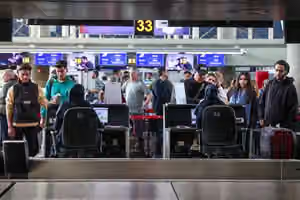
Iranian President Masoud Pezeshkian disembarks from his plane after arriving in New York for the United Nations General Assembly on September 22, 2026.
A military adviser to Iran's supreme leader said the government has room to deal with Washington, and within hours a lawmaker and Guards-affiliated outlets condemned reported contact with it. The split surfaced as the Guards were reported to be directly engaged in Yemen.
Major General Yahya Rahim Safavi said Supreme Leader Mojtaba Khamenei’s decision to leave the government’s “hands open” in negotiations reflected significant strategic judgment.
“If the Supreme Leader has deemed it expedient and left the government’s hands open in the negotiations, that is an important act of prudence,” Safavi said in a televised interview.
He also pointed to coordination between Iran’s military and political leadership and said he hoped decisions by the Supreme National Security Council would help prevent another war.
The remarks provided rare public confirmation from a senior military figure that Pezeshkian’s government has the leadership’s approval to pursue negotiations. They followed a day of indirect exchanges between Iranian and US delegations in New York, though major differences remain over Washington’s naval blockade and Tehran’s conditions for ending the conflict.
The prospect of diplomacy also exposed competing views inside Iran over how far Pezeshkian should go.
Lawmaker Ebrahim Rezaei and the IRGC-affiliated Tasnim and Fars news agencies criticized Foreign Minister Abbas Araghchi’s meeting with US envoy Steve Witkoff. Rezaei questioned its authorization and called it a “sign of weakness,” while the outlets argued that it rewarded Washington and eased pressure on the United States.
Reformist politician Gholamhossein Karbaschi, meanwhile, said the president should meet Trump to help resolve the country’s problems, echoing a similar appeal from senior reformist figure Mehdi Karroubi.
Lawmaker Ahmad Bakhshayesh Ardestani went further, predicting that a Pezeshkian-Trump meeting would take place in New York.
“In my view, the meeting between Pezeshkian and Trump will take place,” he said. “Last year, Pezeshkian decided to meet, but the Americans did not show up.”
Bakhshayesh Ardestani, a member of parliament’s national security and foreign policy committee, also advocated acquiring a nuclear weapon before leaving the Nuclear Non-Proliferation Treaty.
“Buy or build the atomic bomb, then say you are withdrawing from the NPT,” he said, while acknowledging that senior officials were not currently seeking withdrawal.
The competing statements illustrated the political constraints surrounding the New York diplomacy: Pezeshkian is said to have received apparent backing to negotiate, but officials and political factions remain divided over direct contact with Trump and the concessions Iran should seek or offer.
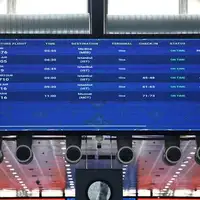
Those talks are unfolding as US economic pressure begins to narrow Iran’s international connections. Iranian airlines continued operating some foreign services Wednesday after a US deadline aimed at grounding the country’s fleet by threatening sanctions against companies providing fuel, ground handling, ticketing and other services.
Bloomberg cited flight-tracking data showing at least six flights leaving Iran for destinations including Bangkok, Phuket, Shanghai and Kabul after the restrictions took effect.
But the pressure appeared to be uneven rather than ineffective. Iran’s Civil Aviation Organization said flights to Baghdad and Muscat had been canceled, while Azerbaijan suspended Iranian airline services and Turkish Airlines halted its flights to Iran until at least March 2027.
The restrictions add urgency to Tehran’s diplomacy by extending the economic confrontation beyond shipping and oil into civilian aviation. At home, however, authorities sought to show that wartime damage was being repaired.
An Oil Ministry official said around half of the damaged capacity at the South Pars gas field had returned to service and that the remaining planned restoration work would be completed before winter.
At the same time, a report of a deeper Iranian military role in Yemen showed how the conflict continues to extend across the region. IRGC personnel were on the ground helping the Houthis seize Yemen’s Red Sea coast from pro-government forces, the Associated Press reported, citing 10 officials and soldiers.
The report said Iranian personnel helped direct a rapid 115-kilometer offensive, marking Tehran’s most direct intervention on behalf of the Houthis since Yemen’s civil war began in 2014. Houthi forces also penetrated the communications of the National Resistance, allowing them to monitor movements and sow confusion.
That reported intervention could complicate efforts to contain the conflict while Tehran and Washington negotiate. Iran is signaling that its government has authority to pursue an agreement, but its regional military posture and the expanding sanctions campaign continue to generate pressure that could either drive diplomacy forward or deepen the confrontation.
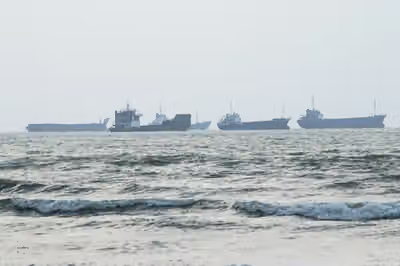
Oil pollution has spread along parts of Iran’s Hormozgan coast and reached the entrances of shrimp farming channels in Sirik, with environmental officials warning that some of the contamination could remain in the marine environment for years.
Tar balls have been reported in several parts of Hormozgan province, including Soro and Golshahr in Bandar Abbas, with additional sightings reported in Hormuz and Minab, ISNA said.
Habib Masihi Taziani, head of Hormozgan’s environmental protection department, told ISNA that the amount found in Sirik was substantial and that experts were still assessing the extent of the contamination.
“The volume of tar balls in Sirik is significant,” he said, adding that authorities had begun work to manage the pollution with fisheries officials, port authorities, the Sirik governor’s office and the provincial crisis management agency.
Pollution reaches shrimp farming channels
The spread to the entrances of shrimp farming channels in Sirik has raised concern because aquaculture facilities there are directly connected to coastal waters.
Masihi Taziani told ISNA that conventional suction equipment was not effective for removing the tar balls.
“Collecting these oil masses with suction equipment is difficult,” he said. “Efforts are continuing to contain them and collect them using absorbent pads and other equipment.”
Tar balls are weathered remnants of petroleum products that can travel across the sea before washing ashore.
Officials warn pollution could persist for years
Ahmadreza Lahijanzadeh, deputy head of Iran’s Department of Environment for marine affairs, told ISNA the tar balls could cause significant damage to coastal and marine ecosystems.
“These oil masses can cause considerable environmental damage, and the resulting pollution can affect coastal and marine ecosystems,” he said.
Lahijanzadeh said organic compounds and heavy metals contained in the material could gradually enter the water and spread through the marine environment.
“The effects of this type of pollution are not limited to the period when the tar balls are visible on the coast,” he told ISNA.
“The entry and accumulation of these materials can cause pollution to remain in the sea for a long time, even for years,” he added, calling for continued monitoring and measures to identify and contain it.
The latest sightings follow several oil pollution incidents along Iran’s southern coastline in recent weeks.
In August, Iranian state news agency IRNA reported that oil had reached mangrove forests on Qeshm island after slicks appeared near Suza and Shib Deraz. Authorities said at the time that the source had not been determined.
Mehr news agency reported that the pollution had initially been detected along about one kilometer of coast near Suza before spreading toward Shib Deraz.
TankerTrackers.com later said the Qeshm pollution appeared to have come from an Iranian attack on the bulk carrier Minoan Pioneer off Oman on August 3, with the spill drifting across the Strait of Hormuz toward Iran. Iranian authorities did not confirm that assessment.
Tanker spills add to pollution concerns
A separate spill was reported off Oman after the tanker Caroline Bezengi, carrying Russian crude, ran aground.
The UN’s International Maritime Organization said oil from the vessel had begun reaching Oman’s mainland, while Oman’s Environment Authority said the slick covered about 150 square miles near the Hallaniyat Islands.
Reuters, citing maritime security sources, reported that the vessel’s crew had first reported difficulties off Yemen in June and that initial assessments pointed to an onboard blast.
A woman with uncovered hair stands beside graffiti depicting Mojtaba Khamenei in Tehran, September 2026
One morning your phone simply stops working. There is no warning, no explanation and often no piece of paper telling you what you have done. Welcome to the Islamic Republic of Iran v.3.1.
I have been hearing versions of this story with disturbing frequency lately, from a doctor, a software engineer, an artist, a journalist and others, men and women ranging from their early twenties to their mid-forties.
Some are politically active, others barely so. What many appear to have in common is that at some point they said something online that somebody in authority did not like.
One woman in her thirties described discovering that the mobile line registered in her name had been blocked. When she tried to buy another SIM card, she learned that her national ID had also been restricted, preventing her from simply starting again with a new number.
It sounds like an inconvenience until you begin listing everything in Iran that now requires a phone number registered in your own name. Government portals routinely require text-message verification. So do university and banking services, even ride-hailing and food-delivery apps.
This is what makes the punishment so effective. The mobile phone is one of the keys to modern life here, and someone can apparently take that key away without ever coming to your door.
Life in Iran is difficult enough without inventing new ways to make it harder. People are still recovering from a brutal crackdown and war while living with the possibility of another round. Prices rise between visits to the supermarket, rent eats into salaries that were inadequate to begin with, power cuts are frequent and the internet remains unreliable.
Most people spend an extraordinary amount of mental energy simply working out how to get through another month. Now imagine trying to do all that without a functioning phone number.
A journalist in her late twenties told me she was preparing a report on SIM blocking when her own number suddenly stopped working. She knew immediately that it was not a technical glitch or an administrative accident.
"It feels as though I've ceased to exist administratively in my own country," she told me.
Others disappear even more quietly. They are not prominent activists whose names people will recognise. They are doctors, programmers, students and artists, or simply people with a few hundred followers who wrote something angry or shared something at the wrong moment.
Their phone goes dead and perhaps a handful of friends know. There is no campaign for them, and often nobody beyond their immediate circle even knows that they have been punished.
One software engineer told me that after his SIM was blocked, he began looking online for people in the same position. In about a week, he says, he came across almost 100 accounts that appeared similar to his own.
There is something particularly cruel about a punishment with no clear beginning or end. If you are charged with an offence, at least there is an accusation to confront. Here, most people are not told about the red line they crossed or how long they should suffer for it.
One person I spoke to had their SIM blocked for months after intervention by Revolutionary Guards intelligence. To have it restored, they say, they were required to delete their Twitter account and promise not to get themselves into further trouble online.
Many watching Iran from afar look at the social changes visible on Tehran's streets and conclude that the state has loosened its grip. Women now walk around without hijab in numbers that would have been difficult to imagine only a few years ago. Young men and women mix openly, and the cafés are full of people who can afford them.
None of this happened because the authorities graciously granted people more freedom of course. They fought these changes and continue to fight them, but society pushed ahead anyway and, on some fronts at least, the state appears for now to have lost.
But political dissent is a different story. There seems to be far less willingness to retreat when people challenge power itself, and the methods do not always have to be spectacular.
Repression can be something as mundane as discovering that the little device in your hand, around which so much of your life has been organised, no longer connects you to anything.
This is the latest version of the Islamic Republic: punishment hidden in plain sight, no dramatic image for the outside world to share, no prison gate for relatives to gather outside and often no official decision that can be challenged.
You can see a young woman walking down a Tehran street with her hair uncovered. What you cannot see is whether her phone still works.
Iranian authorities executed IT expert Hossein Pedaran after what sources familiar with his case described as months of solitary confinement, severe physical and psychological pressure and a forced confession.
Pedaran, born on June 26, 1985, was married and had two children, aged 15 and 11. He was arrested in July 2025 and executed on September 19 at Isfahan Central Prison, also known as Dastgerd Prison.
One informed source told Iran International that plainclothes agents raided Pedaran’s home when he was arrested and seized his personal and work belongings, along with electronic devices belonging to him and members of his family.
The source said Pedaran was then held for months in solitary confinement and in detention facilities run by security agencies, where he faced severe physical and psychological pressure.
Prolonged detention in dark conditions and deprivation of sunlight caused injuries and sores on his toes, the source said. Interrogators also pressured and threatened Pedaran and his wife to force him to make statements against himself, according to the source.
Iran Human Rights previously reported that Pedaran spent four months at the Isfahan Intelligence Department’s detention center before being transferred to an intelligence detention facility in Tehran. He was returned to Isfahan a month later.
Work in information technology
Information obtained by Iran International shows that before his arrest, Pedaran worked in information technology at a company called Gostareh Tarahan Naghsh Almas.
His work included designing and setting up USSD codes and developing digital businesses.
Iran’s judiciary said after his execution that Pedaran had been sentenced to death for “espionage and intelligence cooperation in favor of Israel” and that the sentence was carried out after being upheld by the Supreme Court.
The judiciary accused him of providing Mossad with information about military and missile facilities in Isfahan province.
An informed source rejected the judiciary’s account that Pedaran had access to military or missile information, telling Iran International that his professional work was commercial and focused on information technology and digital services.
Iranian authorities have executed dozens of people in recent months on charges including involvement in the January uprising and espionage.
Trial process
A source familiar with Pedaran’s case told Iran International that Judge Mohammadreza Tavakoli of the Isfahan Revolutionary Court issued the death sentence and that defense submissions filed by the family’s lawyer were not considered.
The family had appointed lawyers at different stages of the case, the source said.
According to the source, one of the lawyers told the family on the night before the execution that no notice confirming the final approval of the sentence or setting an execution date had appeared in the judiciary’s Sana electronic system.
Pedaran’s family therefore did not know when he would be executed until the sentence was carried out, the source said.
Security agencies had also pressured Pedaran’s wife from the time of his arrest not to publicize the case and had told the family that he might receive a pardon, according to the source.
Body handed over after two days
The source said Pedaran’s family faced obstacles when trying to recover his body after the execution.
His body was handed over to the family late in the day after about two days of attempts to obtain it, the source said.
Pedaran was buried under security restrictions at Bagh-e Rezvan cemetery in Isfahan, and his family was not allowed to hold a public mourning ceremony, according to information obtained by Iran International.
Relatives described Pedaran as calm, disciplined, kind and hopeful about life. They said he remained hopeful until his final family visit before the execution.
Mizan, the judiciary-affiliated news agency, did not provide details about when Pedaran was arrested, his access to legal counsel or the conditions of his detention in its report on his execution.
After his death, state media also broadcast excerpts of what authorities described as Pedaran’s “confessions.”
A US flag hangs in a street of Los Angeles' "Little Persia" where about 500,000 Iranian-Americans live, in Los Angeles, California, US, June 21, 2025.
A hacked freeway sign in the heart of Los Angeles’ Iranian community directed drivers to a website threatening opponents of the Islamic Republic, in what cyber and security experts describe as a psychological operation designed to spread fear.
The digital sign on Interstate 405, near Westwood's Persian Square, briefly displayed the address of Goorkan, a Persian-language site that publishes names, photographs and personal information of people it identifies as opponents of Iran's government.
"It touches the heart of the diaspora and sends a message. We can touch you wherever you are. The sophistication is irrelevant. The message is chilling," said Roger Macmillan, an Iran and terrorism specialist and former director of security at Iran International.
Who carried out the intrusion has not been publicly established, and US authorities have not confirmed a link to the Revolutionary Guards.
Three cyber and security experts told Iran International that the incident shows how a simple intrusion can intimidate a community far from the people who carried it out.
A simple hack, a powerful message
The intrusion looked unsophisticated next to the capabilities of Russian and Chinese operators, said Amin Sabeti, a cybersecurity researcher who specializes in Iranian cyber operations.
"It's not that sophisticated hacking. It's more about the propaganda," Sabeti said.
The attackers did not need to disable a transport network or break into a secure system. Putting a web address on a public sign beside one of the largest Iranian communities outside Iran was enough.
Sabeti said the effect falls hardest on ordinary Iranians who attend protests and keep public social media accounts. Finding their photograph or their details on a threatening website leaves them wondering who is watching and what it may cost them.
"It's more about creating chaos amongst the diaspora," he said.
Emel Karsaz, an Iranian-born Los Angeles resident, told the New York Post she reported the matter to the FBI after finding her name, photograph and personal information on the site, and that she had also received threats on social media.
The California Department of Transportation confirmed that an unauthorized message appeared on the sign and said it had instructed a contractor to restore normal operations. A review is under way.
The crudeness offers no comfort, Macmillan said.
"That the hack itself is unsophisticated doesn't reassure me. If anything it confirms what this operation was actually for," he said. "Sophistication was never the point. Fear was."
Tehran has long used intermediaries and loosely affiliated actors to intimidate its opponents abroad, Macmillan said, which lets it benefit from such operations while keeping its own involvement out of view.
How vulnerable was the freeway sign?
It appears to have been a straightforward compromise of a badly secured system, said Annie Fixler, director of the Center on Cyber and Technology Innovation at the Foundation for Defense of Democracies.
"This incident is 100% about intimidation," Fixler told Iran International.
Without the investigation's technical findings, she suspected the sign had an unsecured internet connection that let the attackers change what it displayed.
"It is deeply disturbing for those that saw the message but that is probably the extent of what the hackers could do with that access," she said.
The ease of it points to a larger problem with internet-connected public infrastructure, she added.
"The incident itself is not a big deal but the fact that so much of our systems are unprotected or misconfigured such that even low level hackers can do damage is the main take away. We need to be taking security seriously."
A familiar cyber playbook
The sign follows a run of cyberattacks on American infrastructure that experts have read as demonstrations of reach rather than attempts at damage.
In August, Iran International reported that attacks on water and wastewater facilities in at least seven states appeared aimed less at crippling infrastructure than at unsettling the public.
Federal authorities opened an investigation and did not publicly attribute responsibility, though US media reported that officials considered Iran the leading suspect.
Fixler described the tactic at the time as perception hacking: gaining limited access to a system, then publicizing it to suggest a far larger capability.
Los Angeles follows the same pattern with a narrower audience.
A wider campaign against dissidents abroad
The hack comes with renewed warnings about Iranian operations against opponents abroad.
On September 15, US, British and Dutch authorities issued a joint advisory that Iranian state cyber actors had deployed spyware known as Chosen Brick against dissidents, activists and journalists. The malware can pull communications and contacts from an infected device, exposing not only the target but everyone they know.
The same month, the Islamic Republic promoted a platform called Alaj, meaning remedy in Persian, which asks the public to identify and report opponents living abroad. Iranian state media say it has identified and monitored 1,600 people, 600 of them through public submissions.
It publishes names, photographs and, in some cases, further personal details, and lists measures that could follow, including asset freezes and restrictions on consular and citizenship services.
No operational connection between Alaj, Goorkan and the freeway sign has been publicly established.
"Treating it as trivial because the hack was crude would be a mistake," Macmillan said.