• العربية
  • فارسی
Brand
  • Iran Insight
  • Politics
  • Economy
  • Analysis
  • Special Report
  • Opinion
  • Podcast
  • Live TV
  • Iran Insight
  • Politics
  • Economy
  • Analysis
  • Special Report
  • Opinion
  • Podcast
  • Live TV
  • Theme
  • Language
    • العربية
    • فارسی
  • Iran Insight
  • Politics
  • Economy
  • Analysis
  • Special Report
  • Opinion
  • Podcast
  • Live TV
All rights reserved for Volant Media UK Limited
volant media logo
INSIGHT

Why Iran’s hardliners keep talking of ousting Pezeshkian

Behrouz Turani
Behrouz Turani

Iran International

Sep 17, 2026, 17:29 GMT+1
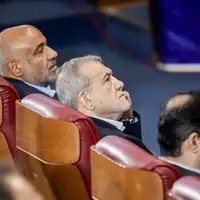
Iran's president Masoud Pezeshkian attends an event celebrating pensioners in Tehran, Iran, September 14, 2026

Renewed talk among Iranian hardliners of removing President Masoud Pezeshkian has revived comparisons with Iran’s only presidential impeachment, but there is little evidence so far of a coordinated effort capable of unseating him.

Instead, the latest speculation fits a pattern that has followed Pezeshkian since taking office in 2024: recurring calls for resignation or impeachment that intensify during periods of political, economic or geopolitical pressure.

The latest round was partly triggered by cryptic comments from Qom MP Mojtaba Zarei referring to a possible “coup” or coordinated political move against Pezeshkian.

Rouydad24 examined whether hardline networks, particularly Sharyan—the Persian acronym for the Strategic Network of Islamic Revolution Supporters—and allies of Saeed Jalili, Pezeshkian’s rival in the 2024 presidential election, were seeking early presidential elections.

The outlet presented no formal evidence of such a plan but pointed to repeated calls by radical lawmakers to invoke Article 89 of the Constitution, under which parliament can declare a president politically incompetent.

Mohsen Gharavian, a seminary and university lecturer, described the campaign to portray Pezeshkian as politically incompetent as a “targeted political conspiracy” and a soft “coup.”

Writing for Khabar Online, he argued that ultra-conservatives angered by their 2024 electoral defeat were using political networks and sustained media pressure to weaken the government.

In a separate Khabar Online report, moderate politician Hassan Rasouli criticised proposals to impeach Pezeshkian or transfer executive authority to First Vice President Mohammad Reza Aref.

Rasouli said such moves, particularly amid heightened national security pressures, amounted to “a direct attack on high-level governance cohesion.” He dismissed comparisons with the 1981 removal of Iran’s first president, Abolhassan Banisadr, as political theatre rather than a serious legal pathway.

Threats to use parliament against sitting presidents have a long history in the Islamic Republic.

During Akbar Hashemi Rafsanjani’s second term from 1993 to 1997, conservative opponents mounted sustained pressure on his government, including the impeachment of cabinet ministers.

Hassan Rouhani also faced repeated impeachment threats during his presidency, particularly from opponents of his diplomatic engagement with Washington.

The only successful precedent remains Banisadr in 1981. Parliament declared him politically incompetent during the Iran-Iraq war, after which Ayatollah Ruhollah Khomeini formally dismissed him.

Banisadr’s removal has since become a recurring reference point in disputes over presidential authority. Hardline lawmakers have invoked his case in attacks on Pezeshkian, particularly over diplomacy, economic policy and the conduct of the war.

But invoking Article 89 and successfully removing a president are different things. There is currently no indication that Pezeshkian’s opponents have assembled the parliamentary support required to declare him politically incompetent.

Opposition to Pezeshkian has nevertheless persisted since he took office following Ebrahim Raisi’s death in 2024. Calls for his resignation, comparisons with Banisadr and threats to invoke Article 89 have resurfaced during periods of economic turmoil, currency volatility and war.

The repeated threat of impeachment can serve a political purpose even without enough votes to remove the president: keeping his competence under question and constraining his room for manoeuvre on economic and diplomatic policy.

This week’s talk of a “coup” and renewed debate over presidential competence therefore appears less a new escalation than the latest iteration of a political struggle that has accompanied Pezeshkian for much of his presidency.

Banner

Most Viewed

Tehran political circles see US hand in postponement of Oman Hormuz talks
1
INSIGHT

Tehran political circles see US hand in postponement of Oman Hormuz talks

2

‘This is the cost you must pay’: Iran accused of denying food to death-row twin

3

Security forces deploy as shops in western Iran strike on Mahsa Amini anniversary

4
ANALYSIS

A generation shaped by Woman, Life, Freedom refuses to go back

5

US officials met Iran-aligned Houthis in Oman - Reuters

Banner

Spotlight

  • Why Iran’s hardliners keep talking of ousting Pezeshkian
    INSIGHT

    Why Iran’s hardliners keep talking of ousting Pezeshkian

  • Woman, Life, Freedom and the Iran that cannot go back
    OPINION

    Woman, Life, Freedom and the Iran that cannot go back

  • Calls to quit NPT grow in Iran as critics warn of strategic trap

    Calls to quit NPT grow in Iran as critics warn of strategic trap

  • From Halkbank to Golden Global: Iran sanctions and Turkey’s banking ties

    From Halkbank to Golden Global: Iran sanctions and Turkey’s banking ties

  • Iranian women recall the first time they went out uncovered
    VOICES FROM IRAN

    Iranian women recall the first time they went out uncovered

  • ‘This is the cost you must pay’: Iran accused of denying food to death-row twin

    ‘This is the cost you must pay’: Iran accused of denying food to death-row twin

Banner
Banner
•
•
•

More Stories

Iran cancer patients sell household goods to pay for treatment

Sep 17, 2026, 11:27 GMT+1
100%
A cancer patient receives treatment at a hospital in Iran.

Some cancer patients in Iran are selling essential household goods or abandoning medication as soaring drug prices and gaps in insurance coverage put treatment beyond the reach of low-income families, a charity director said on Thursday.

Families have sold refrigerators and televisions to buy cancer drugs, while some patients have stopped taking medication because they can no longer afford it, Hossein Zehtaban, the head of a cancer support charity in the western province of Kermanshah, told Iran's ILNA news agency.

“We are facing patients who explicitly say they cannot afford their medication, that they are no longer taking it and are waiting to see what happens,” he said.

The warning comes during a sharp rise in pharmaceutical costs across Iran. Producer inflation in the pharmaceutical, chemical and herbal products sector reached 114% year-on-year, according to Iranian economic outlet Zooman.

A recently published price list from Iranian pharmaceutical manufacturer Loghman showed increases of more than 500% for some medicines. Donepezil, used to treat symptoms of Alzheimer's disease, rose 543% for a 10-milligram dose, while the price of clarithromycin increased 308%.

Workers struggle with treatment bills

Zehtaban cited one family with three cancer patients whose main breadwinner is a worker. Medication for each patient can cost 400 million to 500 million rials ($174-$217 at an exchange rate of 2.3 million rials to the dollar) a month, he said.

100%
A healthcare worker tends to a patient in an intensive care unit at a hospital in Iran.

Iran’s minimum base wage for workers is about 166 million rials a month, meaning the medication for just one of the three patients could cost roughly two-and-a-half to three times a minimum-wage worker’s monthly pay.

The charity has about 1,700 cancer patients registered for support, though the charity director said the figure does not represent the total number of cancer patients in Kermanshah province because other organizations also provide assistance.

Insurance problems are adding to the financial pressure, he said. Pharmacies facing unpaid insurance reimbursements have reduced provision of some medicines, forcing cancer patients to search multiple pharmacies for prescribed drugs, he added.

Drug prices surge

The financial strain described by Zehtaban extends beyond cancer treatment.

Loghman's published price changes show increases across dozens of medicines, with 23 products rising by at least 100%. Donepezil rose by 427% for the five-milligram dose and 543% for the 10-milligram dose, while Tadalafil, which is used to treat erectile dysfunction, enlarged prostates and pulmonary arterial hypertension, had the largest increase at about 706%, according to reports citing the company's regulatory disclosure.

100%

Rising medicine costs have combined with food and other household expenses to make supporting cancer patients increasingly difficult, Zehtaban said. Vitamins and nutritional supplements recommended during treatment are also often excluded from insurance coverage.

The charity provides financial assistance as well as weekly psychological and physical rehabilitation sessions, but he said its resources cannot cover the mounting treatment costs.

Calls to quit NPT grow in Iran as critics warn of strategic trap

Sep 17, 2026, 00:30 GMT+1
•
Maryam Sinaiee
100%
Demonstrators hold Iranian flags and a banner reading “Zero enrichment we do not have a deal” during a rally outside the Atomic Energy Organization of Iran in Tehran, May 2025

Calls for Iran to withdraw from the Nuclear Non-Proliferation Treaty are gaining ground among hardliners after the IAEA referred the country to the UN Security Council and its nuclear chief was barred from attending the agency’s annual conference in Vienna.

The growing debate has exposed a divide within Iran’s political establishment between those who see NPT membership as offering little protection and others who warn that withdrawal would surrender one of Tehran’s remaining diplomatic and legal advantages.

Mohsen Rezaei, secretary of Iran’s Supreme National Security Council, appeared to threaten withdrawal from the treaty on Sunday, saying that “political and destructive actions” by the International Atomic Energy Agency would “push countries toward leaving the Nuclear Non-Proliferation Treaty.”

But President Masoud Pezeshkian reiterated the same day, during a visit to India, that Iran was not seeking nuclear weapons. “If we were seeking nuclear weapons, we would not have become a member of the NPT,” he said.

The debate intensified after Mohammad Eslami, head of Iran’s Atomic Energy Organization, was prevented from attending the IAEA General Conference in Vienna.

Austria had sought an exemption from a UN travel ban to allow Eslami to attend, but the sanctions committee did not approve it after a US objection.

Calls for immediate withdrawal

Supporters of immediate withdrawal say NPT membership has failed to protect Iran from international pressure or attacks on its nuclear facilities.

Continued membership, they argue, only makes sense if members’ nuclear rights are given equal weight alongside their obligations.

Sepehr Khalaji, who headed the Government Information Council under former President Ebrahim Raisi, questioned why Iran remained in the treaty.

“They bombed the nuclear facilities, martyred the scientists, sanctioned nuclear technology and say they will strike the remaining nuclear facilities. They referred Iran’s case to the Security Council, and they do not allow the head of the Atomic Energy Organization to enter the IAEA. So why are we still in the IAEA? Why don’t we withdraw from the NPT?” he wrote on X.

Parliamentary push

The debate has also reached parliament, where lawmakers are preparing a proposal for Iran to withdraw from the NPT.

Hassan-Ali Akhlaghi, a member of parliament, told the Fars news agency on Wednesday that lawmakers had prepared a triple-urgency bill that would be put to a vote if approved by the parliamentary leadership.

Given what he called the IAEA’s “entirely hostile and illogical” resolution, Akhlaghi said Iran should leave the treaty as soon as possible.

The proposal, however, has not yet formally reached parliament’s National Security and Foreign Policy Committee and is not currently on the parliamentary agenda.

Warnings of a trap

The conservative Khorasan newspaper on Wednesday warned that leaving the treaty could increase political and diplomatic pressure on Iran without producing significant security gains.

“On the surface, these positions may appear to be a revolutionary and deterrent response to the enemy; but when the pieces of the situation are put together, another worrying picture emerges,” it wrote.

Khorasan argued that the United States and Israel were deliberately trying to push Iran’s political debate toward more radical positions, including testing a nuclear weapon, changing its nuclear doctrine and immediately withdrawing from the NPT.

The newspaper said leaving the treaty before Iran had achieved deterrence could reveal Tehran’s intentions rather than demonstrate strength, potentially giving its opponents an opportunity to act.

“Iran has obtained an important part of the practical outcome without making an official and costly withdrawal: the IAEA no longer has its previous access, while Tehran continues to benefit from the legal protection of NPT membership and the political support of Russia and China,” Khorasan wrote.

“Official withdrawal would destroy this useful grey zone without creating a new strategic advantage.”

Reformist politician Rasoul Montajab-Nia made a similar argument.

“If the agency has not acted impartially toward Iran, we should not resort to disrupting the framework, because this would mean fuelling disputes and war with other countries.”

Montajab-Nia said withdrawal would not benefit Iran and would be “in line with Israel’s objectives.”

The nuclear threshold

At the outer edge of the debate, some advocates of developing nuclear weapons have argued that Iran should remain in the NPT unless it decides to change its nuclear doctrine — and then coordinate withdrawal with a nuclear test.

Foad Izadi, a hardline political commentator, told the Moj news agency that Iran had no need to leave the NPT while its current nuclear doctrine remained in place.

But if Tehran decided to change that doctrine, he said, Iran could withdraw from the treaty after a nuclear test or simultaneously with one.

Mahsa Amini and the century-long struggle of Iranian women

Sep 16, 2026, 20:59 GMT+1
•
Abdollah Fathi-Nejad
100%

In September 2022, the death of 22-year-old Mahsa Amini in the custody of Iran’s morality police ignited a fire that still burns.

Her arrest for “improper hijab” sparked the historic Woman, Life, Freedom movement, drawing women and men into the streets to demand an end to compulsory veiling and gender apartheid.

For many outside Iran, this seemed like a sudden eruption. But it was the continuation of a struggle that began long before 2022—and long before 1979.

Iran’s state-supported march toward women’s equality began in the early 20th century under Reza Shah, who ruled from 1925 to 1941 and believed modernization required women’s active participation in public life.

His 1936 decree compelling women to unveil—though heavy-handed—was a watershed moment, symbolizing women’s entry into civic life after centuries of seclusion.

Under the Pahlavi shahs, especially Mohammad Reza Shah, who ruled from 1941 to 1979, this state-led transformation expanded into education, political participation, family law and the workplace.

Modern schools for girls expanded dramatically, and by the late 1970s women made up a growing share of university students, entering specialized fields from medicine to engineering.

In 1963, Iranian women won the right to vote and run for office. Within a decade, women held seats in parliament, served as cabinet ministers and worked as judges. The Family Protection Laws of 1967, expanded significantly in 1975, curbed polygamy, raised the minimum marriage age and substantially expanded women’s rights in divorce and child custody.

By the late 1970s, women were increasingly visible as doctors, lawyers, executives, pilots and business leaders.

Together, these advances transformed the legal and social position of Iranian women and brought greater equality within reach.

That progressive trajectory ended abruptly in 1979. While Ayatollah Khomeini cloaked his takeover in the language of prosperity and liberation, he delivered a theocratic counter-revolution.

The Family Protection Laws were dismantled, female judges were removed from the bench, the minimum marriage age for girls was lowered, and compulsory veiling was progressively imposed.

Iranian women resisted almost immediately. In March 1979, thousands marched through the streets of Tehran against compulsory veiling. Yet the West, eager to believe Khomeini’s moderate diplomatic promises, looked away as women’s hard-won gains were rapidly erased.

The consequences of that original betrayal continue to shape Iran, though the Islamic Republic’s methods have changed dramatically. In recent years, state security networks have intensified enforcement through measures including the Noor Plan, which stepped up enforcement of compulsory hijab.

Street-level coercion has increasingly been supplemented by technology and punitive restrictions. Authorities have used surveillance cameras, heavy financial penalties and other restrictions against women who defy compulsory veiling.

Yet this expanding apparatus has failed to break the population’s resolve. The civil defiance that followed Mahsa Amini’s death helped lay the groundwork for subsequent protests that again shook the Islamic Republic.

As an immigration consultant in Canada, I speak to many Iranians seeking to leave Iran. Again and again, they tell me the same story: they want a future where their daughters can study freely, choose their own paths and live without fear.

The history of Iranian women’s struggle also carries a lesson for the outside world. In 1979, Western leaders mistook a theocratic revolution for a movement that would deliver greater political freedom. Today, the West risks repeating its mistakes if it prioritizes short-term “stability” or narrow regional de-escalation agreements over fundamental human rights.

Supporting Iranian women is not a matter of international charity. It is also a strategic question. A secular, free Iran could fundamentally reshape the political and security landscape of the Middle East, reducing the forces that have fuelled proxy warfare and threatened vital maritime routes.

Tehran political circles see US hand in postponement of Oman Hormuz talks

Sep 15, 2026, 20:28 GMT+1
•
Maryam Sinaiee
100%
Omani Foreign Minister Badr al Busaidi visited Tehran on August 25, 2026 for talks with his counterpart Abbas Araghchi.

Iranian lawmakers, hardline media and analysts have blamed Washington for postponing Oman-hosted talks on Strait of Hormuz shipping arrangements, despite officials attributing the delay to regional objections and Saudi concerns over Yemen.

Omani Foreign Minister Badr Albusaidi said the meeting, scheduled for Monday in Salalah, was postponed “in the interests of consensus.” An Iranian Foreign Ministry official separately said the delay came at the request of “some regional countries,” while spokesman Esmail Baghaei said Saudi Arabia had sought the postponement because of developments in Yemen.

No new date has been announced for the meeting.

Baghaei described the planned gathering as an “opportunity” created by Iran and Oman and urged regional states not to let it slip away.

“I don’t think any responsible party would accept that we should lose this opportunity for any reason, whether because of outside interference or because of excuses that really have nothing to do with Iran, and that we should not hold this meeting,” he said Monday.

Several voices in Iran have gone further, explicitly accusing Washington of working to derail the initiative.

Fada-Hossein Maleki, a member of parliament’s National Security and Foreign Policy Committee, told Tabnak that the United States had sought from the outset to prevent the Muscat process from taking shape or, if the meeting went ahead, to ensure Washington participated as a third party.

He said an Iran-Oman understanding on Hormuz could represent “another political defeat for the United States” because Washington had sought a role in arrangements concerning the strategic waterway, while Iran and Oman had pursued dialogue over its future management and shipping arrangements independently of Tehran-Washington negotiations.

Ali Gholhaki, an adviser to parliamentary speaker Mohammad-Bagher Ghalibaf, wrote on X that Saudi Arabia, Bahrain and the United Arab Emirates had obstructed the Oman meeting, but said “the main actor behind the cancellation of this meeting is America!”

International affairs analyst Mir-Ghasem Momeni offered a similar interpretation, telling ILNA that the postponement was aimed at increasing pressure on Iran and extracting further concessions.

“This is a scenario designed by the Americans, with Saudi Arabia and other countries carrying it out,” he said.

Saudi concerns offer another explanation

Saudi Arabia’s request came amid mounting tensions over Yemen and attacks on its energy infrastructure, providing a more immediate explanation for Riyadh’s reluctance to proceed with the talks.

The Houthis have stepped up pressure on Saudi Arabia amid fighting in Yemen, while attacks on Saudi energy infrastructure have added to concerns over the security of alternative export routes as traffic through the Strait of Hormuz remains disrupted.

Hardline Kayhan newspaper nevertheless alleged that Saudi Arabia had used the recent escalation involving the Houthis and attacks on Saudi infrastructure as a pretext to derail the planned meeting.

The Javan newspaper, affiliated with the Revolutionary Guards (IRGC), sought to connect Riyadh’s position more directly to Washington, pointing to Saudi Crown Prince Mohammed bin Salman’s meeting with US Central Command chief Adm. Brad Cooper on Monday as evidence of what it described as US-Saudi coordination against the talks.

The meeting took place after Oman announced the postponement on Sunday night, however, and there is no public evidence linking Cooper’s visit to the decision to delay the Salalah gathering. Saudi state media said Mohammed bin Salman and Cooper discussed bilateral relations and the latest regional developments.

Limits of regional diplomacy

Some Iranian analysts have interpreted the postponement as evidence of a broader problem with attempts to resolve the Hormuz crisis solely through regional diplomacy.

Momeni argued that Washington retained enough influence over Persian Gulf Arab states to prevent them from reaching an independent arrangement with Tehran.

“The solution to the Strait of Hormuz problem is not an agreement between Iran and the Arab countries, but an agreement between Iran and the United States,” he said.

Political analyst Rahman Ghahramanpour wrote on X that the postponement was a sign of President Donald Trump’s reluctance to revive the Islamabad framework and his preference for designing a new framework that would simultaneously address the reopening of the Strait of Hormuz and the nuclear issue.

International relations professor Mohsen Jalilvand told Fararu that it had been clear from the outset that the meeting either would not take place or would fail to produce a tangible outcome because the principal parties to the conflict, particularly the United States and Israel, were absent from the negotiating table.

Jalilvand said that if the objective was to establish a durable mechanism for managing transit through the Strait of Hormuz, parties with genuine deterrent capabilities and the power to enforce an agreement would have to participate.

“Otherwise, regional treaties alone cannot provide a strong security guarantee for changing the current situation,” he said.

He added that the significance of the Oman meeting lay not simply in whether it was held, but in what its postponement revealed about the limits of regional diplomacy.

Opposition inside Iran

Not all criticism inside Iran has focused on why the meeting was postponed.

Kayhan editor Hossein Shariatmadari, a strong opponent of the understanding with Oman, has argued that the proposed arrangement amounts to giving the United States “a breathing space” and that Iran should not negotiate with other Persian Gulf countries over reopening the Strait of Hormuz.

In a Monday commentary, Shariatmadari sharply criticized the decision to invite other Persian Gulf states to the meeting, accusing them of protecting US and Israeli interests.

“As long as they have not paid the price for supporting the crimes of America and Israel and have not been punished, they should have no role or presence whatsoever in the decision-making of the Islamic Republic of Iran,” he wrote.

After Muscat collapse, Tehran argues over what comes next

Sep 15, 2026, 14:14 GMT+1
•
Behrouz Turani
100%
Vessels near the Strait of Hormuz, as seen from Musandam, Oman, August 31, 2026.

Iranian newspapers that agree on almost nothing agreed on Monday that the Muscat talks had collapsed. Kayhan, Shargh and Donya-ye Eghtesad all reported it, and the argument has already moved to what Tehran does next.

Kayhan on the hard right, and Shargh and Donya-ye Eghtesad on the pragmatic and pro-reform side of the divide, all reported that the talks in Oman had effectively broken down, leaving Tehran without an immediate way out and its economy exposed to worsening inflation, shortages and a lurching currency.

The meeting had been meant to give Iran a diplomatic opening. Foreign Minister Abbas Araghchi was due to present maps for a "managed transit corridor" through the Strait of Hormuz, and to seek regional endorsement of an Iran-Oman "phased framework," a temporary joint corridor and mine-clearance plan.

It did not happen. Fars News, affiliated with the Revolutionary Guards, reported that the postponement had been a joint decision by Tehran and Muscat, taken at the request of unnamed "certain regional countries."

Behind that phrasing sat a refusal. Saudi Arabia and Bahrain did not attend, and the Arab monarchies of the Persian Gulf declined to endorse Iran's transit proposal. They were being asked to back a plan for safe passage through Hormuz at a moment when Iran-aligned Houthi forces were expanding strikes on Saudi Arabia's East-West pipeline and fortifying coastal artillery at Bab el-Mandeb after taking the port of Mokha.

Washington's position was its own obstacle. It rejected treating the shipping question in isolation, insisting any transit arrangement be tied to broader nuclear concessions. Tehran's answer was that normal shipping requires an immediate halt to US tanker interdictions and the release of $24 billion in frozen Iranian assets under the Islamabad framework. Neither side moved.

The argument in Tehran

With the diplomatic route stalled, the argument inside Iran has turned to force, and the failure in Oman has sharpened it.

Kayhan, other Guards-aligned outlets and figures in the ultraconservative Paydari Front are pressing to abandon proportional retaliation altogether and to strike all Western-aligned shipping if a single Iranian vessel is hit.

They have paired this with a push to treat calls for referendums or ceasefires as treason, to cast economic hardship as an ideological duty, and to demand full withdrawal from the Non-Proliferation Treaty after the IAEA referred Iran to the UN Security Council.

Reformist and moderate figures in the administration argue instead for keeping the channels through Qatar and Oman open and putting economic survival first. But this is a dispute over method, not over the system either camp is defending: one faction would answer the blockade with escalation across the Persian Gulf and Red Sea, the other fears that combining a naval blockade abroad with intensified repression at home would leave Iran isolated on both fronts at once.

That repression is already visible. Police and the Revolutionary Guards have increased street patrols and moved additional forces into Tehran and Isfahan ahead of the anniversary of the 2022 Woman, Life, Freedom protests, which began in mid-September.

The economy behind the argument

The deadlock feeds directly into the crisis that produced the talks in the first place.

Point-to-point inflation is nearing 90 percent, and on the open market the rial is at 2.3 million to the dollar. Against a minimum monthly wage now worth about $72, the volatility alone makes household budgeting impossible.

The sharpest damage is in medicine. Container backlogs at Bandar Abbas, Iran's main southern port, have choked domestic pharmaceutical production and caused acute shortages of essential drugs. Out-of-pocket medical costs have more than doubled, pushing low-income households to abandon treatment. In call-ins to Persian-language television abroad, viewers have described selling household belongings to pay for care.

The government's own remedies have added to the strain. It has raised petrol prices and drawn on the central bank's foreign currency reserves, steps that have deepened the erosion of public trust rather than eased it.

The postponement, then, does more than delay a meeting. It removes Tehran's nearest diplomatic exit at a moment when the hardline factions are pressing for wider retaliation across the Persian Gulf and the Red Sea, and when the economy can least absorb what that would cost. Whatever Iran's rival camps decide, it is private businesses and urban households that will carry it.