• العربية
  • فارسی
BrandBrand
  • Iran Insight
  • Politics
  • Economy
  • Analysis
  • Special Report
  • Opinion
  • Podcast
  • Live TV
  • Iran Insight
  • Politics
  • Economy
  • Analysis
  • Special Report
  • Opinion
  • Podcast
  • Live TV
  • Theme
  • Language
    • العربية
    • فارسی
  • Iran Insight
  • Politics
  • Economy
  • Analysis
  • Special Report
  • Opinion
  • Podcast
  • Live TV
All rights reserved for Volant Media UK Limited
volant media logo

Outcome of war will shape future Middle East order, Iran lawmaker says

Sep 17, 2026, 17:41 GMT+1

Iranian lawmaker and former foreign minister Manouchehr Mottaki said the outcome of the current war would determine the region’s future order and alignment.

He said that diplomacy does not always require negotiations and can sometimes mean refusing talks.

Most Viewed

Iran turns on Pakistan as Saudi defense pact takes effect
1

Iran turns on Pakistan as Saudi defense pact takes effect

2

Iranian security forces face wave of deadly attacks in restive southeast

3

'Three golden weeks': Trump’s no-strike pledge fuels calls in Iran to act first

4

Iraq creates PMF unit to take faction drones as arms plan advances - Erem News

5

Taliban-run Afghanistan could get ‘land of its own’ on Iran’s coast, MP says

Spotlight

  • War puts Iran’s nuclear ambiguity under scrutiny
    INSIGHT

    War puts Iran’s nuclear ambiguity under scrutiny

  • Iran’s oil lifeline could run dry by mid-December, Kpler says
    PODCAST

    Iran’s oil lifeline could run dry by mid-December, Kpler says

  • 'Three golden weeks': Trump’s no-strike pledge fuels calls in Iran to act first

    'Three golden weeks': Trump’s no-strike pledge fuels calls in Iran to act first

  • J’Accuse! Tehran defends French students, silences Iranian youth
    OPINION

    J’Accuse! Tehran defends French students, silences Iranian youth

  • US pressure hits Iranians harder than rulers, 68% in poll say
    VOICES FROM IRAN

    US pressure hits Iranians harder than rulers, 68% in poll say

  • Saudi Aramco hires US firm to upgrade shared oil field as Iran lags behind

    Saudi Aramco hires US firm to upgrade shared oil field as Iran lags behind

Banner
Banner
Banner
Banner
•
•
•

More Stories

Why Iran’s hardliners keep talking of ousting Pezeshkian

Sep 17, 2026, 17:29 GMT+1
•
Behrouz Turani
100%
Iran's president Masoud Pezeshkian attends an event celebrating pensioners in Tehran, Iran, September 14, 2026

Renewed talk among Iranian hardliners of removing President Masoud Pezeshkian has revived comparisons with Iran’s only presidential impeachment, but there is little evidence so far of a coordinated effort capable of unseating him.

Instead, the latest speculation fits a pattern that has followed Pezeshkian since taking office in 2024: recurring calls for resignation or impeachment that intensify during periods of political, economic or geopolitical pressure.

The latest round was partly triggered by cryptic comments from Qom MP Mojtaba Zarei referring to a possible “coup” or coordinated political move against Pezeshkian.

Rouydad24 examined whether hardline networks, particularly Sharyan—the Persian acronym for the Strategic Network of Islamic Revolution Supporters—and allies of Saeed Jalili, Pezeshkian’s rival in the 2024 presidential election, were seeking early presidential elections.

The outlet presented no formal evidence of such a plan but pointed to repeated calls by radical lawmakers to invoke Article 89 of the Constitution, under which parliament can declare a president politically incompetent.

Mohsen Gharavian, a seminary and university lecturer, described the campaign to portray Pezeshkian as politically incompetent as a “targeted political conspiracy” and a soft “coup.”

Writing for Khabar Online, he argued that ultra-conservatives angered by their 2024 electoral defeat were using political networks and sustained media pressure to weaken the government.

In a separate Khabar Online report, moderate politician Hassan Rasouli criticised proposals to impeach Pezeshkian or transfer executive authority to First Vice President Mohammad Reza Aref.

Rasouli said such moves, particularly amid heightened national security pressures, amounted to “a direct attack on high-level governance cohesion.” He dismissed comparisons with the 1981 removal of Iran’s first president, Abolhassan Banisadr, as political theatre rather than a serious legal pathway.

Threats to use parliament against sitting presidents have a long history in the Islamic Republic.

During Akbar Hashemi Rafsanjani’s second term from 1993 to 1997, conservative opponents mounted sustained pressure on his government, including the impeachment of cabinet ministers.

Hassan Rouhani also faced repeated impeachment threats during his presidency, particularly from opponents of his diplomatic engagement with Washington.

The only successful precedent remains Banisadr in 1981. Parliament declared him politically incompetent during the Iran-Iraq war, after which Ayatollah Ruhollah Khomeini formally dismissed him.

Banisadr’s removal has since become a recurring reference point in disputes over presidential authority. Hardline lawmakers have invoked his case in attacks on Pezeshkian, particularly over diplomacy, economic policy and the conduct of the war.

But invoking Article 89 and successfully removing a president are different things. There is currently no indication that Pezeshkian’s opponents have assembled the parliamentary support required to declare him politically incompetent.

Opposition to Pezeshkian has nevertheless persisted since he took office following Ebrahim Raisi’s death in 2024. Calls for his resignation, comparisons with Banisadr and threats to invoke Article 89 have resurfaced during periods of economic turmoil, currency volatility and war.

The repeated threat of impeachment can serve a political purpose even without enough votes to remove the president: keeping his competence under question and constraining his room for manoeuvre on economic and diplomatic policy.

This week’s talk of a “coup” and renewed debate over presidential competence therefore appears less a new escalation than the latest iteration of a political struggle that has accompanied Pezeshkian for much of his presidency.

Woman, Life, Freedom and the Iran that cannot go back

Sep 17, 2026, 16:10 GMT+1
•
Lawdan Bazargan
100%
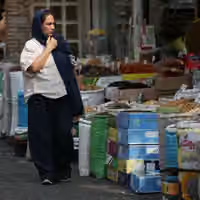
People walk and shop in a local market in Tehran, Iran, summer of 2026

Four years after Mahsa Amini’s death, the deepest legacy of Woman, Life, Freedom may be that Iran cannot simply be returned to the society it was before September 2022.

Four years have passed since Zhina Mahsa Amini, a 22-year-old woman who had travelled to Tehran to visit family, died after being detained by the morality police.

She could never have imagined how her name would appear on walls, streets and university campuses, or on the lips of millions of Iranians, or how three simple words, “Woman, Life, Freedom,” would become one of the most enduring slogans in Iran’s modern history.

The story of 2022 is not only the story of a slogan. It is the story of the price thousands paid to break through the wall of fear.

Zhina’s death on September 16, 2022, sparked protests across Iran. Human rights organizations documented live ammunition and pellet fire, mass arrests, torture, sexual violence and the killing of protesters. HRANA later recorded protests in all 31 provinces, 160 cities and 143 universities, and reported at least 530 people killed, including 68 children and teenagers.

Nika Shakarami and Sarina Esmailzadeh were both sixteen. Kian Pirfalak was nine, remembered for “In the name of the God of the rainbow” and the small boat he built with his own hands. Khodanour Lojei, a 27-year-old Baluch man, lives on in videos of him dancing, alongside the haunting image of him with his hands tied to a pole and water placed before him while in detention.

Their stories were different, but each became part of the collective memory of Woman, Life, Freedom.

Then came the gallows. Mohammad Mehdi Karami, a 22-year-old karate champion, was executed after being sentenced in connection with the fortieth-day commemoration for Hadis Najafi. Seyed Mohammad Hosseini, who worked at a poultry farm and taught martial arts to disadvantaged children for free, was executed the same day; human rights reports say his confessions were obtained under torture. Majidreza Rahnavard, executed only 23 days after his arrest, asked before his death that people not cry at his grave but celebrate and play happy music.

These names are reminders that behind every statistic was a family.

The repression did not end with the street protests. Students, schoolchildren, journalists, artists, athletes and activists were arrested. Families sometimes went weeks or months without news. Some detainees appeared in televised “confessions” that human rights organizations said were tainted by torture. Families seeking the truth about those killed also faced pressure. Others eventually left Iran after imprisonment, threats and persecution, carrying the cost of the uprising into exile, lost careers, interrupted education and separation from family.

And yet one of the movement’s deepest legacies is visible in an ordinary scene: a woman walking down an Iranian street without compulsory hijab.

The state responded with fines, vehicle seizures, arrests, flogging, business closures, cameras and surveillance. But women’s defiance continued. Four years after Zhina’s death, a woman without compulsory hijab is no longer the exceptional image it was in September 2022; it has become part of Iran’s social reality.

That is also where the connection to Dey 1404 (December 2025 and January 2026) becomes important.

The new protests began amid the collapse of the currency, inflation and protests by Tehran bazaar merchants, but quickly moved beyond economic demands. According to HRANA data cited in a UK government report, by January 27 at least 656 gatherings had been recorded in 201 cities across all 31 provinces, compared with 160 cities during the 1401 protests.

There are no reliable data to compare total participation, but the later uprising was documented across more cities and had a far higher reported toll. By March 2026, HRANA had recorded information on more than 7,000 people killed and more than 53,000 arrested in connection with the Dey and Bahman protests, far above the Iranian government’s figures.

HRANA described the confirmed cases as the minimum it could verify, with thousands more still awaiting review. Internet shutdowns, pressure on families and the lack of independent access inside Iran made the full scale harder to establish.

But the difference was not only scale. The society that entered January 2026 was not the same society that had existed before September 2022.

Iranians had lived through a national experience of disobedience, broken taboos, solidarity, bullets, prison, executions, migration and grief.

Abolfazl Hajizadegan’s research on “The Lives of Dey,” based on the social-media traces of 957 of those killed, found people from widely different professions and backgrounds, from baristas, repair workers and sports coaches to lawyers, professors, filmmakers and musicians.

The uprising also entered families in ways that made the breadth of the upheaval painfully visible.

Mehdi Shafiei, 44, and his 18-year-old son Mani were killed in Eslamshahr less than two hours apart. In Bushehr, 37-year-old nurse Mansoureh Heydari and her husband, Behrouz Mansouri, were both killed, leaving behind two children. Elsewhere, fathers and daughters were arrested together.

This does not mean that the 1401 and 1404 uprisings were identical, or that all protesters shared one ideology, leader or vision of Iran’s future. Their immediate triggers were different. But something had changed in society’s relationship with fear.

Repression continued, but the memory of disobedience could not simply be erased. Hajizadegan’s research suggests that those who came into the streets in 1404 did not acquire their anger overnight. Their earlier posts showed dissatisfaction and protest stretching back through previous protest waves, including the November 2019 protests and the 2022 uprising.

Dey 1404 was therefore not simply the explosion of an economic crisis. It was part of a longer accumulation of experience. Perhaps this is one of the most important legacies Woman, Life, Freedom left behind: not a single organization or leadership, but a social experience of the possibility of saying “no.”

The government’s response in Dey 1404 was severe. From January 8, the internet was almost completely shut down. Amnesty International reported widespread killings, mass arrests, enforced disappearances, torture and systematic pressure on victims’ families.

Yet behind every new number was another life: Hamid Mahdavi, Mohammad Jabbari, Mehdi and Mani, Mansoureh and Behrouz, just as Nika, Sarina, Kian and Khodanour had been lives, not statistics, four years earlier.

From September 2022 to January 2026, the names and faces changed and the sparks were different, but each chapter left something for the next: memory, wounds, language, courage and sometimes hope.

Zhina is not only the name of a young woman, and Woman, Life, Freedom is not merely the name of a few months of protest. It became part of the social and political language of a generation that paid an extraordinarily heavy price and emerged with a different understanding of choice, dignity and the possibility of standing firm.

Zhina and thousands of others killed in Iran’s protest movements are no longer with us. But something of them remains: in the hair of a woman who chooses not to cover it; in a mother who refuses to let her child’s name be erased; in a father who rejects the official account of his son’s death; in a family that dances at a loved one’s grave despite threats; and in a generation that has not abandoned its questions about freedom, dignity and the future.

Repression can empty the streets for a time, but it cannot erase what a generation has lived through.
Video of Iran's police sexually abusing teenager draws fury

Sep 17, 2026, 14:25 GMT+1
•
Hooman Abedi
100%
A police officer restrains a teenager in Iran's nortwestern city of Tabriz in footage showing the teenager being beaten, verbally abused and sexually humiliated by officers. The image has been enhanced using AI for improved quality.

A video showing Iranian police beating and sexually humiliating a teenager while officers laugh, insult him and film the abuse has unleashed fury across Iranian social media, with users asking what may happen beyond public view.

The footage shows several uniformed officers surrounding the teenager as he is struck and subjected to sexual humiliation. At one point, an officer appears to expose or touch the boy's buttocks as other officers watch.

The atmosphere captured by the camera has become almost as central to the outrage as the physical treatment itself. The officers can be heard joking during the encounter.

“We haven't seen his buttocks yet,” one voice says in Iranian Turkish during the recording. Another uses a homophobic slur against the teenager.

East Azarbaijan province police confirmed that the confrontation occurred in Tabriz on June 4 after the person was detained following a street fight, according to the police account carried by state media.

The police said "the officers responsible for the improper treatment" of the teenager are in custody. It said it took "internal disciplinary action against the officers as soon as it learned of the incident, but added that this does not preclude judicial proceedings against them."

Dadban, an Iranian legal rights group, argued that the images should not be reduced to “improper behavior” or an internal disciplinary issue.

The beating and humiliation of a detainee by state officers can carry criminal liability under Iranian law, Dadban said. If the person shown is a minor, the sexual conduct would also fall under legal protections covering children and adolescents and should trigger an immediate, independent criminal investigation, the group said.

‘What happens behind closed doors?’

The images quickly produced a torrent of anger online, much of it centered not simply on the violence but on how openly it appeared to take place.

“If they sexually assault a child in front of a camera, what is happening in detention centers?” one social media user wrote, invoking the death of Mahsa Amini after her detention by morality police in 2022.

“When this happens publicly and with this degree of impunity, there can be no guarantee about people's safety in detention centers and behind closed doors,” another reaction said.

Another user returned to the same fear in starker terms: if this can happen to a teenager in front of a camera, “what is happening in detention centers?”

“If we die from this pain, it would be understandable,” another wrote.

Some demanded that the footage be circulated widely enough for every officer involved to be identified.

Another video fuels the anger

The footage emerged only days after another video from Tabriz circulated widely online, showing a police officer holding two young men's heads close to the loud exhaust of their vehicle.

The apparent purpose was to force them to experience the noise their car had been making.

That video drew significant engagement on social media after appearing online.

Dadban argued that even if the men had committed a traffic offense, police had no authority to invent a roadside punishment. Officers could document an offense, take measures permitted by law and refer suspects to the appropriate judicial authority, the group said.

The two recordings circulation within days of each other has intensified an online argument about police power, humiliation and accountability.

Bonuses sharpen anger

The videos have surfaced just as reports of new bonus payments to members of Iran's armed forces have spread online, adding another source of anger over the treatment of security personnel.

Reports published said a presidential bonus linked to service during the recent war had been deposited for armed forces personnel, with 100 million rials ($43) for staff personnel and 150 million rials ($65) for operational personnel.

Normal military personnel generally earn about 300 million rials ($130) a month, according to figures circulating with reports of the payments.

The timing has drawn a darker interpretation from some government critics on social media. They portrayed the payments as an effort to keep security forces loyal and ready to use greater force should another round of anti-government protests erupt.

That fear comes against a charged backdrop. Security forces were deployed in cities across Iran before a gasoline price increase took effect on September 8, with police, special units and Basij forces reported on streets and around fuel stations in cities including Tabriz, Tehran, Mashhad, Shiraz and Isfahan.

For critics circulating the police videos, the combination is combustible: footage they see as evidence of officers abusing their authority arriving at the same time as reports of authorities rewarding members of the security apparatus.

One reaction to the teenager's treatment went further, questioning why people had previously objected to police stations being destroyed by Israel during the war.

George Floyd comparison resurfaces

One social media response to the teenager's video pointed directly to the contrast with the Iranian leadership's reaction to police violence abroad.

“If American police had committed such a crime, what would the Islamic Republic be doing now?” the user wrote.

It is a comparison with a documented precedent.

After Minneapolis police officer Derek Chauvin killed George Floyd in May 2020, former Supreme Leader Ali Khamenei used Floyd's death to criticize the United States and its treatment of Black Americans.

Khamenei described Floyd's killing as revealing the “nature” of the US system and invoked Floyd's dying words, “I can't breathe,” in arguing that they reflected broader grievances against Washington.

Iranian officials and state media devoted extensive attention to Floyd's killing and the demonstrations that followed.

The comparison adds another layer to the anger surrounding the Tabriz footage: For those sharing the teenager's video, the camera has now turned inward.

And beneath the insults, abuse, laughter and blows, one question has persisted across the reaction: if officers can do this while somebody is filming, what happens when nobody is watching?

US House passes Iran sanctions as Trump signals war may be nearing end

Sep 17, 2026, 13:11 GMT+1
100%
Ukraine's President Volodymyr Zelenskiy welcomes US Senator Lindsey Graham (R-SC) before their meeting in Kyiv on July 10, 2026.

The US House of Representatives passed the Lindsey O. Graham Sanctioning Russia and Iran Act of 2026, clearing the sweeping measure for President Donald Trump’s signature as Washington also signaled that the Iran war could be approaching a diplomatic turning point.

The House approved the sweeping sanctions legislation by a vote of 262-159 on Wednesday, after the Senate passed it 86-11 last month. Fifty-eight Democrats supported the bill, while seven Republicans opposed it.

The legislation would authorize the president to impose tariffs of up to 100% on the largest purchasers of Russian oil and natural gas and sanction senior Russian officials, oligarchs, banks and financial institutions. At Trump’s request, lawmakers also expanded the measure to include sanctions targeting Iran’s energy and weapons sectors.

Republican Representative Joe Wilson welcomed its passage and said lawmakers were looking forward to Trump signing it into law.

The measure could affect major importers of Iranian and Russian energy. India said Thursday that it had noted the bill’s passage while emphasizing that it remained committed to securing energy supplies through diversified sourcing and in response to changing market conditions.

The sanctions push came alongside indications that Washington and Tehran may be exploring a path toward ending the war. Trump said on Wednesday after arriving in North Carolina that he hoped the conflict was nearing its conclusion, adding that Iran was seeking an agreement.

“Well, hopefully we’re toward the end of the war,” Trump told reporters. “Iran is very much wanting to make a deal. We’ll see how that works out.”

Trump is also expected to meet leaders or foreign ministers from the six Persian Gulf states on the sidelines of the UN General Assembly in New York next Tuesday, Axios reported. The meeting is expected to address the next phase of the war and US proposals for a postwar strategy.

Iranian Foreign Minister Abbas Araghchi, meanwhile, said consultations during his visit to China had been successful and endorsed Chinese President Xi Jinping’s proposals for ending the conflict.

China’s Foreign Ministry said Araghchi told Foreign Minister Wang Yi that Iran did not want the hostilities to continue and hoped to return to diplomacy. Wang urged Iran and the United States to revive the negotiating framework established under the Islamabad memorandum, called for the reopening of the Strait of Hormuz and backed dialogue between Iran and Persian Gulf states.

Araghchi also held separate telephone calls from Beijing with Turkish Foreign Minister Hakan Fidan and Pakistan’s army chief, Field Marshal Asim Munir, to discuss regional developments.

A parallel diplomatic channel emerged in Oman, where US officials met senior representatives of Yemen’s Iran-backed Houthis over the weekend, Reuters reported. The Houthis said they had no intention of attacking American vessels and remained committed to their 2025 ceasefire with Washington, according to the report.

Two sources told Reuters that the group promised not to target US ships. A Yemeni source said the Houthis also pledged not to attack Israeli or other commercial vessels, with the exception of Saudi ships.

The discussions took place against a backdrop of continued fighting between the Houthis and Saudi Arabia. Riyadh said it intercepted a Houthi drone near Mecca this week, an allegation the group denied. Saudi Arabia has also sought air-defense assistance from France, Britain, Pakistan and Egypt as its interceptor stocks decline, the Associated Press reported.

Houthi-run media said Saudi strikes in Yemen on Thursday hit telecommunications towers in Taiz and killed one person in Abs. The Houthis also released footage they said showed the downing of a Saudi F-15, a claim that Saudi Arabia had not confirmed.

Maritime traffic through the Strait of Hormuz remained severely constrained despite the diplomatic activity. Only three commodity vessels transited the waterway on Wednesday, down from 12 a day earlier and far below the 10-day average of about 17, Reuters reported, citing preliminary ship-tracking data.

US Central Command maintained that commercial traffic was still moving and that Iran did not control the strait. Its spokesperson said US forces had helped vessels carrying more than 900 million barrels of crude pass through the waterway since early May and had cleared mines from internationally recognized shipping lanes.

The sanctions bill, diplomatic contacts and continuing disruptions at Hormuz and in Yemen left Washington applying further economic pressure while testing whether negotiations could reduce the regional fighting.

Iran cancer patients sell household goods to pay for treatment

Sep 17, 2026, 11:27 GMT+1
100%
A cancer patient receives treatment at a hospital in Iran.

Some cancer patients in Iran are selling essential household goods or abandoning medication as soaring drug prices and gaps in insurance coverage put treatment beyond the reach of low-income families, a charity director said on Thursday.

Families have sold refrigerators and televisions to buy cancer drugs, while some patients have stopped taking medication because they can no longer afford it, Hossein Zehtaban, the head of a cancer support charity in the western province of Kermanshah, told Iran's ILNA news agency.

“We are facing patients who explicitly say they cannot afford their medication, that they are no longer taking it and are waiting to see what happens,” he said.

The warning comes during a sharp rise in pharmaceutical costs across Iran. Producer inflation in the pharmaceutical, chemical and herbal products sector reached 114% year-on-year, according to Iranian economic outlet Zooman.

A recently published price list from Iranian pharmaceutical manufacturer Loghman showed increases of more than 500% for some medicines. Donepezil, used to treat symptoms of Alzheimer's disease, rose 543% for a 10-milligram dose, while the price of clarithromycin increased 308%.

Workers struggle with treatment bills

Zehtaban cited one family with three cancer patients whose main breadwinner is a worker. Medication for each patient can cost 400 million to 500 million rials ($174-$217 at an exchange rate of 2.3 million rials to the dollar) a month, he said.

100%
A healthcare worker tends to a patient in an intensive care unit at a hospital in Iran.

Iran’s minimum base wage for workers is about 166 million rials a month, meaning the medication for just one of the three patients could cost roughly two-and-a-half to three times a minimum-wage worker’s monthly pay.

The charity has about 1,700 cancer patients registered for support, though the charity director said the figure does not represent the total number of cancer patients in Kermanshah province because other organizations also provide assistance.

Insurance problems are adding to the financial pressure, he said. Pharmacies facing unpaid insurance reimbursements have reduced provision of some medicines, forcing cancer patients to search multiple pharmacies for prescribed drugs, he added.

Drug prices surge

The financial strain described by Zehtaban extends beyond cancer treatment.

Loghman's published price changes show increases across dozens of medicines, with 23 products rising by at least 100%. Donepezil rose by 427% for the five-milligram dose and 543% for the 10-milligram dose, while Tadalafil, which is used to treat erectile dysfunction, enlarged prostates and pulmonary arterial hypertension, had the largest increase at about 706%, according to reports citing the company's regulatory disclosure.

100%

Rising medicine costs have combined with food and other household expenses to make supporting cancer patients increasingly difficult, Zehtaban said. Vitamins and nutritional supplements recommended during treatment are also often excluded from insurance coverage.

The charity provides financial assistance as well as weekly psychological and physical rehabilitation sessions, but he said its resources cannot cover the mounting treatment costs.