Oil loadings suspended at Saudi Arabia’s Yanbu port after pipeline attack - Reuters
Oil loadings at Saudi Arabia’s Red Sea port of Yanbu have been suspended, days after the world’s largest crude exporter shut its East-West pipeline following an attack by Yemen’s Iran-backed Houthis, Reuters reported on Tuesday, citing shipping industry sources.
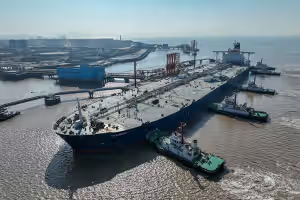
Vessels near the Strait of Hormuz, as seen from Musandam, Oman, August 31, 2026.
Iranian newspapers that agree on almost nothing agreed on Monday that the Muscat talks had collapsed. Kayhan, Shargh and Donya-ye Eghtesad all reported it, and the argument has already moved to what Tehran does next.
Kayhan on the hard right, and Shargh and Donya-ye Eghtesad on the pragmatic and pro-reform side of the divide, all reported that the talks in Oman had effectively broken down, leaving Tehran without an immediate way out and its economy exposed to worsening inflation, shortages and a lurching currency.
The meeting had been meant to give Iran a diplomatic opening. Foreign Minister Abbas Araghchi was due to present maps for a "managed transit corridor" through the Strait of Hormuz, and to seek regional endorsement of an Iran-Oman "phased framework," a temporary joint corridor and mine-clearance plan.
It did not happen. Fars News, affiliated with the Revolutionary Guards, reported that the postponement had been a joint decision by Tehran and Muscat, taken at the request of unnamed "certain regional countries."
Behind that phrasing sat a refusal. Saudi Arabia and Bahrain did not attend, and the Arab monarchies of the Persian Gulf declined to endorse Iran's transit proposal. They were being asked to back a plan for safe passage through Hormuz at a moment when Iran-aligned Houthi forces were expanding strikes on Saudi Arabia's East-West pipeline and fortifying coastal artillery at Bab el-Mandeb after taking the port of Mokha.
Washington's position was its own obstacle. It rejected treating the shipping question in isolation, insisting any transit arrangement be tied to broader nuclear concessions. Tehran's answer was that normal shipping requires an immediate halt to US tanker interdictions and the release of $24 billion in frozen Iranian assets under the Islamabad framework. Neither side moved.
The argument in Tehran
With the diplomatic route stalled, the argument inside Iran has turned to force, and the failure in Oman has sharpened it.
Kayhan, other Guards-aligned outlets and figures in the ultraconservative Paydari Front are pressing to abandon proportional retaliation altogether and to strike all Western-aligned shipping if a single Iranian vessel is hit.
They have paired this with a push to treat calls for referendums or ceasefires as treason, to cast economic hardship as an ideological duty, and to demand full withdrawal from the Non-Proliferation Treaty after the IAEA referred Iran to the UN Security Council.
Reformist and moderate figures in the administration argue instead for keeping the channels through Qatar and Oman open and putting economic survival first. But this is a dispute over method, not over the system either camp is defending: one faction would answer the blockade with escalation across the Persian Gulf and Red Sea, the other fears that combining a naval blockade abroad with intensified repression at home would leave Iran isolated on both fronts at once.
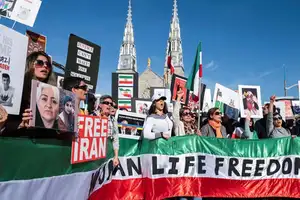
That repression is already visible. Police and the Revolutionary Guards have increased street patrols and moved additional forces into Tehran and Isfahan ahead of the anniversary of the 2022 Woman, Life, Freedom protests, which began in mid-September.
The economy behind the argument
The deadlock feeds directly into the crisis that produced the talks in the first place.
Point-to-point inflation is nearing 90 percent, and on the open market the rial is at 2.3 million to the dollar. Against a minimum monthly wage now worth about $72, the volatility alone makes household budgeting impossible.
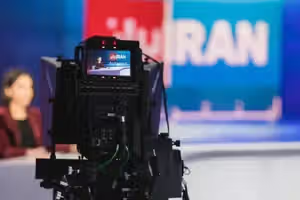
The sharpest damage is in medicine. Container backlogs at Bandar Abbas, Iran's main southern port, have choked domestic pharmaceutical production and caused acute shortages of essential drugs. Out-of-pocket medical costs have more than doubled, pushing low-income households to abandon treatment. In call-ins to Persian-language television abroad, viewers have described selling household belongings to pay for care.
The government's own remedies have added to the strain. It has raised petrol prices and drawn on the central bank's foreign currency reserves, steps that have deepened the erosion of public trust rather than eased it.
The postponement, then, does more than delay a meeting. It removes Tehran's nearest diplomatic exit at a moment when the hardline factions are pressing for wider retaliation across the Persian Gulf and the Red Sea, and when the economy can least absorb what that would cost. Whatever Iran's rival camps decide, it is private businesses and urban households that will carry it.
An Indian liquefied petroleum gas (LPG) carrier, Shivalik, arrives at Mundra Port via the Strait of Hormuz, amid the US-Israel conflict with Iran, in Gujarat, India, March 16, 2026.
Shipping through the Strait of Hormuz fell sharply as Iran prepared diplomatic talks in China, while attacks on Saudi Arabia and damage to Persian Gulf cloud infrastructure underscored the widening consequences of the war on Tuesday.
Only four commodity vessels crossed Hormuz on Monday, down from 10 on Sunday, Reuters reported, citing preliminary Kpler data. Two dry-bulk carriers exited, one carrying cargo and the other empty, while two empty oil tankers entered. The figures exclude ships that may have crossed with their tracking transponders switched off. TankerTrackers separately said two-way daytime traffic by very large crude carriers was continuing.
The dangers facing shipping were illustrated by the Panama-flagged tanker Elgaia, which Oman’s Maritime Security Center said was being towed to port after catching fire following an earlier attack.
An Omani naval vessel evacuated 23 crew members and arranged medical care, while searches continued for two missing people. The incident occurred about 1.3 nautical miles northeast of Musandam governorate. The statement did not identify an attacker.
Pressure also intensified around Bab el-Mandeb, the southern gateway to the Red Sea. Commodity-vessel transits there fell to 21 on Monday from 28 the previous day. France requested a UN Security Council meeting on the crisis for Tuesday afternoon in New York, Reuters reported, citing French diplomats.
Turkey’s Foreign Minister Hakan Fidan said reciprocal attacks in the Persian Gulf were undermining efforts to end the war and must stop immediately. Speaking in Baku, he called for freedom of passage through Hormuz and restoration of the situation before the war, saying Ankara was in contact with all parties.
Pakistan and the UN nuclear watchdog also backed a diplomatic route. Foreign Minister Ishaq Dar and IAEA chief Rafael Grossi agreed that implementing the Islamabad memorandum of understanding between Iran and the United States remained the best way to defuse tensions, Pakistan’s Foreign Ministry said. Grossi offered technical assistance if needed.
Saudi attacks and US war costs The Saudi-led coalition said Houthi ballistic missiles and drones struck civilian targets in Khamis Mushait, Abha and Taif on Monday, injuring 13 people.
Coalition spokesperson Major General Turki al-Malki said the injuries ranged from minor to moderate and that seven homes and two vehicles were damaged. He said the coalition would respond “responsibly and firmly” and take measures to deter further attacks.
Saudi Arabia’s Civil Defense issued new emergency alerts in Abha and Khamis Mushait on Tuesday before announcing shortly afterward that the danger had passed in both locations. Authorities did not disclose the nature of the threats.
Yemeni government aircraft, meanwhile, targeted Houthi weapons depots in Al-Jubah and below Mount Haylan in Marib province, Al Arabiya reported. Government forces also thwarted an attempted Houthi infiltration in Harib, south of Marib, according to the report.
The UN Security Council was scheduled to meet Tuesday afternoon in New York to discuss the deteriorating situation around the Bab el-Mandeb Strait. France requested the meeting, two French diplomats told Reuters.
A US Defense Department inspector general report showed the scale of the conflict’s cost to Washington. The report estimated that the war had cost the United States about $33.4 billion through June 29 and had produced shortages of strategic munitions and exposed bottlenecks in the US defense industrial base.
The total included $22.3 billion in expended munitions, $3.7 billion in equipment losses and $7.4 billion in cumulative obligations, excluding repairs to military infrastructure.
US Central Command said that Iranian strikes damaged or destroyed hundreds of buildings and structures at US bases in Kuwait, Bahrain, Qatar, the United Arab Emirates, Saudi Arabia, Iraq, Oman and Jordan. Dozens of US aircraft were also damaged or destroyed during Operation Epic Fury, according to the report.
Seven US service members were killed in action and 417 were wounded between February 28 and June 30, while seven others died in non-hostile incidents.
IRGC officials mark 200 days of Khamenei’s rule Inside Iran, senior IRGC officials expressed allegiance to Supreme Leader Mojtaba Khamenei as he completed 200 days in power without appearing publicly.
IRGC Aerospace Force commander Majid Mousavi praised Khamenei’s leadership in a message marking the 200th consecutive night of government-backed street gatherings. He urged participants to preserve their “sacred unity” and continue supporting the government, political officials and armed forces by following Khamenei’s directives.
Abdollah Hajisadeghi, Khamenei’s representative to the IRGC, similarly described the nightly gatherings as support for the armed forces, a “steadfast pledge of allegiance” to Mojtaba Khamenei and a demand to “avenge” slain Supreme Leader Ali Khamenei.
The Basij also expanded its Janfada mobilization campaign, sending mass text messages announcing the start of military and first-aid courses for its “people’s units.” The campaign has said preparations are underway to train and organize 1,000 “national resistance” battalions.
Women enter a detention facility under the supervision of a guard in Iran.
Female political prisoners at Iran's Evin Prison face increasingly invasive body searches involving forced undressing and breast touching, leading some to forgo medical treatment and visits, sources told Iran International.
“In some cases, prisoners have been forced to lift their shirts and the guards have also touched their breasts,” one source said.
Body searches have become routine in Evin's women's ward in recent months. Female guards search political prisoners before they leave for family visits, medical treatment or court appearances.
The searches take place in a cubicle recently designated for the purpose. Guards touch different parts of prisoners' bodies and sometimes order them to move or remove clothing, according to the account.
The visitation area of the women’s ward at Evin Prison in Tehran - Photo by Maggie Parvaneh
Families and children searched
Relatives visiting prisoners are also facing more intrusive searches under tighter security measures that differ from previous procedures, another source told Iran International.
Guards force relatives to remove their shoes, inspect the inside of their mouths and touch different parts of their bodies. Children and teenagers visiting imprisoned family members are not exempt and are also touched during searches.
Twenty-two female political and ideological prisoners at Evin demanded an investigation into what they called “sexual harassment” during body searches in a letter in October 2024.
Transgender prisoner Ghazal Marzban also wrote from Evin on August 21 that she was raped following her arrest in May 2023 at an Intelligence Ministry detention facility and threatened into silence.
Sexual violence against detainees has been documented in Iranian prisons since the aftermath of the 1979 revolution, with former prisoners and rights groups describing its use as a means of torture and humiliation.
Searches deter treatment and visits
The increasingly invasive searches have led many women to forgo medical transfers or meetings with relatives and lawyers rather than undergo the procedures, the sources said.
A women’s ward at Qarchak Prison in Iran.
Pressure over prisoners' clothing when leaving the ward has also increased. Women have in some cases been forced to wear slippers and handcuffs.
Iran's Prisons Organization regulations permit searches without clothing only when necessary and under specified conditions. They also require body searches to be conducted with electronic equipment wherever possible.
The sources questioned why scanning equipment was not being used, describing the current procedures as a means of harassment rather than necessary security measures.
More than 40 women imprisoned for financial offenses were recently transferred to Evin's women's ward, and restrictions increased following their arrival, another source told Iran International.
Prison authorities have justified some of the tighter rules by pointing to the presence of non-political prisoners. Women imprisoned for financial offenses now make up around half of those held in the ward.
Iran International reported on July 12 that women protested the transfer over overcrowding and the failure to separate prisoners according to offense. Special prison guards entered the ward and beat several protesters with batons.
A file photo of a women's prison in Iran.
Some political prisoners view the mixing of political and financial prisoners as a deliberate policy intended to weaken collective resistance to restrictions.
Evin's women's ward has become a center of political prisoner activism in recent years, with women staging protests and hunger strikes over executions and other political and social issues.
Photos published by Iran’s Alaj platform show Iranians abroad targeted by the project, which asks members of the public to help identify and report overseas opponents of the Islamic Republic.
The Islamic Republic has launched a platform asking citizens to identify and report opponents living abroad. Iranians met it with ridicule, pointing to how deeply the state's own security apparatus has been infiltrated.
The Alaj platform – whose name means “remedy” or “cure” in Persian – accepts information through its website, a Telegram bot and Iran's Bale messaging service.
“Alaj operates with the aim of safeguarding national security against anti-Iranian currents,” the Guards-affiliated Fars News Agency said in announcing the project on Monday.
State television also promoted Alaj, giving wider exposure to a system Iranian media had previously discussed but not promoted on the same scale.
Alaj says it has identified and monitored 1,600 people, including 600 identified through reports from members of the public, according to Iranian state media.
Its website publishes information about Iranians abroad, including names and photographs and, in some cases, national identification numbers, dates of birth and fathers' names.
The platform says it targets people outside Iran who act “against the country's interests and security,” including those advocating sanctions or military action and members of separatist groups.
Alaj also lists potential measures against people it identifies, including freezing assets and withdrawing access to consular and citizenship services.
The project's name carries a pointed connotation. Alaj translates as “remedy” or “cure,” framing the people targeted by the platform as a problem to be treated.
People ridicule campaign
Responses to the post promoting Alaj ranged from mockery of Iran's security establishment to explicit warnings that people who inform on opponents could themselves be identified and punished in the future.
One commenter predicted the platform would be hacked and the identities of those submitting reports made public, arguing that previous breaches of major Iranian institutions gave little reason to trust Alaj with sensitive information.
Another suggested the government's turn could eventually come, writing that authorities appeared to have little hope left even of securing future amnesty.
Others portrayed the campaign as a tactic opponents of the Islamic Republic could use themselves. One user said supporters of the Revolutionary Guards and Hamas abroad had already been publicly identified by opponents and several had lost their jobs as a result.
Several responses contrasted the effort to identify ordinary Iranians overseas with Israel's apparent intelligence penetration inside Iran.
“Start with the infiltrators inside your own ranks,” one person wrote, arguing that Israeli intelligence appeared to have extensive knowledge of Iranian officials.
Another mocked the limits of Iran's controls over information, asking whether authorities intended to “nationalize the internet outside the country” to prevent overseas opposition activity.
Other comments were considerably more explicit, threatening revenge against people who cooperate with Alaj after any future change of government.
Pezeshkian targets Iranians abroad
The campaign coincides with sharper official rhetoric toward politically active Iranians overseas.
“Some Iranians abroad, aligning themselves with the enemy, seek to incite the public within the country,” President Masoud Pezeshkian said during a social event on Monday, according to state media.
Pezeshkian accused Washington of seeking “to cause social collapse through the problems and restrictions they have imposed,” and said preserving domestic unity would prevent Iran from yielding to US pressure.
Guards used similar model at home
Alaj follows a similar crowdsourcing project launched by the Revolutionary Guards Intelligence Organization in June to identify citizen journalists and social-media users inside Iran.
Known as Jasous-Yab, or “Spy Finder,” the project used channels on the Iranian Eitaa and Bale messaging platforms to ask members of the public to identify people photographing or filming missile strikes and other sensitive locations.
“This time, you identify the spies,” the campaign told users.
A large gathering of Iranians in Munich, Germany, in February 2026, with participants waving Lion and Sun flags.
People were instructed to scrutinize buildings, roads, sounds, distances and other details visible in photographs and videos to determine where material had been recorded and submit information to Revolutionary Guards intelligence.
The project also sought to identify social-media users opposing the Islamic Republic, extending its scope beyond people recording events on the ground.
Alaj takes that crowdsourcing model beyond Iran's borders, asking citizens to help identify overseas opponents and feeding the resulting information into a system that advertises consequences for those it identifies.
Overseas operations
Iranian intelligence activity targeting dissidents and journalists overseas has previously prompted criminal investigations, sanctions and warnings from Western governments.
Authorities in the United States and Europe have accused Iranian security bodies and people working on their behalf of conducting surveillance and plotting abductions or killings of opponents abroad.
Activities linked to Alaj could therefore face scrutiny under espionage, foreign-interference or transnational-repression laws in countries where targets live, depending on how information is gathered and subsequently used.
US prosecutors are seeking the forfeiture of about $61 million in cryptocurrency that came from black-market sales of sanctioned Iranian crude oil and petroleum products and was intended to finance Iran's government and military, including the Revolutionary Guards.
The US Attorney's Office for the Southern District of New York said on Monday it had filed a civil forfeiture complaint over the assets, which prosecutors said were linked to a network that moved more than $1.5 billion in proceeds from Iranian oil sales.
The IRGC is designated by the United States as a terrorist organization.
Prosecutors target oil payment network
"Today's action demonstrates our determination to deprive the Government of Iran and its terrorist proxies of the illegal money they rely on to threaten the lives and safety of the citizens of the United States and elsewhere," Deputy US Attorney Sean S. Buckley said.
Buckley said Iran relied on black-market sales of sanctioned crude oil to fund its military and other activities.
"As alleged in the complaint filed today, the Government of Iran used a network of cryptocurrency actors in China and elsewhere to launder more than $1.5 billion in illicit oil money intended to benefit the Iranian military and the terror-designated IRGC," he said.
Chinese companies named in complaint
The complaint said two Chinese companies, Blessed Trust and Hexa Whale, used accounts at cryptocurrency exchange Binance in the United Arab Emirates to move proceeds from Iranian oil sales.
Prosecutors said Blessed Trust presented itself as a wealth management or virtual asset custodial services firm but received and transferred proceeds from Iranian crude oil and petroleum product sales. They said it also helped convert traditional currency into cryptocurrency, including through US-based cryptocurrency issuers.
Hexa Whale presented itself as a commodities broker but provided similar services and worked with Blessed Trust and related entities, according to the complaint.
More than $1.5 billion moved through addresses
The complaint said a group of linked, unhosted cryptocurrency addresses identified as "Entity A" received and distributed more than $1.5 billion in proceeds from Iranian oil sales.
Prosecutors said the addresses sent funds to money services businesses and cryptocurrency addresses linked to the IRGC, as well as to an Iranian cryptocurrency exchange.
They said transactions involving Blessed Trust, Hexa Whale and people associated with the companies were structured to conceal the source, ownership and nature of the funds. The complaint also said the two companies used the US financial system to send or receive tens of millions of dollars.
FBI says action cuts funding
"Today's complaint demonstrates the FBI's ability to follow the money, root out illicit schemes, and halt the stream of cryptocurrency to any government attempting to evade sanctions or committing terrorist activities," said James C. Barnacle Jr., assistant director in charge of the FBI's New York field office.
"By cutting off funds raised by the black-market sale of crude oil, the Iranian military and terrorists are weakened," Barnacle said.
The US Attorney's Office said a civil forfeiture complaint contains allegations that money or property was involved in, or represents proceeds from, a crime. The allegations have not been proven, and a court must rule in favor of the United States before the assets can be forfeited.