Pakistan, IAEA chief back Iran-US MoU to ease regional tensions


Pakistani Foreign Minister Ishaq Dar and IAEA Director General Rafael Grossi agreed that implementing the Islamabad memorandum of understanding between Iran and the US remained the best way to defuse regional tensions, Pakistan’s Foreign Ministry said Tuesday.
During a phone call late Monday, the two discussed the evolving regional situation, with Grossi offering technical assistance if needed, according to the statement.
Dar also wished Grossi well in his campaign to become the next UN secretary-general.




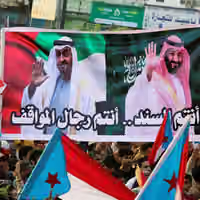


Iran has gained leverage over Saudi Arabia as Houthi advances and attacks put pressure on the kingdom’s territory and oil routes. But Riyadh is responding more forcefully, raising the risk that Tehran’s advantage could provoke a military backlash that ultimately weakens it.
Saudi Arabia is taking a harder military posture after efforts to defuse tensions with Tehran stalled. Riyadh had sought de-escalation, wary that a wider conflict could threaten the regional stability on which its economic ambitions depend.
A meeting planned for Monday between Iran and several Persian Gulf states over arrangements for the Strait of Hormuz was postponed after Saudi Arabia requested a delay, amid Riyadh’s growing frustration over attacks by Iran-aligned groups.
That leaves Riyadh with options, none of them ideal.
Saudi Arabia does not want an all-out war. But the Houthis may be testing how long the kingdom can afford to avoid one.
Saad bin Tefla Al Ajmi, Kuwait's former information minister, said Saudi Arabia has so far exercised patience but its military options remain open.
That restraint reflects what the kingdom has at stake. Saudi Arabia has spent years trying to avoid being dragged back into direct conflict with the Houthis, while its economic transformation depends heavily on regional stability.
"There is no stability, there is no development. There is no stability, there is no prosperity," Al Ajmi told Iran International.
But Houthi attacks on Saudi territory and advances along Yemen’s Red Sea coast are making that restraint increasingly difficult to maintain. The Saudi-led coalition said Houthi missile and drone attacks on Khamis Mushait, Abha and Taif on Monday injured 13 civilians.
Al Ajmi believes some of the Houthis' recent territorial gains could be reversed, particularly if Saudi Arabia decides to deploy its overwhelming advantage in air power. He described Houthi forces operating along the flat Tihamah coastal plain as "sitting ducks."
Saudi Arabia led a military intervention against the Houthis beginning in 2015, with direct hostilities largely subsiding after a UN-brokered truce began in 2022. Years of bombardment failed to eliminate the movement, and Riyadh subsequently spent years trying to avoid being pulled back into a full-scale Yemen war.
The question now is whether the Houthis are pushing that restraint too far.
Houthis risk overplaying their hand
The battlefield in Yemen remains fluid. The Houthis have seized Mokha, Dhubab and Perim Island and expanded their control along Yemen’s Red Sea coast, while Saudi-backed government forces have regrouped and vowed to retake lost territory. That leaves open the question of how durable the Houthis’ gains will prove.
"The Houthis fought the Saudis and the Saudi militias for years. They also have a history of being overextended," Alberto Fernandez, a former senior US diplomat, told Iran International.
Fernandez said the Houthis may have pushed too far.
"I think we could see them lose some of the territory that they've gained," he said.
"They're arrogant. Yes, they're motivated by ideology. And when you're motivated by ideology and you're arrogant, you tend to sometimes overextend," Fernandez said.
But the Houthis are also betting on reluctance from both Saudi Arabia and the United States to become drawn more deeply into the conflict.
Saudi Arabia's attempt to remain outside the wider Iran war has already "certainly backfired on them," Fernandez said.
The uncertainty over how much the kingdom can rely on its allies only complicates its options.
Fernandez described the relationship between Washington and Riyadh as increasingly complicated. The Saudis, he said, felt blindsided by the United States launching the Iran war, while Washington in turn felt unsupported by Riyadh.
That strain has become more visible as Crown Prince Mohammed bin Salman sought direct US military action against the Houthis, while Trump declined requests for US strikes and Washington limited its support to intelligence and targeting assistance.
That uncertainty also extends to the Makkah Joint Defense Agreement, signed by Saudi Arabia, Turkey and Pakistan on August 7. The pact says an armed attack against any one of the three countries will be regarded as an attack against all.
"So far [it] has turned out to be a paper tiger," Fernandez said, joking that the arrangement appeared to have the equivalent of a health insurance "pre-existing condition clause."
Saudi Arabia looks elsewhere for help
As Washington hesitates, Saudi Arabia is looking elsewhere.
British Prime Minister Andy Burnham is considering Saudi requests for diplomatic and military support to counter the Houthis, Bloomberg reported Monday, as London grows increasingly concerned about the economic consequences of another expanding front in the Iran war.
The requests come as Britain has backed Saudi Arabia’s right to defend itself against Houthi attacks and stressed the importance of protecting freedom of navigation and global trade through the Red Sea.
The widening conflict has raised the stakes beyond Yemen. Houthi gains along the Red Sea coast and around Bab el-Mandeb, combined with attacks on Saudi energy infrastructure, are putting pressure on westward export routes that have become more important while shipping through the Strait of Hormuz remains constrained.
The Houthi offensive and attacks on Saudi energy infrastructure have added further pressure to oil markets already strained by the Iran war. Brent crude climbed above $108 a barrel Monday after attacks shut down Saudi Arabia’s East-West pipeline, a crucial alternative export route while shipping through the Strait of Hormuz remains constrained.
"It gets to push up oil prices a little more," Fernandez said.
"For them, every dollar that prices go up, for them they see that as a plus for the regime, putting a little more pressure on the Americans and the Europeans."
The paradox for Tehran is that the greater the disruption caused by the widening conflict, the stronger the incentive may become for governments outside the region to help Saudi Arabia contain the threat.
Iran does not need to control the Houthis
"The broader strategic danger is that Iran does not need to control the Houthis completely to benefit from their actions," Mohamed Fahmy, a journalist and Middle East political analyst, told Iran International.
"It only needs the movement to retain sufficient military capability, autonomy and motivation to pressure critical maritime routes while Tehran maintains distance from the confrontation."
Fahmy cautioned against reducing the Houthis to an Iranian proxy.
They are "an intensely nationalist movement with their own domestic agenda and deeply rooted local interests," he said.
Their relationship with Tehran is nevertheless exceptionally close. Iran has provided weapons, military technology, intelligence and other support, Fahmy said, while the strategic interests of the two sides increasingly converge.
That convergence has become particularly consequential around the Red Sea and Bab el-Mandeb.
"One of the Houthis' strategic objectives is to exert control over Yemen's Red Sea coast and the northern Red Sea, where they can increasingly influence who is permitted to transit and who is not," Fahmy said.
For Tehran, the Houthis therefore provide an additional source of pressure on its adversaries without requiring direct Iranian military involvement.
But Saudi Arabia's military answer is not straightforward.
Fahmy pointed to Saada, the Houthis' traditional stronghold and geographical heart of their power, which has been repeatedly targeted by Saudi forces since the intervention began in 2015. Despite years of Saudi-led bombardment and military pressure, the Houthis survived and retained significant military capabilities.
"A limited campaign of additional strikes is therefore unlikely to fundamentally diminish their ability to threaten shipping or project power across the Red Sea," Fahmy said.
That leaves Saudi Arabia confronting a difficult choice.
Continued restraint risks allowing the Houthis to impose greater costs on the kingdom and giving Tehran additional leverage. But a renewed military campaign carries risks Riyadh knows well after years of fighting failed to eliminate the movement.
Iran has gained leverage as the war reaches Saudi Arabia. But the more Houthi attacks raise the costs for Riyadh, the greater the risk that Tehran’s leverage provokes the response that ultimately erodes it.
The United States and Iran both signaled openness to renewed negotiations Monday, even as Washington intensified its financial pressure campaign and conflicting accounts of incidents around the Strait of Hormuz underscored the mistrust surrounding any diplomatic opening.
President Donald Trump said Iran wanted an agreement and left open the possibility of US engagement, while Iranian President Masoud Pezeshkian said Tehran was ready for talks, including on its nuclear program, if Washington lifted sanctions and stopped negotiating “through force.”
“The failing Nation of Iran wants to make a deal, quickly and badly,” Trump wrote on Truth Social. “I will determine whether or not the U.S.A. will choose to engage - The concept of which we are open to.”
Pezeshkian, speaking to India Today, said Iran was “ready for dialogue” within the framework of the Nuclear Non-Proliferation Treaty and international law. He questioned why Washington wanted new negotiations rather than building on an understanding he said had already been reached in Pakistan with help from Islamabad and Qatar.
“Our position is the same as what we said before: the United States should lift its sanctions, abandon unilateralism, not speak to us through force, and open the way so that we can live like the rest of the world,” Pezeshkian said.
The diplomatic signals came alongside a markedly different message from Washington’s economic campaign.
The US Treasury on Monday imposed Iran-related sanctions on Russia’s VTB Bank, accusing the lender of helping Tehran evade restrictions through banking relationships and payment arrangements.
Treasury said VTB had established correspondent relationships with sanctioned Iranian financial institutions, taken steps to move billions of dollars in frozen Iranian assets and created a rial- and ruble-based settlement system to increase trade between Russia and Iran.
The measure expanded Operation Economic Outcast, launched in August to sever what Treasury describes as Iran’s remaining financial lifelines. Treasury Secretary Scott Bessent said the department would continue targeting those providing financial, technological or material support to Tehran and would “identify, expose, and isolate Iran’s enablers.”
Bessent also renewed a call for whistleblowers worldwide to provide information on networks facilitating Iranian financing, saying people with actionable information could qualify for an award regardless of where they live or work.
The contrast between talk of negotiations and tightening pressure was also visible around the Strait of Hormuz, where Washington and Tehran offered sharply different accounts of what happened to the Panama-flagged tanker EL GAIA.
The IRGC Navy said the tanker struck a naval mine while attempting to pass through what it called a restricted route south of the strait, causing an explosion and major fire. It said the Strait of Hormuz remained closed and under its “smart control.”
US Central Command rejected that account, saying EL GAIA had been struck by an Iranian missile last month and rendered inoperable before Iran hit it again with a drone over the weekend while it sat off Oman. CENTCOM said the vessel was being towed by a regional partner and called the IRGC account false.
Another reported incident late Monday added to the uncertainty.
Hormozgan deputy governor Ahmad Nafisi told Mehr news agency that two "fishing" boats had been struck by drones about 12 miles from Larak Island and 30 miles from Kargan port, leaving several crew members missing. Search-and-rescue operations were underway, he said.
There was no immediate independent confirmation of the attack or who may have carried it out.
The United States on Monday imposed new Iran-related sanctions on Russia’s VTB Bank on Monday, accusing the already heavily sanctioned lender of helping Tehran evade restrictions through banking relationships and payment arrangements.
The Treasury Department’s Office of Foreign Assets Control designated VTB under Executive Order 13902 for operating in Iran’s financial sector, expanding Operation Economic Outcast to one of Russia’s largest banks. The action follows measures targeting banking channels in Turkey and the United Arab Emirates.
Treasury said VTB established correspondent relationships with sanctioned Iranian financial institutions over the past three years, took steps to move billions of dollars in frozen Iranian assets and created a settlement system using rial- and ruble-denominated accounts to increase trade between Russia and Iran.
VTB has also had a presence in Tehran since 2023, when it became the first Russian bank to open a representative office in Iran. The bank stressed at the time that the Tehran operation was a representative office rather than a full branch. Treasury said VTB began taking steps in January 2025 to expand its presence in the Iranian capital.
“Under Operation Economic Outcast, Treasury will continue to target and disrupt those who provide material, technological, or financial support that allows the Iranian regime to sustain its terrorist enterprise,” Treasury Secretary Scott Bessent said.
“Treasury will not tolerate any support to the regime and will continue to identify, expose, and isolate Iran’s enablers,” he added.
VTB sanctioned again
Monday’s action does not mark the first time Washington has sanctioned VTB.
The bank was subjected to US sectoral restrictions in 2014 following Russia’s actions in Ukraine and was fully blocked by OFAC in February 2022 under Executive Order 14024 following Russia’s invasion of Ukraine. Treasury also designated VTB in January 2025 under Executive Order 13662. The new action adds an Iran-specific sanctions authority targeting its activities in Iran’s financial sector.
Treasury said the Iran designation creates additional sanctions exposure for foreign financial institutions conducting certain transactions with VTB and urged institutions that continue dealing with the Russian lender to sever those relationships.
The move was foreshadowed by Bessent on September 10, when he said Washington would sanction an unidentified “large bank” on Monday as it continued ratcheting up pressure on Iran.
“We are just going to continue with this process until everyone stops dealing with this regime,” Bessent told Real America’s Voice.
“We will make it so unprofitable that if you want to risk an extinction-level event for your company or for your person, your personal finances, then have at it. But we are coming for you,” he said.
Bessent had earlier warned financial institutions on X after Washington sanctioned Turkey’s Golden Global Bank on September 4.
“Financial institutions continue to find out the hard way that we are serious about Operation Economic Outcast,” he wrote, adding: “We know who you are, we know where you are.”
Economic D-Day
Bessent launched Operation Economic Outcast on August 24, describing it as an economic “D-Day” aimed at severing the remaining financial lifelines sustaining Iran.
The initiative goes beyond imposing restrictions on Iranian entities themselves by threatening foreign companies and financial institutions with loss of access to the US market and financial system if they continue doing business with Tehran.
The VTB action follows two significant moves against foreign banking channels used by Iran.
On September 4, Treasury sanctioned Turkey’s Golden Global Bank and two subsidiaries, alleging the lender facilitated tens of millions of dollars in transactions for the Revolutionary Guards’ Quds Force and helped move Iranian oil revenue from China into Turkey, where money exchangers could convert funds into cash and gold. Golden Global denied the allegations.
On August 28, US authorities took a different approach against the UAE operations of Egypt’s Banque Misr. The Financial Crimes Enforcement Network proposed cutting the branches off from US correspondent banking after identifying them as a “primary money laundering concern.”
The measure was not an OFAC asset-freezing sanction and applied to Banque Misr’s UAE operations rather than the Egyptian parent bank more broadly.
FinCEN estimated that Banque Misr UAE processed approximately $1.8 billion between January 2024 and June 2026 for 103 companies potentially connected to Iranian shadow-banking networks.
Iran’s overseas banking network
An Iran International investigation published September 2, however, found that Iran’s overseas banking network extended considerably beyond the institutions Washington had targeted.
Based on leaked Bank Parsian correspondence and transaction records spanning November 2022 to May 2023, the investigation identified 15 banks in the UAE and China through which Iranian financial institutions conducted international transactions. Thirteen had faced no publicly recorded US penalties or enforcement action over their involvement at the time of publication.
The records included 33 payment instructions worth roughly $36 million. One showed Bank Parsian directing Bank Shahr to transfer 3.06 million UAE dirhams purchased from Iran’s central bank from a trustee account to an account at Banque Misr.
Iran International found no evidence that the UAE and Chinese banks knowingly helped Iran circumvent US sanctions.
UN Special Rapporteur on Iran Mai Sato said the movement born from Mahsa “Jina” Amini’s death in Iran’s morality police custody remains alive four years on, despite another deadly crackdown and continued enforcement of mandatory hijab rules.
Sato said the Woman, Life, Freedom movement brought together women and men across Iran’s ethnic groups and provinces to demand equal rights for women and girls.
Authorities responded with lethal force in 2022 and again during the nationwide protests of December 2025 and January 2026, she wrote on X.
She said mandatory hijab enforcement had also continued despite the suspension in December 2024 of the Law on Protecting the Family through the Promotion of the Culture of Chastity and Hijab. Cafes, restaurants and shops are still being closed when employees or customers appear without hijab, with arrests reported in some cases.
Mahsa “Jina” Amini, a 22-year-old woman from Saqqez, was detained while visiting Tehran with her brother on Sept. 13, 2022, for allegedly wearing her headscarf improperly. She collapsed after being taken to a morality police detention center and died in hospital three days later.
Iranian authorities denied that she had been beaten and attributed her death to an underlying medical condition, a claim rejected by her family. A UN fact-finding mission later concluded that Amini’s death was unlawful and caused by physical violence while she was in state custody.
Medical documents obtained by Iran International showed skull fractures, hemorrhaging and brain swelling consistent with severe trauma.
Protests began at Amini’s funeral in Saqqez on Sept. 17 and spread to more than 160 cities and towns, with women burning their headscarves and demonstrators chanting “Woman, Life, Freedom.”
At least 551 protesters, including 68 children, were killed, hundreds suffered blinding eye injuries and more than 20,000 people were arrested. The UN mission found that parts of the crackdown, including killings, torture, rape and other sexual violence, amounted to crimes against humanity.
Women continued appearing unveiled in public after the protests subsided, prompting authorities to turn to surveillance cameras, drones, vehicle impoundments and the Nazer reporting application. A 74-article hijab law introducing heavier fines, prison terms and other severe punishments was due to take effect in December 2024 but was halted following widespread opposition.
The next nationwide protest wave began over the collapsing rial and rising prices in late December 2025 before becoming an anti-government uprising.
Documents reviewed by Iran International showed that more than 36,500 people were killed during the crackdown on Jan. 8 and 9, while authorities acknowledged 3,117 deaths. A communications blackout and restrictions on independent reporting complicated verification.
Ahead of Mahsa’s fourth anniversary, people in Isfahan, Rasht, Fouman, Mashhad and Neyshabur told Iran International that morality police, hijab enforcers and plainclothes agents had returned to the streets.
Reports included women being detained for appearing without headscarves and vehicles being stopped or having their license plates removed.
“Four years on, the resistance Jina’s death gave rise to has not been extinguished,” Sato said. “Those rights will not stay deniable forever.”
Iranian authorities blocked the Instagram account of a Tehran restaurant after it posted an apparent play on two terms that have become politically charged for the Islamic Republic: “Bibi” and “cutlet.”
The restaurant, Dastpokht-e Bibi (Bibi’s Cooking), posted an Instagram story reading “Nothing beats Bibi’s cutlet” alongside Iranian pop star Moein’s song Bibi Gol.
Shortly after the post went viral, the restaurant’s account was blocked by judicial order for what authorities described as “publishing criminal content.”
On its face, the post advertised one of the restaurant’s dishes. But both words carry meanings in Iran’s increasingly coded political vocabulary.
“Bibi” is an old-fashioned Persian term for one’s grandmother. But it is also the widely used nickname of Israeli Prime Minister Benjamin Netanyahu and has become politically charged in Iran, particularly after the wars with Israel and the United States, as the nickname appeared in anti-government memes and expressions of support for Israeli attacks on the Islamic Republic.
“Cutlet,” meanwhile, has been a political taunt since Qasem Soleimani was killed in a US drone strike in Baghdad in January 2020. Opponents of the Islamic Republic began referring to the former Quds Force commander as “cutlet” or “kotlet”, mocking the condition of his body after the strike.
The term subsequently became a broader euphemism on Persian social media for senior regime figures killed in military attacks.
The combination of the two words therefore allowed the restaurant’s slogan — “Nothing beats Bibi’s cutlet” — to be read as a reference to Netanyahu and Iranian officials killed by Israel, although the restaurant did not explicitly make such a political statement.
Authorities have acted over similar wordplay before. Celebrity chef Navab Ebrahimi was arrested in January 2023 after posting a recipe for cutlets on Instagram on the anniversary of Soleimani’s killing. His restaurant was also sealed and his Instagram account taken offline.
In January 2024, an Iranian doctor and university professor from the city of Bojnourd in the northeast was detained after posting a picture of "cutlet" on the night of the death of IRGC commander Razi Mousavi.
In June 2024, the Iranian judiciary initiated a legal case against Hossein Pakdel, a playwright and theater director, for allegedly "disrupting the psychological security of society". Pakdel's Instagram post suggested that politics transform "stupid men into special diet cutlets".
The sensitivity surrounding references to Israel has intensified further during the current war.
Iranian authorities said in March that more than 1,000 people had been arrested over accusations including sharing anti-government material online or cooperating with Israel and the United States, while the judiciary warned that some forms of assistance to hostile states could carry the death penalty.