Israel denies pressing Trump for Iran strikes amid diplomatic push
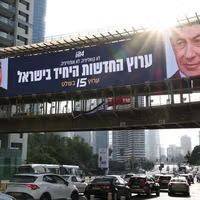
A woman passes by a banner depicting Israeli Prime Minister Benjamin Netanyahu and US President Donald Trump day after the country held a national election, in Jerusalem, October 28 , 2026.
Israel’s UN envoy denied that Prime Minister Benjamin Netanyahu was pressing Donald Trump to resume strikes on Iran and dismissed claims that a nuclear attack was under consideration, while mediators pursued a deal ahead of Tuesday’s US midterm elections.
“Prime Minister Netanyahu is not pressing President Trump. President Trump knows exactly what he wants to achieve and how he wants to achieve it,” Danny Danon told Al Arabiya English.
“Israel will collaborate with the United States. We will support the decision of the United States, but it is not us pressing anyone,” he added.
Danon’s remarks followed an Axios report Sunday, citing an Israeli and a US source, that Netanyahu was urging Trump to strike Iran immediately after the November 3 elections, while the US president preferred to allow negotiations to continue.
The Israeli source described the leaders’ Saturday phone call as “tough,” while the US source called it “direct.”
Trump confirmed Sunday that he had spoken with Netanyahu about Iran, describing their conversation as “a very good talk,” without providing further details.
Danon also rejected a claim by US commentator Tucker Carlson on X that a nuclear strike against Iran was being considered, calling the idea “delusional.”
“No one is even discussing it in the US, nor in Israel,” he said.
Washington weighs military options and diplomacy
Trump said Saturday that negotiations with Iran were “going fine” and that he was in no hurry to resume military action, although he said Washington still needed to target one or two sites, including the suspected underground nuclear complex at Pickaxe Mountain.
US Secretary of State Marco Rubio said Saturday that Trump had not decided whether to launch further strikes.
“He hasn’t made a decision,” Rubio told reporters in Atlanta, adding that Washington preferred to resolve the conflict peacefully.
Rubio said diplomatic contacts had remained active, often through intermediaries, and declined to set a deadline for negotiations.
Iran says diplomatic contacts remain active
Iranian Foreign Minister Abbas Araghchi said Monday that consultations through mediators, including Qatar and Pakistan, remained intensive, after several days of talks with Qatari officials ended without a breakthrough.
“Everything depends on the political rationality of Washington,” Araghchi said, according to the state-run IRNA news agency.
Araghchi said a revised proposal developed through mediation could allow the Strait of Hormuz to reopen within two days if Washington accepts Iran’s conditions.
Tehran’s earlier seven-day plan called for Washington to lift its blockade of Iranian ports, release frozen Iranian assets and waive sanctions on Iranian oil sales before negotiations resumed.
Iranian President Masoud Pezeshkian also said Monday that Supreme Leader Mojtaba Khamenei had granted the government “certain authorities” regarding peace talks with the United States, according to IRNA.
Pezeshkian said Iran would seek to resolve the conflict through dialogue, without specifying the scope of those powers.
An Iranian source cited by the Revolutionary Guards-affiliated Fars news agency said Monday that indirect communications with Washington had produced no breakthrough and that Tehran still insisted on its seven conditions for progress. Exchanging messages through intermediaries was routine, the source said.
Despite the diplomatic contacts, Danon said in his Monday interview that Israel remained prepared for military action regardless of uncertainty surrounding the formation of a new government following last week’s Israeli elections.
“The military is prepared, we are ready and if we will need to protect our people, we will do it,” he said.
QatarEnergy's liquefied natural gas (LNG) production facilities, amid the US-Israeli conflict with Iran, in Ras Laffan Industrial City, Qatar March 2, 2026.
Qatar is securing long-term supplies of US liquefied natural gas to protect revenues against disruptions in the Strait of Hormuz, while pursuing mediation between Tehran and Washington to end the war.
The country’s dependence on the waterway leaves its gas industry exposed to prolonged shipping disruptions. For state-owned QatarEnergy, buying supplies produced outside the Persian Gulf offers a way to earn trading income when its own exports are constrained.
The new contracts will begin delivering in 2030 or later. They offer protection against future losses, but cannot restore shipments from Qatar’s damaged facilities or reopen its export route.
The risks were underscored on Friday, when a Qatari LNG carrier was struck by “unidentified objects” in the Persian Gulf, the same day Qatari mediators held talks in Tehran aimed at reaching a deal between Iran and the United States.
The Al Mayeda was hit Friday evening, its owner Nakilat said Sunday. No crew members were injured or environmental damage reported, and the vessel remained operational.
Qatar condemned the attack as a “dangerous act” threatening maritime navigation and global energy supplies, saying investigations were underway to identify those responsible.
War exposes Qatar’s dependence on Hormuz
Qatar is particularly vulnerable to disruption in the Strait of Hormuz. LNG accounts for half of its foreign-currency export revenues, and shipments to markets beyond the Persian Gulf must pass through the waterway.
Unlike some neighboring oil exporters, Qatar has no pipeline route capable of replacing those shipments. Its oil exports amounted to just 530,000 barrels per day last year, leaving its foreign-currency revenues largely dependent on gas.
According to official Qatari government statistics, the country exported 79 million tonnes of LNG last year, supplying 17% of global LNG consumption. Another 20 billion cubic metres of natural gas, equivalent to approximately 15 million tonnes, was delivered to the UAE and Oman through the Dolphin pipeline. By volume, LNG accounted for nearly 84% of Qatar’s total gas exports.
Qatar was forced to almost completely halt LNG exports for three months starting in March, with shipments gradually recovering from June. According to Kpler data, however, it exported only 4.58 million tonnes in the third quarter, less than a quarter of the volume recorded a year earlier.
September exports reached 1.6 million tonnes, the highest monthly level since the war began. That was still less than a quarter of the pre-war monthly average, with around one-third of shipments going to Kuwait and remaining within the Persian Gulf.
Damage to infrastructure has also been substantial. Iranian missile strikes in March damaged Ras Laffan’s liquefaction units, known as trains, 4 and 6, knocking 12.8 million tonnes of annual capacity offline—about 17% of Qatar’s pre-war capacity.
Energy Minister and QatarEnergy chief executive Saad al-Kaabi initially estimated repairs would take three to five years. In an October 29 interview with Reuters, he put the repair period at about three years.
QatarEnergy has extended force majeure on deliveries to Italy’s Edison until the end of December, the Italian company said on October 27. Shipping has also come under attack: in July, the LNG carrier Al Rekayyat was struck while transiting the Strait of Hormuz.
Qatar has ruled out a pipeline bypass on commercial and technical grounds. Kaabi said in September that transporting gas to another coast would require new liquefaction facilities, duplicating infrastructure already being built in Qatar. He has also warned that pipelines and associated facilities could themselves become targets.
US supplies offer protection against lost revenue
Qatar’s overseas investments predate the war, but its latest purchase agreements form part of a strategy to protect income against future shipping disruptions.
The first major overseas source is the Golden Pass LNG project in Texas. QatarEnergy owns a 70% stake, while ExxonMobil holds the remaining 30%. LNG production began on March 30, 2026.
The project has a total planned capacity of 18 million tonnes per year, giving QatarEnergy an equity share equivalent to 12.6 million tonnes of annual capacity once fully operational. The first train has a capacity of approximately 6 million tonnes per year, of which QatarEnergy’s share is 4.2 million tonnes.
The second element is long-term purchases from US producers. QatarEnergy signed two agreements with Cheniere Energy on October 22 to purchase a combined 4 million tonnes annually, split equally between its Sabine Pass terminal in Louisiana and Corpus Christi terminal in Texas.
Deliveries will begin in the early 2030s and continue through 2054. One million tonnes of the annual Sabine Pass supply is conditional on a final investment decision for an expansion project.
A week later, QatarEnergy signed a 20-year agreement to purchase up to 3 million tonnes annually from Woodside’s Louisiana LNG project. QatarEnergy expects deliveries to begin in 2030, with volumes increasing as additional production units start operating.
Together, the agreements provide for up to 7 million tonnes annually.
The Cheniere purchase price is linked to the US Henry Hub gas benchmark, plus a fixed fee. Both companies’ agreements provide for free-on-board deliveries, meaning QatarEnergy arranges transportation.
Lower US gas prices can create opportunities for profitable sales into Europe and Asia, although returns depend on liquefaction fees, shipping costs and destination-market prices.
Kaabi told Reuters the purchases were intended to generate revenue during future Hormuz disruptions. He cautioned that US cargoes could not simply replace supplies under existing long-term contracts specifying particular export terminals and destinations.
QatarEnergy is also negotiating with Venture Global. Kaabi said he expected further 20- to 25-year supply agreements with US and other producers before the end of 2026.
Qatar has overseas options Iran lacks
Iran’s own gas sector is also under pressure, but it has far fewer options to offset damage through foreign investment and overseas projects.
According to the National Iranian Gas Company, attacks in March knocked around 230 million cubic metres per day of production capacity offline at four gas processing plants. Approximately 100 million cubic metres has since been restored.
That leaves around 130 million cubic metres per day unavailable, equivalent to about 16% of last year’s daily production. Iran already faces substantial gas shortages during colder months, and the company has warned that around 11 provinces could experience supply problems this winter.
Iran’s financial capacity to rebuild damaged infrastructure is limited, while foreign participation in its energy projects is virtually nonexistent. Qatar has substantially greater financial resources to repair its damaged LNG trains and invest overseas.
Those differences do not establish how long Tehran can sustain disruptions to shipping. They do, however, give Qatar more commercial options for managing the consequences.
QatarEnergy’s equity share of Golden Pass will represent 12.6 million tonnes of annual capacity once all three trains are operational, while the Cheniere and Woodside agreements provide for purchases of up to another 7 million tonnes annually.
Those volumes will become available gradually and remain modest compared with Qatar’s pre-war annual capacity of 77 million tonnes and its planned expansion to 142 million tonnes by 2030.
Overseas trading can help cushion the financial impact of disruption. But repairing Qatar’s production facilities and securing passage through Hormuz remain essential to restoring its own exports.
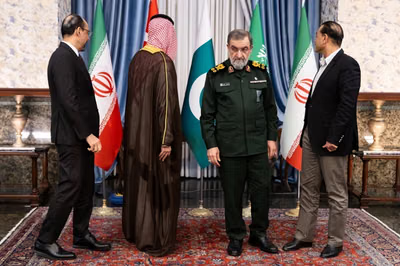
US Vice President JD Vance’s reported bid to meet Iran’s security chief Mohsen Rezaei for peace talks with Tehran raises a troubling question for Washington: Does it understand the man it would face across the table?
For more than four decades, Rezaei has occupied positions of power from which he could make decisions that imposed extraordinary human and economic losses on Iranians, while he and his factional allies in the Islamic Republic remained largely insulated from their consequences.
Understanding this track record and how he calculates the costs of diplomacy is essential to understanding how he might negotiate with Washington, how much he is prepared to tolerate, and what could finally persuade him to compromise.
The wartime calculus
The origins of Rezaei’s cost-benefit calculus go back to 1981, when the founder of the Islamic Republic, Ruhollah Khomeini, appointed the 27-year-old Rezaei as commander of the Islamic Revolutionary Guard Corps (IRGC). The IRGC was at the time a newly established institution in which revolutionary commitment and willingness to sacrifice often carried greater weight than professional military judgment.
Rezaei flourished in that environment and, in turn, helped consolidate a command culture that treated heavy casualties as an acceptable cost of pursuing ideological or factional objectives. The relationship was mutually reinforcing, as the institution rewarded commanders willing to endure enormous losses, while those commanders perpetuated a system in which the political consequences of those losses rarely affected the people responsible for them.
That high threshold for enduring costs paid by others became particularly consequential in 1982, after Iranian forces recaptured the city of Khorramshahr and Iraq subsequently offered negotiations. As IRGC commander, Rezaei was among those who argued for entering Iraqi territory rather than halting at the border. A war begun by Saddam Hussein's invasion now became another six years of bloody battles for goals extending beyond Iran's capacity.
During the catastrophic Operation Ramadan near the port city of Basra in July 1982, Iranian troops, including forces under Rezaei's IRGC command, repeatedly attacked entrenched Iraqi positions. Historians Anthony H. Cordesman and Abraham R. Wagner estimate between 20,000 and 30,000 Iranian troops were killed or critically wounded. Some Iranian leaders nevertheless saw progress in exhausting Iraq.
Mohsen Rezaei (second from left) alongside Ali Khamenei (center) during the Iran-Iraq War.
One of my uncles was killed in Operation Ramadan, and another in the offensive campaigns Rezaei had advocated after Khorramshahr. In this calculation, a battlefield disaster became an investment in a hypothetical victory in the long run. That victory never came.
Iranian forces did improve tactically, as a US National Defense University study demonstrates in its account of the successful 1986 assault on Iraq’s Faw Peninsula. Yet those improvements rarely prompted Iranian commanders to reconsider whether their objectives justified the mounting human suffering and material losses, allowing the same strategic mistakes to persist even as battlefield methods evolved.
Later that year, Operation Karbala-4 proceeded despite warnings that Iraqi forces anticipated the assault and that the operation had been exposed. Thousands of mostly Iranian youths were killed, wounded or went missing. Decades afterward, Rezaei called the operation a “diversion” preceding Operation Karbala-5, before acknowledging that it began as a principal attack.
File photo of Iranian forces preparing for Operation Karbala-4 during the Iran-Iraq War.
Here was another early expression of a dangerous institutional habit among Iranian decision-makers: a battlefield defeat could be treated as an investment in eventual victory, regardless of whether that victory was becoming more attainable or not.
The following year, Iranian forces continued operations toward Iraq’s Basra. A 2009 US National Defense University study, based on extensive interviews with former Iraqi Republican Guard commander Ra'ad Hamdani, described the fighting as the "Somme of the Iran-Iraq War," recalling frontal assaults with high casualties, enormous artillery concentrations and extraordinary destruction.
The National Defense University researchers concluded that repeated attacks reflected Iran’s persistent unwillingness to learn from previous failures. By 1987, they observed, Iranian political and military leaders were struggling to motivate soldiers who had suffered heavy losses without any meaningful gains.
Rezaei’s demands in the final year of the Iraq war exposed the deeper problem with his leadership style. In 1988, Rezaei set out requirements for rebuilding Iran’s offensive capacity over the following five years, including 350 infantry brigades, 2,500 tanks and 300 combat aircraft, while Prime Minister Mir-Hossein Mousavi’s government warned it could no longer finance the war.
Rezaei merely counted the weapons necessary for victory without offering a comparable accounting of the human cost of continuing the war. Ruhollah Khomeini accepted a ceasefire, and Rezaei remained commander until 1997.
Power and privilege
Peace brought Rezaei new positions and privileges, but the wartime mentality that allowed him to accept enormous costs borne by others followed him into politics. He served as secretary of Iran's Expediency Council from 1997 to 2021 and expanded his influence beyond the military.
He ran unsuccessfully for president in 2009, 2013 and 2021, but those electoral defeats did little to diminish his access to senior positions within the Islamic Republic.
Mohsen Rezaei displays his identification document and inked finger as he registers to run in Iran’s presidential election.
A Tehran Bureau investigation identified him as the owner of Tabnak, a major news website whose corporate structure included relatives and associates. He now had assets and networks worth protecting, even as he continued to regard sacrifice by others as an acceptable price for pursuing political objectives.
Rezaei’s response to his son’s dissent also illustrated the tension between family ties and political loyalty. Ahmad Rezaei had publicly criticized the Islamic Republic and fled the country. Mohsen Rezaei denounced him and declared that he would be treated like any dissident if he returned. Ahmad subsequently returned to Iran in 2005 and was not prosecuted, before leaving the country again.
Ahmad was found dead in Dubai in 2011. Police reported an apparent suicide, although questions persisted. Nevertheless, Rezaei's public response to his son's dissent suggested that even family ties could be subordinated to his position in a political order he had devoted his career to building.
In peacetime economic policy, the same institutional tolerance for high costs borne by Iranian citizens found another arena. Rezaei carried his understanding of costs into economics. Former associates of his presidential campaigns told me he conceived what became slain Supreme Leader Ali Khamenei's "resistance economy" and brought the idea to him.
As vice president for economic affairs under President Ebrahim Raisi from August 2021 to June 2023, he helped direct economic policy amid inflation and declining purchasing power. Once again, ordinary people financed the "resistance," while Rezaei retained his position and influence.
In an interview for this article, former Kayhan editor-in-chief and representative of Ali Khamenei Mehdi Nasiri alleged that Rezaei sought a share of Tehran’s roughly €2 billion electric-vehicle procurement deal with China under hardline Mayor Alireza Zakani in 2024, but declined to elaborate on the basis for his allegation. Separately, investigative journalist Yashar Soltani reported that the deal bypassed standard procurement procedures and involved intermediaries whose selection and financial qualifications were unclear. His report did not name Rezaei.
In August 2026, Rezaei became secretary of Iran's Supreme National Security Council, returning to decisions over war and diplomacy. The body, chaired by President Masoud Pezeshkian, coordinates Iran's security and foreign policy. Rezaei brings decades of relationships within the IRGC into its deliberations, along with the same institutional mentality that shaped his earlier career.
His recent words reveal how much of his wartime calculation survives. In an October 2026 interview, Rezaei acknowledged that a prolonged blockade would hurt Iranian families and investment, then insisted that "economic pain and strategic collapse are not the same thing". Four decades after the Iran-Iraq war, he continues to distinguish between the suffering of ordinary Iranians and the ability of their rulers to continue costly confrontations.
Yet Rezaei also has reasons to protect what he himself has acquired. Political scientist Robert A. Pape's influential research showed that even suicide terrorism can follow strategic calculations. The broader point is that ideological commitment need not exclude strategic calculation. Rezaei’s record suggests a high tolerance for losses borne by Iranians and a potentially much lower threshold when his survival, wealth and the political institutions he serves face danger.
Implications for Washington
Pressure directed mainly at Iranian households may therefore leave his incentives intact, since the leadership has long learned to transfer the consequences of its decisions to the population. His estrangement from his son Ahmad Rezaei also makes family ties an uncertain source of restraint.
The calculation changes when leaders themselves face costs they can no longer transfer, particularly when the institutions and networks sustaining their power are directly threatened. This may help explain why Parliament Speaker Mohammad Bagher Ghalibaf, also a former IRGC commander, met JD Vance in Switzerland in June 2026, a few months after US-Israeli strikes killed Supreme Leader Ali Khamenei and other IRGC commanders.
A “credible threat” can bring Tehran to the negotiating table, although the problem of durability remains. Once the threat recedes, the incentives that sustained decades of confrontation may return, leaving agreements vulnerable to reversal. Any lasting settlement therefore needs verification and enforceable consequences for reneging, even after the immediate threat has passed.
For Washington, the implication is that a credible threat must alter the calculations of those making decisions in Tehran. Pressure that the leadership can transfer to civilians has repeatedly proved insufficient. A lasting agreement requires the regime's decision-makers to understand that renewed confrontation would carry sustained consequences for themselves. Those consequences must remain credible even after the immediate danger has receded.
Iranian state media eagerly repeat the claim that Iranian politicians are exceptionally tough negotiators. Much of that toughness comes from their ability to draw on other people’s wealth and lives, which allows them to prolong confrontation without personally bearing its consequences.
Mohsen Rezaei's career illustrates the extraordinary bargaining advantage of making decisions while others pay the price. Anyone who negotiates with other people’s lives and resources can afford to be a tough negotiator.
FILE PHOTO: U.S. President Donald Trump and Israeli Prime Minister Benjamin Netanyahu at the Knesset on the day of Trump's address, amid a U.S.-brokered prisoner-hostage swap and ceasefire deal between Israel and Hamas, in Jerusalem, October 13, 2025.
Israeli Prime Minister Benjamin Netanyahu is pressing US President Donald Trump to strike Iran immediately after Tuesday's midterm elections, but Trump wants to let negotiations play out for now, Axios reported Sunday, citing an Israeli and a US source.
The two leaders had a candid phone call Saturday about the state of US negotiations with Iran and how quickly to return to combat, according to the report.
The Israeli source described the call as "tough," while the US source called it "direct."
Trump is pursuing diplomatic efforts to restart negotiations with Tehran while preparing for a possible resumption of major military operations after the November 3 elections, according to the report.
US Secretary of State Marco Rubio said Saturday that Trump had not decided whether to launch further strikes against Iran and preferred a diplomatic solution.
"He hasn't made a decision. I have no announcement in that regard with you today, and nor do we take any of it lightly," Rubio told reporters in Atlanta.
Trump told reporters Saturday that negotiations with Iran were "going fine" and that he was not "in much of a hurry," but said the United States still needed to "take care" of one or two Iranian nuclear sites.
"We can do that in 10 minutes. We have that planned. You can look at Pickaxe Mountain. We need to take care of that. We can do that very quickly," Trump said, referring to a suspected nuclear facility built into a mountain.
Iran considers US outreach
US Vice President JD Vance sent a letter last week to Mohsen Rezaei, secretary of Iran's Supreme National Security Council, about the possibility of restarting negotiations.
Rezaei said Saturday that he had received and read the letter but had not responded, according to Iranian state media.
"I read the letter. I haven't yet responded. Their tone has completely changed," Rezaei said in remarks broadcast on Iranian television.
IRGC-affiliated Tasnim news agency also reported that Tehran continued to insist on its seven conditions being met by Washington, saying any position contradicting that framework was unacceptable.
Qatar-mediated talks continue
Qatari mediators met with Iranian officials Sunday for a third consecutive day in an effort to reach a deal to restart direct negotiations between Washington and Tehran.
Iranian Foreign Minister Abbas Araghchi said Tehran was discussing a proposal that could allow the Strait of Hormuz to reopen within two days if Washington met Iranian conditions.
Araghchi said Sunday that consultations were continuing but had not produced a final agreement, stressing that progress depended on the United States responding to Iran's questions.
"We are making every effort in this regard and hope that the other side will demonstrate enough rationality to choose diplomacy over other paths," he said.
Iranian officials rejected nuclear negotiations, demanded acceptance of their conditions for ending the war and threatened military retaliation, despite continuing diplomatic contacts with Qatari mediators on Sunday.
Iranian officials rejected nuclear negotiations, demanded acceptance of their conditions for ending the war and threatened military retaliation, despite continuing diplomatic contacts with Qatari mediators on Sunday.
“The window for negotiations with our adversaries is now closed because they have nothing new to offer,” Ali Nikzad, deputy speaker of Iran's parliament, said on Sunday.
Nikzad accused what he called adversaries of repeatedly breaking commitments and attacking Iran's nuclear facilities. He said that renewed military action would trigger an “immediate, effective response without geographical limits.”
Foreign Minister Abbas Araghchi, however, said consultations with Qatari mediators were progressing without a final agreement.
“Consultations with the mediators regarding the two-day plan are continuing and moving toward implementation, but we have not yet reached a definitive conclusion,” Araghchi said.
Washington keeps negotiations open
The United States remains open to negotiations but is prepared to pursue other options, Donald Blome, US assistant secretary of state for Near Eastern affairs, said at the Manama Dialogue security forum in Bahrain, according to the Associated Press.
“The hand of negotiation has been extended, and those channels have continued to be open and active,” Blome said.
Blome warned that Washington could take a different course and would not allow Iran to threaten the region and global economy.
Iranian negotiators were in Doha for a third consecutive day of indirect talks aimed at ending the war with the United States and Israel, Reuters reported, citing an official briefed on the discussions.
Araghchi said the delegation had no plans to meet US officials directly.
Iran sets conditions and threatens retaliation
Iran will not negotiate with Washington until seven conditions announced by the secretary of its Supreme National Security Council are implemented, lawmaker Esmail Kowsari said Sunday.
Nikzad also demanded unconditional acceptance of those conditions, including Iran's proposed arrangements for the Strait of Hormuz.
Ebrahim Azizi, chairman of parliament's National Security Committee, threatened a punitive response to hostile actions in the waterway.
Iranian army spokesman Mohammad Akraminia said that another war could spread beyond the Middle East and said the military was shifting toward an offensive doctrine.
Defense Minister Mehrdad Akhlaghi said Iran was strengthening its military readiness and weapons production to respond to threats without geographical restrictions.
Calls grow to leave nuclear treaty
Lawmaker Nasser Pejmanfar urged Iran to withdraw from the Nuclear Non-Proliferation Treaty, arguing that membership had brought no benefits.
Mohsen Araki, a member of the Assembly of Experts and Expediency Discernment Council, separately called for reviewing Iran's membership, according to the Revolutionary Guards-affiliated Tasnim news agency.
The calls to reconsider Iran's nuclear treaty commitments add another obstacle to efforts to resolve the dispute through diplomacy.
Negotiations through Qatari mediators continue in Doha without a final agreement. Washington has kept the door open to talks, but Iranian officials insist that their seven conditions must be accepted before the war can end.
FILE PHOTO: U.S. President Donald Trump points his finger towards Israeli Prime Minister Benjamin Netanyahu as they shake hands during a press conference after meeting at Trump’s Mar-a-Lago club in Palm Beach, Florida, U.S., December 29, 2025.
Some inside Iran may be focused on Benjamin Netanyahu's political survival after Israel's inconclusive election, but the most consequential decision about another war with Iran may be made in Washington rather than Israel, analysts say.
Netanyahu's promise to "finish the job" in Iran has offered a ray of hope to some Iranians seeking the end of the Islamic Republic.
But Middle East analysts speaking to Iran International's Eye for Iran podcast challenged the idea that Netanyahu's return is essential to further military action against Tehran, arguing that Israel's political divisions do not necessarily extend to its assessment of the Iranian threat.
Instead, they pointed to President Donald Trump's remaining time in office as a potentially decisive factor in whether Israel and the United States launch another round of strikes against Iran.
Dan Feferman, a Middle East researcher and co-founder of Middle East 24, cautioned against interpreting Israel's political divisions through the traditional American left-right framework.
‘No soft approach on Iran’
He argued that an Israeli government led by former military chief Gadi Eisenkot, particularly one involving former prime minister Naftali Bennett and Avigdor Lieberman, would not necessarily approach the Iranian threat significantly differently from Netanyahu.
The divisions between Israel's political camps extend well beyond Iran, encompassing disputes over Netanyahu's handling of the October 7, 2023, security failures, the subsequent wars and military service exemptions for ultra-Orthodox Israelis.
Alex Winston, news editor of The Jerusalem Post, offered a similar assessment, arguing that Netanyahu's principal rivals would not necessarily pursue a softer approach toward the Islamic Republic.
But Winston drew an important distinction between confronting the Islamic Republic militarily and assuming responsibility for overthrowing it.
He argued that most Israelis would prefer to support Iranians seeking political change rather than have Israel itself be seen as the country that brought down the Islamic Republic.
That distinction raises a fundamental question about Netanyahu's repeated promise to "finish the job" in Iran: does it mean further weakening the Islamic Republic's military capabilities, or actively pursuing its removal from power?
Why Trump may matter more
Feferman pointed to the remaining two years of Trump's presidency as a potentially decisive window for further military action.
A future American president, particularly a Democrat, would be far less likely to support or participate in additional strikes against Iran, Feferman argued.
Netanyahu appeared to reinforce that argument in his first address following the October 27 election, in which his Likud party emerged as the largest but neither his bloc nor the opposition secured a clear parliamentary majority.
"Iran is weaker than ever, Israel is stronger than ever," he declared. "Israel stands before a historic, once-in-a-lifetime opportunity, with our partner President Trump, to remove the existential threat from Iran once and for all."
The remarks placed Iran at the centre of Netanyahu's plans for another term, even as his path to forming a government remained uncertain.
Israel has its own security interests and military capabilities, but US political backing remains central to its leaders' calculations.
‘We want Bibi’
The Israeli election has nevertheless attracted considerable interest among Iranians hoping for the Islamic Republic's downfall.
Benjamin Basire, an Iranian-born Jewish political analyst living in the United States, said some had followed the vote as though it were their own, contacting him with messages expressing hope that Netanyahu would remain in power.
"We want Bibi. Bibi is our savior," he recalled them saying, adding that some feared Netanyahu's departure would extinguish their hopes of political change.
Netanyahu has already overseen two rounds of Israeli attacks on Iran, in 2025 and 2026, as well as operations that killed senior Iranian military commanders and severely weakened Hezbollah, Tehran's most powerful regional ally.
But with the prospect of another confrontation looming, the question is whether Israel will act again, and with what degree of American support.
Winston suggested that the prospect of renewed fighting was already shaping expectations in Israel, pointing to the approaching US midterm elections as a potential turning point.
"We're already preparing for war," he warned.
"We're ready. That's for sure."
Watch Eye for Iran on YouTube or listen on your favourite podcast platform.