• العربية
  • فارسی
Brand
  • Iran Insight
  • Politics
  • Economy
  • Analysis
  • Special Report
  • Opinion
  • Podcast
  • Live TV
  • Iran Insight
  • Politics
  • Economy
  • Analysis
  • Special Report
  • Opinion
  • Podcast
  • Live TV
  • Theme
  • Language
    • العربية
    • فارسی
  • Iran Insight
  • Politics
  • Economy
  • Analysis
  • Special Report
  • Opinion
  • Podcast
  • Live TV
All rights reserved for Volant Media UK Limited
volant media logo
ANALYSIS

Foreign investment in Iran hits zero after war

Sep 14, 2026, 01:31 GMT+1

Foreign investment in Iran has effectively come to a halt following the war with Israel and the United States, with no new foreign investment recorded so far this Iranian year, a senior industry ministry figure said.

No foreign investment has been made so far in the current Iranian calendar year, which began on March 21, Tahmoures Lahouti, Deputy Industry Minister and head of Iran’s Small Industries and Industrial Parks Organization, told the Iranian Labor News Agency (ILNA).

“Given the sanctions and restrictions in place, foreign investment is not taking place,” Lahouti said.

Read more

Most Viewed

Heavy fighting spreads in southeastern Iran, with security force casualties reported
1

Heavy fighting spreads in southeastern Iran, with security force casualties reported

2

Blogger sentenced to death in Iran on security-related charges

3

Mideast oil flows recover while Iran exports vanish, tracker says

4

Fall of Hezbollah heights ignites blame game in Tehran

5

Iraqi groups deny Saudi pipeline strike, say ‘would be proud if we did it’

Banner
Banner
Banner

Spotlight

  • Rushed trials, public hangings: Iran courts race to crush dissent
    INSIGHT

    Rushed trials, public hangings: Iran courts race to crush dissent

  • Israeli envoy says no victory until Islamic Republic falls

    Israeli envoy says no victory until Islamic Republic falls

  • Russia may fill Iran gap if support for Yemen Houthis falters
    ANALYSIS

    Russia may fill Iran gap if support for Yemen Houthis falters

  • Bid to oust Pezeshkian exposes rift among Iran conservatives
    INSIGHT

    Bid to oust Pezeshkian exposes rift among Iran conservatives

  • Iran’s hardliners bet on escalation as options narrow
    ANALYSIS

    Iran’s hardliners bet on escalation as options narrow

•
•
•

More Stories

Foreign investment in Iran hits zero after war

Sep 13, 2026, 20:55 GMT+1
•
Dalga Khatinoglu
100%
A view from Bushehr port in southern Iran

Foreign investment in Iran has effectively come to a halt following the war with Israel and the United States, with no new foreign investment recorded so far this Iranian year, a senior industry ministry figure said.

No foreign investment has been made so far in the current Iranian calendar year, which began on March 21, Tahmoures Lahouti, Deputy Industry Minister and head of Iran’s Small Industries and Industrial Parks Organization, told the Iranian Labor News Agency (ILNA).

“Given the sanctions and restrictions in place, foreign investment is not taking place,” Lahouti said.

Domestic investment in industrial development has also declined compared with last year, with exchange-rate volatility, inflation and weakening household purchasing power weighing on businesses, Lahouti added.

The Iranian year began about three weeks after Israel and the United States launched military operations against the Islamic Republic on February 28.

Lahouti did not provide figures for the decline in domestic investment or specify whether his assessment of foreign investment covered all sectors of the Iranian economy.

The rial has lost roughly 60% of its value against the US dollar since the beginning of the Iranian year, increasing the cost of imported equipment and other inputs for businesses. High inflation and uncertainty over future prices have further complicated long-term investment decisions.

Industrial employment declines

The deterioration in investment has coincided with significant job losses in industry.

About 630,000 industrial jobs were lost in the first quarter of the current Iranian year compared with the same period a year earlier, according to figures from Iran’s Statistical Center.

Separate labor-market data have also shown a sharp decline in the number of workers making social-security contributions.

The contraction adds to longer-running problems facing Iranian manufacturers, including sanctions, restrictions on international banking, inflation, currency depreciation and recurring energy shortages.

Foreign investment falls as capital outflows surge

Data from the United Nations Conference on Trade and Development (UNCTAD)shows that Iran was already struggling to attract foreign direct investment well before the war.

  • 100 days after carnage: Iran economy reels from war, inflation, unemployment

    100 days after carnage: Iran economy reels from war, inflation, unemployment

In 2016 and 2017, following the implementation of the nuclear deal and the temporary easing of international restrictions, Iran attracted an average of about $4.2 billion in foreign direct investment (FDI) annually. After the United States withdrew from the nuclear deal and reimposed sanctions in 2018, the trend reversed, with annual FDI subsequently falling to around $1.5 billion.

At the same time, Central Bank data point to a sharp increase in capital outflows. Iran’s capital-account deficit widened from $6.77 billion in 2017 to $19.62 billion in 2025, nearly tripling over the period.

Overall, Iran attracted about $12.7 billion in foreign direct investment between 2018 and the end of 2025, while cumulative capital-account deficits approached $120 billion over the same period.

The gap illustrates that Iran’s problem extends beyond its difficulty attracting foreign capital. The country is also recording substantial capital outflows.

Iran falls further behind regional rivals

UNCTAD data for 2025 show the scale of the investment gap between Iran and some of its regional competitors.

Saudi Arabia attracted $32.6 billion in foreign direct investment last year, while the United Arab Emirates received about $48.2 billion.

The figures underscore Iran’s difficulty competing for foreign capital after years of sanctions and restrictions on international banking and trade.

Lahouti’s comments show that those constraints have now choked off an already limited flow of foreign investment. At the same time, depreciation of the rial, inflation, economic uncertainty and persistent capital outflows have made it more difficult for domestic investors to fill the gap.

  • Iran’s economy is a powder keg. Tehran is preparing for the spark

    Iran’s economy is a powder keg. Tehran is preparing for the spark

Foreign investment falling to zero this year is therefore part of a longer trend. Iran was struggling to attract foreign capital well before the latest war, while substantial capital outflows added to the pressure on investment at home.

Russia may fill Iran gap if support for Yemen Houthis falters

Sep 11, 2026, 17:05 GMT+1
•
Kambiz Tavana
100%
People participate in a parade after attending a Houthi military training as part of a mobilization campaign, in Sanaa, Yemen December 18, 2024

Russia could help sustain Yemen’s Houthis if Iran’s ability to support the group is weakened, providing a lifeline as the group expands its reach around a second crucial Middle Eastern shipping route, according to Anna Borshchevskaya, a senior fellow at the Washington Institute.

Borshchevskaya said Moscow has already provided intelligence and other assistance to the Iran-backed group, making the Houthis the clearest example of how Russia could help sustain parts of Tehran’s regional network if Iranian resources come under greater strain.

“With the Houthis in particular, there were reports in previous years that Russia also provided them with intelligence… details aside, it’s clear that Russia has been supporting the Houthis,” she told Iran International.

The Houthis reached the strategic island of Perim on Friday after Yemeni government forces withdrew, while the group also took the nearby mainland town of Dhubab, tightening its grip on a vital shipping route as disruption continues in the Strait of Hormuz.

Since late 2023, the group has repeatedly attacked shipping in the Red Sea, while previous reporting has indicated that Russia provided targeting data and satellite intelligence used in attacks on Western vessels.

Iran has also brokered secret talks between Russia and the Houthis over the possible transfer of advanced anti-ship missiles, while Russian actors have reportedly explored weapons sales to the group.

Asked whether Iran could effectively delegate some of the burden of sustaining its regional network to Russia if its own resources were depleted, Borshchevskaya said: “Yes, and that’s not just in Syria; that’s in other parts of the Middle East.”

She argued that Moscow could provide a lifeline without crossing what remains an important Russian red line: direct military confrontation with the United States.

“Russia would do a lot to support this regime. I don’t think they would go far enough to risk a direct military clash with the United States… But they’re not going to sit idly by either.”

A weakened network

Iran’s regional network faces some of its most severe pressure in years. The fall of Bashar al-Assad in December 2024 deprived Tehran of a key regional ally and ended its overt military presence in Syria.

Hezbollah has also suffered heavy losses in its conflict with Israel, which said on Thursday it had destroyed a major underground Hezbollah complex in southern Lebanon.

Iran itself is meanwhile under mounting military and economic pressure from the United States, raising questions about how much support it can continue to provide allied armed groups across the region.

The Houthis stand out in that landscape. Their latest offensive has brought them to the Bab el-Mandeb, on the opposite side of the Arabian Peninsula from Hormuz, potentially giving Iran and its allies leverage over another of the world’s most important maritime chokepoints.

For Borshchevskaya, Russia’s previous assistance to the group provides a model for how Moscow could help keep an Iranian ally operational even if Tehran’s own resources diminish.

“I think we can count on Russia to continue to provide this type of support to Iran—that is, support that stops short of putting Russia in a direct military confrontation with the United States.”

A broader Russia-Iran partnership

The relationship with the Houthis sits within a broader pattern of military and technical cooperation between Moscow and Tehran.

Since Russia’s invasion of Ukraine in 2022, Iran has supplied Shahed drones and production know-how to Moscow, while Russia has provided Iran with military technology and equipment.

More recently, Russia has secretly helped Iran develop supersonic cruise missile technology that could give Tehran another means of threatening US naval vessels in the Middle East.

Borshchevskaya said the partnership is driven by a broader convergence of interests, particularly their shared desire to reduce US influence.

For Moscow, she argued, the worst outcome would be an Iran that moved decisively toward the West, depriving Russia of an important partner in its wider confrontation with Washington.

That does not mean Russia would assume responsibility for Iran’s regional strategy wholesale. But it gives Moscow a strong incentive to prevent Tehran and its allies from being weakened beyond recovery.

100%

Syria shows limits—and opportunities

Syria illustrates both the limits of Iranian influence and Russia’s ability to preserve its own position after a major regional upheaval.

Iran lost its overt military presence after Assad’s fall, while Moscow has maintained relations with the government of President Ahmed al-Sharaa and negotiated to preserve a reduced Russian footprint.

“There are no Iranian bases. There are no open talks with the Iranian government the way there are with Russia,” Borshchevskaya said, while cautioning that Iran’s exclusion should not necessarily be assumed to be permanent.

Whether Moscow might eventually use its remaining position in Syria to assist Iranian-linked groups is, she said, “an open question.”

For now, the Houthis provide a more concrete test. Their advance around the Bab el-Mandeb comes as Iran is struggling to maintain pressure around Hormuz and its other regional allies face growing military pressure.

There is little evidence so far that Moscow is assuming the financial burden of Iran’s regional network wholesale. But Borshchevskaya argues that the support already provided to the Houthis offers a model for how Russia could help keep parts of that network operational if Tehran’s resources diminish.

Any such support could complicate Washington’s efforts to weaken Iran by squeezing its ability to finance and supply its regional allies.

Israel crosses Iran’s Lebanon red lines as Tehran leans on maritime leverage

Sep 11, 2026, 02:54 GMT+1
•
Ata Mohamed Tabriz
100%
Explosions are seen in handout video released by the Israeli military on September 10, 2026, which it said showed the destruction of Hezbollah underground infrastructure in the Ali al-Taher ridge area of southern Lebanon.

Israel’s destruction of Hezbollah’s Ali al-Taher complex, despite Iranian warnings, has exposed the limits of Tehran’s deterrence in Lebanon as it increasingly relies on maritime chokepoints for leverage.

Israeli forces on Thursday destroyed more than two kilometers of underground infrastructure beneath the strategic ridge in southern Lebanon after establishing what the military called operational control above and below ground.

The Israeli military said the network contained rockets, missiles, drones, anti-tank weapons, mines and explosives, as well as a command complex used by Hezbollah’s Badr unit.

Prime Minister Benjamin Netanyahu and Defense Minister Israel Katz said the operation completed the consolidation of an Israeli security zone and that troops would remain in the area to prevent Hezbollah from rebuilding its capabilities.

The demolition followed weeks of conflicting claims over control of Ali al-Taher and came after Tehran had warned Washington that a major Israeli assault on the position would provoke a forceful Iranian response.

Yet the operation went ahead, dealing another blow to an Iranian-backed front that Tehran had explicitly sought to protect under the Islamabad memorandum with the United States.

How far do ‘all fronts’ extend?

Lebanon was written into the first clause of the memorandum between Tehran and Washington, with the parties committing to the “immediate and permanent termination of military operations on all fronts, including in Lebanon” and to ensuring Lebanon’s territorial integrity and sovereignty.

The wording was disputed from the outset. Pakistani Prime Minister Shehbaz Sharif, whose government mediated the agreement, said the cessation of hostilities applied to “all fronts, including Lebanon,” while Netanyahu rejected Tehran’s interpretation.

Iranian parliament speaker and chief negotiator Mohammad Bagher Ghalibaf repeatedly portrayed Lebanon’s inclusion as a diplomatic achievement.

“We brought the resistance front and Lebanon into the first clause of the memorandum,” he said, later accusing the other side of violating the provision.

But Tehran’s ability to enforce that interpretation has increasingly been called into question.

Mojtaba Amani, Iran’s former ambassador to Beirut, had argued that an earlier Iranian military response established a deterrence equation that prevented Israel from attacking Beirut and the Dahiyeh.

In southern Lebanon, however, that equation has proved far less effective. Israel has continued strikes, expanded its presence and tied withdrawal to Hezbollah’s disarmament while gradually establishing what it describes as a security zone.

Ali al-Taher has now become one of the clearest tests of that gap between Tehran’s declared red lines and its ability or willingness to enforce them.

Israel destroys the Ali al-Taher network

Ali al-Taher is a strategic elevation near Nabatieh, around 15 kilometers from the Israeli border, overlooking routes connecting southern Lebanon with the mountainous Iqlim al-Tuffah area farther north.

Lebanese security sources had said Hezbollah built a large underground network inside the ridge, including weapons stores and command infrastructure. Israel described it as a major hub for Hezbollah’s Badr unit.

For weeks, control of the position remained disputed.

Hezbollah lawmaker Ihab Hamadeh questioned Israeli claims to control the ridge while Israeli forces continued bombarding it. Media aligned with Tehran also gave conflicting accounts, while one Iranian reporter acknowledged that the area had effectively been lost.

That ambiguity has now largely disappeared.

Israel said Thursday that its forces had established operational control both on the surface and underground before destroying the tunnel system. The network extended for more than two kilometers and included command centers, weapons depots and living quarters that allowed fighters to remain underground for extended periods, according to the Israeli military.

The massive demolition was powerful enough for the US Geological Survey to register a magnitude-4.1 seismic event in the area.

Atlantic Council researcher Nicholas Blanford had previously argued that Israel was more likely to destroy the infrastructure at Ali al-Taher than attempt to permanently occupy every surrounding height. The first part of that assessment has now materialized, although Israel says its forces will remain in the area rather than withdraw after the demolition.

Control of the ridge also gives Israel greater military reach toward Nabatieh and the mountainous belt farther north, where Lebanese military sources have said Hezbollah moved some weapons and air-defense systems as pressure increased around Ali al-Taher.

The battle therefore extends beyond one position. Israel is attempting to break the connection between Hezbollah’s southern front and its operational rear, prevent the group from rebuilding and deepen a security belt inside Lebanon.

A red line crossed

The importance of Thursday’s operation lies not only in what Israel destroyed, but in what happened to Iran’s warning.

Reuters reported last week that Tehran had warned Washington through Oman that it would mount a major response if Israel launched a full-scale offensive against Ali al-Taher.

Two regional officials told Reuters at the time that more than 12 members of the Revolutionary Guards were present in the area. The White House said that account was inaccurate, while Israeli assessments reported by local media said no IRGC forces were there.

Israel nevertheless proceeded to take operational control of the ridge and destroy the underground complex.

Before the demolition, Mohsen Rezaei, secretary of Iran’s Supreme National Security Council, had already implicitly acknowledged territorial setbacks in Lebanon, saying on state television that Israel had “managed to take some places.”

In the same interview, however, Rezaei announced plans for a new restricted zone outside the Strait of Hormuz.

That contrast points to a broader shift in where Tehran sees effective leverage.

Rather than escalating directly over every Israeli advance in Lebanon, Iran has increasingly concentrated pressure around the Persian Gulf, where its ability to disrupt energy flows imposes costs not only on Israel and the United States but on the global economy.

Recent exchanges have demonstrated both the power and the vulnerability of that strategy.

Iran has disrupted shipping through Hormuz, while the United States has imposed a maritime blockade and attacked Iranian oil tankers. Tehran has in turn attacked vessels in and around the strait and threatened stronger retaliation against further strikes on its assets.

Oil prices have climbed above $100 a barrel amid uncertainty over shipping through the Persian Gulf and escalating attacks on tankers.

Unlike the Lebanese front, Hormuz gives Tehran a lever that does not depend on Hezbollah retaining territory or military infrastructure.

But it is no longer Iran’s only significant maritime pressure point.

Pressure at both ends of the region

The latest developments in Yemen have strengthened rather than weakened Iran-aligned forces around another of the world’s most important waterways.

The Houthis on Thursday seized the Red Sea port of Mocha in an offensive that has increased their leverage around the Bab al-Mandeb Strait.

Reuters reported, citing Yemeni, Iranian and regional sources, that Iranian weapons and military advice played a critical role in the offensive and that Revolutionary Guard personnel helped guide the operation. Tehran denies directly directing Houthi military operations.

The Houthis have also seized strategic Red Sea islands, including Perim, Zuqar and Hanish, further strengthening their position around Bab al-Mandeb, according to the Financial Times.

Those gains complicate the picture of an Islamic Republic simply losing its regional capabilities.

In Lebanon, Hezbollah has lost important positions and infrastructure and Israel has shown an ability to cross a red line Tehran had explicitly drawn around Ali al-Taher.

In Yemen, by contrast, an Iran-aligned force is expanding its geographic position around a strategic shipping route.

The result is an increasingly maritime geography of pressure.

The Strait of Hormuz remains Tehran’s most direct instrument, allowing Iran itself to threaten one of the main arteries of global energy trade. Around Bab al-Mandeb, the Houthis now possess greater capacity to disrupt another route linking the Indian Ocean, Red Sea and Suez Canal.

Together, instability at the two chokepoints has placed additional strain on global energy supplies and shipping.

Tehran nevertheless remains under heavy pressure. Its economy has been battered by sanctions and the US maritime blockade, its oil exports have been severely constrained, and Hezbollah’s battlefield position in Lebanon has weakened.

But the Houthi advances show that Iran’s regional leverage is becoming more uneven rather than simply disappearing.

Ali al-Taher illustrates where Tehran’s deterrence has receded. Hormuz and, indirectly, Bab al-Mandeb show where it still has tools capable of imposing wider costs.

As Israel pushes further past Iranian red lines in Lebanon, those maritime levers are therefore becoming increasingly important to Tehran’s effort to retain the initiative without opening another direct front with Israel.

Iran’s hardliners bet on escalation as options narrow

Sep 10, 2026, 19:25 GMT+1
•
Behrouz Turani
100%
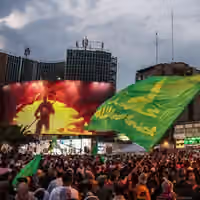
Crowds gather at a state-sponsored event in central Tehran under a large billboard promoting resistance, August 31, 2026

Hardliners in Tehran are pressing for further military and nuclear escalation despite mounting economic pressure and a widening confrontation with the United States. Is it a reckless gamble, or a realistic response to Iran’s dwindling options?

Calls for a tougher response have grown louder as fighting expands beyond the Strait of Hormuz and US pressure on Iranian oil exports intensifies.

In parliament, ultraconservative lawmaker Mohammad Taghi Naghdali has called for a stronger response to prevent further weakening of Lebanese Hezbollah, while Hassan Ghashghavi, spokesman for parliament’s National Security and Foreign Policy Committee, has argued for measures aimed at strengthening Iran’s deterrence.

Other hardline figures have gone further, renewing calls for Iran to withdraw from the Nuclear Non-Proliferation Treaty, end remaining international monitoring and adopt a more confrontational nuclear posture.

The Revolutionary Guards said Thursday its navy had targeted two US vessels, eight oil tankers and 10 other ships in the Persian Gulf and Strait of Hormuz in response to US attacks on five Iranian tankers.

The escalation is taking place against severe economic pressure at home. Food inflation reached 127.5 percent year-on-year in the month to late August, while the rial has fallen to record lows against the dollar.

For advocates of escalation, the calculation is that greater military pressure can produce strategic leverage before the economic and military costs become harder to sustain.

The International Atomic Energy Agency’s Board of Governors this week reported Iran to the UN Security Council over breaches of its nuclear non-proliferation obligations, the first such referral in 20 years.

Tehran rejected the decision, accusing Western governments of using disruption caused by US and Israeli attacks on its nuclear facilities as a pretext for further pressure.

Calls to leave the NPT or further restrict international monitoring could give Tehran another means of raising the stakes. They could also deepen its isolation and increase the risk of further military action at a time when diplomatic options are already limited.

But what are Iran’s alternatives?

Yet judging the hardliners’ strategy solely against Iran’s vulnerabilities misses the other side of the calculation.

President Donald Trump said this week that negotiations with Iran “could happen,” but added that talks were “not something we’re looking at” for now. US forces, meanwhile, have continued attacks on Iranian oil tankers and enforcement of Washington’s maritime blockade.

Trump also said he wants any eventual agreement to go beyond the nuclear issue, potentially making a negotiated settlement more difficult to reach.

Senior advisers have privately warned Trump that Iran could continue resisting US pressure and that the conflict could last through the remainder of his presidency, according to a Wall Street Journal report.

Iran’s latest attack on the US base in Jordan required American forces to fire roughly 30 Patriot interceptors, according to a US official, adding to concerns about the rate at which the war is consuming sophisticated air-defense missiles.

Precise stockpile figures are classified, but independent estimates and recent reporting have pointed to significant pressure on US inventories of Patriot and other high-end interceptors, which can take years to replenish.

The disparity in overall military and economic power remains considerable, while Iran is already contending with high inflation, disruption to its oil trade and the costs of sustained military operations.

But the calculation in Tehran appears to be that Iran can impose sufficient costs on the United States and its regional partners before its own vulnerabilities become overwhelming.

It is a strategy with considerable risks. But with no clear diplomatic off-ramp, the harder question is whether Tehran’s hardliners are ignoring the options available to Iran—or responding to how few remain.

How body bags came to symbolize Iran's January killings

Sep 9, 2026, 13:04 GMT+1
•
Reza Haji Hosseini
100%
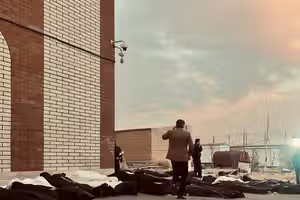
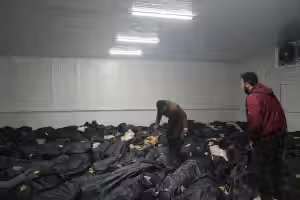
Families look for their loved ones in body bags piled outside a morgue in Iran, January 2026

Rows of black body bags became one of the defining images of Iran’s deadly January 2026 crackdown, as families searched among covered bodies and thousands of photographs for relatives killed or missing during the unrest.

Eight months later, images of the killings and crackdown remain vivid for survivors and the wider public. Iranians describing life after January have spoken of recurring nightmares, crying at night and difficulty returning to ordinary life. Some survivors have attempted suicide.

For many, life is now divided into before and after January.

Body bags have also acquired a place in Iran’s collective memory that they did not have before. Previously associated largely with films, natural disasters and major emergencies, they appeared repeatedly in footage documenting the aftermath of the January killings.

Images from earlier waves of unrest – the 2009 protests, November 2019 and the 2022 Woman, Life, Freedom movement – often showed the bodies of those killed: lying in streets, on hospital beds or wrapped in burial shrouds.

In January 2026, the dead were frequently hidden behind black bags and zippers. Faces disappeared from view and rows of bags remained.

The distinction matters. An object intended to preserve bodies for transportation and identification became one of the most recognizable images of the crackdown.

  • Seven months on, January protests still shape Iranians’ lives

    Seven months on, January protests still shape Iranians’ lives

Amnesty International counted at least 205 separate body bags in verified images from the Kahrizak morgue, south of Tehran. Human Rights Watch identified at least 400 bodies or body bags in three verified videos.

Eurovision News Spotlight, a verification project run by the European Broadcasting Union, also identified the green markings of Tehran’s Behesht-e Zahra cemetery on some of the body bags.

The trauma behind the bags

Part of the disturbing power of such images comes from what the bags conceal.

An exposed body, however difficult to see, retains a face and visible identity. Hundreds of nearly identical bags can instead reduce individuals to units: one package beside another, one number beside another, with the total continuing to rise.

For relatives searching for somebody missing, however, those bags have to be opened. Each zipper brings the possibility of encountering the body of a parent, child, sibling or friend.

This can be understood as a particular trauma associated with body bags: the combination of mass death, the temporary erasure of individual identity, the anxiety of identifying the dead and the repeated return of the same visual image.

There is also the question of dignity. Each bag contains a person whose family may be searching for them, yet footage showed bodies left in rows on the ground as relatives tried to identify them.

Such scenes are not unique to Iran.

  • 36,500 deaths in context: How Iran’s toll compares with wars and crackdowns

    36,500 deaths in context: How Iran’s toll compares with wars and crackdowns

After Egyptian security forces opened fire on protesters around Cairo’s Rabaa Square in the summer of 2013, the El-Iman mosque became a temporary morgue. Bodies were placed in tightly packed rows under white sheets. Volunteers wrote victims’ names on the coverings; some carried names and addresses, while others remained unidentified.

Families also searched morgues in Damascus after the fall of Bashar al-Assad’s government in Syria, opening bags, photographing faces and comparing them with images of missing relatives and acquaintances.

Those bags represented an archive of years of enforced disappearances, torture and deaths in custody.

Iran’s January 2026 images were different in one important respect. The bags appeared during the days and nights of the crackdown itself, within the existing system of hospitals, forensic facilities and cemeteries.

In much of the footage, rows of black bags are visible without names or identifying information that can be seen on their surfaces.

  • Over 36,500 killed in Iran's deadliest massacre, documents reveal

    Over 36,500 killed in Iran's deadliest massacre, documents reveal

The victims’ faces are concealed, but the sheer number of bags makes the scale of death visible.

The bags also did not arrive at morgues by themselves. Behind the images was a system responsible for collecting, transporting, recording and storing bodies.

What happened after the shooting

Mass killing does not end when shooting stops. Bodies have to be moved. That requires ambulances or other vehicles, body bags and labels, morgues or refrigerated containers and lists recording the dead. Decisions also have to be made about where bodies are stored, when they can be identified and under what conditions they are returned to families.

Reports following the killings on January 8 and 9 described shortages of body bags and bodies accumulating in hospitals and morgues.

That raises another question: where did the additional bags come from, and how prepared were authorities for handling large numbers of bodies?

Two procurement notices for body bags appeared around the time of the killings in Alborz province, one of the main centers of the protests and subsequent crackdown.

The Imam Hossein medical center in Alborz sought quotations on January 4, after the protests had begun, for 200 adult body bags and eight bags for children.

Shariati Hospital in Karaj had separately registered a request for 200 adult body bags on December 18, with the procurement notice published two days later.

  • Iranian protester undergoes months of secret treatment to save wounded leg

    Iranian protester undergoes months of secret treatment to save wounded leg

The timing, particularly of the Imam Hossein request, warrants scrutiny. But the records alone do not demonstrate that authorities anticipated mass killings, nor do they establish that these particular bags were subsequently used to carry protesters’ bodies.

Several links in the procurement chain are also missing, including final contracts, delivery receipts, shipment numbers and warehouse release documents.

Body bags are routine supplies for hospitals, cemeteries and emergency services. Purchasing them is therefore not in itself evidence of preparation for a crackdown.

Reports of shortages in cities including Arak, Khorramabad and Gorgan, however, suggest that ordinary stocks were rapidly exhausted. If so, additional supplies would have had to be distributed, potentially following further purchases.

That leaves a narrower but important question: what level of fatalities was the system for handling bodies equipped to manage, and did January’s death toll overwhelm that capacity?

Turning numbers back into names

In hospitals, forensic facilities and disaster operations, body bags serve practical purposes: separating and transporting the dead and protecting workers from contact with blood and bodily fluids.

Joint guidance from the World Health Organization and International Committee of the Red Cross says each body should be placed separately in a bag, with the location and time it was found recorded. Personal belongings should remain with the body and each person should receive a unique identification number.

That number is not intended to erase a name. Its purpose is to help establish an identity and ultimately return the body to relatives.

  • How one Tehran hospital became a window into Iran’s January massacre

    How one Tehran hospital became a window into Iran’s January massacre

For some Iranian families in January, the process appeared to work in reverse: they searched through bags and thousands of photographs in an effort to turn a number back into the name of somebody they knew.

The father of Iman Asadi spent five days searching police stations, prisons and hospitals before finding his son’s photograph among thousands of images of unidentified people.

In that collection, Iman was No. 11838.

A number intended to assist identification had become, at least temporarily, the marker of a person without a name.

Another father, Esmail Shokri, was filmed walking among body bags at the Kahrizak forensic facility in a 12-minute video, calling out for his son.

“Sepehr ... Sepehr, my son ... where are you?” Shokri called.

Every bag could have contained Sepehr. To his family, he had a face, a history and a name. From the outside, each closed black bag looked much like the next.

That is what distinguishes some of the most enduring images of January 2026 from those of earlier Iranian crackdowns. Previously, the victim’s body often occupied the center of the frame. This time, for many Iranians, the body bag stood between the dead and the public looking at them.