Iran-backed militia commander sought to visit Singapore three times, security agency says
Mohammad Baqer Saad Dawood Al-Saadi (right) speaking with Iranian military leader Qasem Soleimani in an undated photo.
An Iraqi commander of an Iran-backed militia who allegedly plotted attacks against Jewish targets in Europe and North America applied three times to visit Singapore, the city-state’s Internal Security Department said.
Singapore would have denied entry to Mohammad Baqer Saad Dawood Al-Saadi had he attempted to travel there, the agency said, warning that conflicts in the Middle East were increasing terrorism risks in Southeast Asia.
“Baqer had applied for visas to visit Singapore on three separate occasions in 2023 and 2024, but did not eventually travel to Singapore,” the Internal Security Department said in its annual terrorism threat assessment.
The agency said it believed Al-Saadi had travelled elsewhere in Southeast Asia during that period.
“Had he attempted to enter Singapore, he would have been denied entry,” it said. “We do not discount the possibility that Baqer’s travel to this region could have been for terrorism purposes, and he could have set his sights on targeting Singapore, including US and Israeli/Jewish interests here.”
The department said it was working with foreign intelligence partners to investigate Al-Saadi’s activities. He is currently in US custody awaiting trial.
Activities by the IRGC and its network of armed proxies “have elevated the threat of terrorism beyond the immediate theater of conflict in the Middle East,” the agency added.
US prosecutors identified Al-Saadi in charges filed in May as a senior figure in Kataib Hezbollah, an Iraqi armed group designated by Washington as a terrorist organization and linked to Iran’s Islamic Revolutionary Guards.
According to US authorities, Al-Saadi directed and encouraged attacks against US and Israeli interests and called for Americans and Israelis to be killed in retaliation for the war against Iran.
Iran's cabinet has opposed a report by parliament's National Security and Foreign Policy Committee concerning a controversial bill aimed at countering infiltration by foreign intelligence services, governments and organizations, state news agency IRNA reported on Thursday.
The published notice did not explain what the committee report contained or specify which parts of it the government opposed.
The cabinet took the decision at an August 23 meeting and it was formally communicated on September 8 by Iran's first vice president, IRNA said, citing the country's national database of laws and regulations.
The cabinet named the president's legal affairs office and the presidential office for science, technology and the knowledge-based economy as government representatives in the matter, IRNA said.
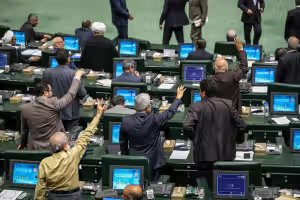
Parliament approved the general principles of legislation on combating foreign infiltration in August by 183 votes to four, but lawmakers have yet to complete consideration of its individual provisions.
A publicly circulated draft would impose new restrictions on contacts with foreign media, universities, embassies and international organizations and give the Intelligence Ministry and the Revolutionary Guards' Intelligence Organization roles in identifying prohibited foreign links.
Some provisions would restrict sharing information with foreign institutions and certain forms of academic, cultural and civil-society cooperation.
Critics in Iran have warned that the broad wording could expose journalists, academics, researchers and other citizens to prosecution.
The notice did not say whether the cabinet opposed the legislation as a whole or only aspects of the parliamentary committee's report.
The decision follows earlier public opposition from President Masoud Pezeshkian's administration. Vice President for Legal Affairs Majid Ansari said in August that the proposal conflicted with constitutional protections for citizens' rights and individual freedoms and would sharply restrict academic contacts with institutions abroad.
"If every type of contact and communication faces restrictions and is criminalized by law, naturally they will prefer to migrate and carry out their scientific and research activities in a free environment," Ansari said, warning that the measure could drive more Iranian researchers, doctors and academics to leave the country.
People look at the new Apple devices on display during Apple's event at the Steve Jobs Theater in Cupertino, California on September 9, 2026.
Maryam Azimi, who has written of being driven blindfolded to court in Mashhad in an intelligence vehicle, thinking those were the last minutes of her life, introduced the new iPhone's camera technology at Apple's global launch on Tuesday.
Azimi, identified in Apple's prerecorded presentation as an image-quality engineer, presented a feature called Apple Reference Image during the segment on the iPhone 18 Pro's camera, which the company described as its most advanced to date.
Her appearance drew notice among Iranians for two reasons: her role in developing imaging technology at one of the world's largest companies, and her public opposition to the Islamic Republic, including her account of her own detention.
In a post on January 9, as protests spread across Iran, Azimi shared footage from the Vakilabad area of Mashhad and described being driven along the same street years earlier, blindfolded, in the back of an intelligence vehicle on her way to court.
"At the time, I did not know where we were going and thought these were the final minutes of my life," she wrote.
As the vehicle approached Park Square, she said, an interrogator told her to remove the blindfold, hold her head up and behave naturally. It was the hour she should have been in class at a nearby university. Looking out of the window, she recognized a close friend driving past.
"It felt like a dream," she wrote. "She was going toward her home, the safest place in the world, and I was a prisoner of the demon, with death before my eyes every second."
In the same post she praised those confronting the authorities as people seeking to "take back their rights from the bloodthirsty Islamic government," wrote that "now Vakilabad, Mashhad, Khorasan and all of Iran smell of freedom," and closed with the words Woman, Life, Freedom, the slogan of the uprising that followed Mahsa Amini's death in morality police custody in September 2022.
In a separate post in English after the January killings, addressed to non-Iranian friends and colleagues, Azimi described "the grief, the anger, the helplessness, the not-knowing," listed five Iranian human rights organisations and asked readers to donate.
Azimi's University of British Columbia profile records a bachelor's degree in computer engineering from Ferdowsi University of Mashhad in 2009 and a master's in electrical and computer engineering from UBC in 2014.
The feature she presented on Tuesday captures digitally signed data from the camera sensor and produces an unalterable reference image against which a finished photograph can be checked, in the manner of a digital negative.
Apple said it was intended for photojournalists, photographers and anyone seeking to distinguish an authentic image from one edited or generated by artificial intelligence.
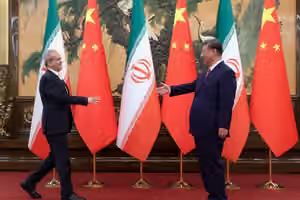
Chinese President Xi and Iranian President Pezeshkian meet in Beijing, File photo.
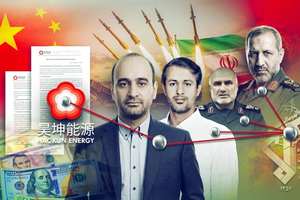
Iran routed an estimated $2 billion to $2.5 billion through a China-based trade mechanism over the past year, using proceeds from oil sales to pay for Chinese goods and, at least once, contracts for military equipment, Reuters reported on Thursday.
The barter-like arrangement allowed Tehran to turn payments for Iranian oil into credits for Chinese imports without sending money directly through international banking channels, Reuters said, citing two senior Iranian sources and three other people familiar with the mechanism.
Iran used the system to buy medicines, vehicles and communications equipment, while it was also used in connection with contracts worth millions of dollars to supply Iran with air defense equipment over the past year, the sources said.
The mechanism has been operating since at least 2021 but has become more important as Washington tightened sanctions on Iran and companies doing business with Tehran, according to the report.
A buyer acting on behalf of Chinese state-owned oil trader Zhuhai Zhenrong had, at least until this year, deposited hundreds of millions of dollars a month with a China-based financial entity known as ChuXin, three people familiar with the arrangement told Reuters.
Those payments covered Iranian oil purchases. ChuXin then sent funds to Chinese exporters and companies involved in infrastructure projects in Iran, likely through other Chinese financial institutions, Reuters reported.
Around 70% of the Iranian oil proceeds handled through the arrangement went to infrastructure projects, while the rest entered accounts belonging to a special purpose vehicle, or SPV, used to pay suppliers of goods to Iran, the sources said.
The two Iranian sources confirmed the existence of the SPV, which Reuters said had not previously been reported.
Oil exchanged for access to Chinese goods
The SPV is managed by two entities, one acting on behalf of China's Ministry of Commerce and another linked to Iran's central bank, according to all five sources.
When Iran's central bank approves an importer to use funds held in the SPV, the Iran-linked entity informs its Chinese counterpart so payments can be made to suppliers, three of the sources said.
The structure gives Chinese manufacturers access to payment without dealing directly with Iran, according to the report. Reuters said there was no indication that the Chinese manufacturers supplying civilian goods had broken sanctions.
Reuters could find no record of a financial institution called ChuXin in Chinese corporate registries, and one source said it may exist only on a spreadsheet.
China's foreign ministry told Reuters it was "not familiar with the situation you describe" when asked about the mechanism.
"China has consistently opposed unilateral sanctions that have no basis in international law and have not been authorized by the United Nations Security Council," the ministry said.
Iran's UN missions in New York and Geneva did not respond to Reuters requests for comment. Iran's central bank, China's commerce ministry, the National Iranian Oil Company and Zhuhai Zhenrong also did not respond to questions about their reported roles.
China has long been the main buyer of Iranian oil. More than 80% of Iran's shipped crude went to China in 2025, averaging around 1.4 million barrels per day, according to Kpler data cited by Reuters.
The arrangement has helped Tehran keep trade flowing despite years of sanctions, while giving China access to discounted Iranian crude.
Its importance has grown as the United States has increased economic pressure on Iran during the six-month-old war. Treasury Secretary Scott Bessent warned countries in August to cut business ties with Tehran or risk losing access to the dollar-based financial system.
Reuters said it could not determine how the US naval blockade on Iranian oil exports had affected the China trade mechanism. No Iranian crude cargoes had successfully passed through the Strait of Hormuz to China since the blockade was reinstated on July 14, according to the news agency.
A UN embargo on exports of most major conventional weapons to Iran was restored in September 2025 along with other sanctions.
Andrea Ghiselli, an international politics lecturer at the University of Exeter who studies China's relations with the Middle East, told Reuters that Beijing wanted to resist US pressure without putting major Chinese banks and companies at risk of exclusion from the international financial system.
A screen-grab from a video released by the IRGC purporting to show missiles being launched toward US warships
Iran is seeking to turn the US maritime blockade back on Washington by expanding its retaliation beyond the Strait of Hormuz, threatening shipping across a wider area after US attacks on Iranian tankers.
Nour News, a website close to Iran’s Supreme National Security Council, said Wednesday that the latest escalation showed signs of reversing the logic of the blockade.
“The US naval blockade was supposed to target Iran’s economic resilience by cutting or restricting its export routes,” it said.
But with both sides now attacking tankers and military vessels and traffic through Hormuz again sharply reduced, “the cost of the blockade is no longer distributed solely on the Iranian side.”
The Revolutionary Guards (IRGC) said Wednesday that Iranian forces had responded to US attacks on five Iranian tankers by targeting two US warships and eight oil tankers, as well as 10 “violating vessels” attempting to pass through Iran’s restricted zone in Hormuz.
The US denied that its warships had been hit.
‘An eye for an eye’
Iran is now threatening to widen that confrontation geographically.
IRGC spokesman Hossein Mohebbi said a new restricted area would extend from the direction of Chabahar through parts of the Gulf of Oman and Arabian Sea along routes leading towards Hormuz. Its precise coordinates have yet to be announced.
The IRGC has also warned tankers and other vessels at ports and anchorages in Kuwait and Bahrain to leave, threatening those that remain.
Ships entering without Iranian permission would be placed on a sanctions list and denied maritime, insurance and other services, Mohebbi said, including during future passages through Hormuz.
Conservative political activist Amir Chizari, who is close to parliament speaker Mohammad-Bagher Ghalibaf, advocated going further, calling for Iran to prevent ships from using ports in Persian Gulf countries hosting US military bases.
“Head for head, eye for eye—that means all these ports will be blockaded by Iran,” he wrote on X.
Nour News said the significance lay not simply in creating another restricted zone but “in changing the logic of confrontation with the blockade.”
“Tehran does not necessarily need to seize a ship to change the behaviour of an actor; it is enough for the cost of interacting with a vessel or network to rise so that the other side retreats in advance,” it said.
Diplomacy narrows
The increasingly expansive strategy comes as prospects for reviving diplomacy appear to be shrinking.
Foreign Minister Abbas Araghchi said Tuesday that a US return to its commitments and the Islamabad understanding would “pave the way for a return to normality.”
But Middle East Eye reported Wednesday, citing two sources close to the Iranian government, that President Donald Trump had conveyed through Pakistani and Qatari officials that Washington would not return to the previous understanding.
The absence of a diplomatic route raises the stakes of Iran’s strategy: Tehran is betting that making the blockade more expensive for Washington, commercial shipping and regional states will eventually create pressure to ease it.
A costly gamble
Inside Iran, critics warn that the same strategy could inflict enormous damage on the country itself.
Heshmatollah Falahatpisheh, a conservative former chairman of parliament’s National Security and Foreign Policy Commission, accused hardliners of risking Iran’s tanker fleet.
“The National Iranian Tanker Company is the largest tanker company in the world. They are setting the country’s unparalleled wealth on fire. This Iran-burning must end,” he wrote on X.
Hardliners counter that such economic calculations make little sense when they believe Iran faces an existential threat.
One user responding to Falahatpisheh asked what guarantee Iran had that peace would last if it compromised now, or that the United States would not attack again months later.
The costs of escalation are already becoming apparent. Brent crude rose above $100 a barrel Wednesday, while flows through Hormuz fell as low as two million barrels a day after reaching eight to nine million before fighting resumed.
In Iran, the dollar rose above 2.33 million rials on the foreign exchange market, another record low for the national currency.
Iran’s strategy amounts to a gamble that widening the geographic and economic costs of the blockade will eventually make it harder to sustain. But the deeper Tehran extends the confrontation beyond Hormuz, the greater the risk that those costs return to Iran itself.
Young Iranian women are seen in a shopping center without mandatory hijab.
Iranian authorities are holding back from enforcing mandatory hijab as extensively as they would like because of “war conditions,” a senior official said Wednesday, even as pressure grows for tougher enforcement.
“Look at how the enemy has managed to promote that decadent Western lifestyle in our society. Look at the hijab issue itself. Because of the war conditions, for now we cannot enter this front the way we should,” Gholam-Ali Haddad-Adel, a member of Iran’s Expediency Council, and Supreme Leader Mojtaba Khamenei’s father-in-law said at a gathering of student associations.
The effects would be visible in schools, making the authorities’ task “much harder than in 1981, when we started working,” Haddad-Adel added.
His comments came a day after an official representing supreme leader in Iranian universities announced that mandatory hijab instructions for universities had been drafted and would soon be issued by the ministries of science and health.
Women without mandatory hijab are seen at an outdoor market in Iran.
Universities prepare hijab rules
Existing hijab regulations were already sufficient but needed renewed attention, Saeed Karami, the cultural and political deputy of leader’s representative body in universities, told Mehr news agency Tuesday.
“We certainly will not see the bitter occurrences in universities that we sometimes see on the streets,” Karami said.
The new rules should be described as “instructions” rather than a “hijab charter,” Karami added.
Women without mandatory hijab are seen at a shopping center in Iran.
Lawmaker Mohammad-Taghi Naghdali also criticized the government Tuesday for what he called a “retreat” on hijab and for failing to promulgate legislation known as the Chastity and Hijab Law.
Parliament would continue pursuing the issue, Naghdali added.
The comments are part of a renewed push by officials for greater enforcement after years of disobedience by women against compulsory veiling.
Officials press for tougher enforcement
The secretary of Iran’s Supreme Council of the Cultural Revolution said Wednesday that mandatory dress rules were not being observed in some government offices and pharmacies.
Women without mandatory hijab walk along a street in Iran.
“In some government offices, hijab is not observed, and in some pharmacies things have gone beyond not wearing hijab,” Abdolhossein Khosropanah said at a meeting of university faculty members in Hamedan.
Government agencies and public-service institutions, including offices and facilities such as pharmacies overseen by ministries, were required to monitor compliance with regulations, Khosropanah added.
The Supreme Council of the Cultural Revolution had adopted “comprehensive and sufficient” measures on hijab over the past two decades, meaning new measures were unnecessary, he said.
A woman without mandatory hijab walks along a street in Iran.
Other officials have made similar calls in recent weeks.
Hossein Akbari, the Revolutionary Guards commander in North Khorasan province, announced Saturday that groups tasked with verbally warning people about their dress would be revived and reorganized to promote mandatory hijab.
Lawmaker Mostafa Moeini Arani has called for action against women deemed improperly veiled and urged parliament speaker Mohammad-Bagher Ghalibaf to promulgate the hijab law.
Kayhan, a newspaper overseen by a representative of Khamenei, has also urged the government to address what it described as a failure to enforce hijab requirements.
Government supporters have staged demonstrations in several cities. They formed a human chain in Qom on August 29 demanding enforcement, while Friday prayer attendees demonstrated outside the South Khorasan governor’s office in Birjand a day earlier.
Young Iranians attend a social gathering without mandatory hijab in Iran.
A video sent to Iran International showed a group of women supporting the government demonstrating in Isfahan on August 24 and chanting for the hijab law to be implemented.
Women continue to defy mandatory hijab
Women have continued to appear without mandatory hijab in public despite pressure from authorities, extending a form of civil disobedience that expanded after the 2022 Woman, Life, Freedom protests.
Citizens have sent Iran International videos and messages criticizing renewed enforcement efforts at a time of rising prices and economic hardship.
They have described mandatory-hijab advertisements in Mashhad, confrontations with women in the streets, warnings issued to shops and cafes and the closure of dozens of businesses in cities across the country.
Women without mandatory hijab walk along a street in Iran.
CNN reported in August that authorities had increased pressure on women over mandatory hijab but were avoiding widespread direct street enforcement because of concern that it could trigger another wave of protests.
Authorities were instead relying on legal measures, business closures and economic pressure while women continued their civil disobedience, CNN reported.
Haddad-Adel’s reference to “war conditions” comes as the Islamic Republic faces continuing military conflict alongside a worsening economic crisis and growing pressure on household finances.
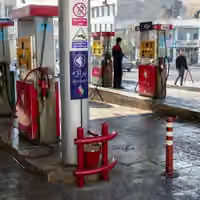
The doubling of Iran’s highest petrol price tier has also increased official concern about public discontent and possible protests.