Iranian lawmakers and military officials attend a parliamentary session to confirm Mehrdad Akhlaghi as Iran’s new defense minister, October 17, 2026
Iranian leaders raised the conditions for negotiations with the United States and issued fresh warnings of a wider military response on Wednesday, even as signs persisted that Tehran was leaving room for diplomacy.
President Masoud Pezeshkian said threats and sanctions must be lifted in practice before conditions for negotiations could be established, while Revolutionary Guards spokesman Hossein Mohebbi said Iran would launch offensive operations against any country that attacked it as part of a shift toward asymmetric warfare.
An unnamed senior security official also told state-run Press TV that Iran was prepared for an all-out war and would respond “without restraint” to renewed attacks or assassinations.
The rhetoric coincided with high-level discussions in Tehran. Iranian media reported Wednesday that Parliament Speaker Mohammad Bagher Ghalibaf had met Supreme Leader Mojtaba Khamenei to discuss the latest military and economic developments in the confrontation with the United States and Israel.
The meeting also addressed strengthening Iran's national capabilities, maintaining social cohesion, tackling economic difficulties and “advancing relations with strategic partners,” according to the reports.
Yet diplomatic channels remain active. Russian President Vladimir Putin told US envoy Steve Witkoff on Wednesday that there was still room for diplomacy over Iran and that an agreement with Tehran was needed, according to the Kremlin.
The competing signals leave open whether Tehran is raising the price of a negotiated pause or preparing for another phase of confrontation.
Talk of a negotiated pause
The conservative daily Jomhouri Eslami reported, citing “informed sources,” that discussions mediated by Qatar and Pakistan could take place this week around a framework for halting military clashes and securing reciprocal concessions.
The report followed Pakistani Field Marshal Asim Munir's visit to Tehran on Tuesday and came amid a flurry of diplomatic activity involving Russia and other regional powers.
According to Jomhouri Eslami, the framework would seek to halt military clashes, address outstanding disputes and sequence concessions in a way that reduced the risk of fighting resuming.
The newspaper said it expected that “the region will not see an escalation of tensions under current conditions.”
The prominence given to the prospect of an agreement by a conservative establishment newspaper is notable at a time when Iranian officials publicly deny that substantive nuclear negotiations with Washington are under way.
Sobh-e No, a newspaper aligned with Parliament Speaker Ghalibaf, also linked renewed discussion of talks to diplomatic contacts involving Pakistan and Russian Foreign Minister Sergei Lavrov, who visited Tehran on Tuesday.
The newspaper reported on a Russian proposal for a joint Iranian-Russian-Chinese initiative concerning the Strait of Hormuz, although Tehran has continued to insist on maintaining its authority over the waterway.
The Pezeshkian administration's Iran newspaper argued that the country's security depended on exercising sovereignty over the strait rather than sharing responsibility with outside powers.
“To preserve our security, we have no option but to exercise sovereignty over the Strait of Hormuz,” it wrote.
That position points to one of the difficulties facing any potential agreement: Tehran wants the Strait of Hormuz and broader maritime security addressed alongside the conflict, while Washington has continued to prioritize Iran's nuclear program.
Pressure in the other direction
Hardline lawmaker Hassan Nataj called for Supreme Leader Khamenei to reconsider the religious prohibition on nuclear weapons in response to the conflict.
“We should ask the Supreme Leader to revise the fatwa prohibiting nuclear weapons in light of the current situation,” he told the Didban Iran website.
The comments come amid a wider debate among Iranian politicians and commentators over whether the country's nuclear posture still provides sufficient deterrence against further US or Israeli attacks.
The simultaneous emphasis on diplomacy and escalation does not establish which course Tehran ultimately intends to pursue.
But the pattern has become clearer: diplomatic channels remain open while Iranian officials publicly raise the conditions for negotiations and stress that renewed attacks could bring a broader military response.
Iraqi security forces stand at the Shalamcheh border crossing with Iran after Iraq closed the crossing following airstrikes on the Iranian side that security sources said killed an Iraqi citizen, Iraq, April 4, 2026.
Conflicting accounts emerged Wednesday over Iraq's plans for its border with Iran, as Baghdad attributed the closure of one major crossing to technical shortcomings while reports said more could be shut amid US pressure to restrict trade routes with Tehran.
Iraqi government spokesperson Haider al-Aboudi said the Sheeb crossing, known as Chazabeh in Iran, was closed because it lacked sufficient technical, technological and developmental readiness, according to the official Iraqi News Agency.
He said trade was proceeding normally through several other crossings with Iran.
But Al Jazeera cited an Iraqi government official on Tuesday as saying Prime Minister Ali al-Zaidi had ordered Sheeb closed indefinitely and several other crossings gradually shut in the coming days. No reason was given for the planned closures.
Separately, AFP reported Wednesday, citing two Iraqi political sources, that Washington was pressing Baghdad to close crossings with Iran as part of efforts to increase economic pressure on Tehran.
One source said the US Treasury Department raised the issue with Zaidi during his visit to New York for the UN General Assembly last month and that the proposed restrictions would leave only two crossings open, one in federal Iraq and another in the Kurdistan region.
The second source said Washington had asked other countries bordering Iran to take similar measures.
Reuters reported that Sheeb had been closed to passengers, vehicles and commercial trucks. An Iraqi border official told the agency the closure would allow security arrangements to be reviewed and detection equipment installed to prevent the smuggling of prohibited materials.
Tehran seeks reopening
Iranian officials said they had received no advance warning of the closure.
Valiollah Hayati, a security official in Iran's southwestern Khuzestan province, said consultations were under way with Iraqi authorities to reopen Sheeb and advised passengers and commercial trucks to use the nearby Shalamcheh crossing.
Iranian Interior Ministry spokesperson Ali Zeinivand said Iraq was required to notify Tehran of extended border closures but had not done so.
Foreign Minister Abbas Araghchi also criticized disruptions at Iran's borders on Wednesday, saying they had become places where traffic was held up rather than allowed to pass. He said the Foreign Ministry would seek to resolve obstacles originating in neighboring countries.
The uncertainty comes days after Pakistan suspended commercial activity at two major crossings with Iran, Taftan-Mirjaveh and Gabd-Rimdan, on October 17.
Iranian authorities said the border reopened on Tuesday, although the resumption of normal commercial traffic at both crossings has not been independently confirmed.
Iran and Iraq share a border of more than 1,400 kilometers (870 miles) and have extensive political, religious and economic ties.
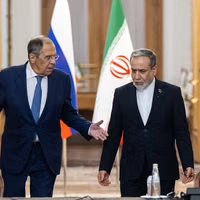
Russian Foreign Minister Sergei Lavrov and his Iranian counterpart Abbas Araghchi during talks in Tehran, October 20, 2026.
Russian President Vladimir Putin discussed Iran with US envoy Steve Witkoff on Wednesday and offered Moscow’s help, shortly after Foreign Minister Sergei Lavrov visited Tehran as Russia seeks a role in efforts to end the Iran-US conflict.
The meeting adds to signs that Moscow is positioning itself as both an ally of Tehran and a potential intermediary with Washington as diplomatic efforts remain deadlocked over Iran’s nuclear program and the sequencing of commitments.
Earlier this month, Putin said Russia was prepared to do everything it could to help resolve the crisis and subsequently conveyed Tehran’s position to US President Donald Trump. Neither the contents of the message nor Washington’s response was made public.
In Tehran on Tuesday, Iranian Foreign Minister Abbas Araghchi said the two countries had “never” worked as closely as they do now, while Lavrov described Iran’s cause as “just” and said Russian specialists who left the Bushehr nuclear power plant during the war were gradually returning.
Yet Iranian media and commentators questioned how much Moscow could achieve as an intermediary given the fundamental differences between Tehran and Washington.
Tabnak, a news website considered close to Supreme National Security Council Secretary Mohsen Rezaei, said Moscow could help by conveying messages, consulting with both capitals and supporting a political solution, but cautioned that no mediator could overcome the underlying disagreements on its own.
“As long as fundamental disagreements over the terms of an agreement persist, no mediator can guarantee success,” it wrote, citing differences over the sequencing of negotiations and the scope of commitments.
The reformist outlet Rouydad24 said there was little evidence Moscow had brought a comprehensive plan capable of breaking the deadlock.
“What has so far been presented by official Iranian and Russian sources points less to a ‘grand peace plan’ than to the continuation of Russia’s traditional role as a facilitator of dialogue,” it wrote.
Uranium emerges as key obstacle
A central obstacle in the diplomatic impasse is Iran’s stockpile of uranium enriched to 60%.
Russian officials, including Deputy Foreign Minister Sergei Ryabkov, have indicated that Moscow is prepared to receive the stockpile, a move that could address one of the central concerns surrounding Iran’s nuclear program.
Tehran, however, has rejected the idea of transferring its enriched uranium abroad and denied that nuclear negotiations with Washington are under way.
The position was reiterated during Pakistani army chief Asim Munir’s visit to Tehran on Tuesday. Rezaei told Munir that none of Iran’s enriched material would leave the country, describing it as a national asset intended for domestic use.
Before Lavrov’s arrival, conservative political activist Ali Gholhaki claimed Russia had been partly persuaded by an Iranian proposal, advanced when Ali Larijani was secretary of the Supreme National Security Council, to establish a framework for transferring uranium enriched to 60%.
But following the visit, Gholhaki said Lavrov had produced no tangible result and had left “without any particular achievement.”
The conservative newspaper Khorasan argued that negotiating over Iran’s enriched uranium could increase rather than reduce the danger of another attack.
It argued that while Iran did not possess a nuclear deterrent, its stockpile of highly enriched uranium itself acted as a form of deterrence by raising the risks of further US escalation.
Mohammad-Sadegh Alizadeh, a journalist interviewed by the conservative Farhikhtegan newspaper, said Tehran’s immediate priority should instead be ending the war on terms acceptable to Iran.
“Whether the Russians have agreed to accept Iran’s 440 kilograms of uranium enriched to 60% is a secondary issue to be addressed later,” he said. “First, the question of ending the war must be settled.”
Doubts over Moscow’s interests
Doubts about Russia’s intentions extend beyond whether it can bridge the divide between Tehran and Washington.
Reformist journalist Ahmad Zeidabadi argued that Iranian decision-makers should nevertheless welcome any Russian initiative capable of stopping another war.
“Russian interference is an evil, of course, but compared with the prospect of another war, it is the lesser evil,” he wrote on Telegram.
Commentator Mehran Tabatabaei argued that Moscow’s approach to Iran remained subordinate to its negotiations with Washington over Ukraine.
“Russia will not take any positive steps until it resolves the Ukraine issue and obtains the concessions it wants from the United States over Ukraine,” he wrote.
Journalist Mohammad Aghazadeh offered a starker assessment, saying failure by Lavrov to make progress would suggest diplomacy itself was approaching a dead end.
“Either the current state of uncertainty will continue, or an intense war will begin,” he wrote, “one that will probably not be as easy to end as it is to start.”
The Revolutionary Guards' threat to target undersea internet cables in the Strait of Hormuz raises questions about its feasibility, as the waterway carries a fraction of global bandwidth and damaging its cables would not shut down the world's internet.
Yadollah Javani, the Revolutionary Guards' political deputy, warned on Wednesday, October 21, that vital internet cables in the Strait of Hormuz could be targeted if Iranian infrastructure came under attack.
The strait's importance to global oil and gas shipments may suggest that it holds similar significance for international internet traffic. Telecommunications data, however, paints a different picture.
According to the International Cable Protection Committee (ICPC), five active submarine cable segments pass through the Strait of Hormuz, accounting for less than one percent of the world's international bandwidth.
Telecommunications research firm TeleGeography identifies three major cable systems serving the route: Asia Africa Europe-1 (AAE-1), FALCON and Gulf Bridge International (GBI).
The principal data routes linking Europe and East Asia pass through the Red Sea, meaning the strategic importance of Hormuz to global energy markets does not translate into equivalent influence over the internet.
Cables serving Iran's neighbors
Submarine cables crossing the Strait of Hormuz, according to TeleGeography, have been routed through Omani waters because of longstanding political considerations and difficulties in relations with Iran.
These cables primarily serve countries in the Persian Gulf, meaning an attack would pose a more immediate threat to regional connectivity than to the wider global internet.
Damage to submarine cables in the Strait of Hormuz could disrupt international connectivity in Bahrain, Qatar, Kuwait and the United Arab Emirates, although all four countries have alternative terrestrial connections. Saudi Arabia is less dependent on Persian Gulf cable routes, with most of its international bandwidth carried through systems landing on its Red Sea coast.
Why cutting cables does not mean cutting internet access
The global internet does not depend on a single network or point of failure. Telecommunications operators use multiple submarine and terrestrial routes to carry data and can redirect some traffic when a connection becomes unavailable.
Such rerouting may reduce speeds, increase latency or disrupt certain services, but it does not necessarily disconnect users entirely.
Damaging a cable is also fundamentally different from depriving a country of internet access. The outcome depends on the number of affected routes, operators' dependence on them and the capacity remaining elsewhere in the network.
Mehdi Saremifar, a Canada-based technology expert, described earlier Revolutionary Guards threats against submarine cables as largely rhetorical in an interview with Iran International.
Referring to similar threats made by Iranian authorities during the summer, Saremifar said their calculations had used the total volume of global submarine cable traffic rather than the much smaller amount passing through the Strait of Hormuz.
"These cables carry much of the traffic for countries along the southern shores of the Persian Gulf, Kuwait, parts of Iraq, Jordan and Syria. That means traffic in these areas would be affected, but not all of it," Saremifar said.
Alternative terrestrial connections, including routes through Saudi Arabia and Egypt, could carry some of the displaced traffic, Saremifar said, adding that Iran's earlier threats had already encouraged consideration of backup routes.
"So it is neither a particularly far-reaching threat nor a particularly serious one," Saremifar said.
He also questioned the operational significance of the earlier warning, noting the institutional background of the Revolutionary Guards official who issued it. Evidence of actual naval movements toward the cables would warrant a different assessment, he said.
Damage could disrupt communications and economic activity in Persian Gulf commercial centres, but would not necessarily produce a prolonged internet outage, Saremifar added.
What the Red Sea disruptions reveal
Previous submarine cable failures have disrupted communications without shutting down internet access across entire regions.
In February 2024, three cables were damaged in the Red Sea, most likely by the dragging anchor of the Rubymar, a cargo ship struck by Houthi missiles. Repairs took six months, according to TeleGeography.
Four submarine cables were damaged in the Red Sea in September 2025, disrupting connectivity across parts of the Middle East and Asia, according to the Center for Strategic and International Studies.
In March 2024, damage to four cables off West Africa disrupted internet services in 13 countries. Operators rerouted some traffic through unaffected submarine and terrestrial networks, according to the Internet Society.
These cases illustrate an important distinction: the time required to repair a cable is not necessarily the length of the resulting internet disruption. Operators may restore some services through alternative networks before physical repairs are completed.
Security risks in the Persian Gulf could delay cable repairs by restricting access for specialized vessels. However, the availability of alternative submarine and terrestrial routes means delayed repairs would not necessarily cause a prolonged internet shutdown across the region.
Legal constraints on targeting submarine cables
Submarine communications cables are also subject to international legal protections.
The United Nations Convention on the Law of the Sea protects the laying and maintenance of submarine cables under Article 79, while Article 113 requires states to criminalize certain intentional or negligently caused damage to cables beneath the high seas.
Legal responsibility would depend on factors including the location of an attack, applicable jurisdiction and the international obligations of the countries involved.
During armed conflict, international humanitarian law also applies.
According to the International Committee of the Red Cross, civilian communications infrastructure is generally protected against direct attack unless it meets the specific criteria for becoming a military objective.
Military use of part of a communications network does not automatically make the entire network a lawful target. The principles of distinction, proportionality and precaution must still be observed.
Workers install the 2Africa undersea cable on the beach in Amanzimtoti, South Africa, February 7, 2023.
These requirements are particularly relevant to cables carrying civilian communications for several countries simultaneously.
The gap between the threat and the internet's reality
Javani's warning follows earlier threats by Iranian officials against submarine internet infrastructure in the Persian Gulf.
Yet the Strait of Hormuz's limited share of international bandwidth, together with the availability of alternative routes, means that even substantial damage to cables in the area would not amount to a global internet shutdown.
The more immediate consequences could fall on Persian Gulf Arab states and businesses dependent on regional connectivity.
The threat therefore highlights a gap between the Revolutionary Guards' warnings and the technical and geographical limits of carrying them out: cables in the Strait of Hormuz can be damaged, but the global internet does not depend on them to remain operational.
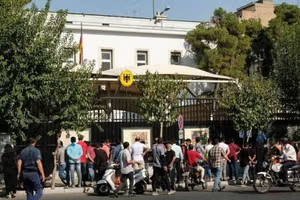
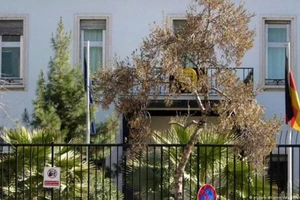
Iranian applicants for German work and vocational-training visas protest outside the German Embassy in Tehran over delays in securing appointments.
Iranians seeking German work and vocational-training visas protested outside the German Embassy in Tehran on Tuesday over lengthy delays in securing appointments, with some saying they had already lost job offers or training places while waiting.
Some applicants told Iran International they had been waiting since July for appointments despite already receiving preliminary approval from German authorities. They included healthcare and nursing professionals seeking work visas, as well as applicants using Germany’s fast-track procedure for skilled workers.
Some said the delays had caused language certificates or preliminary approvals to expire, forcing them to repeat parts of the process and pay additional costs.
Applicants say delays are costing them jobs
The protesters also include applicants for Germany’s Ausbildung system, which combines workplace training with classroom instruction and typically lasts between two and three-and-a-half years.
Applicants told Iran International that appointments had been released only in small numbers despite repeated protests and correspondence with German authorities. Some said they had lost job offers or places on vocational programs because they could not complete the visa process in time.
Thousands of people are reported to be waiting for appointments to submit German visa applications in Tehran.
Family reunification applicants have also protested
The latest gathering follows repeated protests by Iranians seeking other types of German visas.
Family reunification applicants have demonstrated outside the embassy in recent weeks, with some saying they have waited as long as two years for appointments or decisions.
Videos sent to Iran International showed applicants calling for faster processing and an end to prolonged uncertainty.
Students have faced similar delays, with some saying they risk losing university places because they cannot complete the visa process before their courses begin.
Embassy remains on emergency operations
Germany’s Foreign Office told Iran International in August that its embassy in Tehran remained open but that its consular and visa section was operating in emergency mode because of the security situation.
“The visa section is closed to regular visitors until further notice; no regular visa appointments are being issued,” the ministry said at the time.
Applications already submitted through the embassy or an external service provider were continuing to be processed where capacity allowed, and visas already approved could still be issued.
Berlin said the latest crisis had worsened problems that had already affected the visa section since June last year, when conflict between Iran and Israel forced several foreign embassies to reduce or suspend consular operations.
Germany also said staffing had been affected by restrictions imposed by Iranian authorities on diplomatic accreditations.
Germany offers limited alternatives for some visa applicants
Germany’s Foreign Office told Iran International in August that it had introduced alternative arrangements for some Iranians affected by the reduced visa services in Tehran.
Family reunification applicants who had already joined the embassy’s waiting list were being contacted to submit applications in Istanbul through the International Organization for Migration’s Family Assistance Programme. Priority was being given to people whose appointments in Tehran had been canceled because of the war.
The ministry also said visa provider TLScontact was issuing appointments to some applicants with preliminary approval under Germany’s fast-track skilled-worker procedure.
Since July, new waiting lists have also been opened for several national visa categories, including students and doctors, although German authorities had not said when those applicants would receive appointments.
Iranian Parliament Speaker Mohammad Bagher Ghalibaf visits the grave of former Iraqi paramilitary commander Abu Mahdi al-Muhandis in Najaf, Iraq, on August 21, 2026 (Reuters)
A current within Iran’s conservative establishment associated with Parliament Speaker Mohammad Bagher Ghalibaf favors maintaining military and economic leverage while keeping open the possibility of a negotiated end to the war with the United States.
Ghalibaf has played a leading role in negotiations. The position reflected in the conservative newspapers Khorasan and Sobh-e No rejects both indefinite confrontation and a settlement on US terms, favoring preparations for renewed fighting, retaining Iran’s strategic leverage and keeping open the possibility of a negotiated settlement.
The divisions are also reflected in Iran’s media landscape, with outlets including Kayhan, Javan and Tasnim taking more confrontational positions, while Shargh and Sazandegi have generally favored diplomacy.
Commentaries and an interview published by Khorasan on October 18 illustrate the argument emerging from conservatives associated with Ghalibaf.
Hormuz as negotiating leverage
In “Ambiguity: The New Battlefield”, Khorasan argues that diplomatic contacts do not mean the military threat has disappeared. Uncertainty itself, the commentary suggests, can wear down Iran’s psychological and operational readiness, making continued vigilance necessary even while negotiations remain possible.
A second article, “The Puzzle of Iranian and American Resilience”, develops the economic case for resistance. It acknowledges Iran’s severe inflation and financial pressures but questions whether the United States can necessarily outlast Iran simply because its economy is larger. American debt, exposure in financial markets, borrowing costs and the economic consequences of disruption around the Strait of Hormuz are presented as potential weaknesses.
Taken together, the Khorasan articles present the Strait of Hormuz as a source of bargaining power that Iran should retain during negotiations. They do not address how long Iran could sustain disruption or whether the economic costs to its adversaries would outweigh those to Iran.
A negotiated exit
The articles leave room for diplomacy. “Ambiguity” refers to a seven-day proposal transmitted through Qatar under which maritime traffic could resume if specified conditions were met.
In a separate interview, political analyst Ehsan Salehi, an adviser to former President Ebrahim Raisi, argues that the diplomatic outcome associated with the Islamabad understanding should have been presented to the public as a potential achievement. Otherwise, negotiations risk becoming synonymous with betrayal.
Salehi also warns against labeling officials as traitors without evidence, arguing that disagreements over diplomacy should not divide the country.
The arguments point toward a conditional settlement addressing Iran’s security concerns and providing economic or political benefits that could be presented domestically as the result of resistance. The articles do not establish whether this faction would accept particular compromises on the nuclear program, sanctions or control of Hormuz. Those questions remain unresolved.
How the faction differs from its rivals
The clearest contrast is with the more confrontational conservative current associated with the Paydari (Steadfastness) Front. Paydari figures have generally resisted concessions to Washington and challenged negotiators when agreements fall short of maximalist demands.
The position associated with Ghalibaf is more transactional, treating military pressure as potential leverage for an agreement and diplomacy as a means of securing gains that military action alone may not deliver. The disagreement is less about whether Iran should resist American pressure than about how that resistance should end and what would constitute an acceptable outcome.
Reformist and pragmatic voices have placed greater emphasis on ending the conflict, reducing sanctions and easing economic pressure, contrasting with conservatives who argue that Iran should retain leverage while negotiating. Ghalibaf’s camp, by contrast, insists that distrust of Washington and the possibility of renewed attacks must shape any agreement.
Salehi’s interview adds a domestic dimension. His calls for broader political representation, stronger parties and a more inclusive state broadcaster suggest that national resilience requires political reform as well as military strength.
Parliamentary influence and its limits
Ghalibaf has considerable institutional weight. He was re-elected speaker in May 2026 with 235 votes, following his 198-vote victory in 2024. The results show that his parliamentary support extends beyond a narrow personal faction, although they do not establish that those lawmakers share his foreign-policy positions.
His former senior role in the Revolutionary Guards also gives him military credentials and connections that many civilian politicians lack. But these should not be confused with command over the armed forces. Parliament can influence political debate, scrutinize ministers and shape legislation, but it does not independently determine questions of war and peace.
The Supreme National Security Council brings together the presidency, parliament, the armed forces and other centers of power. Its decisions require the Supreme Leader’s approval. Ghalibaf can influence deliberations but cannot guarantee that the military establishment or the supreme leadership will accept his preferred compromise.
The political test
The faction’s broader influence across Iranian society is harder to establish. Salehi argues that wartime solidarity will not last if citizens who defended the country feel excluded from political life. This is a strategic argument, not evidence that Ghalibaf’s faction commands majority public support.
The immediate political question is whether conservatives advocating this approach can present a negotiated settlement to their rivals as the result of resistance rather than its abandonment.
The unresolved question is whether Iran can retain the Strait of Hormuz as negotiating leverage while pursuing an agreement that ends the conflict without deepening its own economic pressures.