US says it struck three Iranian oil tankers after attacks on warships
US forces struck three Iranian crude oil tankers on Saturday after Iran’s Revolutionary Guards launched ballistic missiles at two US Navy warships in regional waters, US Central Command said in a statement.
CENTCOM said a US aircraft carrier and guided-missile destroyer evaded multiple Iranian attacks and that no American personnel were harmed.
In response, US forces “permanently disabled” the M/T Downy off Kharg Island and the M/T Stark 1 near Jask, CENTCOM said. It added that American forces destroyed the unladen M/T Kylo, also known as the Noxen, in the Gulf of Oman after directing its crew to abandon ship.
CENTCOM said the Kylo was struck “in multiple critical locations” to render it inoperable.
The command described the three tankers as part of a “multibillion-dollar shadow network” used to fund the IRGC and its regional proxies, and said Iran had “no means by which to defend them.”
“Let the message to the IRGC be clear: If you shoot at two of our ships, we will impose an even higher economic cost — taking out three of yours,” CENTCOM commander Adm. Brad Cooper said.
“We will not hesitate to defend American forces, and if necessary, destroy Iran’s limited and exposed oil fleet,” he added.
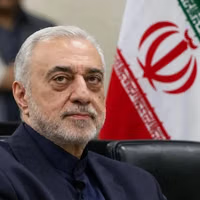
Senior hardline cleric Ahmad Alamolhoda is seeking support to become president of Iran’s Assembly of Experts, an 88-member clerical body responsible for selecting and overseeing the supreme leader, a Tehran-based outlet reported citing informed sources.
Entekhab reported that maneuvering over the assembly’s leadership has intensified ahead of its next session because of concerns about the health of its current president, Mohammad-Ali Movahedi-Kermani.
Alamolhoda, who represents Razavi Khorasan province in the assembly and serves as Friday prayer leader in Mashhad, is seeking to secure enough votes to take the presidency, according to the report.
His main rival is said to be Alireza Arafi, the assembly’s second deputy president, a member of the Guardian Council and head of Iran’s Islamic seminaries.
Another potential contender is Mahmoud Rajabi, who succeeded Mohammad-Taqi Mesbah-Yazdi at the Imam Khomeini Educational and Research Institute. Entekhab quoted an informed source as saying that Rajabi believes he has a stronger chance of securing the post.
Alamolhoda is one of the Islamic Republic’s most prominent hardline clerics and has for years used his influential Friday prayer platform in Mashhad to advocate some of the establishment’s most uncompromising positions on social and political issues.
He is also the father-in-law of late President Ebrahim Raisi, who died in a helicopter crash in May 2024.
Alamolhoda’s positions have included fierce opposition to challenges to compulsory hijab. In 2024, he likened defiance of the Islamic dress code to collaboration with Iran’s enemies, and the previous year suggested that religious hardliners might need to intervene themselves as women increasingly rejected mandatory hijab.
The European Union sanctioned Alamolhoda in March 2023 over serious human rights violations linked to the suppression of protests. The EU cited speeches in which it said he propagated hostility toward women, protesters and religious minorities.
Alamolhoda has remained an outspoken supporter of the Islamic Republic’s leadership following the death of Ali Khamenei.
In June, he said no agreement or commitment by Iran would be acceptable without Supreme Leader Mojtaba Khamenei’s approval and described hostility toward the United States as a fundamental principle of the Islamic Republic.
The contest would put Alamolhoda at the head of a body that played a central role in the succession earlier this year. The Assembly of Experts selected Mojtaba Khamenei following his father’s death, although Iran International reported divisions among members over the process and the choice of the former supreme leader’s son.
The assembly normally elects its leadership for two-year terms. Movahedi-Kermani was elected president in May 2024 with 55 votes, succeeding Ahmad Jannati, while Hashem Hosseini-Bushehri and Arafi serve as first and second deputies respectively.
A satellite view shows tunnel entrances at Pickaxe Mountain, of the Natanz nuclear facility, near Natanz, Iran, June 30, 2026. Vantor handout via Reuters
Donald Trump said again on Friday that the United States may soon strike Pickaxe Mountain, the underground complex near Natanz that is the last significant site linked to Iran's nuclear program still untouched after two wars.
What is it?
A mountain in the Zagros range in Isfahan province, about 1.5 kilometers south of the Natanz enrichment complex, with a large facility dug into it.
The name is a small accident of translation. The mountain is called Kuh-e Kolang Gaz La, and kolang means pickaxe, so foreign analysts began calling the site Pickaxe Mountain. It is not what Iranians call the facility, and Iran has never given it a public name at all.
Why was it built there?
Because of the rock. Most of the surrounding range is sedimentary, but this mountain is hard, dense granite, which gives anything tunneled beneath it substantial natural protection.
Construction began in the autumn of 2020, months after an explosion destroyed an above-ground advanced centrifuge assembly plant at Natanz in an attack widely attributed to Israel. Iran said at the time that the underground halls would replace it.
The destroyed plant had been built to assemble roughly 6,000 advanced centrifuges a year, a capacity sized for the tens of thousands Iran expected to need as restrictions under the 2015 nuclear deal expired between 2025 and 2030.
What is inside?
Nobody outside Iran knows, which is the heart of the problem.
The International Atomic Energy Agency has never been given access. A double security perimeter, a fence and a wall with a patrol route, rings the entire mountain and joins Natanz's own perimeter. There are two pairs of tunnel entrances, one on the east side and one on the west. Analysts assume they lead to a single facility, but even that is not certain.
Iran has said the site is for producing and assembling advanced centrifuges. The Institute for Science and International Security, which has tracked the construction by satellite for years, judges the space beneath the mountain large enough to hold considerably more: not only an assembly plant but a working enrichment plant capable of producing weapons-grade uranium, and probably enough room for weaponization work such as casting uranium metal and shaping it into weapon components.
Two further claims circulate, neither verified. One is that part of Iran's stockpile of uranium enriched to 60 percent, estimated by the IAEA at around 440 kilograms, has been moved there.
The other, from an Israeli intelligence assessment reported by the Wall Street Journal, is that thousands of centrifuges were moved into the mountain last autumn. Neither Israel nor the United States has published evidence.
The institute's reading of the imagery is that the facility is not yet operational, and that construction continues.
How deep is it?
At least 100 meters beneath the mountain, which stands 1,608 meters above sea level.
There is a detail in those measurements worth noticing. The eastern entrances sit about 145 meters below the ridge; the western entrances about 100 meters. That 50-metre difference between the two sets of doors suggests the facility may have more than one level.
Either way it is deeper than Fordow or Natanz, both of which the United States has bombed.
Could American bombs destroy it?
Not the mountain itself. The GBU-57, the largest conventional bunker-buster in the US arsenal, weighs about 13,000 kilograms and is reported to penetrate 18 meters of concrete or 61 meters of earth. Against 100 meters of granite, experts are skeptical.
But a buried facility still has to breathe, and that is where the vulnerability lies. Any working complex needs power, ventilation, heating and cooling, deliveries and people going in and out, and each of those connections surfaces somewhere.
There is a precedent for exactly this. Schematics have been published for two other Iranian tunnel sites built by the Amad nuclear weapons program, Fordow and Shahid Boroujerdi. Both showed ventilation shafts, and in both cases those shafts were directly targeted in air strikes, in June 2025 and March 2026 respectively, because they offered penetrating weapons a way further inside.
No schematics for Pickaxe Mountain have surfaced publicly, but a probable ventilation shaft near the eastern entrances was seen under construction in 2024, fed by a power line that runs above ground before disappearing underground.
The institute's assessment is that an attack would most likely aim at the power supply, the ventilation shafts and the open tunnel mouths, and it notes that as of imagery from July 9 the western pair of entrances remained open.
It also notes that hitting the hardened portals alone would probably deny Iran access only temporarily, adding the mountain to the list of sites that then have to be watched for attempts to dig back in.
Air defenses are not seen as an obstacle. Israel overcame them at Natanz in the opening hours of the June 2025 war.
A June 30, 2026, Vantor Technologies image overview of Pickaxe Mountain. (The Institute for Science and International Security)
The other way in
There is a second possibility, and it has history behind it.
The institute judges that the site, as it now stands, would be more suitable for attack or sabotage by ground forces than from the air. Its model is the 2020 destruction of the Natanz assembly plant, which reportedly involved explosives brought into the building during its construction.
Pickaxe Mountain is still under construction.
A June 30, 2026, Vantor Technologies image of Pickaxe Mountain showing potential locations for ventilation shafts. (The Institute for Science and International Security)
What does Iran say?
That there is nothing there to bomb. Foreign ministry spokesman Esmail Baghaei said in July that "no nuclear activity is taking place" at the site and called the American threats "a fabricated pretext for aggression, destruction, and sabotage."
Others have been less restrained. Mehdi Mohammadi, an adviser to the parliament speaker, called Pickaxe Mountain "the most heavily fortified nuclear facility in the world" and said a strike would "turn the region into hell."
Iran's joint military command has warned that any attack on nuclear or sensitive sites would widen the war.
Every time Trump has threatened it
July 13. On the Hugh Hewitt show: "We have eyes on it and Pickaxe mountain is a possible target for a nice big fat shot right in the front door. We're watching Pickaxe Mountain very closely. We don't see any activity there." He ended the interview more bluntly: "We're going to take out Pickaxe Mountain. Tell the Iranians to be ready."
July 21. After the Israeli intelligence assessment surfaced: "The new site that they're talking about, they're trying to possibly reconstitute a site, we'll hit that site. Any site where they're even thinking about nuclear, we'll be hitting it very, very powerfully." He said the US would hit the area "pretty soon, and very heavily."
July 28. "I know exactly what's going on at Pickaxe. It's not a big problem. We took out their nuclear sites, and we'll have to take out Pickaxe if we don't make a deal."
September 4. Trump said the US may hit the site very soon, crediting the Space Force for the intelligence. "We know everybody that's moving at Pickaxe, we know everybody that's moving everywhere, all over Iran, and if anything goes bad, we hit them. We hit them hard." He called the conflict a "military conflict" rather than a war, and added: "It's small potatoes for us."
So why has it not been hit?
Across two wars, the only recorded strike at the site destroyed a single vehicle on a spoil pile, thought to have been connected to air defense.
One explanation is simply that it is hard to destroy and may not yet contain anything worth destroying.
Iran has spent the interval hardening it further: concrete poured over a western entrance extension, a reinforced structure added at another portal, rock and soil pushed up over an eastern one, and by late April both eastern entrances partially backfilled to block vehicles.
A separate, smaller tunnel complex inside the same perimeter, built in 2007, was sealed shortly after the June 2025 war. What is inside it is unknown.
The other explanation is that Washington wants the option of getting in rather than burying it. Rebeccah Heinrichs of the Hudson Institute has suggested the United States may be preserving the possibility of entering or securing the complex, which would mean a ground operation rather than an air strike. There is no public evidence that one is being planned.
An AI-enhanced photo shows a home appliance shop in Tehran.
When a refrigerator breaks in Iran now, the family often cannot replace it, and increasingly cannot afford to repair it either. Behind that is an industry losing its raw materials, its customers and, since March, two of the industrial hubs that supplied it.
Iranian manufacturers are being squeezed from both ends at once. The steel and plastics they build appliances from have multiplied in price since Israeli and US strikes hit the country's main industrial hubs in March, while the households they sell to have been priced out of the market entirely. Production of refrigerators, televisions and washing machines was already falling by a quarter to more than 40 percent a year before the war began.
What the industry cannot do is pass the costs on, because the arithmetic on the shop floor no longer works for anybody.
The price of a working kitchen
Iran's minimum monthly wage is about 166 million rials, roughly $75. Set against that, the price list on the country's largest online retailer reads as a catalogue of things a working household can no longer buy.
The cheapest mini refrigerator sells for 258 million rials, about $117, a month and a half of that wage. A basic 13-cubic-foot fridge-freezer costs 544 million rials, some $247, more than three months. A mid-sized model runs to 890 million rials, about $405. A washing machine, in the band where most models cluster, costs around 920 million rials, roughly $418, or five and a half months of a minimum wage, and a gas cooker starts at about 360 million rials, $164, rising to 638 million.
Televisions trace the same curve. The cheapest set on the site, a 24-inch model, costs 230 million rials, about $104. A 32-inch television runs to 270 million, and a 43-inch, among the best-selling sizes, to 490 million rials, roughly $223, or nearly three months of wages. A 65-inch set, also a strong seller, costs 1.06 billion rials, about $482, more than six months. At the top of the range, an 85-inch model is listed at 2.9 billion rials, some $1,318, or nearly a year and a half of a minimum wage.
The cheapest dishwasher listed costs 1.34 billion rials, some $609, eight months of wages, which is why dishwashers have moved out of the category of household appliance altogether and into the category of luxury.
At the very top of the market, an imported side-by-side refrigerator is advertised at 4.54 billion rials, about $2,065, or more than two years of a minimum wage.
Iranian media have been documenting what these numbers mean. In May, when conditions were still less severe than they are now, the newspaper Donya-e Eqtesad reported that field observations and consumer complaints showed the breakdown of a refrigerator or washing machine had become an economic and psychological crisis for many families.
Until a few years ago, the paper noted, many households could replace an appliance after saving for several months. Today, buying even a refrigerator, a washing machine or a basic vacuum cleaner has become a distant prospect for a growing number of them.
Repair was the fallback. Repair costs have risen too, and for many families that door is closing as well.
A sector that was already shrinking
The industry serving this market was contracting before the war began.
The Statistical Center of Iran's most recent figures, covering the winter that ran through to March, show refrigerator production down 25 percent year-on-year to 531,000 units. Television production fell 36 percent to 332,000, and washing machine production dropped 42 percent, to 270,000 units.
No comparable production data have been published for other major categories, and the government has released no comprehensive industrial production figures for the past six months.
What the Statistical Center has published is the price index: home appliances in August cost 117 percent more than a year earlier.
Bombed inputs
Then came the strikes. Israeli and US attacks in March hit Iran's two main steel hubs, Mobarakeh and Khuzestan, and its two main petrochemical hubs, Asalouyeh and Mahshahr. Together these complexes account for roughly 50 percent of Iran's steel capacity and 70 percent of its petrochemical capacity.
The effect on manufacturers' input costs has been severe. According to the Iranian Home Appliance Industries Association, the price of the steel used by the industry has risen roughly two and a half times since last summer. Petrochemical feedstocks, including ABS and polypropylene, have gone up three to fourfold.
Authorities have released no detailed figures on the damage or on the operational status of the affected complexes. What is visible is the response: the government has restricted or banned the export of a large share of steel and petrochemical products, while domestic prices for those products have risen sharply.
The industry these costs are crushing was built behind a wall.
Iran banned home appliance imports in 2016, and in 2021 imposed a particularly strict ban on appliances made by South Korean companies, which had previously held a significant share of the market. The policy shifted the market decisively toward domestic manufacturers, and it has drawn persistent criticism over the quality of what those manufacturers produce.
With foreign competitors largely excluded, domestic firms have faced far less pressure on price. The restrictions have also sustained a thriving trade in smuggled foreign appliances.
What protection has not produced is self-sufficiency. Iran has failed to fully localize production of even its four main categories: refrigerators, washing machines, televisions and dishwashers. According to Hakem Memkan, a member of parliament's economic commission, the country imports around $1.2 billion of components a year for those four categories alone.
So the strategy of substituting domestic production for imports has left manufacturers dependent on imported parts while their domestic input costs multiply.
Each of these pressures would be serious alone. Arriving at once, collapsing household purchasing power, multiplied raw material costs, import restrictions, input shortages and continued dependence on foreign components leave the industry with nothing to adjust.
It cannot raise prices without losing more of a market that has already stopped buying. It cannot cut costs without inputs it cannot obtain. And it cannot look abroad, because the wall built to protect it also encloses it.
Most families will simply keep the fridge they have, for as long as it runs.
Iranians are being warned against handing their gold to jewelers in return for regular payments, with the head of a provincial Gold and Jewelry Union saying the practice carries a high risk of losses.
Head of the Gold and Jewelry Union in Kermanshah, Mohammad Saeed Jafari, told ISNA that under the arrangement, jewelry businesses use or trade the gold and pay the owner what is described as rent or a return.
Jafari did not specify exactly how the gold is used after it is handed over. Such arrangements can effectively allow a jeweler to use the metal as part of its business inventory, meaning the owner's gold may not necessarily be kept aside in its original form.
"We have received numerous complaints," he said, adding that in some cases operators initially paid attractive returns to gain customers' trust but later failed to return their gold.
Jafari urged people to avoid such arrangements where possible. Those who still choose to lease out their gold should obtain strong documentation and deal only with licensed, established jewelers, he said.
He also cautioned investors buying melted gold or bullion to avoid online sellers where possible and instead use licensed gold and jewelry businesses.
The warning comes as Iran's economy faces mounting pressure after years of sanctions, high inflation and chronic currency weakness. The rial fell to a record low of about 2.2 million to the US dollar this week, while inflation was running at about 66% in July.
Washington has also stepped up its economic campaign in recent weeks. In late August, Treasury Secretary Scott Bessent launched a campaign aimed at cutting Iran's financial links abroad, building on measures targeting shadow banking networks, foreign exchange houses, cryptocurrency platforms and shipping channels used to move money and trade revenues.
These steps are designed to make it harder for Iran to access foreign currency and move funds through the international financial system, adding pressure to an economy that was already struggling with sanctions, high inflation and a weakening rial.
File Photo: Iran’s Fajr-5 multiple-launch rocket system fires a rocket during a military exercise.
Even the possibility that Iran could put mines into one of the world’s most important shipping routes can deter commercial traffic and force the US military to maintain constant surveillance, former CENTCOM commander Joseph Votel told Iran International.
“The mere threat out there, just the threat of these, is enough to deter traffic, certainly commercial traffic,” Votel told Eye for Iran podcast. .
“It has a huge deterrent effect and it puts the burden on us to keep really, really close watch on this area.”
That creates a paradox in the latest battle over Hormuz: Iran may be turning to rocket-launched mines because more powerful options have been degraded, yet Washington must still behave as though the threat could get through.
The latest US-Iran flare-up began after the US military said it detected Iranian forces on Larak Island preparing to launch rockets carrying sea mines into the Strait. US forces struck the launchers before they could fire.
Iran has traditionally been able to deploy naval mines using small boats, submarines or aircraft. Firing them from rockets would allow Iranian forces to place mines at a distance without exposing boats and crews to US forces watching the waterway.
Why Iran may be turning to rockets
Iranian state television reported on the Fajr-5 multiple-launch rocket system as a weapon for mining Hormuz as early as January 2025, and military analysts have said Iran had been testing the concept.
What has changed is the battlefield around it.
Farzin Nadimi, a senior fellow at the Washington Institute and an expert on Iran’s military and asymmetric warfare, told Eye for Iran that Iran’s conventional military capabilities were significantly degraded during the war, followed by attacks on important IRGC Navy infrastructure.
Nadimi said Iran has lost much of its ability to deploy the larger and more dangerous sea mines it could once put into the water through more traditional means.
“They have little choice but using these smaller, less capable rocket-launched mines,” he said, adding that Iran has also repeatedly tried to strike shipping with anti-ship cruise missiles and one-way attack drones, many of which have been intercepted or jammed.
Iran’s apparent new weapon can therefore be read not simply as evidence of innovation, but as adaptation after military losses.
Less destructive does not mean less disruptive
Rocket-launched mines come with significant compromises. Naval mines capable of badly damaging large ships are heavy. Fitting one into a rocket requires a smaller weapon, limiting its destructive power.
Nadimi said Iran’s rocket-delivered versions are significantly smaller than some older naval mines in its arsenal and consequently less capable of inflicting major damage on large tankers.
But a mine’s effectiveness is psychological as much as it is physical: once mines are believed to be in the water, uncertainty over their location can deter ships from entering.
Votel pointed to the history of mine warfare in the Persian Gulf, including US Navy encounters with Iranian mines during the Tanker War of the 1980s.
Commercial vessels and their insurers therefore do not necessarily need evidence that a mine will hit a ship before taking the threat seriously.
Washington’s burden
That uncertainty shifts part of the burden from Iran to the United States.
The US does not simply have to destroy mines once they enter the water. It has to watch the Strait, Iranian coastal positions and potential launch sites closely enough to prevent Tehran from putting them there in the first place.
“It puts a lot of pressure on us to make sure that we have constant surveillance, not only of the waterways themselves and the main transit routes, but really of the locations where these mines or these weapons can come from,” Votel said.
The latest US strike suggests Washington currently has the intelligence, surveillance and reconnaissance capabilities to do that. American forces identified the Iranian launchers and struck them before the mines could be fired.
But Iran does not necessarily have to defeat that surveillance system to impose a cost. Simply retaining the capability forces the US to keep watching and commercial operators to trust that nothing has slipped through.
For Tehran, that creates an asymmetric advantage even after significant military losses: the US must repeatedly demonstrate that Hormuz is safe, while Iran only has to preserve doubt that it might not be.
Degradation or restraint?
There is an important caveat. The smaller scale of Iran’s recent attacks does not necessarily mean Tehran is incapable of doing more.
Nadimi said there are signs Iran is deliberately exercising restraint with some weapons, particularly ballistic missiles, to avoid triggering a larger escalation involving both the United States and Israel.
The rocket-launched mine claim itself also remains contested. Some maritime specialists have questioned whether Iran has operationalized the system as the US describes, while others consider it technically plausible.
Even if the system is operational, however, Iran would not need to mine the Strait extensively for it to have an effect. All Tehran needs is for military planners, ship operators and insurers to believe there is a credible possibility that it could get some mines into the water.
Votel sees that as part of a broader Iranian strategy: “Their intention is to make this painful for us and for those that are supporting the United States.”
Iran may now have fewer options for mining Hormuz than it once did. But if the threat of a mine is enough to make a ship hesitate—and enough to make the US military watch Iran’s coastline around the clock—Tehran can still impose a cost without a mine ever hitting a vessel.