• العربية
  • فارسی
Brand
  • Iran Insight
  • Politics
  • Economy
  • Analysis
  • Special Report
  • Opinion
  • Podcast
  • Live TV
  • Iran Insight
  • Politics
  • Economy
  • Analysis
  • Special Report
  • Opinion
  • Podcast
  • Live TV
  • Theme
  • Language
    • العربية
    • فارسی
  • Iran Insight
  • Politics
  • Economy
  • Analysis
  • Special Report
  • Opinion
  • Podcast
  • Live TV
All rights reserved for Volant Media UK Limited
volant media logo

Alamolhoda seeking presidency of Iran’s Assembly of Experts - report

Sep 5, 2026, 14:39 GMT+1
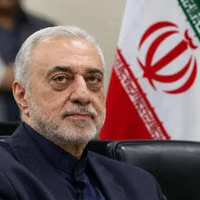
Ahmad Alamolhoda
Ahmad Alamolhoda

Senior hardline cleric Ahmad Alamolhoda is seeking support to become president of Iran’s Assembly of Experts, an 88-member clerical body responsible for selecting and overseeing the supreme leader, a Tehran-based outlet reported citing informed sources.

Entekhab reported that maneuvering over the assembly’s leadership has intensified ahead of its next session because of concerns about the health of its current president, Mohammad-Ali Movahedi-Kermani.

Alamolhoda, who represents Razavi Khorasan province in the assembly and serves as Friday prayer leader in Mashhad, is seeking to secure enough votes to take the presidency, according to the report.

His main rival is said to be Alireza Arafi, the assembly’s second deputy president, a member of the Guardian Council and head of Iran’s Islamic seminaries.

Another potential contender is Mahmoud Rajabi, who succeeded Mohammad-Taqi Mesbah-Yazdi at the Imam Khomeini Educational and Research Institute. Entekhab quoted an informed source as saying that Rajabi believes he has a stronger chance of securing the post.

Alamolhoda is one of the Islamic Republic’s most prominent hardline clerics and has for years used his influential Friday prayer platform in Mashhad to advocate some of the establishment’s most uncompromising positions on social and political issues.

He is also the father-in-law of late President Ebrahim Raisi, who died in a helicopter crash in May 2024.

Alamolhoda’s positions have included fierce opposition to challenges to compulsory hijab. In 2024, he likened defiance of the Islamic dress code to collaboration with Iran’s enemies, and the previous year suggested that religious hardliners might need to intervene themselves as women increasingly rejected mandatory hijab.

The European Union sanctioned Alamolhoda in March 2023 over serious human rights violations linked to the suppression of protests. The EU cited speeches in which it said he propagated hostility toward women, protesters and religious minorities.

Alamolhoda has remained an outspoken supporter of the Islamic Republic’s leadership following the death of Ali Khamenei.

In June, he said no agreement or commitment by Iran would be acceptable without Supreme Leader Mojtaba Khamenei’s approval and described hostility toward the United States as a fundamental principle of the Islamic Republic.

The contest would put Alamolhoda at the head of a body that played a central role in the succession earlier this year. The Assembly of Experts selected Mojtaba Khamenei following his father’s death, although Iran International reported divisions among members over the process and the choice of the former supreme leader’s son.

The assembly normally elects its leadership for two-year terms. Movahedi-Kermani was elected president in May 2024 with 55 votes, succeeding Ahmad Jannati, while Hashem Hosseini-Bushehri and Arafi serve as first and second deputies respectively.

Most Viewed

Xi snub reignites Iran’s doubts about China
1
INSIGHT

Xi snub reignites Iran’s doubts about China

2
INSIGHT

Five years ago, Iran’s planners put today’s crisis on paper

3
INSIGHT

US strikes deepen Tehran debate over compromise or confrontation

4
ANALYSIS

If Britain backs US plan, Iran's London bank shuts down on October 22

5
ANALYSIS

Trump’s call for an Iranian uprising runs into a trust problem

Banner
Banner

Spotlight

  • If Britain backs US plan, Iran's London bank shuts down on October 22
    ANALYSIS

    If Britain backs US plan, Iran's London bank shuts down on October 22

  • US strikes deepen Tehran debate over compromise or confrontation
    INSIGHT

    US strikes deepen Tehran debate over compromise or confrontation

  • Xi snub reignites Iran’s doubts about China
    INSIGHT

    Xi snub reignites Iran’s doubts about China

  • Trump’s call for an Iranian uprising runs into a trust problem
    ANALYSIS

    Trump’s call for an Iranian uprising runs into a trust problem

  • Five years ago, Iran’s planners put today’s crisis on paper
    INSIGHT

    Five years ago, Iran’s planners put today’s crisis on paper

  • Women footballers came home under pressure. Now Iran wants them on camera
    ANALYSIS

    Women footballers came home under pressure. Now Iran wants them on camera

Banner
•
•
•

More Stories

US strikes deepen Tehran debate over compromise or confrontation

Sep 4, 2026, 08:09 GMT+1
•
Behrouz Turani
100%
Supporters of the Islamic Republic attend a state-organized event celebrating the birthday of the Prophet Mohammed in Tehran, holding Iranian flags and portraits of former Supreme Leader Ali Khamenei, August 30, 2026

The latest round of US and Iranian attacks has shifted the debate in Tehran from whether the country is in crisis to a more fundamental question: what does survival now require—compromise or continued confrontation?

The argument comes after six months of war, intermittent diplomacy and repeated attempts at mediation have failed to produce a durable settlement.

US strikes and economic pressure have continued, Iran has retaliated across the region, and the latest escalation has again brought attacks to southern Iran while traffic through the Strait of Hormuz has fallen close to a standstill.

At home, the rial has pushed past 2.2 million to the dollar, while gas shortages and mounting economic pressure have sharpened the question of how long Iran can sustain the confrontation.

“Iran is now living through one of the most fateful junctures of its confrontation with known adversaries,” the IRGC-linked Javan newspaper wrote Wednesday.

Coming from a publication close to the security establishment, the unusually stark assessment was notable.

Khorasan, aligned with parliament speaker Mohammad-Bagher Ghalibaf, sounded a similarly somber note, describing the crisis as “a moment not yet past but already worth calling history.” Iranians, it said, “have lived through two wars in one year.”

Economy or ideology

For those advocating a diplomatic way out, the increasingly urgent argument is that Iran’s economy cannot withstand indefinite confrontation.

Pro-reform Shargh defended President Masoud Pezeshkian’s call at the Shanghai Cooperation Organization summit in Bishkek for a return to reciprocal diplomacy under the June MoU.

Columnist Ahmad Zeidabadi argued that with the rial above 2 million to the dollar and the country facing severe gas shortages, Iran could no longer afford endless confrontation.

“Pezeshkian’s message in Bishkek reflects the urgent needs of our society: our real economy cannot survive endless isolation,” Zeidabadi wrote. “True national strength lies in protecting citizens’ livelihoods through practical diplomacy, not in clinging to dogmatic slogans.”

The argument echoes concerns raised by Pezeshkian himself, who has identified sanctions, political infighting and the role of quasi-governmental companies among the pressures weighing on Iran’s economy.

But for hardliners, the lesson of the past six months is almost precisely the opposite.

‘Capitulationist current’

Kayhan’s ultraconservative editor Hossein Shariatmadari demanded the “purging of the capitulationist current,” attacking Executive Deputy Jafar Ghaempanah and Yousef Pezeshkian, the president’s son, for questioning whether uranium enrichment was essential to Iran’s survival.

“Questioning enrichment under enemy fire is not pragmatism—it is ideological surrender,” Shariatmadari wrote.

He argued that abandoning enrichment would merely encourage Washington to demand further concessions over Iran’s missiles and coastal defense systems, echoing a longstanding argument made by former Supreme Leader Ali Khamenei.

Shariatmadari portrayed the advisers’ comments as an attempt to prepare public opinion for capitulation to Washington’s D-Day campaign, arguing that pressure over enrichment, missiles and regional support formed part of a single Western effort to strip Iran of its defensive capabilities.

He pointed to the latest US strikes on Larak Island as proof that Washington responds only to uncompromising force.

Those strikes, however, came amid another escalation that brought the human costs of the confrontation back to southern Iran. Attacks were reported on Larak and in several southern cities, including Ahvaz, Bandar Abbas, Qeshm and Chabahar.

Six months of war have therefore produced an unusual point of agreement across Iran’s bitter political divides: the country has reached an extraordinarily dangerous moment.

For advocates of diplomacy, economic exhaustion makes compromise increasingly necessary. For hardliners, the same six months have demonstrated that compromise under pressure would only invite more pressure.

Five years ago, Iran’s planners put today’s crisis on paper

Sep 4, 2026, 00:43 GMT+1
•
Behrouz Turani
100%
Shopkeepers chat in the carpet section of the Bazaar in Iran's northern city of Qazvin, August, 31, 2026

An economic forecast produced by Iran’s own government planners more than five years ago projected where continued sanctions would leave inflation and the national currency by 2026—and the numbers have proved strikingly accurate.

The model projected inflation of 66% and the dollar at 178,000 tomans in the current Iranian year under a scenario in which sanctions remained in place.

The forecast has resurfaced after Iranian economic journalist Marzieh Mahmoudi highlighted it in a widely shared YouTube video, arguing that successive governments disregarded warnings their own planners had put on paper.

The model was produced by economist Mohammad Hossein Rahmati, then head of the Macroeconomics Office at Iran’s Planning and Budget Organization (PBO).

It projected government revenues and spending, economic growth, inflation, exchange rates and other fiscal indicators through the Iranian year 1406, ending in March 2028.

Best case, worst case

Crucially, it offered policymakers two possible futures: one in which sanctions were lifted and another in which they continued.

Under the continued-sanctions scenario, the model projected the dollar reaching 284,000 tomans in 2027. It now stands at 220,000, having exceeded Rahmati’s 178,000.

Under the alternative scenario, in which sanctions were lifted, Rahmati projected a dramatically stronger rial, with the dollar at around 50,000 to 60,000 tomans by the end of the period.

Several of the projections now bear a striking resemblance to Iran’s economic trajectory, although comparisons are complicated by the multiple exchange rates operating in Iran and the extraordinary volatility of the rial during the war.

In a recent episode of the YouTube-based daily news program Hasht-e Shab (8 PM), Mahmoudi displayed the table and argued that what now looks prescient was politically inconvenient when it first appeared.

The numbers were alarming even in 2021. But rather than treating the projections as a constraint around which policy needed to be built, Mahmoudi said, officials largely sought to distance themselves from them.

‘The dollar sage’

The controversy extended to the Planning and Budget Organization itself. After the table was published and debated in the Iranian press in 2021, the PBO issued a formal denial disputing the forecast attributed to it, despite the model having emerged from its own economic planning apparatus.

The table remains available in the archives of the Iranian Parliament’s Research Center and was also published at the time by Iranian news outlets including Tabnak and Khabar Online.

Rahmati subsequently left his position following disagreements over budget formulation. He became known in Iranian media as “the man of the dollar forecast,” while Mahmoudi argues that his warnings about the fiscal and inflationary consequences of continued sanctions were marginalized rather than acted upon.

The significance of the model goes beyond whether Rahmati correctly guessed the future price of the dollar.

Its two scenarios attempted to show how sanctions would shape Iran’s broader fiscal trajectory. Continued sanctions meant weaker revenues and growth alongside mounting inflationary and exchange-rate pressure, while their removal produced a substantially less damaging outlook.

Five years later, Iran has moved much closer to the former scenario.

Everybody knew

The period covered by Rahmati’s projections has spanned three presidencies—those of Hassan Rouhani, Ebrahim Raisi and Masoud Pezeshkian—and the rial has weakened substantially under each.

The market rate stood at roughly 30,000 tomans to the dollar when Rouhani left office in 2021. It weakened to around 60,000 during Raisi’s presidency before depreciating much more sharply under Pezeshkian amid war, sanctions and mounting fiscal pressure.

The official exchange rate, meanwhile, remained politically managed and increasingly detached from the price at which ordinary Iranians and businesses could obtain dollars.

The result is a trajectory remarkably similar in direction to the one Rahmati’s model warned about more than five years ago, even if individual figures cannot be compared precisely with today’s volatile exchange rates.

Mahmoudi’s central argument is therefore less that one economist successfully predicted the price of the dollar than that Iran’s own economic planners had already modeled the consequences of allowing existing pressures to continue.

Iran’s economy is a powder keg. Tehran is preparing for the spark

Sep 3, 2026, 02:03 GMT+1
•
Negar Mojtahedi
100%
People walk in Tehran's Grand Bazaar, August 17, 2026

Iran’s economic crisis is deepening, and with few answers for a population becoming poorer, Tehran is signaling how it may respond if economic anger again spills into the streets: repression and lethal force.

Judiciary chief Gholam-Hossein Mohseni-Ejei has threatened an even harsher crackdown on another uprising. Leaked Basij audio has exposed anxiety inside the security establishment, while authorities have identified gasoline, unemployment and livelihoods as potential triggers.

Security forces have already opened fire on people protesting over jobs in southwestern Iran this week.

“The economic crisis in itself is turning Iran into a powder keg,” Khosro Isfahani, research director at the National Union for Democracy in Iran (NUFDI), told Iran International.

Fixing the conditions driving the anger would require the state to change into “something that is fundamentally not the Islamic Republic,” he said, adding that Iran’s rulers are willing to “kill as many as it takes to stay in power.”

At least 950 people have been executed since the beginning of the year. Not all were political prisoners, but the accelerating use of capital punishment has added to a wider climate of fear.

The same pattern can be seen in a renewed crackdown on compulsory hijab, cafe closures, pressure on workers and pensioners and the deployment of police onto the streets.

  • Jobs protests met with gunfire in southwestern Iran

    Jobs protests met with gunfire in southwestern Iran

‘Damaged fruit’

And there is little economic relief in sight, with fewer and fewer families able to afford meat, fruit or even dairy products.

Economist Ali Dadpay points to damaged fruit, once sold cheaply to the poorest or left for the homeless, as an increasingly common measure of what many families can afford.

For decades, the Islamic Republic has sought to blame economic hardship on sanctions, foreign powers, merchants or individual officials. But Dadpay says it is becoming harder to separate what Iranians experience in the supermarket from the decisions made by the state.

Inflation, he said, has become “the perfect indirect taxation.”

Instead of openly raising the money needed to finance its policies, Tehran prints it. The rial loses value and ordinary Iranians pay the difference every time they buy food, medicine or other necessities.

They have been made “poorer and poorer and poorer,” Dadpay said, and are now in danger of being “permanently impoverished.”

Middle class no more

The deterioration is reaching people who once considered themselves middle class. Pensioners are protesting. Even some government-linked companies are struggling to pay wages that barely cover basic living costs.

“Even the middle class cannot afford,” Dadpay said.

And winter threatens to tighten the squeeze.

Gasoline is already in short supply. Mahdi Ghodsi, senior economist at the Vienna Institute for International Economic Studies, estimates Iran has lost 15% to 30% of its energy-production capacity through war damage and depreciation.

As temperatures fall, factories may have to shut down so scarce gas can be redirected to households.

Transport workers would be among those hit by worsening fuel shortages, with disruptions potentially spreading quickly through the wider economy.

‘Fragile calm’

Miad Maleki, a former senior US Treasury sanctions strategist and senior fellow at the Foundation for Defense of Democracies (FDD), says the regime is looking at the same deteriorating numbers as everyone else.

“To keep paying salaries and pensions to roughly eight million state payees, including its own security forces, the regime has been printing rials and borrowing directly from the central bank,” Maleki said.

“Ejei’s threat tells you they know how fragile that is.”

Dadpay points to Venezuela and Zimbabwe as reminders that governments can survive extraordinary economic deterioration. Money can be printed, salaries can be deposited and the machinery of the state can continue operating even as the population becomes dramatically poorer.

“Yes, it works,” Dadpay said. But what it produces is “a miserable impoverished situation.”

Iran’s rulers learned in November 2019, however, how quickly the calculation can change. A sudden gasoline price increase led to spontaneous protests that Tehran crushed with lethal force.

‘Revolutions are not advertised’

Inflation is easier to disperse. It quietly takes purchasing power from millions of people without creating a single moment around which they can mobilize.

The danger for Tehran comes when that diffuse suffering suddenly becomes concrete: an empty gas station, a bread shortage, a missed salary, a delayed pension or another sudden price decree.

That is when, Maleki said, scattered grievances can acquire “a single address and a single date.”

But there is another calculation now: fear.

Iranians have seen what happens when they confront the state. Ghodsi said the expected cost of taking to the streets has become enormous because people know they could be shot or killed.

And yet, he said, “society is boiling.”

What changes that calculation may ultimately be impossible to forecast. Ghodsi believes it could take an unpredictable shock. Isfahani looks for something even less measurable: the image, death or act of defiance that suddenly turns private anger into a collective cause.

Mahsa Amini became such a moment in 2022. Isfahani said he has not seen an equivalent tipping point yet. “It’s never about number,” he said.

He quoted his late father: “Revolutions don’t advertise their time of arrival. They arrive.”

The Islamic Republic may not know when, or whether, scattered economic grievances will converge into another uprising. But its threats, preparations and response to smaller protests are already showing how it intends to confront one.

Every time Iran talks about de-escalation, something happens in Hormuz

Sep 2, 2026, 10:14 GMT+1
•
Behrouz Turani
100%
Iranian President Masoud Pezeshkian attends a session of the Shanghai Cooperation Organisation (SCO) summit in Bishkek, Kyrgyzstan September 1, 2026.

Iran's president spent Tuesday assuring Xi Jinping, Vladimir Putin and Narendra Modi that Tehran would return to the Islamabad framework if Washington did. As he spoke, news broke that two Saudi tankers had been hit in the Strait of Hormuz.

Masoud Pezeshkian was at the Shanghai Cooperation Organization summit in Bishkek when the news came in.

Two supertankers, each carrying 2 million barrels of Saudi crude loaded at the Juaymah terminal, were struck within minutes of each other as they sailed out of the strait off Khasab, Oman, according to the shipping intelligence firms Marisks and Kpler.

The timing was, at minimum, unhelpful to Pezeshkian, and it fits a pattern in which his intermittent push for de-escalation is contradicted within hours by events in the strait. Whether by design or coincidence, escalation in Hormuz has repeatedly arrived at the moments his diplomatic track needed quiet.

It did not stay at tankers. By Tuesday night the most significant exchange of fire in weeks was under way. US Central Command said it had struck Revolutionary Guards air defenses, radar, maritime assets, mine-laying capabilities and communications sites, with Iranian media reporting hits near the strait.

Iran said it struck American assets in Bahrain, Jordan, Kuwait and Iraq; Jordan reported intercepting 10 of 13 ballistic missiles, and a drone set a residential block alight in Kuwait City. The Guards claimed heavy American casualties in Jordan and Erbil. Two US officials told Reuters initial assessments found none.

The civilian toll was not in dispute. Five people were killed and dozens wounded near Sirik on the Hormuz coast, according to the Iranian Red Crescent, with the Mehr news agency reporting a four-year-old among the dead. Seven more were killed in strikes on Khuzestan province.

Pezeshkian, it should be said, was not offering peace. He paired his appeal for a mutual return to the Islamabad framework with a declaration that Iran remains prepared to fight, which is the standard formula and the reason his diplomacy has never been the alternative to the war camp that outsiders sometimes take it for.

Inside Iran the coverage and the anxiety pointed in different directions. Newspapers led on the fight over Hormuz and the arguments over the war and the nuclear file; the public was watching the exchange rate.

And when Pezeshkian's de-escalation push was defended at all, it was defended by his own side: outlets close to the administration were the only ones to amplify his son Yousuf and Vice President Jafar Ghaempanah, who spoke up for him.

Both sides want the same thing

What makes the collapse of the past week strange is that the two governments are asking for the same outcome.

At the G20 finance ministers' meeting in Asheville, North Carolina, US Treasury Secretary Scott Bessent set out a dual-track strategy of financial pressure and calibrated military action, emphasizing economic isolation under Operation Economic Outcast over any broad expansion of the war.

Secondary sanctions and banking blockades, he said, are meant to force Tehran back to negotiations without committing ground forces.

That is, in substance, what Pezeshkian was asking for in Bishkek. Both capitals want a route back to talks. Neither can stop shooting long enough to find one.

A controlled cycle, for now

The shape of the conflict supports that reading. What is visible is a tit-for-tat pattern: targeted American strikes on Iran's mine-laying and air defense assets, localized Iranian missile and drone retaliation, both sides using maximum leverage without opening a sustained strategic bombing campaign.

Constraint is part of the explanation. Iran's war-damaged economy and degraded conventional forces have left it stretched, while the US Army has burned through much of its global stockpile of precision long-range missiles, as Reuters reported last month. Trump's own position is complicated by fuel prices rising ahead of November's congressional elections, and this week's strikes pushed oil to a five-week high and sent Asian stocks down.

The rhetoric has not adjusted. "I like our position now much better, with almost total control of the Hormuz Strait, and their economy totally collapsing," Trump said, asking when Iranians would "rise up and fight." Iran's joint military command warned that any country aiding American action in the region would face "heavier, more widespread, and devastating responses."

Washington's attempt to assemble an economic coalition is meeting resistance from partners wary of further disruption to energy and trade, particularly amid tariff disputes. Major importers in Europe and Asia want maritime stability restored rather than prolonged hostilities.

In Bishkek, Xi urged all parties to end the conflict at Hormuz, warning that continued instability threatens energy routes for everyone, which is Iran's largest customer asking it, in public, to stop.

Qatar, which mediated the June ceasefire that swiftly unraveled, went further, holding Iran "fully legally responsible" for this week's attacks and their consequences.

Both sides are pursuing leverage rather than victory. The trouble with leverage is that it only works if the other side can concede, and nobody in Tehran has shown any sign of conceding on the strait.

President's son questions enrichment, ignites fierce debate in Tehran

Sep 1, 2026, 04:10 GMT+1
•
Maryam Sinaiee
100%
Yousef Pezeshkian, son and media adviser of President Masoud Pezeshkian. File photo.

A dispute over Iran’s nuclear enrichment program has escalated into a broader political fight after President Masoud Pezeshkian’s son and adviser Yusef Pezeshkian defended remarks questioning whether enrichment is worth its costs during wartime.

The dispute has evolved into a wider argument over what constitutes national security: maintaining strategic capabilities regardless of their costs or reassessing them in light of the risks to Iran’s population, infrastructure and economy.

The controversy began with remarks by Jafar Ghaempanah, executive deputy to President Pezeshkian, who argued that Iran should consider the costs of pursuing its nuclear program amid the threat of further attacks on the country.

“Wisdom means achieving an objective that you can achieve at the lowest possible cost,” he said.

His comments drew fierce criticism from conservatives and hardliners, but the dispute intensified after Yusef Pezeshkian entered the debate in an Instagram story on Saturday.

“Enrichment is neither a principle of religion nor our honour, nor is our survival dependent on it,” he wrote.

Pezeshkian stressed in another story on Sunday that decisions should be made with full awareness of their consequences.

“We must do whatever is necessary to secure our interests,” he wrote, arguing that Iran should pursue enrichment, missiles and drones only insofar as they served those interests.

But he did not retreat from his central argument: “Our survival does not depend on enrichment. We won’t die if we don’t enrich uranium.”

The intervention broadened the controversy, with hardliners directing their criticism not only at Ghaempanah but also at the president and his administration. Some even called for the president to be removed from office.

Hardline attacks

Yadollah Javani, deputy political chief of the Revolutionary Guards (IRGC), rejected the argument that abandoning enrichment would have prevented war or pressure on Iran in an interview with state television on Sunday.

He said claims that Iran’s nuclear program, human rights record, missile program and regional allies were the fundamental causes of pressure were inconsistent with historical realities. Rather, he argued, these issues were pretexts for a broader confrontation.

The hardline Kayhan newspaper described the positions of Ghaempanah and Yusef Pezeshkian as “subversive”, saying Ghaempanah’s remarks “smell of outright surrender”.

It accused them of being part of a “capitulationist current” and warned that the same logic could eventually be used to justify abandoning Iran’s drone industry, defensive capabilities and regional influence.

The conservative Khorasan newspaper argued that Iran’s enrichment program could not be assessed solely through an economic cost-benefit calculation.

Referring to what it called Iran’s policy of “nuclear ambiguity”, the newspaper argued that continuing enrichment would not give Iran nuclear deterrence but could preserve the possibility of changing its nuclear doctrine in response to a nuclear attack.

It also said enrichment could leave open the possibility of developing so-called dirty bombs and a painful second-strike capability, potentially forcing Iran’s adversaries to reconsider their calculations.

Other conservative critics argued that Washington’s demands would not end with enrichment and that concessions would merely shift pressure to Iran’s missile program and other strategic capabilities.

Meisam Zohourian, a hardline lawmaker, said the more important issue was not simply that Ghaempanah had made the remarks but that the presidential administration’s public relations office had republished them.

“This means that at least a current within the government has decided to openly stand against the Leader’s position,” he wrote.

Reformist defence

Reformist voices have argued that critics of Ghaempanah and Yusef Pezeshkian were putting ideological commitments ahead of the costs imposed on ordinary Iranians.

Rouydad24 said the attacks reflected hostility toward an approach that seeks to define national security through realism and the interests of the population rather than through slogans that impose additional costs.

The website argued that the nuclear dispute could not be reduced to a legal or technological question when its potential costs included the destruction of infrastructure, economic paralysis and threats to the foundations of the state. Iran’s foreign policy, it said, needed to put “prudence” ahead of provocation.

Journalist Davoud Heshmati rejected the argument that giving up enrichment would simply lead Washington to make further demands, describing it as evidence of faulty reasoning.

He argued that the controversy surrounding Iran’s nuclear program was ultimately connected to Israel’s security concerns and warned against pursuing a nuclear capability that Iran could not adequately protect.

“A bomb that you cannot protect is, in fact, a basis for killing your own people,” he wrote.

The argument now goes beyond whether uranium enrichment itself is worth its cost. The deeper divide is over the lessons Iran should draw from the war: whether vulnerability makes preserving strategic capabilities more necessary, or whether the risks associated with those capabilities require Tehran to reconsider what national security is meant to protect.