US probes Iran wedding strike as experts suggest direct hit
A destroyed building in Iran's Sirik on the shore of the Persian Gulf
The United States is investigating whether its forces were responsible for a deadly strike on a wedding in southern Iran, Vice President JD Vance said Thursday, as evidence emerged suggesting the building may have been directly hit by a US munition.
“We’re investigating it because obviously we care. We want to know,” Vance told reporters in Washington.
“If we do make mistakes, again, this is a big difference between us and Iran, when our military makes mistakes, they learn from them to try to get better from them,” he added.
The explosion ripped through a residential building hosting a wedding in the small town of Kuhestak in Sirik County on Tuesday, during a new wave of US strikes along Iran’s Strait of Hormuz coast.
Iranian authorities said at least 68 people were wounded. A four-year-old child was among those reported dead. Foreign Ministry spokesperson Esmaeil Baghaei described the wedding strike as a “war crime.”
CENTCOM said Wednesday it was already looking into reports of the incident but rejected allegations that American forces deliberately target civilians.
“We’re aware of the reports, which originated from Iranian state media, and we are looking into them,” US Navy Captain Tim Hawkins, a CENTCOM spokesperson, told Iran International. “The U.S. military never targets civilians, unlike the IRGC.”
CENTCOM said its forces carried out multiple strikes across southern Iran on Sept. 1, targeting Revolutionary Guard air-defense sites, radar systems, maritime assets and facilities, mine-laying capabilities and communications sites.
On Thursday, Reuters published an analysis by four weapons experts who said the damage was more consistent with a direct hit than a ricochet from another target.
Three assessed that the munition was likely American rather than an errant Iranian air-defense missile. One said a US weapon may simply have missed its intended target.
Those assessments are not definitive, and the US investigation remains ongoing.
Shahin Milani, executive director of the Iran Human Rights Documentation Center, told Iran International that any strike on civilians required proper investigation, while cautioning that restrictions on independent access inside Iran made the full civilian toll difficult to verify.
“Striking civilian targets contravenes international law, and all such incidents must be properly investigated,” Milani told Iran International. “The Iranian government, however, has consistently denied UN mechanisms access to the country. Moreover, given the Iranian government’s long history of disseminating falsehoods, it is very difficult to ascertain the real extent of harms to civilians based on the reports produced by state-run media in Iran.”
Reuters cited a US official, speaking on condition of anonymity, as saying investigators were considering several possible causes, including a US strike, a US munition ricocheting from another target, or an Iranian air-defense missile or interceptor going astray.
The incident has renewed scrutiny of the civilian toll of the US-Iran war, six months after a missile struck a primary school in Minab, killing scores of children and teachers, according to Iranian authorities.
Washington did not publicly accept responsibility for the Minab strike.
Reuters reported in March, however, that an initial internal US military investigation found American forces were likely responsible.
The Pentagon has not publicly released the findings of that investigation.
Merchants protest in Tehran in December 2025 as security forces stand nearby.
A rights group has asked German prosecutors to investigate crimes against humanity by Iranian authorities, presenting evidence of thousands of killings and mass detentions during nationwide protests that began in late 2025 and early 2026.
Human Rights Activists in Iran (HRA), supported by legal group UpRights, submitted the request to Germany’s Federal Prosecutor General on August 31, according to an executive summary released Thursday.
The nearly 100-page submission draws on more than 60 interviews with victims, witnesses and relatives, alongside documentary and digital evidence. It identifies 48 suspected perpetrators and examines their positions and links to specific cases and command structures.
HRA said its evidence provided sufficient indications that Iranian state authorities committed acts potentially amounting to crimes against humanity under Germany’s Code of Crimes against International Law.
Thousands killed, rights group says
The protests began on December 28, 2025, with shopkeepers and merchants closing businesses before spreading to at least 203 cities across all 31 provinces, according to HRA.
People gather around burning debris on a street in Iran in during January 2026 protests.
Thousands were killed and arrested or detained during the crackdown, HRA said. Its documented cases include unlawful killings, torture, enforced disappearances, sexual violence, arbitrary detention and forced confessions.
The submission also describes the involvement of the Revolutionary Guards, Basij, Law Enforcement Command, intelligence agencies and the judiciary.
HRA documented what it described as recurring patterns across different parts of Iran, including the use of live ammunition and pellet-firing weapons against protesters and bystanders. It also linked a nationwide communications blackout and the shutdown of street lighting to an escalation in the use of force.
Why Germany
HRA argued Germany is well placed to open a structural investigation because victims and witnesses are already present in Europe and suspected perpetrators could eventually enter or transit German territory.
Iran is not a party to the Rome Statute, leaving the International Criminal Court without jurisdiction over crimes committed inside the country unless jurisdiction is otherwise established, including through a UN Security Council referral.
HRA said a German investigation could therefore provide an avenue for preserving evidence and pursuing accountability over the alleged crimes when jurisdictional opportunities arise.
Pedestrians walk along a street in Iran in this undated file photo.
The UN’s fact-finding mission on Iran called for the immediate withdrawal of legislation that could expose Iranians to up to 30 years in prison for contact with foreign individuals and organizations, according to a statement released Thursday.
“We are appalled at the steps by the Government of Iran to subject everyday Iranians to blanket criminalisation for any contact with the outside world when people are already suffering from isolation due to long-standing international sanctions, the Government’s repression of recent protests, the longest ever Internet shutdown, and the US-Israeli airstrikes,” Sara Hossain, chair of the Independent International Fact-Finding Mission on Iran, said.
The draft “Countering Foreign Infiltration” bill would allow cooperation or interaction with designated foreign states, media organizations, academic institutions, human rights defenders and civil society groups to be prosecuted as major security offenses, the mission said.
Broad activities require approval
The legislation would require Iranians to declare and register activities involving foreign agents or nationals and obtain authorization through an online system that prioritizes security considerations from the Ministry of Intelligence and the Intelligence Organization of the Revolutionary Guards.
Publishing books or articles, sharing data and analysis, academic cooperation, interacting with foreign or designated “hostile” media, and operating newspapers or websites could require prior approval.
The requirements would also cover workshops, scientific conferences, artistic festivals and some film, music and visual-arts activities, as well as certain commercial and financial transactions.
“If implemented, this bill would subject all interactions with the outside world to Government control and sanction, the law also would further curtail the rights of citizens, with consequences for commerce, education, freedom of expression and the pursuit of justice among other areas,” mission member Viviana Krsticevic said.
UN contacts could face punishment
The mission warned that the bill could also criminalize communication with its investigators and said punishment for such cooperation would constitute a reprisal.
Students attend a lecture at a university in Iran in this undated file photo.
“Punishing any interaction by Iranians or persons living in Iran with the Mission under this bill constitutes a reprisal and the threat of criminalising such activity is a form of intimidation and oppression,” mission member Max du Plessis said.
The UN Human Rights Council established the mission in 2022 following protests sparked by Mahsa Amini’s death. Its mandate was extended for another two years in January 2026 to investigate allegations of recent and continuing serious human rights violations in Iran.
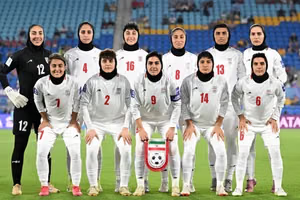
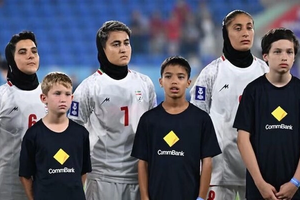
A file photo of the Iranian national football team in Australia
Five months after Iran's women footballers sought asylum in Australia, the football federation has called the squad back into camp, not to train but to film a documentary about what happened there. Some of the players it wants on camera are the ones who came home under pressure.
While two of those players are building new lives in Australia, thousands of kilometers from their families, having received citizenship there, the Islamic Republic's football federation has summoned their former teammates to record the state's account of the same events.
Farideh Shojaei, the federation's vice-president for women's football, has confirmed that a documentary about Iran's participation in the AFC Women's Asian Cup will be filmed at the camp. She described the purpose as completing the tournament archive and setting down part of the history of Iranian women's football.
The outlet Football 360 had reported earlier that the project belongs to a body outside football, and that most of the players who returned from Australia have no wish to sit in front of the federation's camera and recount what happened on that trip.
A camp that does not add up
The camp has pushed back the start of Iran's women's premier league by a week, and the federation's explanations for holding it have not been consistent.
According to Iranian media, when club coaches objected to the timing, Shojaei assured them the players would not be put under any football training load, because the point of the camp was to film the documentary. Later, explaining why a camp was being held outside a FIFA international window with no fixture ahead of the national team, she said it had been convened at the request of Marzieh Jafari, the national coach, to prepare the players.
Jafari does not currently hold an active contract with the federation. She is head coach of Khatoon Bam, the club that supplies the core of the national squad, which has just come through Asian Champions League qualifying and now needs to prepare for a new league season.
So a camp that has forced clubs to rearrange their calendars is attributed to a coach with no active federation contract, and was described to the objecting coaches as not being about training at all.
The version the state told first
The documentary is being made several months after Iranian officials gave their own account of what happened in Australia.
In the team's final days there, federation president Mehdi Taj claimed Australian police had separated the women from the men in the delegation and pressured the players into staying and claiming asylum. Esmail Baghaei, the foreign ministry spokesman, went further on television, accusing the Australian government of "taking members of the team hostage."
While those claims were being made in public, according to one club executive, money was being raised inside Iranian football to encourage the players to come home.
Alireza Babaei, chief executive of Chadormalou Ardakan, told a Football 360 live program that while the federation was working to bring the whole delegation back, its general secretary Hedayat Mombeini asked Chadormalou to pay 30 billion rials, about $15,000, for the women's national team. Chadormalou does not have a women's team.
According to Babaei, Mombeini also mentioned a payment of 50 billion rials, roughly $25,000, from the Gol Gohar club, and named Sepahan of Isfahan, a club that at that moment was weighing whether to continue fielding teams at all because of war damage to the steel industry.
In Iranian women's football, 50 billion rials from a single club is not a sum to be waved away. Afsaneh Chatrenoor, the national team forward who plays for Gol Gohar, was the premier league's leading scorer last season. She is also the player who sat across from Gholamhossein Mohseni-Ejei a few months ago and asked the head of the judiciary to help her find work for when her football career ends. At the top level of the Iranian women's game, the contracts of prominent players are still measured in a few billion rials.
For the Islamic Republic's officials, the Women's Asian Cup in Australia was never only a football tournament.
Several members of the delegation applied for humanitarian protection from the Australian government during the war and after the killing of Ali Khamenei. Some later abandoned their asylum applications and returned to Iran under pressure from security forces on their families.
In those same days, Iranian officials were assembling their own version of events. They spoke of hostage-taking and of players being deceived, while simultaneously turning to threats, intimidation and financial inducements to get the asylum seekers back.
Now some of the same players who returned after that pressure are to sit in front of a camera, in a project belonging to a body outside football, and describe those days again.
It looks less like archiving history than like producing a state edition of it.
This time the Islamic Republic is not only constructing its own account of Australia. It wants the players inside the rewriting.
A scene of protests in Arak, Markazi province, on January 8, 2026
Donald Trump’s question about when Iranians would rise against the Islamic Republic drew thousands of responses arguing that fear of renewed repression, doubts over US policy and insufficient outside support are holding back another uprising.
“This time you fight. Help from the people is on its way,” one Iran International audience told the US president, turning back on Trump a phrase he used during earlier anti-government protests.
Trump asked the question on Truth Social on Tuesday night while rejecting an ABC News report that he was seeking to bring Iran into negotiations.
“I’m not trying to force Iran to the bargaining table... I couldn’t care less if they sign a worthless, to them, agreement,” Trump wrote.
“I like our position now much better, with almost total control of the Hormuz Strait, and their economy totally collapsing. They are just playing out the inevitable. When are the Iranian people going to rise up and fight?” Trump added.
Thousands of responses sent to Iran International pointed to a common argument: Iranians have repeatedly confronted the Islamic Republic, but many are reluctant to return to the streets without greater confidence that its forces can no longer suppress them and that outside powers will not change course.
‘People have been fighting for 47 years’
Several respondents pointed to successive waves of anti-government protests in Iran and the heavy costs borne by demonstrators.
“The people of Iran fought and rose up a thousand times beyond their capacity. Now it is time for other countries to help them,” one wrote.
“The people of Iran have been fighting for 47 years,” another told Trump.
Others pointed to protesters who took to the streets on January 8 and 9, asking when people who confronted government forces without weapons would receive meaningful assistance.
Some respondents said further negotiations between Washington and the Islamic Republic would undermine Iranians seeking political change.
“This government does not represent the people. Negotiating with the killers of the people is a mistake. Help so that the people themselves can finish the job,” one respondent wrote.
Fear of another crackdown
The prospect of another crackdown featured prominently in the messages, with people arguing that the capacity of security forces would have to be weakened before another uprising could succeed.
One described reducing the strength of forces used against demonstrators as the most important condition for renewed street protests.
“No matter how brave you are, if you know you will be killed by snipers, it is foolish to fight empty-handed,” another respondent wrote, referring to Trump’s previous calls for Iranians to protest.
On March 15, Trump said: “The protesters have no guns. And I know you’re a brave person, but I don’t think you’d be protesting. And so I think it’s very hard for them to protest. I fully understand it.”
Another person said ordinary people could not be treated as “cannon fodder,” adding that an uprising without a plan would be a mistake.
Several respondents said people would return to the streets when they believed the authorities’ ability to suppress demonstrations had been sufficiently weakened. Others pointed to disabling checkpoints and disrupting security structures as steps that could change the balance.
A scene of protests in Tehran on January 8, 2026
“Mr. Trump, continue the naval blockade and add a land blockade. Give [Benjamin] Netanyahu a free hand to destroy the system of repression, and then the people of Iran are ready to overthrow the Islamic Republic,” another one wrote.
Some also called for increased pressure on the Islamic Republic and clearer international backing for exiled Prince Reza Pahlavi during a potential transition.
Trump’s ‘help is on its way’ message returns
A separate strand of responses focused on mistrust of Washington and concern that Trump could encourage another uprising only to resume negotiations with the Islamic Republic.
“We are afraid that we will come out and you will negotiate with the mullahs’ regime again,” read a message.
“The people of Iran will rise when you do not negotiate with this murderous regime,” another wrote.
Trump had urged Iranians to continue protesting during demonstrations in January and told them that “help is on its way,” a message several respondents invoked in answering his latest question.
“When you said help was on its way, people came into the streets, but you sat down and made a deal with the government.”
The respondent added that if Iranians returned to the streets, they would do so “to fight and regain their own freedom,” rather than to advance US strategy.
A US sailor directs the takeoff of a UH-1Y Venom utility helicopter from the flight deck of USS Boxer (LHD 4) as the amphibious assault ship sails in the Arabian Sea. (CENTCOM)
Senior White House officials will consider intensifying military action against Iran after the November 3 midterm elections, Reuters reported on Wednesday, citing four people familiar with internal discussions.
No decision has been made on returning to full-scale conflict, but top aides to US President Donald Trump are pushing to keep the war relatively contained until the election as Republicans defend narrow majorities in Congress.
“We are keeping the pressure on Iran,” one White House official said. “But November is a priority.”
Vice President JD Vance and Secretary of State Marco Rubio are among the senior officials supporting efforts to keep the conflict relatively quiet until November, two White House officials told Reuters.
The sources said containing the war could limit its impact on Republican midterm campaigns and give the US military time to replenish depleted munitions. High gasoline prices have also contributed to public dissatisfaction with the conflict.
“The timetable has changed,” one senior White House official said. Another added: “The calendar is driving Iran.”
Reuters reported in August that the US military had used “virtually all” of its stock of some long-range precision missiles. The Pentagon, however, said the military had “everything it needs to execute” its mission.
The sources said Washington was focusing for now on intensifying economic pressure through sanctions and its naval blockade, seeking concessions in future negotiations that months of military action had failed to secure.
Trump warned on Tuesday that further Iranian action would bring a stronger US response.
“If the failed Nation of Iran retaliates for this very justified attack, they will be hit again at a much harder and higher level, but it will not be the biggest attack of them all, that is waiting in the wings,” he wrote on Truth Social.
White House spokeswoman Olivia Wales defended the administration’s strategy, saying: “President Trump has destroyed Iran’s military capabilities and is crippling what’s left of its abysmal economy with the most powerful naval blockade in world history and crushing sanctions.”
“The President will continue to advance America’s interests at home and abroad and will never allow Iran to have a nuclear weapon,” she added.