• العربية
  • فارسی
Brand
  • Iran Insight
  • Politics
  • Economy
  • Analysis
  • Special Report
  • Opinion
  • Podcast
  • Live TV
  • Iran Insight
  • Politics
  • Economy
  • Analysis
  • Special Report
  • Opinion
  • Podcast
  • Live TV
  • Theme
  • Language
    • العربية
    • فارسی
  • Iran Insight
  • Politics
  • Economy
  • Analysis
  • Special Report
  • Opinion
  • Podcast
  • Live TV
All rights reserved for Volant Media UK Limited
volant media logo

IAEA says status of Iran’s fourth enrichment site remains unknown

Sep 1, 2026, 20:44 GMT+1
FILE PHOTO: A satellite image shows airstrike craters over the underground centrifuge halls of the Natanz Enrichment Facility, following U.S. airstrikes amid the Iran-Israel conflict, in Natanz County, Iran, June 22, 2025. Maxar Technologies/Handout via REUTERS

The UN nuclear watchdog says it remains unable to determine the status of Iran’s fourth declared uranium-enrichment facility after Tehran failed to provide information or allow inspectors access to the site.

A confidential quarterly International Atomic Energy Agency report said the agency had made no progress over the past three months in verifying key parts of Iran’s nuclear program, with its continued lack of access to nuclear material remaining a proliferation concern, Reuters reported on Tuesday, citing a copy of the report it had seen.

Iran has provided neither information on the status of affected declared nuclear facilities and material nor access needed for on-site verification at the Isfahan Fuel Enrichment Plant.

Iran notified the IAEA on June 12, 2025 that it intended to establish the plant at the Nuclear Reactors Fuel Company site in Isfahan, making it the country’s fourth declared uranium-enrichment facility after two plants at Natanz and one at Fordow.

The IAEA planned to carry out its first design verification at the new facility the following day, but the visit was cancelled when Israeli strikes on Iran began.

The agency has never inspected the plant and says it does not know its precise location, whether it became operational or whether it contained nuclear material. Iran later told the IAEA that the facility had been subjected to military attack, which the agency has been unable to verify.

The uncertainty forms part of a wider gap in the IAEA’s knowledge of Iran’s nuclear material since the June 2025 attacks. Its last estimate before losing verification put Iran’s uranium stockpile at 2,391.1 kg enriched up to 2%, 6,024.4 kg up to 5%, 184.1 kg up to 20% and 440.9 kg enriched up to 60%, close to weapons grade. The agency has since been unable to verify the current quantities or whereabouts of the material.

IAEA Director General Rafael Grossi said earlier this year that the agency believed a little more than 200 kg of Iran’s 60%-enriched uranium had been stored in the wider Isfahan tunnel complex and was likely still there. That storage area is distinct from the fourth enrichment facility whose status the agency has been unable to establish.

Underground uranium storage site

Separately, the US-based Institute for Science and International Security last week identified what it assessed to be a probable uranium hexafluoride storage facility at the Natanz Nuclear Complex. The partially underground, bunkered structure was built between 2010 and 2017 and was likely intended to support large-scale enrichment at Natanz, the institute said.

The institute said the facility does not appear to have been targeted in the 2025 or 2026 military strikes, but said its role before and after the June 2025 war remains unclear. It said no vehicle activity had been observed there in available satellite imagery since that conflict.

Iranian nuclear chief Mohammad Eslami said last week that Tehran still considers itself to be in wartime conditions and would not permit inspections of nuclear sites hit by military strikes until a new inspection protocol is established. He said IAEA inspections could continue at facilities that were not attacked.

Mohsen Rezaei, secretary of Iran’s Supreme National Security Council, has meanwhile suggested Tehran could reconsider its longstanding rejection of nuclear weapons, arguing that US attacks had strengthened the case for an atomic bomb as a deterrent.

Rezaei stopped short of saying Iran had decided to develop a nuclear weapon. Tehran continues to maintain that its nuclear program is exclusively peaceful.

Most Viewed

US-Iran fighting flares after diplomatic push stalls
1

US-Iran fighting flares after diplomatic push stalls

2
VOICES FROM IRAN

Iranians hit back at VP's case for pricier gasoline as dollar passes 2.1m rials

3
VOICES FROM IRAN

Nearly half in poll would not buy home in Iran even if they could afford it

4
INSIGHT

Actor dropped from play after pro-Palestine stance in rare reversal for Iran

5
EXCLUSIVE

IRGC Unit 4000 plans attacks on shipping in East Asia, sources say

Banner
Banner
Banner

Spotlight

  •  Hackers without borders: serving Tehran, stealing on the side
    SPECIAL REPORT

    Hackers without borders: serving Tehran, stealing on the side

  • The republic of magic: How Iran turned the unseen into an instrument of rule
    ANALYSIS

    The republic of magic: How Iran turned the unseen into an instrument of rule

  • President's son questions enrichment, ignites fierce debate in Tehran

    President's son questions enrichment, ignites fierce debate in Tehran

  • Iran fires back, but can missiles ease economic pain?
    ANALYSIS

    Iran fires back, but can missiles ease economic pain?

  • IRGC Unit 4000 plans attacks on shipping in East Asia, sources say
    EXCLUSIVE

    IRGC Unit 4000 plans attacks on shipping in East Asia, sources say

  • Iran loses ground on trade as war hits oil and non-oil exports
    ANALYSIS

    Iran loses ground on trade as war hits oil and non-oil exports

  • Iranians hit back at VP's case for pricier gasoline as dollar passes 2.1m rials
    VOICES FROM IRAN

    Iranians hit back at VP's case for pricier gasoline as dollar passes 2.1m rials

•
•
•

More Stories

President's son questions enrichment, ignites fierce debate in Tehran

Sep 1, 2026, 04:10 GMT+1
•
Maryam Sinaiee
100%
Yousef Pezeshkian, son and media adviser of President Masoud Pezeshkian. File photo.

A dispute over Iran’s nuclear enrichment program has escalated into a broader political fight after President Masoud Pezeshkian’s son and adviser Yusef Pezeshkian defended remarks questioning whether enrichment is worth its costs during wartime.

The dispute has evolved into a wider argument over what constitutes national security: maintaining strategic capabilities regardless of their costs or reassessing them in light of the risks to Iran’s population, infrastructure and economy.

The controversy began with remarks by Jafar Ghaempanah, executive deputy to President Pezeshkian, who argued that Iran should consider the costs of pursuing its nuclear program amid the threat of further attacks on the country.

“Wisdom means achieving an objective that you can achieve at the lowest possible cost,” he said.

His comments drew fierce criticism from conservatives and hardliners, but the dispute intensified after Yusef Pezeshkian entered the debate in an Instagram story on Saturday.

“Enrichment is neither a principle of religion nor our honour, nor is our survival dependent on it,” he wrote.

Pezeshkian stressed in another story on Sunday that decisions should be made with full awareness of their consequences.

“We must do whatever is necessary to secure our interests,” he wrote, arguing that Iran should pursue enrichment, missiles and drones only insofar as they served those interests.

But he did not retreat from his central argument: “Our survival does not depend on enrichment. We won’t die if we don’t enrich uranium.”

The intervention broadened the controversy, with hardliners directing their criticism not only at Ghaempanah but also at the president and his administration. Some even called for the president to be removed from office.

Hardline attacks

Yadollah Javani, deputy political chief of the Revolutionary Guards (IRGC), rejected the argument that abandoning enrichment would have prevented war or pressure on Iran in an interview with state television on Sunday.

He said claims that Iran’s nuclear program, human rights record, missile program and regional allies were the fundamental causes of pressure were inconsistent with historical realities. Rather, he argued, these issues were pretexts for a broader confrontation.

The hardline Kayhan newspaper described the positions of Ghaempanah and Yusef Pezeshkian as “subversive”, saying Ghaempanah’s remarks “smell of outright surrender”.

It accused them of being part of a “capitulationist current” and warned that the same logic could eventually be used to justify abandoning Iran’s drone industry, defensive capabilities and regional influence.

The conservative Khorasan newspaper argued that Iran’s enrichment program could not be assessed solely through an economic cost-benefit calculation.

Referring to what it called Iran’s policy of “nuclear ambiguity”, the newspaper argued that continuing enrichment would not give Iran nuclear deterrence but could preserve the possibility of changing its nuclear doctrine in response to a nuclear attack.

It also said enrichment could leave open the possibility of developing so-called dirty bombs and a painful second-strike capability, potentially forcing Iran’s adversaries to reconsider their calculations.

Other conservative critics argued that Washington’s demands would not end with enrichment and that concessions would merely shift pressure to Iran’s missile program and other strategic capabilities.

Meisam Zohourian, a hardline lawmaker, said the more important issue was not simply that Ghaempanah had made the remarks but that the presidential administration’s public relations office had republished them.

“This means that at least a current within the government has decided to openly stand against the Leader’s position,” he wrote.

Reformist defence

Reformist voices have argued that critics of Ghaempanah and Yusef Pezeshkian were putting ideological commitments ahead of the costs imposed on ordinary Iranians.

Rouydad24 said the attacks reflected hostility toward an approach that seeks to define national security through realism and the interests of the population rather than through slogans that impose additional costs.

The website argued that the nuclear dispute could not be reduced to a legal or technological question when its potential costs included the destruction of infrastructure, economic paralysis and threats to the foundations of the state. Iran’s foreign policy, it said, needed to put “prudence” ahead of provocation.

Journalist Davoud Heshmati rejected the argument that giving up enrichment would simply lead Washington to make further demands, describing it as evidence of faulty reasoning.

He argued that the controversy surrounding Iran’s nuclear program was ultimately connected to Israel’s security concerns and warned against pursuing a nuclear capability that Iran could not adequately protect.

“A bomb that you cannot protect is, in fact, a basis for killing your own people,” he wrote.

The argument now goes beyond whether uranium enrichment itself is worth its cost. The deeper divide is over the lessons Iran should draw from the war: whether vulnerability makes preserving strategic capabilities more necessary, or whether the risks associated with those capabilities require Tehran to reconsider what national security is meant to protect.

Iran security chief hints at nuclear doctrine shift after US attacks

Aug 23, 2026, 21:32 GMT+1
100%
File photo shows former IRGC chief-commander Mohsen Rezaei (right) attending a conference in Kerman on November 26, 2025.

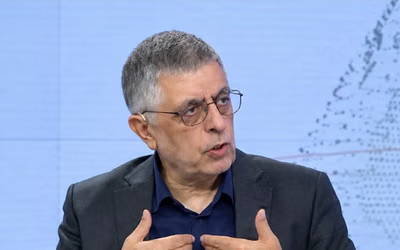
Iran’s top security official has suggested Tehran could reconsider its longstanding rejection of nuclear weapons, arguing that US attacks on Iran have strengthened the case for acquiring an atomic bomb as a deterrent.

Mohsen Rezaei, secretary of Iran’s Supreme National Security Council, said Washington had demonstrated that adherence to the global nuclear non-proliferation system offered countries little protection from military attack.

“The whole world is saying, ‘Wait a minute. So the NPT has no effect?’” Rezaei said in an interview broadcast by Iranian state television.

“When America is waging such a war, people naturally ask: Why shouldn’t we pursue nuclear weapons ourselves?”

Rezaei, a former commander-in-chief of the Revolutionary Guards, stopped short of saying Iran had decided to build a nuclear weapon. But his remarks were unusually explicit for one of the Islamic Republic’s most senior security officials.

Iran has long maintained that its nuclear program is peaceful and has rejected the development and use of atomic weapons.

Rezaei argued that Iran had subjected itself to extensive international monitoring, joined the Nuclear Non-Proliferation Treaty and ultimately accepted the 2015 nuclear agreement, known as the JCPOA.

“The level of safeguards and inspections carried out in Iran over the past two decades has been unprecedented anywhere else in the world,” he said.

Yet Iran and its nuclear facilities were ultimately attacked, Rezaei said, arguing that this had changed the calculation around nuclear deterrence.

“Why shouldn’t we develop a nuclear weapon so that nobody can attack us?” he said, describing the question he said countries were now asking.

The comments come at an especially volatile moment in the US-Iran confrontation, with diplomacy following the war and subsequent ceasefire largely stalled and Washington shifting its focus towards intensified economic pressure.

Trump has announced what he described as a sweeping new economic campaign against Iran, while Treasury Secretary Scott Bessent said Washington would impose the “toughest sanctions in history.”

US officials have presented the pressure campaign as a way of forcing Tehran towards an agreement while reducing the need for another large-scale military offensive.

Iranian officials have rejected the threats, while maintaining that Tehran remains open to diplomacy.

The 60-day negotiating period associated with the US-Iran memorandum expired last week without a breakthrough, leaving the two sides at odds over sanctions, Iran’s nuclear program and the Strait of Hormuz.

Rezaei, who recently took over as secretary of the Supreme National Security Council, has adopted an increasingly confrontational posture, saying Iran would move towards a “fully offensive” military strategy if diplomacy failed.

In the TV interview, he went further, explicitly contrasting the cost of a nuclear deterrent with conventional military power.

“If a country possesses a nuclear weapon, it can be cheaper and more effective than having hundreds of F-35s and spending enormous amounts of money on other military capabilities,” he said.

Rezaei blamed Trump for undermining the wider non-proliferation system.

“Trump has made a mistake by attacking Iran … Many countries are now looking for ways to reconsider the international nuclear order,” he said. “Wasn’t that foolish?”

US miscalculated Iran’s resilience and hurt deal prospects, expert says

Aug 7, 2026, 20:25 GMT+1
•
Kambiz Tavana
100%
Paul J. Saunders, President and CEO, Center for the National Interest

Washington likely underestimated Iran’s ability to withstand the initial US-Israeli strikes, making a negotiated settlement harder to achieve and deepening mistrust, foreign-policy expert Paul Saunders told Iran International.

The United States appeared to believe that military force would quickly weaken the Iranian government and compel Tehran to accept an agreement closer to US terms, Paul Saunders, president and CEO of the Center for the National Interest, said in an interview in Washington DC.

“I think the administration probably … overestimated how easy it would be to use force to bring about a successful agreement,” Saunders said.

Washington and Tehran remain divided over efforts to end the conflict, with the Strait of Hormuz at the center of competing military and diplomatic calculations. Recent reports have offered conflicting accounts of whether an agreement to reopen the waterway is imminent.

Strikes complicated diplomacy

“Targeting Iran’s leadership did more than escalate the military campaign,” Saunders said. “It also posed a direct threat to the survival of the Islamic Republic, making it harder for Washington to persuade Tehran to compromise.”

“I think that, from my point of view, it would have been better not to execute the strike on the Iranian leadership,” Saunders said, adding that the decision increased mistrust and left Washington in a weaker position to negotiate after the initial military action.

The US-Iran Memorandum of Understanding, signed in June, was a 14-point interim framework to end hostilities, restore commercial passage through the Strait of Hormuz, remove the US naval blockade and negotiate a final agreement within 60 days.

In July, Iran suspended implementation of its commitments under the MoU, accusing Washington of effectively abandoning its own obligations.

“In order to get a deal, we needed to have a government to negotiate with,” Saunders said. “When that government is really damaged and destabilized … will that new regime be sufficiently powerful that it will be able to make concessions to the United States?”

Trump has described Iran as being under a “third regime,” arguing that successive layers of the country’s leadership were killed in US and Israeli strikes and that the officials now in charge were different and more reasonable than their predecessors.

Iran’s internal response

Saunders said the political effects of the war extended beyond negotiations to Iran’s domestic response. He said it was predictable that Iranian society would rally behind the state when facing an external attack, even if many people remained unhappy with their government.

“Regardless of how angry or frustrated people might be with their own government, the only thing that they actually want less than their own government interfering in their lives … is someone else’s government doing it,” Saunders said.

“The Iranian government is responding to a threat to its survival, while Iranian society is reacting to an external attack. At the same time, the US president and the American public are weighing how much risk and cost the conflict justifies,” he added.

The conflict is important to Washington but not existential for the United States, Saunders said. He added that the administration had shown sensitivity to growing public concern over the costs of continuing the campaign.

Hormuz remains central

The Strait of Hormuz remains central to Iran’s leverage and to efforts to end the conflict. Commercial traffic through the waterway has fallen sharply, while Iran is also bearing substantial economic costs from the disruption.

Saunders said traders had so far expected the strait to reopen, limiting the immediate impact on global oil prices. But he warned that the economic consequences could become far more serious if the disruption persisted and refiners were forced to adapt to reduced supplies.

US tightens military and financial pressure as Iran talks falter

Aug 1, 2026, 00:46 GMT+1
100%
US President Donald Trump speaks during the first televised Cabinet meeting at Camp David, flanked by Secretary of State Marco Rubio and Defense Secretary Pete Hegseth, July 31, 2026.

The Trump administration on Friday outlined military and financial measures against Tehran alongside negotiations that President Donald Trump said were being undermined by Iran’s conduct.

Speaking during the first televised Cabinet meeting at Camp David, Trump, Defense Secretary Pete Hegseth and Treasury Secretary Scott Bessent addressed continued talks, military action aimed at preventing Iran from obtaining a nuclear weapon and a worldwide search for assets linked to its government.

Talks continue as trust erodes

Trump said negotiations with Iran were continuing but that he was “losing faith” in Tehran because “they do lie” and “they do misrepresent.”

“They always want to talk, but they break their words so often,” he said.
Trump said Steve Witkoff, Jared Kushner, Vice President JD Vance and Secretary of State Marco Rubio were involved in the talks. “We have great people talking,” he added.

He said five missiles were fired at a US base in Jordan while negotiations were underway.

“Instead, I got a call from Pete that they just shot five missiles at one of our bases in Jordan,” Trump said.

Asked whether the attacks could continue, Trump said: “I think I’m going to be foolish to say no. You always have to keep your guard up.”

“They get weaker. They get a little stronger, maybe now, but they’ll get weaker, and then they peter out,” he added.

Military pressure and nuclear sites

Hegseth praised Trump for having “the courage to do Midnight Hammer and conclude the 12-day war by obliterating their nuclear sites.”

He said previous presidents had considered such action but “never pulled the trigger because of the complications, because of the challenge, and because of the risk.”

Hegseth said Trump remained committed to ensuring Iran never obtained a nuclear weapon and praised his willingness to negotiate with people who had “shown no willingness to do so honestly.”

Diplomacy under pressure

As hopes for diplomacy flicker, the United States is increasing military and economic pressure on Tehran while Trump and Hegseth continue to voice confidence in the US negotiating team.

“We have great people talking,” Trump said. “We have the best negotiators in the world,” Hegseth added.

Potential US targets in Iran extend beyond Pickaxe Mountain - WSJ

Jul 26, 2026, 08:18 GMT+1
100%
A satellite view shows tunnel entrances at Pickaxe Mountain, of the Natanz nuclear facility, near Natanz, Iran, June 30, 2026. Vantor handout via Reuters

If President Donald Trump expands US strikes on Iran, Washington could target several remaining nuclear facilities beyond Pickaxe Mountain, the Wall Street Journal reported on Saturday, citing former officials and nuclear experts.

The report said Iran's nuclear infrastructure had already been heavily damaged by Israeli strikes and the US "Midnight Hammer" operation against its main enrichment sites, but that several facilities could still be considered targets.

"It appears that the bulk of the sites that were needed to make nuclear weapons have been hit," David Albright, president of the Institute for Science and International Security and a former UN weapons inspector, told the newspaper.

"But Israel may know of new sites through intelligence, and there may be reason to strike old sites that are being rebuilt," he said.

  • Why Iran’s Pickaxe Mountain has become Trump’s next target

    Why Iran’s Pickaxe Mountain has become Trump’s next target

Pickaxe Mountain seen as top target

The Journal said Pickaxe Mountain, known in Iran as Mount Kolang, remains the most likely target because Israeli intelligence believes Iran moved thousands of uranium-enrichment centrifuges into tunnels there after last year's 12-day war.

According to the report, the underground complex lies hundreds of feet beneath granite, making it difficult to destroy even with US bunker-busting bombs. Experts cited by the newspaper said Washington could instead strike tunnel entrances or other access points.

"Washington's clearest nonproliferation wins against Iran in the war were stopping all uranium enrichment at declared facilities and entombing enriched uranium stockpiles," Behnam Ben Taleblu of the Foundation for Defense of Democracies told the Journal.

"The more time elapses, however, the more crucial Pickaxe mountain appears to Iran's reconstitution effort," he said.

  • Trump threat to hit Pickaxe renews calls in Iran for nuclear bomb, NPT exit

    Trump threat to hit Pickaxe renews calls in Iran for nuclear bomb, NPT exit

Other facilities could also be struck

The Journal said other potential targets include the Taleghan 2 facility at the Parchin military complex, which satellite imagery suggests Iran has been rebuilding, although experts differ over how much of the site survived previous Israeli strikes.

It also identified support facilities at Fordow, where above-ground buildings housing centrifuges and isotope-production equipment remain, as well as parts of the Isfahan Nuclear Technology Center, where satellite imagery has shown continued vehicle activity despite previous US missile strikes.

The report added that remaining buildings at Iran's Natanz uranium enrichment plant could also be targeted if Washington expands its air campaign.