• العربية
  • فارسی
Brand
  • Iran Insight
  • Politics
  • Economy
  • Analysis
  • Special Report
  • Opinion
  • Podcast
  • Live TV
  • Iran Insight
  • Politics
  • Economy
  • Analysis
  • Special Report
  • Opinion
  • Podcast
  • Live TV
  • Theme
  • Language
    • العربية
    • فارسی
  • Iran Insight
  • Politics
  • Economy
  • Analysis
  • Special Report
  • Opinion
  • Podcast
  • Live TV
All rights reserved for Volant Media UK Limited
volant media logo

President's son questions enrichment, ignites fierce debate in Tehran

Maryam Sinaiee
Maryam Sinaiee

Iran International

Sep 1, 2026, 04:10 GMT+1
Yousef Pezeshkian, son and media adviser of President Masoud Pezeshkian. File photo.

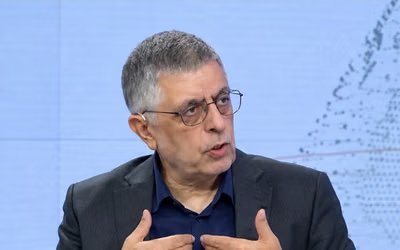
A dispute over Iran’s nuclear enrichment program has escalated into a broader political fight after President Masoud Pezeshkian’s son and adviser Yusef Pezeshkian defended remarks questioning whether enrichment is worth its costs during wartime.

The dispute has evolved into a wider argument over what constitutes national security: maintaining strategic capabilities regardless of their costs or reassessing them in light of the risks to Iran’s population, infrastructure and economy.

The controversy began with remarks by Jafar Ghaempanah, executive deputy to President Pezeshkian, who argued that Iran should consider the costs of pursuing its nuclear program amid the threat of further attacks on the country.

“Wisdom means achieving an objective that you can achieve at the lowest possible cost,” he said.

His comments drew fierce criticism from conservatives and hardliners, but the dispute intensified after Yusef Pezeshkian entered the debate in an Instagram story on Saturday.

“Enrichment is neither a principle of religion nor our honour, nor is our survival dependent on it,” he wrote.

Pezeshkian stressed in another story on Sunday that decisions should be made with full awareness of their consequences.

“We must do whatever is necessary to secure our interests,” he wrote, arguing that Iran should pursue enrichment, missiles and drones only insofar as they served those interests.

But he did not retreat from his central argument: “Our survival does not depend on enrichment. We won’t die if we don’t enrich uranium.”

The intervention broadened the controversy, with hardliners directing their criticism not only at Ghaempanah but also at the president and his administration. Some even called for the president to be removed from office.

Hardline attacks

Yadollah Javani, deputy political chief of the Revolutionary Guards (IRGC), rejected the argument that abandoning enrichment would have prevented war or pressure on Iran in an interview with state television on Sunday.

He said claims that Iran’s nuclear program, human rights record, missile program and regional allies were the fundamental causes of pressure were inconsistent with historical realities. Rather, he argued, these issues were pretexts for a broader confrontation.

The hardline Kayhan newspaper described the positions of Ghaempanah and Yusef Pezeshkian as “subversive”, saying Ghaempanah’s remarks “smell of outright surrender”.

It accused them of being part of a “capitulationist current” and warned that the same logic could eventually be used to justify abandoning Iran’s drone industry, defensive capabilities and regional influence.

The conservative Khorasan newspaper argued that Iran’s enrichment program could not be assessed solely through an economic cost-benefit calculation.

Referring to what it called Iran’s policy of “nuclear ambiguity”, the newspaper argued that continuing enrichment would not give Iran nuclear deterrence but could preserve the possibility of changing its nuclear doctrine in response to a nuclear attack.

It also said enrichment could leave open the possibility of developing so-called dirty bombs and a painful second-strike capability, potentially forcing Iran’s adversaries to reconsider their calculations.

Other conservative critics argued that Washington’s demands would not end with enrichment and that concessions would merely shift pressure to Iran’s missile program and other strategic capabilities.

Meisam Zohourian, a hardline lawmaker, said the more important issue was not simply that Ghaempanah had made the remarks but that the presidential administration’s public relations office had republished them.

“This means that at least a current within the government has decided to openly stand against the Leader’s position,” he wrote.

Reformist defence

Reformist voices have argued that critics of Ghaempanah and Yusef Pezeshkian were putting ideological commitments ahead of the costs imposed on ordinary Iranians.

Rouydad24 said the attacks reflected hostility toward an approach that seeks to define national security through realism and the interests of the population rather than through slogans that impose additional costs.

The website argued that the nuclear dispute could not be reduced to a legal or technological question when its potential costs included the destruction of infrastructure, economic paralysis and threats to the foundations of the state. Iran’s foreign policy, it said, needed to put “prudence” ahead of provocation.

Journalist Davoud Heshmati rejected the argument that giving up enrichment would simply lead Washington to make further demands, describing it as evidence of faulty reasoning.

He argued that the controversy surrounding Iran’s nuclear program was ultimately connected to Israel’s security concerns and warned against pursuing a nuclear capability that Iran could not adequately protect.

“A bomb that you cannot protect is, in fact, a basis for killing your own people,” he wrote.

The argument now goes beyond whether uranium enrichment itself is worth its cost. The deeper divide is over the lessons Iran should draw from the war: whether vulnerability makes preserving strategic capabilities more necessary, or whether the risks associated with those capabilities require Tehran to reconsider what national security is meant to protect.

Most Viewed

Poverty pushes Iranian children into hazardous border work
1

Poverty pushes Iranian children into hazardous border work

2

Iran court sentences 10 protesters to death in Isfahan

3

Iran arrests alleged financial intermediary over €300 million bank debt

4

US-Iran fighting flares after diplomatic push stalls

5

Syria veteran emerges as key figure in Shahriar crackdown

Banner
Banner
Banner

Spotlight

  • President's son questions enrichment, ignites fierce debate in Tehran

    President's son questions enrichment, ignites fierce debate in Tehran

  • Iran fires back, but can missiles ease economic pain?
    ANALYSIS

    Iran fires back, but can missiles ease economic pain?

  • Iran loses ground on trade as war hits oil and non-oil exports
    ANALYSIS

    Iran loses ground on trade as war hits oil and non-oil exports

  • Iranians hit back at VP's case for pricier gasoline as dollar passes 2.1m rials
    VOICES FROM IRAN

    Iranians hit back at VP's case for pricier gasoline as dollar passes 2.1m rials

  • Nearly half in poll would not buy home in Iran even if they could afford it
    VOICES FROM IRAN

    Nearly half in poll would not buy home in Iran even if they could afford it

•
•
•

More Stories

Iran bets on China to blunt Trump’s economic offensive

Aug 29, 2026, 01:00 GMT+1
•
Maryam Sinaiee
100%
Chinese President Xi Jinping welcomes Iran's president Masoud Pezeshkian

China’s refusal to bow to US sanctions has raised hopes in Tehran that Beijing could blunt Washington’s new economic offensive, but a debate inside Iran reveals doubts over how far China is willing or able to go on Iran’s behalf.

China has warned that it would respond if Chinese companies were targeted by any significant expansion of US secondary sanctions related to Iran, prompting Iranian officials to portray Beijing as a potential obstacle to Washington’s effort to further isolate Tehran economically.

The question has become more pressing as the Trump administration weighs whether to extend its campaign to Chinese financial institutions.

Asked Thursday why Washington had not imposed new sanctions on Chinese banks dealing with Tehran, President Donald Trump suggested such measures could already be under consideration.

“You don’t know if I’m doing it. I don’t have to announce everything,” Trump said.

China’s war too?

Some in Tehran see China’s resistance as part of a much larger struggle with Washington in which Iran has become an important front.

Hasan Ameli, the Supreme Leader’s representative in Ardabil province, argued during Friday prayers that Beijing understood that the United States’ ultimate confrontation was with China rather than Iran.

“China fully understands that America’s main war, and the war of the future, is with China, and this war passes through Iran,” Ameli said. “If America gains control over Iranian oil, it will prepare for war with China.”

He described China’s position as “a major opening for Iran’s economy and a heavy blow to American sanctions,” arguing that Tehran could use it to ease Washington’s economic pressure.

Mohammad-Bagher Ghalibaf, Iran’s parliament speaker and the country’s special representative for China, also welcomed Beijing’s position.

“The Iran-China comprehensive strategic partnership is rooted in mutual respect, win-win cooperation, and a shared vision for a multipolar world. This relationship needs no one’s permission,” he wrote on X.

Alaeddin Boroujerdi, a member of parliament’s National Security and Foreign Policy Committee, pointed to China’s importance as one of Iran’s largest oil buyers and called for faster implementation of the two countries’ 25-year cooperation agreement.

“Given China’s opposition to American sanctions against Iran and its role as one of the largest buyers of Iranian oil, there is considerable potential for expanding trade and economic cooperation,” he said.

China’s interests, not Iran’s

But even among those who see China as an important counterweight to US pressure, there is skepticism over a crucial assumption: that Beijing’s interests and Tehran’s necessarily coincide.

Majid-Reza Hariri, head of the Iran-China Chamber of Commerce, said China was not confronting Washington because of any military or ideological alliance with Iran.

“Rather, its economic and strategic interests require it to preserve its trade independence,” Hariri told Khabar Online.

He acknowledged that intensified US pressure could inflict significant economic damage on Iran, but argued that Washington could not cripple the Iranian economy without broader international cooperation.

Relations with China and Iran’s neighbors, he said, remained important to the country’s economic resilience.

Iranian journalist Ata Bahrami similarly argued that Beijing’s position should be understood primarily as a defense of its own sovereignty and growing power rather than a commitment to Iran.

“Their clear message to Washington is: ‘We have grown stronger and you must respect our sovereignty,’” he said. “In fact, Iran is the starting point for demonstrating this power.”

The Hormuz contradiction

The limits of the partnership become more apparent in the Strait of Hormuz, where Iran’s own actions potentially conflict with Chinese interests.

Moderate journalist Ahmad Zeidabadi questioned whether Beijing could be expected to deepen its support for Tehran while Iran keeps closed a waterway through which China receives more than 40% of its oil.

Zeidabadi also pointed to the fact that Ghalibaf has yet to visit Beijing despite his appointment as Iran’s special representative for China, asking whether the delay could reflect Chinese frustration with Tehran’s refusal to end its threat over Hormuz.

The problem goes beyond political differences. Even if Beijing refuses to comply with US secondary sanctions and Chinese buyers remain willing to purchase Iranian oil, Tehran must still be able to move that oil out of the Persian Gulf under a US maritime blockade.

Overcoming that obstacle would potentially require a level of Chinese involvement in Iran’s confrontation with Washington that Beijing has so far shown no willingness to undertake.

The debate inside Iran therefore exposes the gap between diplomatic resistance to US sanctions and the practical ability to defeat them.

Beijing may be willing to protect Chinese commercial interests and challenge Washington’s extraterritorial sanctions, but that is different from assuming the economic—let alone military—costs of Iran’s confrontation with the United States.

For Tehran, China may be Washington’s biggest obstacle in enforcing its economic campaign, but not necessarily Iran’s economic lifeline.

War or deal? Rezaei begins to define Iran’s price

Aug 28, 2026, 18:30 GMT+1
•
Behrouz Turani
100%
Iran's security chief and former IRGC commander Mohsen Rezaei

Mohsen Rezaei on Friday set out four Iranian conditions for an agreement with the United States, another sign that the former IRGC commander who once championed an “offensive doctrine” may be moving from advocating war to contemplating a deal at the right price.

Rezaei named an end to the regional war, lifting the blockade of Iranian ports, compensation and sanctions relief as Iran’s core conditions. He said the demands had been compiled in response to requests from mediators.

Rezaei has served since August 10 as secretary of the Supreme National Security Council and is also the Supreme Leader’s representative on the body, giving his remarks greater institutional weight than those of an individual political or military figure.

Whether the conditions constitute a formally approved negotiating mandate, however, remains unclear. Rezaei’s description suggests an ongoing process of defining Iran’s negotiating position rather than the presentation of final instructions to negotiators.

Since taking over the SNSC, Rezaei has increasingly emerged as one of the principal voices through which Iran’s security establishment frames diplomacy.

The council brings together senior military, intelligence and government officials alongside representatives of the Supreme Leader, who holds ultimate authority over major national security decisions.

Back to MoU

That makes the evolution of Rezaei’s language significant. His movement from advocating an “offensive doctrine” to discussing the terms of a possible agreement has not amounted to an embrace of accommodation with Washington.

But diplomacy is increasingly appearing in his rhetoric as an instrument of Iranian strategy rather than something inherently at odds with it.

Only days ago, Rezaei told Pakistan’s Field Marshal Asim Munir that Washington needed to change its behavior and take practical steps to implement the Islamabad MoU. Iranian media, including Press TV, quoted him as saying the United States should return to the June agreement.

That was notable because the Islamabad MoU provided a framework for de-escalation: ending hostilities, reopening the Strait of Hormuz and moving toward a broader agreement.

President Masoud Pezeshkian has also defended the MoU as the best available path while emphasizing adherence to the Supreme Leader’s policy.

Friday’s demands do not necessarily reverse that position. Rather, they fit an evolving sequence in Rezaei’s public stance: initial rejection of the MoU, movement toward reviving the June framework and now a willingness to discuss negotiations while attaching a higher price to them.

Tactical shift

There is an echo here of Donald Trump’s own approach to the conflict. The US president has moved between military pressure, diplomacy, rejection of the MoU, economic pressure and renewed suggestions that an agreement remains possible.

Both sides appear to be using uncertainty itself as leverage: escalating, reopening the door and then raising the terms for walking through it.

That does not mean Rezaei is consciously emulating Trump. But his recent statements suggest a similarly transactional approach in which apparently contradictory positions can coexist.

Negotiations remain possible, while threats and maximal demands are used to improve the terms on which they might take place.

For Rezaei, this represents a change in tactics rather than ideology. He has not abandoned the hardline worldview that has defined much of his political career, nor do his statements yet signal a broader Iranian pivot toward accommodation with Washington.

More significant may be the evolution of the role he is now playing. The former IRGC commander is no longer simply warning against compromise; he is beginning to define its price.

Iranians are selling their own graves to pay for living

Aug 28, 2026, 13:58 GMT+1
•
Saman Rahmatian
100%
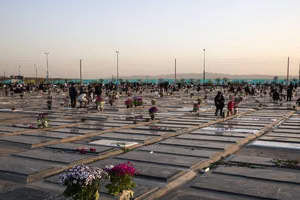
A view from Tehran's Behesht-e Zahra cemetary

Dying has become one of the costs Iranians can no longer meet. Burial plots are advertised at years of wages, families are selling the graves they had reserved for themselves, and some are taking their dead to villages where burial is still free.

A review of grave listings in Tehran found a three-tier plot in sections 39 and 72 of Behesht-e Zahra, the vast cemetery on the southern edge of the capital where Iran's war dead and the founder of the Islamic Republic are buried, offered at 30 billion rials, about $15,000. Tiered graves are stacked burials sold as a single right, allowing several family members to be interred in one plot over time.

The official 2026 tariff for reserving the same three tiers in that part of the cemetery is 3.47 billion rials, roughly $1,740. The asking price in the listings is more than eight and a half times the state rate.

Set against wages, the figures become clearer. Iran's minimum base wage is about 166 million rials a month, around $83. The advertised grave is equivalent to more than 180 months of that wage: a worker on the minimum would have to save every rial for more than fifteen years, spending nothing at all, to reach the asking price. Even the official tariff comes to nearly 21 months of wages.

The market is not confined to the capital. At the Bagh-e Ferdows cemetery in Kermanshah, listings reach 34 billion rials, about $17,000. Two-tier graves at the Saheb al-Zaman cemetery in Kerman are advertised at up to 20 billion rials, some $10,000, and plots at 10 billion rials, around $5,000, appear in Karaj and Yazd.

In Mashhad, family tombs at Behesht-e Reza are priced at up to 18 billion rials, roughly $9,000, and published reports have put burial inside the shrine of Imam Reza, the holiest Shia site in Iran and a place many families regard as a religious privilege, at as much as 14 billion rials, about $7,000.

The bill for a last farewell

A grave is only one of the costs of dying. Transporting the body, ritual washing and the shroud, the burial itself, the headstone, a mosque, flowers, catering and the ceremonies each carry a separate charge.

Under Tehran's official 2026 tariff, basic services run from hundreds of thousands to several million rials. A private hearse costs 50 million rials, about $25, for the first three hours.

Adding the grave, cemetery services, a temporary headstone, a mosque or hall, flowers, catering and other costs, a burial and urban funeral for around 100 people can come to between 1.2 and 1.8 billion rials, roughly $600 to $900. A more expensive plot, a costlier stone, a full meal or several ceremonies can push it far higher.

For many families, though, the question is not whether to buy an expensive grave or an elaborate headstone. It is how to pay for an ordinary burial at all, a cost that pushes them to shrink the ceremonies, drop the traditional third-day and seventh-day gatherings, or find somewhere cheaper to bury their dead.

What has actually changed

Prices inside Behesht-e Zahra vary by zone and section, and the state rates rise every year. In rials the climb is steep: three tiers in the older sections cost 825 million rials in 2022 against 3.47 billion today, a fourfold increase.

Measured in dollars, though, the official price has barely moved. It was worth about $1,700 in 2022 and about $1,740 now, because the city council raises the tariff by a fraction of what the currency loses each year. What has collapsed is the ability to pay: Iran's minimum wage has fallen from more than $230 a decade ago to around $83.

  • Names of some Iran protest victims vanish from Tehran cemetery database

    Names of some Iran protest victims vanish from Tehran cemetery database

That gap between a suppressed official price and what the market will bear is where the private trade lives. The cemetery's managing director said in 2023 that grave sales are the organization's main source of income, that capacity was running out and three new cemeteries were planned, and that each national identity number was now limited to a single plot, a rule introduced to stop what he called brokering and the emergence of "grave sultans." Such brokering, he acknowledged, exists.

Cemetery officials also dispute the highest figures in circulation. A previous managing director said the most expensive grave ever sold there had gone for a fraction of the sums now advertised. The listings reviewed for this report are advertisements placed by private sellers, not transactions recorded by the cemetery.

When a burial right becomes an asset

Iran International contacted three people who had advertised graves for sale in Tehran and Kermanshah, presenting itself as a prospective buyer. None is named here.

One, in Tehran, was selling an unused tier of his father's grave, a space the family had kept for his mother.

"Thank God our mother is alive, and right now we need this money more," he said.

In Kermanshah, another seller had listed his mother's grave, in Bagh-e Ferdows for about 40 years. He counted its position near the car park among its advantages, and said that whenever a buyer needed it, he would come to complete the transfer once the money had been paid, so that the grave could be given to them as a "gift."

  • Iran crackdown reaches cemeteries as graves of slain protesters defaced

    Iran crackdown reaches cemeteries as graves of slain protesters defaced

A third seller in Kermanshah had bought a plot beside his brother's years earlier, intending to be buried next to him. He has put it up for sale. Finding a grave in Bagh-e Ferdows has become difficult, he said, but the money matters more for now: he is still alive, and he would rather use it for what his children need than worry about how easily they will be able to visit him later.

In this market, even a place kept to lie beside a father, a mother or a sibling can lose out to something more urgent: the money a family needs today.

Graves at auction

Burial rights are not only offered as assets in private listings. Court enforcement records show they can be seized and auctioned to settle debts.

In 2022, a single tier of a grave in section 36 of Behesht-e Zahra was put up for auction. In June 2025, so was a grave in section 62 of Bagh-e Ferdows in Kermanshah.

Open trade in graves is not permitted in many Iranian cemeteries, and transfers of burial rights are supposed to go through official channels. In Tehran, the right of use must be registered through the Behesht-e Zahra organization.

The restrictions have not ended the market. Listings continue to appear, and some transfers are dressed as gifts, as the Kermanshah seller described.

The result is a market with almost no transparency: there is no comprehensive official record of how many such deals are done, no clarity on the prices finally paid, and no certainty that a right advertised in a listing can lawfully be transferred at all.

The migration of the dead

Another consequence is visible in the villages around some Iranian cities.

Reports from areas near Mashhad and Gorgan describe urban families moving the bodies of relatives to village cemeteries, where burial is free or cheap, to reduce costs.

One described a rise in city families turning up at rural graveyards. In another village, residents built a fence around the cemetery to stop outsiders being buried there.

Similar accounts have emerged from other cities. There are no official figures, but the cases suggest the price of a grave is now capable of redrawing the geography of burial.

Prices are not driven by inflation alone. Older cemeteries are running short of capacity, families want to be buried alongside relatives, and the religious standing of certain sites carries a premium of its own.

The pressure works in both directions at once: one family drives a body out of the city to save money while, in the same period, a burial plot in an old cemetery becomes an asset worth the equivalent of years of work.

Mourning under financial and security pressure

For some families the difficulty of burial is not only economic.

Reporting on those killed in protests and on people executed in Iran shows that the release of a body, the place of burial and even the holding of a funeral can fall under the control of security institutions. In some cases that pressure has come with a demand for money.

  • Pay for bullets: How Iran pressures families after killing protesters

    Pay for bullets: How Iran pressures families after killing protesters

The family of Babak Pourmazaheri, a 37-year-old protester killed in Alborz province, received his body after three days and a payment of 4 billion rials, about $2,000.

In the case of Jamshid Momeni, 16 billion rials, roughly $8,000, was demanded for the return of his body; when the family said they could not pay, they were asked instead to present him as a "martyr of the state."

In the case of Esmail Fekri, the family was not told where he had been buried, and a security officer demanded 1.5 billion rials, some $750, to reveal the location of the grave.

Here the cost of death is no longer the price of a plot and a ceremony. Money has become entangled with control over the body, the burial and the right to grieve.

Two sides of the market

In a market where a burial right can be worth years of wages and can be auctioned to settle a debt, some families are selling the very place they had kept for themselves or their relatives, in order to pay for living.

In Kermanshah, a man bought a grave beside his brother's years ago. He has now put it up for sale.

He says he needs the money for his children more than he needs somewhere to be buried.

Tehran debates austerity as US targets sanctions lifelines

Aug 28, 2026, 00:58 GMT+1
•
Behrouz Turani
100%
A motorcyclist checks his phone on a street in Tehran, with a banner depicting Iran’s slain Supreme Leader Ali Khamenei visible in the background, August 26, 2026

As Washington targets the financial and trading networks Iran has used to withstand years of sanctions, economists and analysts in Tehran are debating how much more economic hardship the country can absorb to survive a prolonged economic war.

The latest US pressure goes beyond broad restrictions on oil exports, increasingly targeting middlemen, front companies, financial channels and other mechanisms Tehran has relied on to keep foreign currency and goods flowing under sanctions.

Ehsan Movahedian, an international affairs analyst, described the approach as an attempt to choke Iran’s access to foreign currency, fuel inflation and deepen internal economic instability.

Other analysts writing in the moderate outlets Fararu and Donya-ye Eghtesad argue that with those traditional workarounds under growing pressure and no comprehensive alternative in place, Tehran may increasingly be forced to turn inward: tightening budgets, reducing subsidies, rationing scarce resources and curbing consumption.

But austerity presents the government with its own political dilemma. Measures that conserve resources and help Iran withstand sanctions would also transfer more of the cost of the confrontation to a population already struggling with inflation and utility shortages.

Iranian governments have long been wary of abruptly reducing subsidies for precisely that reason. A sudden increase in gasoline prices in November 2019 triggered nationwide protests that were met with a deadly crackdown, leaving authorities acutely aware of the political risks attached to measures that sharply increase household costs.

President Donald Trump and Treasury Secretary Scott Bessent have made clear that economic pressure will remain central to Washington’s Iran strategy.

In Tehran, the campaign is broadly perceived as an attempt to force capitulation rather than genuine negotiations, even though President Masoud Pezeshkian has repeatedly said the two sides must eventually resolve their differences through talks.

Former diplomats Fereydoun Majlesi and Jalal Sadatian describe the current trajectory of Iran-US relations as one of strategic ambiguity and economic attrition, with neither an imminent diplomatic breakthrough nor a clear route out of the confrontation.

That uncertainty has sharpened disagreement over whether diplomacy can relieve the economic pressure before Tehran is forced to impose still greater costs at home.

Former ambassador Mohsen Pakaeen argued that the recent stream of regional mediators visiting Tehran was focused on the wrong capital.

The obstacle, he said, was Washington’s insistence on Iranian capitulation without offering credible concessions, meaning mediators seeking a breakthrough should concentrate their efforts on the United States.

Hardline voices, including the editor of the ultraconservative daily Kayhan, reject talks under economic pressure and push for a more confrontational posture capable of raising the costs for the United States and its regional partners.

The disagreement leaves Tehran confronting two related calculations: whether it can economically outlast Washington’s pressure campaign, and how much domestic hardship it can impose in doing so.

For advocates of greater economic resilience, austerity could preserve scarce government resources while buying Tehran time. But analysts also warn that the same measures could weaken domestic stability and ultimately undermine the negotiating position they are intended to protect.

China offers Iran its most important external economic lifeline, but also an uncertain one.

Majlesi and other observers argue that intensified US enforcement against buyers of Iranian goods increasingly overlaps with Washington’s wider economic competition with Beijing.

China remains crucial to Iranian trade, but Tehran cannot determine how much economic or political risk Beijing will ultimately accept on its behalf.

That leaves Iran with few easy alternatives. Informal trading networks can soften sanctions, regional diplomacy may eventually produce negotiations and austerity can stretch limited resources, but none provides a clear exit from a prolonged economic confrontation.

Austerity may therefore buy Tehran time, but not necessarily leverage. But the question is not only how long Iran’s economy can withstand Washington’s pressure, but how much more pressure its government believes Iranian society can bear.

Three mediators in three days seek path back to Iran-US talks

Aug 27, 2026, 22:01 GMT+1
•
Maryam Sinaiee
100%
Qatar’s Prime Minister and Foreign Minister Mohammed bin Abdulrahman Al Thani shakes hands with Iran's President Masoud Pezeshkian in Tehran. August 27, 2026

Three regional mediators have visited Tehran in three days in an intensifying diplomatic push to revive Iran-US talks, even as the two sides remain deeply divided over the Strait of Hormuz and Washington’s economic pressure campaign.

Qatar’s Prime Minister Mohammed bin Abdulrahman Al Thani arrived on Thursday, following Omani Foreign Minister Badr Albusaidi on Tuesday and Pakistan Army Chief Field Marshal Asim Munir on Monday, as regional powers seek to create a path toward de-escalation and renewed negotiations.

Al Thani’s visit, his first to Iran since the war began in late February, came after days of diplomacy focused partly on finding an arrangement over Hormuz that could provide an opening for broader talks.

He met President Masoud Pezeshkian, Foreign Minister Abbas Araghchi, Parliament Speaker and senior negotiator Mohammad-Bagher Ghalibaf and security chief Mohsen Rezaei.

The messages he received reflected the competing currents shaping Tehran’s response to the diplomatic push.

Pezeshkian praised efforts by Qatar, Pakistan, Oman and other countries to promote peace and security in the region. He also pointed to factions in the United States, Israel and Iran that he said were trying to prevent agreements from taking shape, urging US officials to ignore voices opposed to a return to stability.

Ghalibaf told Al Thani that an economic blockade of Iran would be ineffective and said Washington should implement commitments made under the Islamabad memorandum.

Rezaei struck a more confrontational tone, warning that Iran would target US military and economic interests if Washington sought to “commit mischief” against Iran. He reiterated that the Strait of Hormuz would remain closed unless the United States met Tehran’s conditions.

Qatar’s Foreign Ministry said Al Thani discussed regional developments, efforts to reduce tensions and creating conditions for the resumption of dialogue between Tehran and Washington.

Mediators push for talks

The flurry of diplomatic activity has fueled speculation in Iranian media that Tehran and Washington could return to negotiations, although there is little indication that a breakthrough is imminent.

Iran Nuances, an English-language outlet apparently linked to Iran’s Foreign Ministry, argued that the succession of visits reflected concern among regional states that intensified economic pressure could produce wider instability rather than force Iran to capitulate.

The Iranian news agency ILNA was more cautious. In a commentary headlined “Can Qatar Unlock the Negotiations?”, it said the gap between Tehran and Washington remained too wide for Qatar’s mediation to be certain of success.

“If Iran considers lifting economic pressure and ending the blockade a precondition for any opening, while the United States continues to insist on increasing pressure, even activating Qatar’s mediation channels will not necessarily lead to the resumption of negotiations,” it said.

ILNA suggested that Doha could instead begin by mediating over de-escalation and freedom of navigation in the Strait of Hormuz, potentially creating an opening for wider negotiations.

Economic daily Donya-ye Eqtesad described the succession of regional visits as a form of “multi-layered diplomacy” aimed at developing a phased roadmap involving Iran, the United States and regional mediators, with maritime arrangements providing an initial route toward de-escalation.

But optimism in parts of the Iranian media contrasts sharply with Washington’s public posture.

US President Donald Trump told Al Jazeera on Wednesday that he was “not in a hurry” to resume negotiations with Iran and had set no timetable for ending the war. He said economic pressure and military action were proving effective.

White House spokeswoman Karoline Leavitt said Thursday that there were currently no negotiations between the United States and Iran and that all options remained on the table.

Fate of missing Iranian pilots

Al Thani’s visit also brought renewed attention in Tehran to the fate of Iranian pilots who went missing in March after their Sukhoi fighter jets were shot down over Qatar.

Iranian officials say three pilots survived after ejecting from their aircraft, were captured by Qatari forces and have been held there since.

Qatar strongly rejects that account. Doha says its search-and-rescue teams found the remains of one pilot and handed them to Iran, but that it has no information about the fate of the others.

Iran has requested that an Iranian Air Force expert team and the International Committee of the Red Cross become involved in determining their fate.

Iranian army spokesman Mohammad Akraminia said Wednesday that if Qatar genuinely did not know what had happened to the pilots, it should make greater efforts to establish their whereabouts.

Fada-Hossein Maleki, a member of parliament’s National Security Commission, said Thursday that the lack of clarity over the pilots remained a source of tension with Doha and warned that any evidence they had been mistreated would affect bilateral relations.

Hardliners also seized on the issue during Al Thani’s visit, accusing Iranian officials of failing to press Qatar publicly over the pilots’ fate.