• العربية
  • فارسی
Brand
  • Iran Insight
  • Politics
  • Economy
  • Analysis
  • Special Report
  • Opinion
  • Podcast
  • Live TV
  • Iran Insight
  • Politics
  • Economy
  • Analysis
  • Special Report
  • Opinion
  • Podcast
  • Live TV
  • Theme
  • Language
    • العربية
    • فارسی
  • Iran Insight
  • Politics
  • Economy
  • Analysis
  • Special Report
  • Opinion
  • Podcast
  • Live TV
All rights reserved for Volant Media UK Limited
volant media logo

Insider says China tied Ghalibaf trip to reopening Hormuz, easing US dispute

Sep 1, 2026, 21:53 GMT+1

China has conditioned a potential visit to Beijing by Parliament Speaker Mohammad Bagher Ghalibaf and broader ties with Tehran on Iran reopening the Strait of Hormuz without imposing tolls and resolving its disputes with Saudi Arabia and the United States, reformist politician and regime insider Hossein Marashi said in an interview with EcoIran website.


Most Viewed

US-Iran fighting flares after diplomatic push stalls
1

US-Iran fighting flares after diplomatic push stalls

2
VOICES FROM IRAN

Iranians hit back at VP's case for pricier gasoline as dollar passes 2.1m rials

3
VOICES FROM IRAN

Nearly half in poll would not buy home in Iran even if they could afford it

4
INSIGHT

Actor dropped from play after pro-Palestine stance in rare reversal for Iran

5
EXCLUSIVE

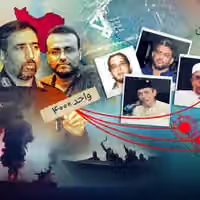
IRGC Unit 4000 plans attacks on shipping in East Asia, sources say

Banner
Banner
Banner

Spotlight

  •  Hackers without borders: serving Tehran, stealing on the side
    SPECIAL REPORT

    Hackers without borders: serving Tehran, stealing on the side

  • The republic of magic: How Iran turned the unseen into an instrument of rule
    ANALYSIS

    The republic of magic: How Iran turned the unseen into an instrument of rule

  • President's son questions enrichment, ignites fierce debate in Tehran

    President's son questions enrichment, ignites fierce debate in Tehran

  • Iran fires back, but can missiles ease economic pain?
    ANALYSIS

    Iran fires back, but can missiles ease economic pain?

  • IRGC Unit 4000 plans attacks on shipping in East Asia, sources say
    EXCLUSIVE

    IRGC Unit 4000 plans attacks on shipping in East Asia, sources say

  • Iran loses ground on trade as war hits oil and non-oil exports
    ANALYSIS

    Iran loses ground on trade as war hits oil and non-oil exports

  • Iranians hit back at VP's case for pricier gasoline as dollar passes 2.1m rials
    VOICES FROM IRAN

    Iranians hit back at VP's case for pricier gasoline as dollar passes 2.1m rials

•
•
•

More Stories

IAEA says status of Iran’s fourth enrichment site remains unknown

Sep 1, 2026, 20:44 GMT+1
100%
FILE PHOTO: A satellite image shows airstrike craters over the underground centrifuge halls of the Natanz Enrichment Facility, following U.S. airstrikes amid the Iran-Israel conflict, in Natanz County, Iran, June 22, 2025. Maxar Technologies/Handout via REUTERS

The UN nuclear watchdog says it remains unable to determine the status of Iran’s fourth declared uranium-enrichment facility after Tehran failed to provide information or allow inspectors access to the site.

A confidential quarterly International Atomic Energy Agency report said the agency had made no progress over the past three months in verifying key parts of Iran’s nuclear program, with its continued lack of access to nuclear material remaining a proliferation concern, Reuters reported on Tuesday, citing a copy of the report it had seen.

Iran has provided neither information on the status of affected declared nuclear facilities and material nor access needed for on-site verification at the Isfahan Fuel Enrichment Plant.

Iran notified the IAEA on June 12, 2025 that it intended to establish the plant at the Nuclear Reactors Fuel Company site in Isfahan, making it the country’s fourth declared uranium-enrichment facility after two plants at Natanz and one at Fordow.

The IAEA planned to carry out its first design verification at the new facility the following day, but the visit was cancelled when Israeli strikes on Iran began.

The agency has never inspected the plant and says it does not know its precise location, whether it became operational or whether it contained nuclear material. Iran later told the IAEA that the facility had been subjected to military attack, which the agency has been unable to verify.

The uncertainty forms part of a wider gap in the IAEA’s knowledge of Iran’s nuclear material since the June 2025 attacks. Its last estimate before losing verification put Iran’s uranium stockpile at 2,391.1 kg enriched up to 2%, 6,024.4 kg up to 5%, 184.1 kg up to 20% and 440.9 kg enriched up to 60%, close to weapons grade. The agency has since been unable to verify the current quantities or whereabouts of the material.

IAEA Director General Rafael Grossi said earlier this year that the agency believed a little more than 200 kg of Iran’s 60%-enriched uranium had been stored in the wider Isfahan tunnel complex and was likely still there. That storage area is distinct from the fourth enrichment facility whose status the agency has been unable to establish.

Underground uranium storage site

Separately, the US-based Institute for Science and International Security last week identified what it assessed to be a probable uranium hexafluoride storage facility at the Natanz Nuclear Complex. The partially underground, bunkered structure was built between 2010 and 2017 and was likely intended to support large-scale enrichment at Natanz, the institute said.

The institute said the facility does not appear to have been targeted in the 2025 or 2026 military strikes, but said its role before and after the June 2025 war remains unclear. It said no vehicle activity had been observed there in available satellite imagery since that conflict.

Iranian nuclear chief Mohammad Eslami said last week that Tehran still considers itself to be in wartime conditions and would not permit inspections of nuclear sites hit by military strikes until a new inspection protocol is established. He said IAEA inspections could continue at facilities that were not attacked.

Mohsen Rezaei, secretary of Iran’s Supreme National Security Council, has meanwhile suggested Tehran could reconsider its longstanding rejection of nuclear weapons, arguing that US attacks had strengthened the case for an atomic bomb as a deterrent.

Rezaei stopped short of saying Iran had decided to develop a nuclear weapon. Tehran continues to maintain that its nuclear program is exclusively peaceful.

Trump dismisses Iran deal after Tehran pushes return to Islamabad memorandum

Sep 1, 2026, 17:11 GMT+1
100%
President Masoud Pezeshkian showing his copy of the MoU signed remotely with President Donald Trump. June 17, 2026

Hours after Tehran called on Washington to return to the Islamabad memorandum, President Donald Trump dismissed the value of any agreement with Iran, ordered massive strikes on southern Iran and threatened an even larger attack if Tehran retaliates.

Trump told Fox News on Tuesday that he had given Iran “a lot of chances” and said he had little faith in any agreement with Tehran.

“I think an agreement with them isn't worth the paper it's written on. We gave them a lot of chances,” Fox News quoted him as saying.

His remarks came as President Masoud Pezeshkian said Iran would respond immediately if the United States returned to its commitments under the June agreement, reinforcing Tehran’s position that the memorandum remains the principal route back to diplomacy.

However, Parliament Speaker and chief negotiator Mohammad-Bagher Ghalibaf struck a harder tone in a video message the same day, saying Iran’s policy, based on Supreme Leader Mojtaba Khamenei’s directive, was to secure implementation of the memorandum’s conditions.

“If the United States does not fulfill its commitments, we will force it to do so through the language of power,” Ghalibaf said.

He said the Strait of Hormuz would not reopen until Washington implemented its obligations under the agreement and described forcing the United States to comply as what would become its “third defeat.”

Ghalibaf also warned that Iran would respond militarily if Washington intensified its maritime blockade.

“If the enemy intends to prevent Iran from exporting oil from the Persian Gulf, it should know that no one else will be able to export oil from this region either,” he said.

He added that Iran had exported more than 80 million barrels of oil while the Islamabad memorandum was being implemented and had also made progress in importing essential goods.

The renewed emphasis on the memorandum comes amid another escalation in direct US-Iran fighting. The United States struck IRGC positions in southern Iran on Tuesday, two days after attacking Larak Island, prompting Iranian retaliatory attacks.

Trump on Tuesday warned Iran against further retaliation, saying any response would trigger much heavier US strikes and threatening an even larger attack that he said could leave “very little” of the Islamic Republic.

Mediation efforts

Against that backdrop, regional mediators including Pakistan have continued efforts to revive the diplomatic process. Pakistani Prime Minister Shehbaz Sharif discussed the memorandum with Pezeshkian on the sidelines of the Shanghai Cooperation Organization summit this week and described it as the “only viable pathway” toward lasting peace.

Pakistan’s Foreign Minister Ishaq Dar echoed that position in talks with Iranian Foreign Minister Abbas Araghchi on Tuesday, saying sincere implementation of the agreement by both sides remained the “only way forward.”

The latest diplomatic effort follows Pakistani army chief Field Marshal Asim Munir’s visit to Tehran last week, when he met Pezeshkian, Ghalibaf and other senior Iranian officials.

Reuters reported that Munir spoke with Trump before traveling to Tehran, with a Pakistani source saying Washington wanted Islamabad to use its influence to bring Iran back toward negotiations.

Iranian officials subsequently said Munir’s visit had made significant diplomatic progress, although Washington has publicly maintained that no negotiations with Tehran are currently underway.

Pakistan is not alone in trying to revive diplomacy. Qatar has also pursued mediation between Tehran and Washington, including discussions over arrangements for commercial shipping through the Strait of Hormuz.

The Islamabad memorandum, agreed in June, was intended to halt the conflict and provide a temporary framework for negotiations. It included provisions dealing with the US maritime blockade and commercial navigation through Hormuz.

Article 5 has become particularly important to Tehran. It provides for arrangements ensuring commercial passage through the strait and for Iran and Oman to discuss its future administration and maritime services in accordance with international law.

Iran has increasingly made implementation of those provisions, alongside an end to the US blockade, a condition for fully reopening Hormuz.

The renewed diplomatic push therefore comes as the two sides publicly move further apart: Tehran says it is prepared to return to the memorandum if Washington moves first, while Trump has dismissed the value of an agreement with Iran and threatened substantially heavier military action if Tehran retaliates.

The republic of magic: How Iran turned the unseen into an instrument of rule

Sep 1, 2026, 14:27 GMT+1
•
Reza Haji Hosseini
100%

The Islamic Republic moved beliefs about the unseen from the margins of society to the center of power, and used oil money to give them institutions, budgets and a propaganda apparatus, so that its rulers could draw legitimacy from a source no citizen can question.

Two recent scenes show what that means in practice.

At state-organized rallies in February, marking the anniversary of the 1979 revolution, organizers set fire to effigies they identified as Baal, the Canaanite deity condemned as a false god in both the Bible and the Quran. In the middle of an economic crisis, the state staged its victory over its enemies as a piece of street ritual.

  • Why were ‘Baal’ statues burned at Iran’s revolution anniversary rallies?

    Why were ‘Baal’ statues burned at Iran’s revolution anniversary rallies?

Months later, Salar Velayatmadar, a member of parliament, said the decision to stop publishing images of Mojtaba Khamenei had been taken on the advice of senior clerics in Qom, Mashhad and Najaf, and of security officials, so that Iran's enemies could not use "occult sciences," a term covering practices such as talismans, incantations and divination, to harm him.

With that, the occult had entered the official language of national security.

A distinction matters here. This is not an argument about what Iranians privately believe, and the point is not that millions of people hold beliefs about the sacred, as they do in every society. The question begins at the moment an unfalsifiable claim becomes the basis of political legitimacy, a security decision and the distribution of public money. At that point it has stopped being faith and become statecraft.

Nor is this a case of a secular state later contaminated by such thinking. The Islamic Republic's identity was bound from the beginning to a phrase that describes the country as belonging to someone who cannot be seen.

The absent owner

Speaking to government officials in September 1981, Ruhollah Khomeini, the cleric who led the 1979 revolution and founded the Islamic Republic, said: "The owner of this country is the Imam of Time." The line is recorded in volume 15 of Sahifeh-ye Imam, the official collection of his speeches and writings.

The Imam of Time is the twelfth imam of Shia Islam, who is believed to have vanished in the ninth century, to be alive and hidden, and to be destined to return. Iran's constitution frames clerical rule explicitly as an arrangement for the era of his absence.

  • Will Mojtaba Khamenei's absence help the Islamic Republic survive?

    Will Mojtaba Khamenei's absence help the Islamic Republic survive?

Read as a theory of ownership, the consequences are considerable. If the country's true owner is absent, clerics become the interpreters of his will, and the Supreme Leader, rather than representing citizens, becomes the deputy of an absent proprietor. His accountability runs towards a realm no one can reach, not towards a public that could remove him.

Khomeini's arrival did not create popular belief in miracles and unseen forces, which long predated him. What the state he founded did was move those beliefs out of private life and into the machinery of power.

Manufacturing the sacred

The apparatus has been building sanctity around its leaders since the beginning.

The historian Olmo Gölz, in a study of the claim that Khomeini's face could be seen in the moon, drew on memoirs and newspapers of the period to trace both the spread of the rumor and its rejection by Khomeini himself and by a number of clerics. The denial did nothing to prevent the halo forming.

Video from Khomeini's first days back in Tehran shows a man touching his hand and then the hands of the crowd, passing on a blessing said to reside in the leader's body.

Decades later, Mohammad Saeedi, the Friday prayer leader of Qom, said that Ali Khamenei, the late supreme leader, had uttered the name of Imam Ali at the moment of his birth. The political significance of such a story lies not in efforts to establish whether it happened, but in the fact that the official apparatus uses it to build sanctity around a ruler.

The unseen world also has physical addresses. The most important is the mosque at Jamkaran, outside Qom, built on the belief that the hidden imam once appeared on the spot. Its own website describes the well where visitors drop written petitions addressed to him. Around such beliefs the state has built rituals, buildings, media, pilgrimage routes and an economy.

Set in that history, the absence of Mojtaba Khamenei is the most recent expression of the same logic. A leader with no verified image or voice governs a system whose true owner is also described as absent. What looks from outside like a crisis of decision-making, and has clearly produced disagreement inside the government, is material that this apparatus is equipped to convert into mystery, sanctity and waiting.

The security dimension is real, and the comparison with Osama bin Laden's final years captures it. But the difference is in the structure of meaning: the al-Qaeda leader hid in order not to be found, while the ruler of a country said to belong to a hidden imam can turn his own invisibility into symbolic capital.

In a secular system, a vanished leader is a legitimacy crisis. Here, absence was given meaning in advance by the architecture of belief.

Messages attributed to Mojtaba Khamenei extend the same logic outward, describing Iranians as the bearers of a historic mission and placing the public, state institutions and allied forces abroad in a chain of divine purpose. The ruler cannot be seen, but society is required to carry out his mission.

Who pays for it

None of this could have expanded so far without earthly backing.

The Venezuelan anthropologist Fernando Coronil, in The Magical State: Nature, Money, and Modernity in Venezuela, described how oil states use wealth from beneath the ground to stage a power that appears miraculous. In the Islamic Republic the metaphor has acquired a literal meaning.

In the state's first decades, oil revenue freed the government from depending on taxation, and therefore from bargaining with its citizens. Money came out of the ground and was spent building an apparatus that took its legitimacy from the sky. Oil remains the state's source of foreign currency: according to data from the analytics firm Kpler, China took about 1.2 million barrels a day from Iran in 2026.

On that foundation, the seminaries, the propaganda organizations, the shrines, religious foundations, devotional associations and cultural institutes became a network for reproducing this worldview.

Superstition in the Islamic Republic moved well beyond the pulpit and the amulet-writer: it acquired organizations, media, staff and budget lines.

In the 2026 budget bill, the Supreme Council of Seminaries was allocated 74.5 trillion rials, about $37 million at market exchange rates, and the Seminary Services Centre 164.2 trillion rials, roughly $82 million. What those figures show is less their size than their presence: bodies of this kind now appear as line items in the national accounts. In the same budget, a meaningful pay rise for civil servants and pensioners was set aside in the name of controlling inflation, while the apparatus that produces and distributes religious legitimacy was left untouched.

The political function of these institutions is clear enough. They produce clerics, preachers, rituals, obedience, enemies and legitimacy. They build a world in which a foreign policy failure becomes a divine test, poverty becomes an occasion for patience, repression becomes the defense of faith, and the survival of the government becomes a sacred promise.

But the apparatus is no longer run on oil money alone. The 2026 bill projects that 87 percent of total budget resources will come from taxation. Oil was central to constructing this ideological edifice; taxes, inflation and the falling purchasing power of Iranians now pay to maintain it.

Magic did not produce oil for the Islamic Republic. The Islamic Republic used oil money to turn magic into an instrument of power.

In the republic of magic, the orders still come from heaven. The bill is increasingly paid out of people's pockets.

President's son questions enrichment, ignites fierce debate in Tehran

Sep 1, 2026, 04:10 GMT+1
•
Maryam Sinaiee
100%
Yousef Pezeshkian, son and media adviser of President Masoud Pezeshkian. File photo.

A dispute over Iran’s nuclear enrichment program has escalated into a broader political fight after President Masoud Pezeshkian’s son and adviser Yusef Pezeshkian defended remarks questioning whether enrichment is worth its costs during wartime.

The dispute has evolved into a wider argument over what constitutes national security: maintaining strategic capabilities regardless of their costs or reassessing them in light of the risks to Iran’s population, infrastructure and economy.

The controversy began with remarks by Jafar Ghaempanah, executive deputy to President Pezeshkian, who argued that Iran should consider the costs of pursuing its nuclear program amid the threat of further attacks on the country.

“Wisdom means achieving an objective that you can achieve at the lowest possible cost,” he said.

His comments drew fierce criticism from conservatives and hardliners, but the dispute intensified after Yusef Pezeshkian entered the debate in an Instagram story on Saturday.

“Enrichment is neither a principle of religion nor our honour, nor is our survival dependent on it,” he wrote.

Pezeshkian stressed in another story on Sunday that decisions should be made with full awareness of their consequences.

“We must do whatever is necessary to secure our interests,” he wrote, arguing that Iran should pursue enrichment, missiles and drones only insofar as they served those interests.

But he did not retreat from his central argument: “Our survival does not depend on enrichment. We won’t die if we don’t enrich uranium.”

The intervention broadened the controversy, with hardliners directing their criticism not only at Ghaempanah but also at the president and his administration. Some even called for the president to be removed from office.

Hardline attacks

Yadollah Javani, deputy political chief of the Revolutionary Guards (IRGC), rejected the argument that abandoning enrichment would have prevented war or pressure on Iran in an interview with state television on Sunday.

He said claims that Iran’s nuclear program, human rights record, missile program and regional allies were the fundamental causes of pressure were inconsistent with historical realities. Rather, he argued, these issues were pretexts for a broader confrontation.

The hardline Kayhan newspaper described the positions of Ghaempanah and Yusef Pezeshkian as “subversive”, saying Ghaempanah’s remarks “smell of outright surrender”.

It accused them of being part of a “capitulationist current” and warned that the same logic could eventually be used to justify abandoning Iran’s drone industry, defensive capabilities and regional influence.

The conservative Khorasan newspaper argued that Iran’s enrichment program could not be assessed solely through an economic cost-benefit calculation.

Referring to what it called Iran’s policy of “nuclear ambiguity”, the newspaper argued that continuing enrichment would not give Iran nuclear deterrence but could preserve the possibility of changing its nuclear doctrine in response to a nuclear attack.

It also said enrichment could leave open the possibility of developing so-called dirty bombs and a painful second-strike capability, potentially forcing Iran’s adversaries to reconsider their calculations.

Other conservative critics argued that Washington’s demands would not end with enrichment and that concessions would merely shift pressure to Iran’s missile program and other strategic capabilities.

Meisam Zohourian, a hardline lawmaker, said the more important issue was not simply that Ghaempanah had made the remarks but that the presidential administration’s public relations office had republished them.

“This means that at least a current within the government has decided to openly stand against the Leader’s position,” he wrote.

Reformist defence

Reformist voices have argued that critics of Ghaempanah and Yusef Pezeshkian were putting ideological commitments ahead of the costs imposed on ordinary Iranians.

Rouydad24 said the attacks reflected hostility toward an approach that seeks to define national security through realism and the interests of the population rather than through slogans that impose additional costs.

The website argued that the nuclear dispute could not be reduced to a legal or technological question when its potential costs included the destruction of infrastructure, economic paralysis and threats to the foundations of the state. Iran’s foreign policy, it said, needed to put “prudence” ahead of provocation.

Journalist Davoud Heshmati rejected the argument that giving up enrichment would simply lead Washington to make further demands, describing it as evidence of faulty reasoning.

He argued that the controversy surrounding Iran’s nuclear program was ultimately connected to Israel’s security concerns and warned against pursuing a nuclear capability that Iran could not adequately protect.

“A bomb that you cannot protect is, in fact, a basis for killing your own people,” he wrote.

The argument now goes beyond whether uranium enrichment itself is worth its cost. The deeper divide is over the lessons Iran should draw from the war: whether vulnerability makes preserving strategic capabilities more necessary, or whether the risks associated with those capabilities require Tehran to reconsider what national security is meant to protect.

Jobs protests met with gunfire in southwestern Iran

Sep 1, 2026, 02:16 GMT+1
100%
Young job-seekers in gather to demand more jobs be allocated to local applicants, in southwestern city of Ahvaz, Iran

Iranian security forces on Monday used gunfire and beatings to disperse two protests by young jobseekers in southwestern Iran, as anger over unemployment and alleged discrimination in hiring spills into the streets.

Police opened fire Monday on protesters in Gachsaran who had gathered over hiring practices at the Lishtar refinery project, according to rights groups and footage from the scene.

Human rights group HRANA published a video that appeared to show police firing shots at the gathering. Gunfire can be heard in the footage.

The group said at least one person was injured, while the Iran Human Rights Center and other local and rights groups reported multiple injuries.

Protesters had gathered to denounce what they described as unfair and discriminatory recruitment practices at the refinery project, including the influence of political connections, and demanded greater transparency and priority for qualified local workers.

The dispute has been building for weeks. Young jobseekers from the Garmsiri Boyer-Ahmad region previously demonstrated outside the refinery project and the Gachsaran governor’s office, demanding what they called “justice in hiring” and an end to discrimination against local applicants.

Domestic media reports indicate construction and excavation work at the Gachsaran refinery project in Lishtar was underway in August, while local officials had previously faced demands for greater transparency over recruitment.

The confrontation came alongside another jobs protest in Ahvaz, where security forces used beatings and gunfire to disperse young people protesting hiring practices at the Dabal Khazaei Sugarcane Agro-Industry Company, according to the Karun Human Rights Organization.

The group said it received videos and accounts showing armed forces confronting protesters and opening fire.

It also cited witnesses as saying an officer deliberately injured his own fingers in an attempt to provide grounds for arresting protesters. Iran International could not independently verify that claim.

The protesters say the company operates on around 12,000 hectares of land, much of it belonging to the local area and its residents, but that qualified local applicants have been passed over while workers from outside the region receive priority.

They have called for authorities to disclose how vacancies are advertised, the criteria used to recruit workers and the share of jobs allocated to local applicants.

The two confrontations come as economic grievances over jobs and alleged discrimination increasingly spill into public protest in Iran.

In both cases, young people were demanding jobs and greater transparency over who gets them. In both, their protests were met with violence by security forces.