• العربية
  • فارسی
Brand
  • Iran Insight
  • Politics
  • Economy
  • Analysis
  • Special Report
  • Opinion
  • Podcast
  • Live TV
  • Iran Insight
  • Politics
  • Economy
  • Analysis
  • Special Report
  • Opinion
  • Podcast
  • Live TV
  • Theme
  • Language
    • العربية
    • فارسی
  • Iran Insight
  • Politics
  • Economy
  • Analysis
  • Special Report
  • Opinion
  • Podcast
  • Live TV
All rights reserved for Volant Media UK Limited
volant media logo

Araghchi says US launched attacks from UAE territory

Sep 1, 2026, 01:32 GMT+1

Iranian Foreign Minister Abbas Araghchi said in an interview with MS NOW’s Velshi that US forces used locations in the United Arab Emirates to launch rocket attacks on Iran’s Kharg and Abu Musa islands.

“The reaction would be clear,” Araghchi said. “Last night they attacked Kharg Island and Abu Musa Island” using HIMARS rockets.

He said Iranian forces tracked the launches and determined they came from two locations in the UAE, including Ras Al-Khaimah and an area near Dubai.

“It is now clear that they were fired from the UAE,” Araghchi said, calling the use of neighboring territory to attack Iran “absolutely unacceptable.”

He also said it was “very dangerous” to launch rockets from areas close to heavily populated locations.

Most Viewed

Iran court sentences 10 protesters to death in Isfahan
1

Iran court sentences 10 protesters to death in Isfahan

2

Iran arrests alleged financial intermediary over €300 million bank debt

3

US-Iran fighting flares after diplomatic push stalls

4

Syria veteran emerges as key figure in Shahriar crackdown

5
VOICES FROM IRAN

Nearly half in poll would not buy home in Iran even if they could afford it

Banner
Banner
Banner

Spotlight

  • President's son questions enrichment, ignites fierce debate in Tehran

    President's son questions enrichment, ignites fierce debate in Tehran

  • Iran fires back, but can missiles ease economic pain?
    ANALYSIS

    Iran fires back, but can missiles ease economic pain?

  • Iran loses ground on trade as war hits oil and non-oil exports
    ANALYSIS

    Iran loses ground on trade as war hits oil and non-oil exports

  • Iranians hit back at VP's case for pricier gasoline as dollar passes 2.1m rials
    VOICES FROM IRAN

    Iranians hit back at VP's case for pricier gasoline as dollar passes 2.1m rials

  • Nearly half in poll would not buy home in Iran even if they could afford it
    VOICES FROM IRAN

    Nearly half in poll would not buy home in Iran even if they could afford it

•
•
•

More Stories

Iran fires back, but can missiles ease economic pain?

Aug 31, 2026, 23:57 GMT+1
•
Negar Mojtahedi
100%
People browse a local market in Iran's Persian Gulf port city of Bandar Abbas, August 25, 2026

Iran’s latest strikes on American forces have brought threats of further US retaliation, but Washington increasingly sees Tehran’s military escalation as a sign of economic vulnerability rather than strategic strength.

After Iran launched missiles at US bases in Jordan in response to an American strike on Larak Island in the Strait of Hormuz, President Donald Trump promised another response.

“We’re going to hit them hard,” Trump told Fox News. “There will be a response.”

At the same time, Treasury Secretary Scott Bessent offered a different measure of who has the advantage.

“I would think that they are lashing out kinetically because they are losing economically,” Bessent said, arguing that Tehran is feeling the effects of Washington’s expanding pressure campaign.

Iran’s economy does not have to collapse, he said. “We just have to have the regime come to their senses.”

That leaves a central question hanging over the latest exchange: can Iran’s military retaliation actually improve its position as economic pressure mounts?

“Keep firing on Jordan, keep firing on Kuwait and Bahrain and UAE, but does that solve your problem at home?” Kamran Bokhari, Strategic Forecaster and Senior Resident Fellow with the Middle East Policy Council in Washington, told Iran International.

Bokhari believes Washington has little incentive to escalate into a larger war when it can respond to specific Iranian actions while maintaining the blockade and economic pressure.

“Keep the blockade,” he said. “If they try to mine, do what they did yesterday, but don’t escalate anything, and just keep the pressure up on the economic front.”

In that scenario, Iran retains the ability to retaliate, but its attacks do little to relieve the broader pressures facing the Islamic Republic.

Can economic pressure lead to something bigger?

Ali Dadpay, an Iranian American economist from Texas, said Washington’s stated objective is to change the Islamic Republic’s behavior rather than openly pursue regime change.

“Right now, they officially and legitimately say change of behavior,” Dadpay said.

But he argued that the economic deterioration Iran is experiencing could ultimately produce a more consequential outcome than Washington’s stated goal.

Dadpay pointed to the Soviet Union, East Germany and communist Poland as examples of political systems that collapsed without being invaded by a foreign power.

“A similar set of socio-economic factors can create a similar outcome,” he said of Iran.

Dadpay also said the combination of military and economic pressure could alter calculations among groups within the Islamic Republic and push the system toward what he described as a “new equilibrium.”

The immediate question is how far Washington is prepared to go with that economic pressure.

Max Meizlish, a former senior policy adviser at the Treasury Department’s Office of Foreign Assets Control, said a key test will be whether the US targets financial institutions facilitating Iranian trade with China.

Iran may still have oil to sell. The bigger question is whether Tehran can get paid. Unless financial channels through Hong Kong, the UAE and elsewhere are constrained, Meizlish said, “the regime is still going to have pathways for rearming itself.”

The pressure reaches ordinary Iranians

The expanding campaign is also having consequences beyond the regime. On August 24, OFAC suspended General License G, which had permitted certain educational services and academic exchanges involving Iranians.

ETS told Iran International it has since paused TOEFL and GRE testing inside Iran. Iranian nationals can still take the tests outside the country.

  • Iran sanctions reach education: Duolingo blocked, TOEFL and GRE in doubt

    Iran sanctions reach education: Duolingo blocked, TOEFL and GRE in doubt

Dadpay called the impact on testing a “side effect” of the broader restrictions. Meizlish said the administration may be trying to prevent regime-linked individuals from using educational opportunities abroad.

But he acknowledged the wider cost.

“There could be an unintended effect here where ordinary Iranians are caught in the crossfire, so to speak,” Meizlish said.

Iran’s missiles have shown Tehran can still strike back. What remains unclear is whether those attacks can ease the pressure building on the Islamic Republic — or whether Washington’s economic squeeze can change the regime’s behavior without increasingly hurting the Iranians it is meant to pressure Tehran on behalf of.

IRGC Unit 4000 plans attacks on shipping in East Asia, sources say

Aug 31, 2026, 22:25 GMT+1
•
Mojtaba Pourmohsen
100%

Iran’s IRGC intelligence arm is recruiting non-Iranian operatives to carry out attacks on ships, waterways and ports in East Asia, including two major Chinese ports, sources familiar with the plans told Iran International.

Iran International has obtained information about three alleged recruits and an operation being developed by Unit 4000, the Special Operations Division of the Islamic Revolutionary Guard Corps Intelligence Organization.

According to the sources, the unit recruited the three individuals through Shiite clerics in Thailand and Indonesia and has begun planning attacks in the Malacca and Bangka straits, as well as at Tanjung Priok Port in Indonesia and the Ningbo-Zhoushan and Shanghai ports in China.

The operations are being overseen by Brigadier General Rahman Moghaddam, commander of Unit 4000, according to Iran International’s sources.

Moghaddam was reported killed in an Israeli strike in Tehran on March 3, during the opening days of the war. Israeli security agencies identified him among senior Iranian intelligence figures killed in Israeli attacks.

Two days later, drones struck Nakhichevan in Azerbaijan in an attack Baku blamed on Iran, although Tehran denied responsibility. CNN later reported that Iranian officials believed the drone attack was retaliation for Moghaddam’s killing, which Tehran suspected had been carried out with Israeli assistance from Azerbaijan.

Iran International has now obtained information indicating that those reports of Moghaddam’s death were incorrect. According to the new information, he survived the strike and is now overseeing what the sources describe as a new phase of Unit 4000’s overseas maritime operations.

100%

Moghaddam, a former deputy coordinator at the Defense Ministry’s Protection and Intelligence Organization, took charge around three years ago of Unit 4000, which has been linked to assassination and sabotage operations targeting opponents of the Islamic Republic and Israeli interests abroad.

Plans to target ships in Indonesian and Chinese waters

Two sources familiar with the IRGC’s activities said Moghaddam is overseeing a new program aimed at expanding Unit 4000’s operations into East Asian waters.

The sources said the unit is considering attacks on commercial, military and privately owned vessels transiting the Malacca Strait, one of the world’s most important shipping routes, as well as the Bangka Strait.

Operatives recruited by the unit have also developed plans targeting Tanjung Priok, Indonesia’s busiest port, and the major Chinese ports of Ningbo-Zhoushan and Shanghai, the sources said.

The plans would represent a significant geographical expansion of Iran’s maritime pressure campaign.

Since the war began on February 28, Iran has sought to restrict shipping through the Strait of Hormuz, while the Iran-backed Houthis in Yemen have disrupted maritime traffic around the Bab al-Mandab and the Red Sea.

In June, Mohsen Rezaei, then a senior adviser to Iran’s supreme leader and now secretary of the Supreme National Security Council, told CNN that Tehran could expand the conflict if the war and US naval blockade continued.

“If the war continues and the naval blockade is not lifted, we will drag the war to the Indian Ocean, the Bab al-Mandab Strait, the Red Sea and the Mediterranean,” Rezaei said.

Around the same period, Quds Force commander Esmail Qaani said a new “security belt” of Iran’s so-called resistance front would extend from the Strait of Hormuz to Bab al-Mandab and from the Persian Gulf to the Red Sea.

Sources identify recruitment links in Thailand and Indonesia

Iran International’s sources said Unit 4000 had been seeking non-Iranian recruits for its East Asian maritime operations, allowing Tehran greater deniability if an operation was exposed.

100%

The recruits were brought to Iran for training before being assigned to operations in East Asia, according to the sources.

For recruitment in Thailand, Moghaddam approached Seyyed Momen Saketicha, a prominent figure in the country’s Shiite community, the sources said.

Saketicha was part of a Thai delegation that travelled to Tehran in 2023 and met Hamas representatives in efforts to secure the release of Thai nationals taken hostage during the October 7 attack on Israel.

The sources described Saketicha as a close associate of prominent Thai Shiite cleric Seyed Sulaiman Husaini, who heads the Al-Mahdi Foundation in Thailand and serves as imam of the Ruhollah Mosque in Nakhon Si Thammarat.

Husaini also has ties to Al-Mustafa International University, an Iran-based institution sanctioned by the US Treasury in 2020 over what Washington described as its role in facilitating recruitment for the IRGC Quds Force.

In 2012, after explosions in Bangkok that Thai and Israeli officials said were part of a plot targeting Israeli diplomats, Husaini blamed Mossad. A Thai court later convicted two Iranian men over the bomb plot. Iran denied involvement.

Focus on Indonesia

The bulk of Unit 4000’s planned East Asian maritime activity is centered on Indonesia, according to Iran International’s sources.

The sources said Moghaddam used two Indonesian clerics to identify potential recruits.

100%

One is Zahir Yahya, chairman of Ahlulbait Indonesia, a national Shiite organization. Iran International’s sources described Yahya as an intermediary who introduced potential operatives to Unit 4000.

The second is Abdullah Saqqaf, whom the sources identified as head of the Amir al-Mu’minin seminary in Bogor and as having links to Al-Mustafa International University.

According to the sources, Saketicha, Yahya and Saqqaf introduced potential recruits to the IRGC, while two Unit 4000 figures — Mohsen Aghazadeh and Vahid Yekeh-Dehqan — were responsible for recruitment and training.

100%

Three alleged recruits identified

Iran International has identified three individuals its sources say were recruited by Unit 4000 for covert maritime operations in East Asia.

The first, Pandu Yudhawinata, is an Indonesian operative who has previously been linked in counterterrorism reporting to Hezbollah and Iranian intelligence.

Yudhawinata was implicated in a failed 1994 Hezbollah plot to bomb the Israeli Embassy in Bangkok. Counterterrorism reporting has said he underwent training in Iran and later worked with Hezbollah networks in Southeast Asia.

Iran International’s sources also linked him to attacks in Sri Lanka.

The sources said Yudhawinata and two other Indonesian nationals, Ardiyanta Mutoha and Mohammad Hossein, travelled to Tehran for training intended to prepare them for covert operations at ports and waterways across East Asia.

The alleged plans come as Washington seeks to increase pressure on Iran’s oil exports while helping move energy shipments through the Strait of Hormuz.

US Treasury Secretary Scott Bessent said last week that the United States had helped move 130 million barrels of oil through the waterway over a two-week period while preventing Iranian exports.

Asia is particularly exposed to any expansion of maritime disruption. The International Energy Agency estimates that around 80% of oil passing through the Strait of Hormuz is destined for Asian markets.

The plans described to Iran International suggest that Unit 4000 may now be seeking to threaten another critical section of the energy and commercial shipping network serving Asia — extending the potential reach of Iran’s maritime campaign from the Middle East into some of the world’s busiest waters.

Iran loses ground on trade as war hits oil and non-oil exports

Aug 31, 2026, 21:04 GMT+1
•
Dalga Khatinoglu
100%
File photo shows the Bushehr port in southern Iran

Iran’s foreign trade has contracted sharply since the conflict with the United States began, with non-oil exports and imports falling by around a quarter or more, according to customs data released after months of delay.

Iran exported about $15 billion worth of non-oil goods, including natural gas and LPG, through August 16, nearly five months into the Iranian calendar year that began on March 21. That was nearly 30% below the figure reported for the first five months of the previous year.

Imports fell to about $17 billion over the same near-five-month period, about a quarter below the full five-month figure reported a year earlier.

The figures show a sharp deterioration in Iran’s trade during a conflict that has disrupted key industries and shipping routes, adding to an economy already struggling under years of sanctions, declining oil revenues and chronic shortages of foreign currency.

The United States has intensified economic pressure on Tehran since the conflict began on February 28, while imposing a maritime blockade on Iran amid disruptions to shipping through the Strait of Hormuz.

Iranian customs authorities have not published a detailed breakdown of the decline in non-oil exports. But the latest figures indicate that non-oil exports have fallen for a second consecutive year, with the current near-five-month total roughly a third below the level recorded in the first five months of 2024.

Imports have performed even worse over the longer period, with the latest total nearly 40% below the first-five-month figure recorded in 2024.

Petrochemicals and steel hit by strikes

The deterioration comes after attacks disrupted two of Iran’s most important non-oil export industries: petrochemicals and steel.

Iran exported about $45 billion in non-oil goods during the previous Iranian fiscal year, with petrochemicals and steel accounting for roughly $17 billion, or 37% of the total.

Israeli strikes in March hit Iran’s major petrochemical hubs in Mahshahr and Asaluyeh, as well as major steel producers including Mobarakeh Steel and Khuzestan Steel.

The Iranian government subsequently halted the export of a wide range of petrochemical and steel products for two to three months. Some export permits were later restored, but the government has not disclosed how much these industries exported during the first five months of the current year.

That makes it difficult to determine precisely how much of the overall decline in non-oil exports was caused by disruptions to these sectors.

But given their importance to Iran’s export earnings, any prolonged disruption to production, transportation or overseas sales would have a significant effect on the country’s trade balance.

Oil exports fall even faster

The decline in Iran’s oil exports appears to have been even steeper.

Iranian customs authorities do not publish oil-export figures. Kpler data seen by Iran International, however, show that Iran’s average daily crude-oil and condensate sales to China during the first five months of the current Iranian year were slightly above 1 million barrels per day, about 40% below the same period last year.

Iran’s total fuel-oil exports to international markets also fell sharply, averaging about 96,000 barrels per day, down 57% year on year.

The decline has accelerated in recent months.

Iran’s oil shipments to China, its main customer, have fallen to roughly 520,000 barrels per day this month, while the average over the previous two months was about 800,000 barrels per day, according to Kpler estimates.

That compares with roughly 1.7 million barrels per day of crude oil and condensate sold to China at the beginning of the conflict.

Iran’s fuel-oil exports have also dropped from an average of about 220,000 barrels per day at the start of the war to 61,000 barrels during August.

The collapse in fuel-oil exports has also coincided with a sharp deterioration in Iran’s trade with the United Arab Emirates.

The UAE was Iran’s largest fuel-oil customer last year, accounting for more than 70% of Iran’s fuel-oil exports. But following widespread Iranian attacks on the UAE, the trade has been almost suspended.

Malaysia, Singapore and China have also largely stopped buying Iranian fuel oil since the beginning of the conflict.

Mounting pressure on Iran’s economy

The combined decline in oil and non-oil exports is likely to put further pressure on Iran’s already strained foreign-exchange position.

At the same time, the fall in imports suggests that Iranian companies and consumers are facing increasing difficulty accessing foreign goods, raw materials, machinery and intermediate products.

The trade figures therefore point to a broader deterioration than a simple decline in exports. Iran is simultaneously losing export revenue and reducing its ability to import the goods needed to sustain domestic production.

If the decline in oil shipments persists, pressure on Tehran’s foreign-currency reserves and its ability to finance imports could intensify further in the coming months.

For an economy heavily dependent on oil revenue and imports of industrial inputs, the latest figures suggest that the economic costs of the conflict are extending well beyond the energy sector.

Actor dropped from play after pro-Palestine stance in rare reversal for Iran

Aug 31, 2026, 16:23 GMT+1
100%

A major Tehran theater production has dropped a prominent actor after his support for Palestine triggered fierce backlash, exposing a rare reversal where a stance strongly backed by the Islamic Republic appears to have become a liability with the public.

Navid Mohammadzadeh, one of Iran’s most prominent film and theater actors, was removed Monday from the cast of the theater-orchestral production “Arash,” according to a statement from the production team.

The producers cited “multiple controversies,” unspecified personal problems and, unusually, “the lack of audience interest in him” as reasons for the decision, saying a replacement would be announced soon.

The wording was striking in a country where support for Palestine has been promoted for decades as a foundational political and ideological cause, while expressions of sympathy for Israel can carry legal consequences.

Mohammadzadeh had drawn a wave of criticism on social media about two weeks earlier after posting an image of himself wearing clothing bearing the Palestinian flag. He responded with a video in which he made clear that his position went beyond concern for Palestinian civilians.

“I supported Palestine before, I support it now and I will continue to support it,” he said. “Why? Because I simply don’t like Israel. I will definitely choose Palestine forever.”

Mohammadzadeh pointed to football stars Diego Maradona and Cristiano Ronaldo, whom he described as personal idols, as figures whose attitudes toward the Palestinian issue helped confirm his own position.

He also pushed back against attacks on Iranian artists from rival political camps, complaining that both government hardliners and their opponents were quick to accuse people of betraying the country.

“I’m not on your side and I’m not on their side. I’m on nobody’s side,” he said. “I’m only on the side of one thing: life. And one place: Iran.”

“My love is Iran,” he added, saying he could have lived elsewhere but had chosen to remain despite the country’s difficulties.

His remarks failed to quell the criticism, as the social-media backlash over his support for Palestine continued.

The controversy coincided with another problem for “Arash”: anger over its unusually expensive tickets. Prices ranged from 990,000 tomans to nearly 5 million tomans for a limited number of premium seats, prompting criticism that the production had turned theater into a luxury product during a period of severe economic pressure. The producers later announced a 20% discount.

Reports about weak demand cited both ticket prices and opposition to Mohammadzadeh, making it impossible to establish how much of the production’s commercial difficulties resulted from his Palestine stance alone.

What distinguishes Monday’s decision is the production’s own explanation: rather than merely citing scheduling problems or artistic differences, it publicly identified a lack of audience interest in Mohammadzadeh as one of the reasons for removing one of Iran’s biggest stars.

Hardliners question ‘invisible red lines’

The decision drew sharp criticism from hardline Farhikhtegan newspaper, which linked Mohammadzadeh’s removal to his pro-Palestine post.

In a critical piece on Monday, the newspaper asked whether parts of Iran’s cultural scene had developed “invisible red lines” under which support for Palestine could lead to boycott and exclusion.

Farhikhtegan said the unusually blunt announcement — rather than the customary references to scheduling or contractual disagreements — resembled a hurried attempt to distance the production from the actor.

It suggested his removal amounted to a public warning that taking a particular political position could carry a professional cost, while disputing claims of weak demand by noting that audiences had still bought the expensive tickets.

The reaction is revealing. For most of the Islamic Republic’s history, pressure on cultural figures has generally operated in the opposite direction: artists could face bans, prosecution or professional consequences for challenging officially sanctioned causes.

In Mohammadzadeh’s case, a conservative newspaper is effectively complaining that an actor may have suffered commercially for embracing one of the state’s own defining positions.

A divide hidden by censorship

The episode brings into view a political divide that has existed in Iran for years but has been difficult to measure through the country’s tightly controlled domestic media.

Support for the Palestinian cause, and particularly for what Tehran calls the “resistance,” has been a cornerstone of the Islamic Republic’s identity since 1979. Iran has provided money, arms and training to Palestinian armed groups including Hamas and Palestinian Islamic Jihad. The US State Department estimated that Tehran provided up to $100 million annually in combined support to Palestinian militant groups before the latest regional wars.

That policy has unfolded while Iranians have faced repeated currency crises, high inflation, sanctions and declining purchasing power, helping turn Tehran’s spending abroad into a recurrent theme of anti-government protests.

“Neither Gaza nor Lebanon, my life for Iran” first emerged prominently during the 2009 Green Movement and returned during successive waves of unrest.

It was heard again during the economic protests that erupted in late December 2025, including in Tehran, Kermanshah and universities, and continued into January 2026.

The slogan does not necessarily express hostility toward Palestinians themselves. Its central message is that Iran’s resources and political priorities should be directed toward Iranians rather than Tehran’s regional allies.

But other expressions have gone considerably further.

Two days after Hamas’s October 7, 2023 attack on Israel, hundreds of Persepolis football fans at Tehran’s Azadi Stadium shouted an obscene slogan demanding the removal of Palestinian flags displayed around the pitch. At another match later that month, spectators disrupted an officially requested minute of silence for people killed in Gaza by shouting and blowing horns.

The scenes contrasted sharply with government-organized rallies supporting Palestinians and Hamas, which failed to generate participation comparable to pro-Palestinian demonstrations seen in several other countries in the region and beyond.

Iranian social media after October 7 also saw unusually visible expressions of sympathy for Israel and hostility toward Hamas, despite the risks involved. In October 2023, Iran’s attorney general designated online activity promoting or supporting Israel a criminal offense, underscoring why such attitudes are largely absent from licensed domestic media.

The divide surfaced again in 2024 when Iranian celebrities joined the global “All Eyes on Rafah” campaign. Critics responded with “All Eyes on Iran,” accusing public figures of showing greater concern for Palestinians than for Iranians killed or imprisoned by the Islamic Republic.

Is Iran’s society anti-Palestine?

Polling helps quantify the gap, while also showing why describing Iranian society simply as anti-Palestinian or pro-Israel would be misleading.

A 2021 survey by the Netherlands-based GAMAAN research foundation found that 70.6% opposed the Islamic Republic’s approach toward Hamas. Nearly 64% agreed with “Neither Gaza nor Lebanon, my life for Iran,” while 65.5% opposed the official “Death to Israel” slogan.

Those findings predate the recent wars, suggesting that resentment toward Tehran’s regional priorities is not itself a new postwar development.

A GAMAAN survey conducted after the 12-day Iran-Israel war last year showed the same divide in a more complicated form. Sixty-nine percent said the Islamic Republic should stop calling for Israel’s destruction, while 63% viewed the conflict as a war between Israel and the Islamic Republic rather than between Israel and the Iranian people.

But that did not amount to majority support for Israel. The same survey found 39% viewed Israel favorably and 48% unfavorably. Fifty-seven percent agreed that many Israeli military actions in Gaza could be considered war crimes.

The results suggest that several attitudes can coexist: opposition to Tehran’s funding of armed Palestinian groups, rejection of the “Death to Israel” ideology, anger at the use of Palestine as a compulsory political cause, sympathy toward Israel in its confrontation with the Islamic Republic, and concern about Palestinian civilians and Israel’s conduct in Gaza.

For some government opponents, Israel has also taken on a political meaning separate from the Palestinian conflict: it is an adversary of the state they themselves oppose. That dynamic has helped produce expressions of sympathy for Israel that are unusually visible by the standards of much of the Middle East.

  • 'Thank you uncle Netanyahu': some Iranians praise Israeli strikes

    'Thank you uncle Netanyahu': some Iranians praise Israeli strikes

What may be new is the consequence

It is impossible to know whether hostility toward a celebrity for publicly backing Palestine has significantly increased since the recent wars, or whether audiences previously felt much the same way but were less willing or less able to act on it.

What appears different in the Mohammadzadeh case is the consequence.

Attitudes long visible in protest slogans, football stadiums and relatively uncensored corners of social media appear to have crossed into the commercial calculations of a major, officially licensed cultural production.

That creates an extraordinary inversion.

For decades, Iranian artists have had reason to fear the consequences of straying too far from state ideology. Mohammadzadeh publicly embraced a position at the heart of that ideology — rejection of Israel and support for Palestine — yet the production employing him cited audience reluctance when removing him.

In other words, a political stance heavily promoted by the state appears, at least in this case, to have become a liability with part of the paying public.

That does not prove that support for Palestine has become broadly unacceptable in Iran. Mohammadzadeh had other controversies, and the high price of “Arash” tickets provides a separate explanation for the production’s difficulties.

Nor does the episode establish that public attitudes changed because of the wars. The “Neither Gaza nor Lebanon” slogan and polling against Tehran’s regional policies long predate them. The more significant development may instead be that such sentiment can now manifest itself openly enough to affect a high-profile cultural project.

Whether the reversal is allowed to stand is another matter.

Public theater performances in Iran require authorization from the Ministry of Culture and Islamic Guidance, giving the state considerable leverage over productions and venues. Iranian regulations require theatrical works shown to the public to obtain a performance license from the ministry.

Hardline media are already framing Mohammadzadeh’s removal as punishment for supporting Palestine, a cause the Islamic Republic regards as central to its values and foreign policy.

It remains to be seen whether “Arash” will proceed without official consequences or whether its producers will face pressure over a decision that runs so visibly against the political priorities of the state.

If the removal stands, its significance may extend beyond one actor and one play. It would offer a rare example of a sentiment largely excluded from Iran’s controlled media environment exerting enough pressure from below to produce a tangible result inside the cultural system the state itself regulates.

Iranians hit back at VP's case for pricier gasoline as dollar passes 2.1m rials

Aug 31, 2026, 11:59 GMT+1
•
Hooman Abedi
100%
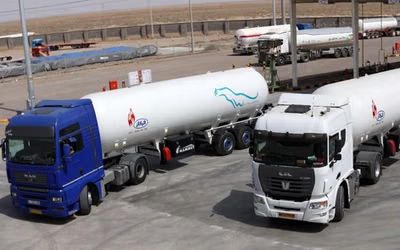
A woman fills her car with gasoline at a fuel station in Iran.

Iranians pushed back against a senior government official questioning cheap gasoline, contrasting fuel subsidies with low wages and soaring living costs as the US dollar traded around a historic 2.1 million rials on Monday.

“Give us a $3,000 salary and sell gasoline for 750,000 rials ($0.36) a liter. No problem,” one person wrote in response to Mohammad Jafar Ghaempanah, President Masoud Pezeshkian’s executive vice president.

Ghaempanah questioned the sustainability of selling gasoline for 15,000 rials per liter, less than one US cent at the current exchange rate, when he put its value at 700,000 rials ($0.33).

“You cannot buy gasoline that costs 700,000 rials per liter for 15,000 rials. No sound mind accepts this,” Ghaempanah said.

His comments drew responses comparing gasoline prices with wages, food, cars and the exchange rate, with several people questioning why international pricing should apply to household costs but not incomes.

An average monthly income of around 200 million to 250 million rials amounts to just $95 to $119 at an exchange rate of 2.1 million rials to the dollar, sharpening the contrast between earnings and prices increasingly measured against international market rates. At that income level, gasoline priced at Ghaempanah’s 700,000-rial ($0.33) valuation would make a 50-liter tank cost 35 million rials ($16.67), equivalent to about 14% to 18% of a month’s income.

‘Income in rials, expenses in dollars’

A worker writing from Tabriz turned Ghaempanah’s argument back on the government, questioning why wages remained so low if selling gasoline below its assessed value was unsustainable.

100%
A man counts US dollar banknotes outside a currency exchange in Tehran, Iran.

“We workers also ask why a worker whose wage should actually be $4,000 is paid $100,” the person wrote.

Another response focused on the exchange rate, questioning why Iranians must pay more than 2.1 million rials for one US dollar while the government objects to selling domestically produced gasoline for 15,000 rials per liter.

“You can’t have income in rials and expenses in dollars,” another person wrote.

Others compared wages with what they described as the poverty line.

“You can’t have a salary of 200 million rials ($95) when the poverty line is 1.5 billion rials ($714),” one person wrote.

Cars and food enter the comparison

Cars were another recurring point of comparison, with people questioning the gap between domestic vehicle prices and those in international markets.

“But we can buy a car worth five billion rials ($2,381) for 50 billion rials ($23,810)?” one person wrote.

Another called for cars to be offered at international market prices if officials want to apply similar logic to energy, saying consumers should not have to depend on Iranian and Chinese manufacturers.

Food prices also featured prominently in the reactions.

“It’s possible to make 400,000-rial rice cost six million rials, three-million-rial meat cost 30 million rials, and a two-billion-rial salary become 200 million rials. But gasoline has to become more expensive,” one person wrote.

Ghaempanah said food prices had risen 123%. The latest figures cited from the Statistical Center of Iran also put point-to-point food inflation above 128%, almost twice the roughly 67% rate for non-food goods.

Other messages described households cutting back on basic purchases as prices rise.

One person said their 75-year-old father, a pensioner receiving 160 million rials ($76) a month and paying rent, could no longer afford meat or chicken and had long since stopped buying fruit.

Another said they wanted to buy apples for their son but could not afford the price of 1.5 million rials ($0.71) per kilogram.

Government says budget deficit drives money printing

Ghaempanah also said the government’s budget imbalance forces it to create money to cover shortfalls, contributing to inflation.

“Because our budget is unbalanced, we are forced to print money. When money is printed, it itself creates inflation,” Ghaempanah said.

100%
A woman walks past a currency exchange displaying foreign exchange rates in Tehran, Iran.

The executive vice president attributed 67% of inflation to the banking sector, arguing that lenders issue loans that are not repaid and accept collateral without sufficient underlying value.

Banks then seek money from the Central Bank to cover their deficits, prompting further money creation, according to Ghaempanah.

He also described Iran’s economic conditions as poor and said ordinary people were bearing the greatest pressure.

“The bitter reality is that the country’s economic conditions are not good and the greatest pressure is being placed on the people,” Ghaempanah said.