Iranian photographer named IPA Fine Art Photographer of the Year for 'Painful hug'
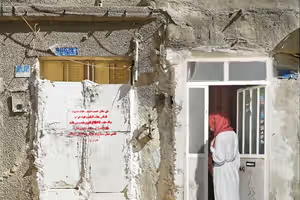
Maryam Saeedpoor's “Painful hug,” taken during the March war in Iran / Credit: The photographer's Instagram page @msaeedpoor
Iranian photographer Maryam Saeedpoor has been named Fine Art Photographer of the Year at the 2026 International Photography Awards for her wartime series “Painful hug,” placing her among the finalists for the competition’s top professional prize.
The International Photography Awards (IPA) selected Saeedpoor as the winner of its professional Fine Art category, one of 11 professional categories in this year’s competition.
Painful Hug is “a deeply personal image made during wartime in Tehran, expressing fear, protection, and a longing for peace through the simple gesture of an embrace,” the IPA said in a statement.
IPA juror Patti O’Halloran highlighted the tension in the images between pain, comfort and fear.
Saeedpoor said she spent the days of the war on the rooftop and wanted to “hold Tehran” and protect it from harm, adding that she wished world leaders would embrace one another so there would be no war.
As a professional category winner, Saeedpoor receives a $1,000 prize and advances as a finalist for International Photographer of the Year. The 11 professional category winners will compete for the title and a $10,000 prize.
The overall winner will be announced at the IPA Awards Gala at the Benaki Museum in Athens on October 11.
An Iranian couple, with the woman wearing a wedding dress, walk along a street in Tehran.
Nine in 10 respondents to an Iran International Instagram poll said they did not want to marry or have children under Iran’s economic, social and political conditions, according to results gathered from about 100,000 participants.
More than 12,000 people also commented on the poll, with financial pressure, job insecurity, housing costs and concerns about children’s futures emerging repeatedly among the reasons given for putting off marriage or parenthood.
Some respondents said they wanted to marry or have children but lacked the financial or social conditions to do so. Others pointed to divorce and unsuccessful marriages as reasons for avoiding marriage.
Men accounted for 68% of respondents and women for 32%. The largest age group was 25 to 34, representing 40.3% of participants, followed by people aged 35 to 44 at 29.2%.
Respondents aged 18 to 24 made up 13.3%, while those aged 45 to 54 accounted for 9.8%.
Economic pressures weigh on family plans
Many respondents linked their reluctance to start families to the cost of everyday life, according to an examination of comments submitted with the poll.
Some wrote that meeting their own expenses had become difficult enough and that supporting a spouse or child was beyond their financial means. Others said they remained interested in marriage or parenthood but could not afford either.
Iran has faced years of high inflation and a steep decline in the value of its currency, eroding household purchasing power and making housing and other basic costs harder to meet.
The economic strain has been compounded by international sanctions and government policies at home and abroad, with their contribution to Iran’s economic problems a subject of continuing political debate.
Personal experiences of divorce and unsuccessful marriages also appeared repeatedly in the responses. Some participants described marriage under present conditions as a “high-risk decision.”
A man and a woman sit on a bench in Tehran.
Others who were already married said they had decided against having children because of economic and social conditions. Respondents also cited mistrust and difficulty finding a suitable partner.
A smaller number expressed support for marriage or having children.
Parents question children's prospects
Concerns about the conditions in which children would grow up formed another major strand of the responses.
Some said they wanted children but were unwilling to bring them into a society where they feared they could face poverty, inflation, electricity shortages, insecurity and an uncertain future.
A number used much stronger language, describing having children under present circumstances as a “crime” or a “betrayal” of the child because parents could not guarantee an adequate quality of life or future.
Iran faces severe environmental challenges including air pollution, groundwater depletion, forest fires and wider ecosystem degradation. Experts have linked such problems to a combination of poor policymaking, weak environmental protections, corruption and insufficient resources.
Political outlook feeds pessimism
Some respondents connected their decisions directly to Iran’s political and social conditions and their expectations for the country’s future.
Years of economic hardship have coincided with repeated waves of anti-government protests and deadly crackdowns, alongside restrictions on political and social freedoms.
For some participants, those pressures appeared to have turned decisions about marriage and parenthood into a broader judgment about what kind of future is possible in Iran.
The scale and substance of the responses point to a question facing many of them: not simply whether they can afford to build families, but whether they see a future in which they want to do so.
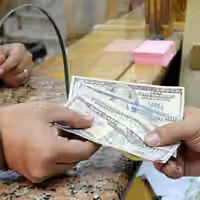
Iranian rials and US dollars are exchanged in Tehran. (File photo)
Iranians described deepening financial hardship and questioned whether economic pressure can change government policy as the dollar hit a historic 2 million rials, extending the currency's sharp decline on Sunday.
The US dollar reached 2 million rials on Iran's open market, crossing a threshold it had approached rapidly in recent days.
“We saw revolution, war, sanctions, rising prices and hardship,” one person told Iran International. “Now that we are over 50, we worry about our children, their jobs, their future, education, university and marriage costs. Pressure from outside, pressure from inside. How much can one endure?”
The dollar stood at around 1.865 million rials at the beginning of last week, putting its rise at more than 7% in less than a week. It has more than doubled from around 958,000 rials during the same period last year.
The British pound climbed above 2.72 million rials, while the euro approached 2.34 million rials. Rates can vary between sources because open-market trading is informal and fragmented.
Iranians describe pressure from all sides
The currency's latest fall comes days after US President Donald Trump announced what he called the “most crushing economic operation ever taken against any country,” warning of unprecedented economic isolation and consequences for countries whose financial institutions, businesses or government entities continue providing Tehran with an economic lifeline.
“Oil smuggling, swap lines, cash transfers, exchange houses, ship registries, front companies – it all needs to stop NOW,” Trump wrote on Truth Social, calling on US allies to join the campaign.
Messages sent to Iran International in response to a question about US economic pressure largely focused on the burden borne by ordinary people rather than its effect on the Islamic Republic.
“Iran has been under sanctions for nearly 50 years and the Islamic Republic is still governing,” one person said. “These measures do not work. They only leave the Iranian people poorer and hungrier, without medicine, healthcare or housing.”
Others questioned whether greater economic pressure could force authorities to change course.
“I don't think the government will come under pressure because it covers its budget deficit from people's pockets,” another respondent said. “The tip of the sanctions spear is aimed directly at the people; healthcare, nutrition, education and sports are all at risk.”
Rial's decline compounds daily hardship
Market participants point to high inflation, growing demand for foreign currency, declining foreign-exchange revenues and concern over sanctions as factors driving demand for dollars.
Political uncertainty, disruption to regional oil exports and the deadlock between the Islamic Republic and the United States have added to inflation expectations.
The currency slide comes alongside electricity and water shortages that have disrupted production and daily life. Further rial depreciation can raise the cost of imported raw materials and essential goods, adding to pressure on household budgets.
Some Iranians who contacted Iran International argued that economic pressure would be more effective if directed at assets held abroad by officials and their relatives.
“When they can freeze the foreign accounts of officials and their children, then you can call it pressure on the government,” one respondent said. “Seize their assets.”
Messages sent to Iran International after the death of its 37-year-old presenter Farahnaz Espad have mixed personal tributes with reflections on exile, repression and hopes for political change among Iranians at home and abroad.
Espad died on Aug. 17 after a two-year battle with cancer. Born on March 11, 1989, she had worked with Iran International for eight years before stepping away from media work two years ago because of her illness.
“Farahnaz, beautiful daughter of Iran, we thank you for all the moments when your voice was a refuge and hope for the people,” one person wrote in a message sent to Iran International, adding that her name and kindness would remain alive in people’s hearts.
Iran’s domestic media is tightly controlled by the state, while independent journalists face censorship, arrests and restrictions. Many journalists have left the country, and Persian-language media based abroad have continued to serve audiences inside Iran despite efforts by authorities to block access to their broadcasts and websites.
The messages and videos sent after Espad’s death reflected not only grief over a familiar journalist, but also wider feelings of separation, exile and repeated loss among Iranians.
One person described Espad as a “kind and capable presenter” whose death felt like losing a member of their own family, “like a sister.”
Another said the news had left them “shaken” after years of watching the work of an “honorable and professional” journalist.
For others, her death evoked the experience of separation from Iran.
One person wished Espad’s family patience and wrote: “Hoping for a day when no one is forced to live in exile, far from their loved ones.”
Another wrote: “Hoping that nothing bad ever happens again to any of my compatriots. Hoping for good days. Long live Iran.”
A message from Firuzkuh, east of Tehran, connected Espad’s death with hopes for political change.
“Once again, another person has left us without seeing the freedom of Iran and the Iranian people,” it said.
Others called Espad a “daughter of Iran” and remembered her as compassionate toward the Iranian people, courageous and sincere, saying her work would not be forgotten.
A person from the northeastern city of Mashhad offered condolences to Espad’s family and colleagues and wrote: “Her honorable voice will remain in our memories.”
Another, from the northern city of Amol, described her as “a fighting, kind and selfless woman” and wished her eternal peace.
One message placed Espad’s death in the context of executions, killings and repeated loss in Iran, saying that losing her in exile felt no less painful to them than losing those killed during anti-government protests.
For many of those who wrote in, Espad’s death became intertwined with a wider sense of loss among Iranians at home and abroad, shaped by exile, repression and years of political upheaval.
The tributes were ultimately as much about what Espad represented to those who watched her as they were about her years on air: a connection to a country from which many Iranians have been separated, and hopes for changes that some fear they may never live to see.
An Islamic Republic supporter holds a picture of Supreme Leader Mojtaba Khamenei
A campaign by pro-establishment religious groups in Iran is asking people to help fund the ritual slaughter of 10,000 sheep as a religious offering for Supreme Leader Mojtaba Khamenei’s health, with each animal priced at 250 million rials, or about $132.
The campaign says it is being carried out with the participation of Heyat-e Gharar, a religious group active on the Iranian messaging platform Eitaa. Donations are being collected through accounts belonging to the Qom-based Hazrat Khadijeh Institute, a religious charity that organizes collective animal sacrifices and meat distribution.
The campaign website describes the initiative as a nazr, a religious vow or offering made for a particular purpose. In this case, it takes the form of qorbani, the ritual slaughter of an animal as an act of religious devotion dedicated to Khamenei’s health.
Donors can cover the full 250 million-rial cost of a sheep, about $132, or contribute smaller amounts collectively. At the advertised price, 10,000 sheep would cost 2.5 trillion rials, or about $1.32 million.
Abdolkarim Abedini, a former representative of the Supreme Leader in Qazvin province and former Friday Prayer leader of Qazvin, has also urged people to participate. In a video, he called for 10,000 sheep to be sacrificed for Khamenei’s health and to ward off what he called the “Zionist-American enemy,” urging people to “hurry” to take part.
Locals question campaign amid economic hardship
The campaign has drawn criticism from Iranians who told Iran International they questioned why the public should fund it amid severe economic pressure and high food prices.
“Why would I sacrifice a sheep for Mojtaba when I haven’t been able to afford lamb myself for years?” one person wrote to Iran International.
A Tehran resident said they had received a text message about the campaign several days earlier.
“A few days ago, we received a text saying they were collecting an offering for the Leader’s health and that we should send money for 10,000 sheep,” the resident told Iran International. “Why should the money come from the people?”
The campaign comes amid continued uncertainty over Khamenei’s health and whereabouts. He was reportedly seriously injured in the Feb. 28 US-Israeli strike that killed his father and predecessor, Ali Khamenei, and has not appeared in public since becoming Supreme Leader.
Khamenei has not delivered a public speech or interview since taking office, and no new authenticated photograph, video or audio recording of him has been released. His public communications have instead consisted of written statements attributed to him.
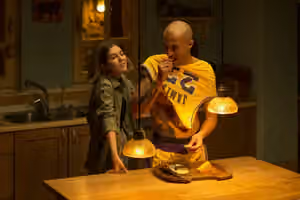
A scene from Bidad. Courtesy of the Karlovy Vary International Film Festival.
An Iranian film made in defiance of the censors reached YouTube last week, and the argument it started was not the one its makers might have expected: many viewers are asking not whether Bidad goes too far, but whether it goes far enough for the country it depicts.
For some viewers, Soheil Beiraghi's fourth feature puts a recognizable Iran on screen for the first time in years: women without mandatory hijab, men and women embracing, underground music, and a young singer who refuses to accept that her voice cannot be heard.
Others reached almost the opposite conclusion, arguing that the film trails the society it means to portray, or that its accumulation of drugs, alcohol, sex and broken relationships pulls focus from what Iranians are actually living through.
"I watched the film. The story is deeply moving, and it reflects what we are living through as a society," one user wrote on Iran International's Instagram page, praising its defiance of taboos while criticizing some of its dialogue and pacing.
Another called it simply "behind society," arguing that Iranians now have "much, much more serious" concerns than the ones on screen.
The split has turned a film into an argument about something larger than cinema: the widening distance between what Iran's censors forbid, what filmmakers can now show by ignoring them, and what audiences already consider ordinary life.
A scene from Bidad. Courtesy of the Karlovy Vary International Film Festival.
When the street becomes the stage
Bidad follows Seti, played by Sarvin Zabetian, an aspiring singer whose ambitions collide with the restrictions on women's voices.
"You can't hear my voice," she protests to a music teacher early in the film, and is told that female singers may not be louder than the men accompanying them.
Seti refuses the compromise. She ends up singing in the street, where passers-by film her and circulate the clips, turning her into an emblem of a generation increasingly willing to take in public what official institutions withhold.
Making the film carried a price. Security agents raided the production office and seized equipment and recorded material, and Beiraghi and several cast and crew members faced prosecution.
The director received a prison sentence later converted into a fine; Zabetian and Leili Rashidi, who plays Seti's mother, were also sentenced, while other defendants were acquitted.
The film went on to win the Special Jury Prize at the Karlovy Vary International Film Festival before its release online.
Have the taboos already changed?
For some Iranian viewers, the value of Bidad lies in showing what approved cinema has never managed to.
"Just the fact that they weren't wearing scarves or headscarves at home was very good," one Instagram commenter wrote, describing the film as all the more bitter for being drawn from life. Another called it the "reality of our lives as women" in Iran.
Others questioned whether those images still transgress anything. One wrote that the film addresses concerns belonging to an earlier phase of Iranian society and has failed to keep pace with what people now demand.
Mohammad Abdi, a writer and film critic, places Bidad within Iran's underground cinema but argues that Beiraghi has gone further than his peers by abandoning the compromises censorship imposes.
"The important point is that, when it comes to the government, the film stops compromising and speaks very directly about a generation that is tired and is taking its demands to the street," Abdi told Iran International.
He rejected suggestions by some commenters that the film reflects a reformist outlook, pointing to Seti's journey from negotiating within the rules to carrying her demand into the open.
"The film is actually about moving beyond reformism," Abdi said. "She goes through all these tests until she finally concludes that reformism no longer has meaning and that she has to stand against the regime in the street."
A scene from Bidad. Courtesy of the Karlovy Vary International Film Festival.
A harsher line of criticism concerns how the film draws those who break the rules. One commenter objected to the prominence of alcohol, marijuana, sex and dysfunctional relationships, warning that such choices risk tying musicians and dissenters to social disorder in viewers' minds.
The Hollywood Reporter read the same world differently, describing a film populated by "rebels and outcasts" and arguing that Seti is far from alone in it: the picture follows one singer, but its wider significance lies in placing her among a growing number of young Iranians pushing back against limits on personal expression.
A related complaint appeared on X, where one user praised the film for its recognizable picture of Iranian life but wrote that it tries to carry too many injustices at once. Sexual harassment, a subplot in which Seti's mother is coerced into sex with an interrogator to secure her detained daughter's release, and Seti getting her period in custody were all unnecessary, the commenter argued.
That debate captures the unusual bind Bidad finds itself in: escaping censorship let it cross lines that approved cinema cannot, but crossing them no longer looks radical to audiences whose own lives changed faster than the rules did.
A scene from Bidad. Courtesy of the Karlovy Vary International Film Festival.
Two generations meet
The same divide runs inside the film, through Seti's relationship with a nameless older man played by Amir Jadidi, who asks to be called only "Bebin," or "Look."
Tattooed, frequently high and seemingly emptied of his old ideals, he stands against Seti's determination to force her way into public life, Abdi said.
Their intimate but unconventional relationship becomes an encounter between two generations: one carrying the weight of disillusionment, the other unwilling to accommodate restrictions.
The film's singing voice ties the fiction to the present. Its vocal tracks feature Parastoo Ahmadi, who has faced prosecution for performing without mandatory hijab.
In June, a court in Qom sentenced Ahmadi and eight musicians and crew members to 74 lashes each, a two-year ban on artistic work and a two-year travel ban over her 2024 Caravanserai Concert.
Bidad was made outside official channels because the Iran it shows cannot exist within the rules of approved cinema. Its reception online has exposed a second gap: some viewers celebrate the sight of those rules being broken, while others ask why the screen is still catching up with a society that broke them first.