• العربية
  • فارسی
Brand
  • Iran Insight
  • Politics
  • Economy
  • Analysis
  • Special Report
  • Opinion
  • Podcast
  • Live TV
  • Iran Insight
  • Politics
  • Economy
  • Analysis
  • Special Report
  • Opinion
  • Podcast
  • Live TV
  • Theme
  • Language
    • العربية
    • فارسی
  • Iran Insight
  • Politics
  • Economy
  • Analysis
  • Special Report
  • Opinion
  • Podcast
  • Live TV
All rights reserved for Volant Media UK Limited
volant media logo

Rosatom ties could enable Iran to build nuclear power plants, official says

Aug 20, 2026, 08:34 GMT+1

Expanded cooperation with Russia’s Rosatom could enable Iran to build nuclear power plants rather than merely purchase nuclear technology, a board member of the Iran-Russia Joint Chamber of Commerce, said on Thursday.

“Expanding cooperation with Rosatom could transform Iran from a buyer of technology into a builder of nuclear power plants,” Reza Rafiei said.

He also said Russian contractors had resumed work on the second and third phases of Iran’s Bushehr nuclear power plant.

Most Viewed

Ghalibaf's hunger warning sparks hardline backlash over showing weakness
1
INSIGHT

Ghalibaf's hunger warning sparks hardline backlash over showing weakness

2

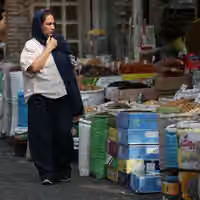
With the war quieting, Iran's hijab crackdown gathers pace again

3
ANALYSIS

Turkey’s gas pivot leaves Iran with fewer cards to play

4

Iran leaders sound economic alarms under Trump’s Economic D-Day

5

Trans woman prisoner says she was raped in Iran Intelligence Ministry detention

Banner
Banner
Banner

Spotlight

  • Ghalibaf's hunger warning sparks hardline backlash over showing weakness
    INSIGHT

    Ghalibaf's hunger warning sparks hardline backlash over showing weakness

  • Iran crude loadings plunge to one-seventh of pre-war level as blockade bites
    ANALYSIS

    Iran crude loadings plunge to one-seventh of pre-war level as blockade bites

  • Turkey’s gas pivot leaves Iran with fewer cards to play
    ANALYSIS

    Turkey’s gas pivot leaves Iran with fewer cards to play

  • Can Iran's fragile economy survive Trump's 'Economic D-Day'?
    ANALYSIS

    Can Iran's fragile economy survive Trump's 'Economic D-Day'?

  • The unlikely return of European diplomacy in the Iran-US conflict
    ANALYSIS

    The unlikely return of European diplomacy in the Iran-US conflict

  • For Iranian journalists, exile can last a lifetime
    OPINION

    For Iranian journalists, exile can last a lifetime

•
•
•

More Stories

Iran executes fifth defendant over January protests in Isfahan

Aug 20, 2026, 07:20 GMT+1
100%

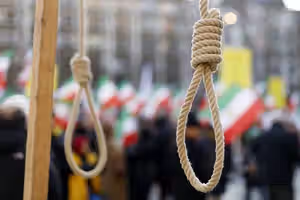
Iran executed Ghaem Hosseini, also known as Arian, on Thursday over his involvement in protests in the central city of Isfahan in January, making him the fifth person put to death in a case in which UN experts have raised concerns about the defendants' trials.

Iran's judiciary described Hosseini as a foreign national but did not say which country he was from. A source familiar with the case told Iran International earlier his month that Hosseini was a cousin of Golmohammad Mohammadi, an Afghan national who was previously executed in the same case, indicating Hosseini may also have been Afghan.

The judiciary's media center said Hosseini was executed on Thursday morning after his death sentence was upheld by the Supreme Court. It said he had been convicted of charges including moharebeh, or "waging war against God," and corruption on earth, as well as destruction of property and collusion to act against national security.

  • Iran executes two protesters amid heavy security in Isfahan

    Iran executes two protesters amid heavy security in Isfahan

Fifth execution in Ali-Khani Square case

Twelve people were sentenced to death in the Ali-Khani Square case, which stems from protests in Isfahan on January 8.

Iranian authorities executed Golmohammad Mohammadi and Erfan Esfandiari on July 19, followed by Amirhossein Safari and Abolfazl Sepahi on July 28. Hosseini's execution on Thursday brings the number of defendants put to death in the case to five.

Safari and Sepahi were hanged after an execution scaffold was erected at Ali-Khani Square, the site of the January protests. People gathered near the square overnight amid a heavy deployment of security forces and fears of imminent executions.

Iranian authorities have accused the defendants of involvement in the deaths of four security personnel, as well as arson and vandalism during the protests.

  • Iran executes 20-year-old protester as fears grow for other detainees

    Iran executes 20-year-old protester as fears grow for other detainees

Judiciary says Hosseini took part in violence

Iranian authorities said Hosseini was involved in unrest at Isfahan's Ali-Khani Square on January 8, where four members of the security forces were killed.

The judiciary said Hosseini admitted being present during the unrest and carrying a bladed weapon. It said he wore a jacket, hat and mask and switched off his mobile phone to avoid being identified or tracked.

The judiciary also accused Hosseini of taking part in the burning of the Amir al-Momenin mosque in Isfahan's Malekshahr district on the same night.

The authorities said Hosseini was convicted of drawing a weapon and "creating fear and terror," causing widespread insecurity, acting against national security, destroying public property and colluding to act against national security.

The judiciary said the Supreme Court reviewed Hosseini's appeal and upheld the death sentence before it was carried out on Thursday.

  • Iran executed at least 56 people since March, UN rights chief says

    Iran executed at least 56 people since March, UN rights chief says

UN experts questioned fairness of trials

Before the July 28 executions, UN human rights experts urged Iranian authorities to halt the executions of the remaining defendants in the Ali-Khani Square case.

"Sentencing 12 people to death in one hearing, in a closed courtroom and without clarity as to each defendant's individual responsibility violates established fair trial standards," the experts said.

The experts, led by Mai Sato, the UN Special Rapporteur on the situation of human rights in Iran, said the defendants, ranging from their late teens to their early twenties, had reportedly faced arbitrary detention, enforced disappearance and, in some cases, ill-treatment.

They also raised concerns that convictions relied heavily on confessions broadcast on Iranian state television, while Revolutionary Court hearings were held behind closed doors and the judgments were not made public.

Other rights groups have also raised concerns over access to independent lawyers and court files in the case.

  • Executions in Isfahan renew calls to end German city partnership

    Executions in Isfahan renew calls to end German city partnership

Executions rise after January protests

Hosseini's execution comes amid a broader rise in the use of the death penalty for national security-related offenses following Iran's January protests.

UN human rights chief Volker Türk said on August 5 that Iran had executed at least 56 people on national security-related charges since March 19, including 27 in cases linked to protests earlier this year.

Türk said more than 100 other people faced similar charges and the possibility of the death penalty. He urged Iranian authorities to halt executions and move toward abolishing capital punishment.

Trump says Hormuz open as reports point to weaker Iran control

Aug 19, 2026, 22:05 GMT+1
100%
President Donald Trump speaks by phone with freed American Robert Gilman at the White House on August 11, in a photo released by the White House on X.

President Donald Trump said Wednesday the Strait of Hormuz was open and the US blockade of Iran had been “100% successful,” as media reports indicated Tehran had lost significant control over traffic through the waterway.

More than 80% of liquid cargo transits through the strait over the past two weeks either used the Omani route or traveled with transponders switched off and likely followed that path, CNN reported, citing Kpler, which tracks ships using transponder and satellite data.

The US military is meanwhile quietly operating a shipping corridor along the Omani side of the strait that is helping move about 10 million barrels of oil a day, Axios reported, citing two US officials.

“It increasingly looks like Iran has at least partially lost control of the strait,” Homayoun Falakshahi, Kpler’s head of crude oil analysis, told CNN.

US organizes traffic along Oman

The US operation has been underway for several weeks, with 15 to 20 tankers entering and leaving the strait each night through a southern channel along Oman’s coast, the two US officials told Axios.

The effort goes beyond moving outbound oil shipments. The US military is helping empty tankers enter the Persian Gulf from the Arabian Sea, travel to ports in the UAE, Bahrain and Kuwait to load oil and then exit through the strait, according to Axios.

A task force run from the US Army’s 82nd Airborne Division headquarters at Fort Bragg coordinates daily inbound and outbound traffic with regional Gulf partners, Axios reported. US fighter jets patrol above the route to intercept Iranian cruise missiles and drones.

“We have been controlling the southern lane of the Strait of Hormuz for two months now. The Islamic Revolutionary Guard Corps can be a nuisance, but they don't control the strait. We do,” a US official with direct knowledge of the operation told Axios.

The growing use of the Omani route has also reduced Iran’s ability to collect tolls from vessels passing through the strait as it did earlier in the war, according to Kpler.

Ali Gholhaki, a political activist close to Iranian parliament speaker and top negotiator Mohammad Bagher Ghalibaf, said in a post on X that the United States had used specialized vessels to clear sharp rocks along the southern, Omani side of the Strait of Hormuz to facilitate traffic through the corridor.

“The quiet transfer of oil by the United States through the southern Strait of Hormuz will reduce the strait’s leverage,” he wrote, adding that if the arrangement continued, Washington would have little incentive to lift its blockade, ease sanctions or release frozen funds.

Trump says blockade is working

Trump said Wednesday the strait remained open and described the US naval blockade of Iran as “100% successful.”

“Right now, the Strait is open. A lot of boats are coming through,” Trump told reporters at the White House.

“The blockade has been 100% successful. No boats have gotten into Iran, but they are getting in for other places,” he said.

US Central Command said Wednesday that US forces had redirected 65 commercial vessels, disabled three and boarded two as part of enforcement of the blockade against Iran.

Iran has nevertheless continued attacking vessels using the waterway, according to CNN. The continued attacks leave control of the strait contested even as recent shipping patterns indicate Tehran has less ability to dictate traffic than it did earlier in the war.

Washington weighs further pressure

The erosion of Iran’s leverage in the Strait of Hormuz comes as Washington considers tightening economic pressure on Tehran further.

Trump said Wednesday the United States was weighing additional sanctions on Iran.

“We have things that we could sanction. We have very draconian sanctions, and we’ll see what happens,” he told reporters.

Treasury Secretary Scott Bessent also signaled tougher measures last week, telling Newsmax that Washington would apply measures against Iran that had “never been seen” in the economic isolation of a country.

Trump also argued that Hormuz could become less important to global energy markets as countries turn to alternative oil supplies and new pipelines.

“People have found other alternatives, which they never thought about: Texas, Alaska, Louisiana, and other places,” he said.

“So I think the Hormuz Strait is not going to be quite as important as it was in the past,” Trump added.

Trump also said Wednesday that Iran could not be allowed to obtain a nuclear weapon.

“Iran cannot have a nuclear weapon. You know why? Because they would use it. We are not gonna let them use it,” he said.

For now, the growing use of the Oman-side route and the US-organized corridor point to a significant erosion of Iran’s leverage over Hormuz, while continued Iranian attacks show that control of the strategic waterway remains contested.

Iran campaign urges people to fund sacrifice of 10,000 sheep for Khamenei’s health

Aug 19, 2026, 20:56 GMT+1
100%
An Islamic Republic supporter holds a picture of Supreme Leader Mojtaba Khamenei

A campaign by pro-establishment religious groups in Iran is asking people to help fund the ritual slaughter of 10,000 sheep as a religious offering for Supreme Leader Mojtaba Khamenei’s health, with each animal priced at 250 million rials, or about $132.

The campaign says it is being carried out with the participation of Heyat-e Gharar, a religious group active on the Iranian messaging platform Eitaa. Donations are being collected through accounts belonging to the Qom-based Hazrat Khadijeh Institute, a religious charity that organizes collective animal sacrifices and meat distribution.

The campaign website describes the initiative as a nazr, a religious vow or offering made for a particular purpose. In this case, it takes the form of qorbani, the ritual slaughter of an animal as an act of religious devotion dedicated to Khamenei’s health.

Donors can cover the full 250 million-rial cost of a sheep, about $132, or contribute smaller amounts collectively. At the advertised price, 10,000 sheep would cost 2.5 trillion rials, or about $1.32 million.

Abdolkarim Abedini, a former representative of the Supreme Leader in Qazvin province and former Friday Prayer leader of Qazvin, has also urged people to participate. In a video, he called for 10,000 sheep to be sacrificed for Khamenei’s health and to ward off what he called the “Zionist-American enemy,” urging people to “hurry” to take part.

Locals question campaign amid economic hardship

The campaign has drawn criticism from Iranians who told Iran International they questioned why the public should fund it amid severe economic pressure and high food prices.

“Why would I sacrifice a sheep for Mojtaba when I haven’t been able to afford lamb myself for years?” one person wrote to Iran International.

A Tehran resident said they had received a text message about the campaign several days earlier.

“A few days ago, we received a text saying they were collecting an offering for the Leader’s health and that we should send money for 10,000 sheep,” the resident told Iran International. “Why should the money come from the people?”

The campaign comes amid continued uncertainty over Khamenei’s health and whereabouts. He was reportedly seriously injured in the Feb. 28 US-Israeli strike that killed his father and predecessor, Ali Khamenei, and has not appeared in public since becoming Supreme Leader.

Khamenei has not delivered a public speech or interview since taking office, and no new authenticated photograph, video or audio recording of him has been released. His public communications have instead consisted of written statements attributed to him.

The unlikely return of European diplomacy in the Iran-US conflict

Aug 19, 2026, 17:00 GMT+1
•
Clément Therme
100%
US Secretary of State Marco Rubio meets Greek Foreign Minister Giorgos Gerapetritis in Washington, March 1, 2025. (Marco Rubio/X)

For years, diplomacy between Iran and the United States has largely been conducted through a familiar group of intermediaries.

Oman has traditionally provided the most discreet and trusted channel, while Qatar, Pakistan and Turkey have used their relations with both sides to facilitate contacts or transmit messages.

Yet the continuing deadlock in negotiations has now encouraged Washington to widen the diplomatic circle.

In recent days, Austria and Greece have separately opened contacts with Tehran after consultations with US Secretary of State Marco Rubio, according to media reports.

The unexpected involvement of Austria and Greece suggests that European diplomacy, long marginalized in the Iran-US relationship, may be making a cautious return in the context of a regional military escalation.

The sequence of recent contacts is striking. US Secretary of State Marco Rubio met Austrian Foreign Minister Beate Meinl-Reisinger in Washington on August 11 and spoke by telephone with Greek Foreign Minister George Gerapetritis the following day. On August 13, both European ministers held separate conversations with Iranian Foreign Minister Abbas Araghchi. Although the US State Department denied asking them to transmit messages, the timing was probably not coincidental. The State Department subsequently confirmed that Iran had been discussed, while Austria formally offered Vienna as a venue for potential future talks. Greece emphasized freedom of navigation and maritime security in its exchanges with Tehran.

This is not yet formal mediation. Neither Austria nor Greece has the experience, access or accumulated trust that Oman possesses. Their involvement should instead be understood as an exploratory attempt to identify additional channels at a moment when traditional diplomacy is struggling. The proliferation of intermediaries itself is revealing: it demonstrates not the vitality of the diplomatic process, but its fragmentation.

Austria’s possible role is rooted in diplomatic history. Vienna hosted negotiations that culminated in the July 14, 2015 nuclear agreement, formally known as the Joint Comprehensive Plan of Action (JCPOA). It is also home to the International Atomic Energy Agency, which would likely play a central role in verifying any future settlement concerning Iranian nuclear activities. Austria can therefore offer more than a neutral meeting room. It provides an institutional environment closely associated with nuclear diplomacy, technical verification and the memory of an agreement that once appeared capable of containing the Iranian nuclear crisis.

Vienna nevertheless carries contradictory symbolism. For Iranian officials, it recalls the JCPOA’s acceptance of limited Iranian enrichment for civilian purposes and the partial lifting of sanctions. But it also evokes the subsequent collapse of the agreement after the first Trump administration withdrew from it in 2018. Austria cannot repair that breach of confidence on its own. Its principal advantage is therefore procedural rather than political: it can provide a discreet and credible setting in which the United States, Iran and the IAEA might clarify their positions.

Greece brings a different form of leverage. As one of the world’s leading maritime nations, it has direct interests in the security of the Strait of Hormuz and the Red Sea. The disruption of navigation through Hormuz is not an abstract geopolitical problem for Athens. It affects Greek-owned shipping, insurance costs, energy prices and the stability of international trade. Greece can consequently address Iran not only as a European Union member and US ally, but also as the representative of an industry directly exposed to the consequences of escalation.

This maritime dimension may make Athens useful in discussions focused on practical arrangements rather than an immediate comprehensive agreement. Measures guaranteeing freedom of navigation, reducing threats against commercial vessels or creating communication mechanisms to prevent incidents at sea could be easier to negotiate than the most divisive nuclear and security questions. Greece could contribute technical knowledge and political advocacy to such discussions, although it lacks the capacity to provide Iran with the sanctions relief or security guarantees Tehran ultimately seeks.

The emergence of Austria and Greece also exposes the decline of the traditional European powers in the Iranian diplomatic arena. France, Germany and the United Kingdom were central to the nuclear negotiations that began in the early 2000s. Since then, however, the credibility of the European trio has deteriorated in Tehran and the three countries are facing bilateral diplomatic crises in their relations with Tehran. Iranian leaders accuse them of failing to protect the economic benefits of the nuclear agreement after the American withdrawal and of increasingly aligning themselves with Washington’s coercive approach. The mutual distrust generated by sanctions, mutual accusations of security “infiltration” and spying, regional conflict and disputes over Iran’s nuclear activities has left little space for the earlier model of European mediation.

This marginalization is being reinforced by the widening security confrontation. The Financial Times reported Wednesday that Iran had considered attacking US military targets in Europe, including in Bulgaria and Cyprus, if Washington further escalated the war.

Reuters reported Wednesday that a NATO official said the alliance was prepared to address any threat and take necessary action to defend its members. The official cited four occasions earlier this year when NATO air defenses intercepted Iranian ballistic missiles heading toward Turkey, saying they demonstrated the strength and effectiveness of NATO’s deterrence and defense posture.

Smaller European countries may therefore benefit from carrying less political baggage. Austria is associated more closely with dialogue than with strategic pressure and maintained substantial economic and energy ties with the Islamic Republic throughout the 1990s and 2000s. Greece, for its part, has generally remained outside the most confrontational debates over Iran. Yet their relative neutrality should not be overstated. Both countries are members of the European Union and close partners of the United States. Tehran will ultimately judge their usefulness by their ability to secure concrete concessions from Washington, not by the cordiality of their diplomatic rhetoric.

Their involvement also reflects the widening international cost of the conflict. The restriction of traffic through Hormuz, a corridor through which roughly one-fifth of global oil consumption normally passes, has transformed the crisis from a bilateral confrontation into a global economic emergency. Washington wants the strait reopened, while Tehran sees control over navigation as one of its most powerful remaining sources of leverage. Austria and Greece are entering the process because the consequences of failure now extend far beyond the Middle East.

The immediate objective should therefore be modest. Vienna and Athens are unlikely to replace Muscat, Doha or Islamabad, and multiplying intermediaries can produce contradictory messages and allow both Iran and the United States to avoid making difficult decisions. Their most useful contribution would be to support a coordinated diplomatic framework: Austria concentrating on nuclear verification and the venue for talks, Greece on maritime security, and traditional regional mediators on political communication and guarantees. Ultimately, no mediator can compensate for a lack of political will to pursue a diplomatic solution rather than military escalation. Austria and Greece cannot make that choice on behalf of Washington and Tehran, but they may help create the conditions in which diplomacy becomes possible.

Their return is therefore neither a diplomatic breakthrough nor an irrelevant gesture. It reflects an increasingly marginalized Europe urgently seeking new ways around a dangerous impasse. If carefully coordinated, these unlikely European channels could help prepare the ground for renewed negotiations. Otherwise, they risk becoming yet another improvised attempt to contain a conflict that its principal actors have so far proved unable to resolve. Europe nevertheless has a strong interest in assuming a more active diplomatic role: European states are already bearing many of the conflict’s economic and security consequences, yet they possess neither the political leverage to shape a settlement nor the military capacity – and, in most cases, the willingness – to impose one.

Tehran gas stations run dry as fuel price hike fears mount

Aug 19, 2026, 16:09 GMT+1
100%
A general view of a gas station, Tehran, Iran.

Gas stations in parts of Tehran closed after running out of fuel Wednesday, while motorists elsewhere in the Iranian capital waited up to an hour to fill their tanks amid mounting fears of a fuel price hike, locals told Iran International.

“I went to three gas stations to fill up and all three were closed,” one Tehran resident told Iran International on Wednesday. “One of them had put up a banner saying, ‘We have no gasoline.’”

Another resident said: “Today I spent about an hour in line for gasoline. Many gas stations had no fuel.”

Another Tehran resident said the Interior Ministry had ordered traffic police to crack down on older cars and motorcycles and impound them.

“They have said these vehicles should remain in impound lots for a month so that fuel consumption can be reduced this way,” the resident said.

The accounts come as Iran faces mounting pressure on fuel supplies, with domestic production struggling to keep pace with demand as a US naval blockade on Iranian maritime traffic disrupts fuel imports that previously helped cover the country’s domestic shortfall.

Esmail Saqab Esfahani, head of Iran’s Energy Efficiency Organization, said Saturday that the country faced a daily gasoline shortfall of around 14 million to 15 million liters.

Hossein Samsami, a member of parliament’s Economic Committee, warned Monday that raising gasoline prices amid current economic pressures could trigger widespread unrest, likening it to “a spark in a powder keg.”

Iranian officials have grown increasingly concerned about the prospect of renewed protests, while seeking to cast public discontent as being fueled by foreign adversaries.

Parliament Speaker Mohammad-Bagher Ghalibaf said Tuesday that the enemy was seeking “riots, assassinations and separatist activities” and intended to “exploit” any potential dissatisfaction over gasoline.

Concerns over methanol-blended gasoline

Plans to blend methanol into gasoline have also raised concern among Iranians, with locals telling Iran International they were uneasy about the fuel’s safety and its potential impact on vehicles and public health.

The concerns come against a backdrop of longstanding questions over fuel quality in Iran and previous reports that authorities used non-standard chemical compounds to help offset gasoline shortages.

Vahid Ghanei-Fard, CEO of the Persian Gulf Star Refinery, Iran’s largest gasoline producer, said Tuesday that a pilot project to produce methanol-based gasoline had been successful, with methanol accounting for 3% of the blend.

He said the fuel met “national and international standards” and that the use of methanol had helped raise the refinery’s daily gasoline output to around 49 million liters.

Saadatollah Molavi, an Iran-based refinery expert and frequent energy commentator, told IMNA, an Isfahan municipality-affiliated news agency, that methanol could play a role in easing Iran’s fuel shortage.

But Molavi warned against treating it as a long-term solution without assessing costs, efficiency, gas consumption and infrastructure needs, suggesting the blend may offer only a temporary fix rather than a sustainable answer to Iran’s fuel deficit.

Last May, the London-based independent research group Iran Open Data reported in May 2025, citing a confidential Oil Ministry document, that authorities had used hazardous and contaminated chemical compounds outside the conventional refining process to increase gasoline supplies.

The report described the practice as widespread and systematic and said it was aimed at compensating for the country’s gasoline shortfall.

Concerns over the quality of Iran’s gasoline are longstanding. In January 2023, Dariush Golalizadeh, an official with the Department of Environment, said only 38% of gasoline produced in the country met Euro 4 and Euro 5 standards.