• العربية
  • فارسی
Brand
  • Iran Insight
  • Politics
  • Economy
  • Analysis
  • Special Report
  • Opinion
  • Podcast
  • Live TV
  • Iran Insight
  • Politics
  • Economy
  • Analysis
  • Special Report
  • Opinion
  • Podcast
  • Live TV
  • Theme
  • Language
    • العربية
    • فارسی
  • Iran Insight
  • Politics
  • Economy
  • Analysis
  • Special Report
  • Opinion
  • Podcast
  • Live TV
All rights reserved for Volant Media UK Limited
volant media logo

France to expel two Iranian diplomats over assault on French officials

Aug 18, 2026, 19:14 GMT+1Updated: 22:22 GMT+1

French Foreign Minister Jean-Noël Barrot said on Tuesday that two Iranian diplomats in France would be expelled in the coming days in response to what he described as the deliberate assault of two French diplomats on July 19.

“It is precisely because France stands alongside the Iranian people, supporting its artists, scientists and researchers, that two French diplomats were scandalously and deliberately assaulted on July 19,” Barrot wrote on X.

“I had announced that this intolerable act would have consequences. It has,” he added. “Two Iranian diplomats in France will be expelled in the coming days.”

Barrot also said the Iranian people were the “primary victims” of the current period of extreme tension in the Middle East, caught between what he called the “bloody repression” of the January 2026 protests and bombings.

Most Viewed

US rules out Iran truce extension as Tehran official sets new deadline
1

US rules out Iran truce extension as Tehran official sets new deadline

2

State TV host sparks backlash over ‘southern Iran for southern Lebanon’ remark

3
INSIGHT

Forced to serve in the IRGC, now fighting to stay in Canada

4
OPINION

For Iranian journalists, exile can last a lifetime

5
VOICES FROM IRAN

Seven months on, January protests still shape Iranians’ lives

Banner
Banner
Banner

Spotlight

  • For Iranian journalists, exile can last a lifetime
    OPINION

    For Iranian journalists, exile can last a lifetime

  • Seven months on, January protests still shape Iranians’ lives
    VOICES FROM IRAN

    Seven months on, January protests still shape Iranians’ lives

  • Forced to serve in the IRGC, now fighting to stay in Canada
    INSIGHT

    Forced to serve in the IRGC, now fighting to stay in Canada

  • Iran’s ‘infiltration’ bill sparks backlash over sweeping reach

    Iran’s ‘infiltration’ bill sparks backlash over sweeping reach

  • To survive maximum pressure, Iran kept pumping and broke its oil company
    ANALYSIS

    To survive maximum pressure, Iran kept pumping and broke its oil company

  • They carry the evidence of Iran’s crackdown on their bodies

    They carry the evidence of Iran’s crackdown on their bodies

•
•
•

More Stories

For Iranian journalists, exile can last a lifetime

Aug 18, 2026, 17:50 GMT+1
•
Niusha Saremi
100%
Farahnaz Espad

Journalists are not supposed to become the story. We are usually on the other side of it. Someone lives through an event and we write about it. Someone is gone and we report their passing. A crisis unfolds and we try to find the right words to tell its story.

But sometimes life reverses the roles. The narrator becomes the subject of the story.

Today, Farahnaz Espad, one of Iran International’s finest news anchors, died of cancer at the age of 37. Hearing the news, I found myself thinking of Reza Haghighatnejad, an editor at RFE/RL’s Radio Farda and one of Iran’s most accomplished political journalists, who also died of cancer in 2022.

Perhaps because I see a bitter similarity in their fates. Two Iranian journalists; two young, talented and hardworking people whose lives were deeply bound up with Iran — with its news, its people, their concern for what was happening to it, and their hope that perhaps tomorrow life for Iranians might be a little better than it is today.

Both developed cancer far from Iran, and both died far from home.

I remember Farahnaz for her calm. For a dignity that even illness could not take from her. There was an unassuming humility and kindness in the way she carried herself, the kind some people bring into every room without even trying. She was hopeful. She was calm.

She wanted to go back to work.

Perhaps “going back to work” sounds like a small wish. But for Farahnaz, work was not merely a job. She wanted to stand in front of the camera again, read the news from Iran, begin her day with Iran and end it with Iran. Illness had kept her away from the newsroom, but it had not severed the thread connecting her to her professional life.

Reza’s death a few years ago was a reminder of much the same thing.

Reza was one of those journalists for whom Iran was never merely the subject of his work. Iran was his abiding concern — something he read about, wrote about, researched and worried about. He lived in exile, but much of his mind and his work remained in the country where he could no longer continue his professional life.

Even after death, his fate remained bitter. Reza died of cancer in Berlin at the age of 45. His body was sent to Iran so he could be buried in the soil he came from. But security forces seized his body after it arrived, preventing his family from saying goodbye to him as they wished and from burying him in his hometown.

100%
Farahnaz Espad (Left) and Reza Haghighatnejad (Right)

Sometimes I think exile, for an Iranian journalist, is more than geographical distance.

One day, you begin working as a journalist in Tehran, Shiraz, Isfahan or another city, with the simple idea that you will write about the society in which you live. Then a day comes when, to continue doing that same work, you have to leave your country. Your desk moves. Your newsroom moves. The language spoken on the street you walk down every morning changes. Your home changes. Your friends scatter. Years pass.

But the subject of your work does not change.

It is still Iran.

You wake up in a city thousands of kilometers from Tehran, and the first thing you read is news from Iran. You spend your day immersed in the crises, protests, elections, prisons, hopes and disappointments of people you may not have seen in person for years. You talk about the future of a country when you yourself do not know when you will be able to return to it without fear.

It is a strange contradiction: sometimes you spend most of your years away from your homeland while devoting most of your professional life and your thoughts to that same homeland.

Farahnaz and Reza were like that. And I do not want to remember them only through their illness and death. Cancer was the final chapter of their lives; it was not the whole book.

What came before mattered more: curiosity, work, concern, hope, friendship, laughter, long hours in the newsroom, stories written and read, questions asked, and that essential belief every journalist carries — that knowing the truth, telling it and understanding it more deeply still matters.

But there is something in both their stories that I find deeply painful.

They were people who thought about Iran, worked on Iran and wanted a better life for the people of Iran. Yet they themselves were denied one of the most basic possibilities of an ordinary life: to live at “home,” to work there, to grow old there and one day, when the time came, to close their eyes in their own country, surrounded by family and memories.

That should not be something one has to wish for.

Staying in your homeland should not be a privilege.

Exile should not be the price of journalism.

No one should have to choose between their profession and their country simply for speaking and writing.

And perhaps that is why today, as I write the news of Farahnaz’s death, I am not grieving only the loss of a friend and colleague. I grieve for a generation of Iranian journalists who packed their bags, built homes in other cities, spoke about their homeland from distant studios and newsrooms, and spent years of their lives waiting for an Iran they might one day be able to return to freely.
Some of them never got to see that day.

Reza did not.

Neither did Farahnaz.

A journalist is meant to bear witness to history, not become a victim of geography. A journalist is supposed to tell the news, not have their illness or death in exile become a headline written by their colleagues.

But sometimes that is exactly what happens.

Today we read Farahnaz’s name in the news, just as we read Reza’s a few years ago. And behind those two names, for me, one simple wish remains:

That one day Iran will be a place where its journalists can stay; where they can ask questions, write, make mistakes, write again, live, grow old — and not be forced away from “home” to do the work they love.

A day when an Iranian journalist’s share of their homeland is more than having it as the subject of their stories.

Until that day, we are left with the memory of those who are gone — and with stories that, this time, contrary to our professional habit, we have to write about the storytellers themselves.

May the memory of Farahnaz Espad and Reza Haghighatnejad live on.

Seven months on, January protests still shape Iranians’ lives

Aug 18, 2026, 12:31 GMT+1
•
Farnoosh Faraji
100%
Crowds take part in anti-government protests in Tehran in January 2026.

Seven months after the January massacre, Iranians answering an Iran International call-out describe lives still bent around it: sleep and nerves that never recovered, friendships remade or broken, politics hardened, and a future they struggle to picture.

For many, life now divides in two: before January, and after. The same images return again and again in their accounts: the sound of gunfire, the people killed beside them, the friends and children who went out to protest and never came home.

“Time stopped for me after January 9,” one respondent wrote. “My life was divided into before and after the protests, and I never became the person I was before,” another said.

The responses vary widely. Some describe depression, recurring nightmares, anger and an inability to return to ordinary routines. Others say the experience made them more politically engaged and more determined to join future protests.

  • Iranians turn on Pezeshkian over protest death toll comments

    Iranians turn on Pezeshkian over protest death toll comments

Together, they offer a picture of an upheaval whose consequences for some participants and witnesses have extended from the streets into private life.

‘All those scenes keep playing like a film’

Descriptions of psychological distress were among the most frequent responses.

One person who said they witnessed young people being killed described recurring nightmares, depression, crying at night and a sense that there was no future.

“I can no longer walk with a good feeling on streets where blood was spilled or do the everyday things I used to do,” the respondent wrote.

Another described being unable to escape the memories.

“I could never return to normal life. All those scenes keep playing in front of my eyes like a film – those streets and the faces of people who were dying.”

For some, particular dates have themselves become reminders. One said seeing the numbers 8 and 9, corresponding to the dates of the protests, now causes their heart rate to rise.

Others described guilt over having survived.

“Every day, I have to answer to my conscience for breathing,” one person wrote.

The effects described went beyond grief. Some said their relationship with ordinary pleasures, familiar streets and even other people had changed.

  • 36,500 deaths in context: How Iran’s toll compares with wars and crackdowns

    36,500 deaths in context: How Iran’s toll compares with wars and crackdowns

“I don't make fun of young people anymore,” one wrote. “I realized that anyone, regardless of their job, style or appearance, can be a Kaveh the Blacksmith against Zahhak.”

The reference draws on two figures from Persian mythology: Kaveh, a blacksmith who leads a revolt, and Zahhak, a tyrannical ruler.

  • The three snakes of Zahhak

    The three snakes of Zahhak

Anger, but also determination

Anger repeatedly accompanied grief in the responses, with some saying executions, rising prices and what they see as continuing injustice had deepened rather than diminished it.

“At first I was very happy, then angry and hopeless, and then hopeful,” one wrote. “Now I am waiting and angry, with flames of suppressed anger; sometimes hopeless and sometimes hopeful. But we know we have to go to the end.”

Another wrote: “Those two nights ended, but a piece of me broke away and remained alone somewhere.”

Yet despair was not the only consequence described. Some said January had made them more willing to take risks and participate again.

  • Over 36,500 killed in Iran's deadliest massacre, documents reveal

    Over 36,500 killed in Iran's deadliest massacre, documents reveal

“I became braver and more determined to achieve freedom,” one person wrote.

“Other than some of my hair turning grey, the biggest change is that I have prepared myself to repay my debt with the next call,” another said, referring to a future call for protests.

For these respondents, the memories of January have become a reason to continue rather than withdraw.

Politics enters personal relationships

Some responses described a shift in political understanding, including greater attention to the Islamic Republic's institutions, propaganda and political currents.

“January made me understand the propaganda system of this regime and its operatives,” one person wrote. “My political knowledge increased greatly. I learned about left and right. I understood how I was being played and why this regime has lasted 47 years.”

Political divisions have also entered friendships and family relationships.

One described the biggest change simply as: “Cutting ties with fence-sitting relatives and friends!”

For some, the reaction of people around them to protesters being killed, the crackdown and arguments about Iran's political future became a new measure for deciding which relationships to maintain.

Others described the opposite effect: a stronger sense of connection with fellow Iranians.

100%
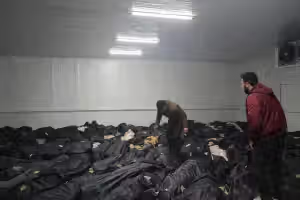
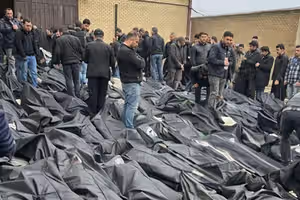
Bodies wrapped in blankets lie outside Alghadir Hospital in eastern Tehran following anti-government protests in January 2026.

“In one sentence, I am proud of my Iranian compatriots because on January 8 and 9 we stood together,” one wrote.

Another cited the “courage, strength and self-sacrifice of a nation” as one of the enduring impressions of the protests.

‘We are alone’

Several said January also changed their expectations of foreign powers and whether outside intervention could alter Iran's future.

“We are alone and should not hope for any power to save us or bring us freedom, except through our own efforts,” one person wrote.

For others, grief, anger and political determination now coexist rather than replacing one another.

  • They carry the evidence of Iran’s crackdown on their bodies

    They carry the evidence of Iran’s crackdown on their bodies

“The January protests changed something in me forever,” one respondent wrote. “Since that day, I have become angrier, more wounded and more depressed, but I have not been broken.”

For those who sent responses to Iran International, January remains more than a date marking a political confrontation. It has become a dividing line in their own lives – separating who they were before the protests from who they became afterward.

Leaked audio: Iran's Basij brace for new protests and fear being named online

Aug 18, 2026, 11:47 GMT+1
100%
File photo of an IRGC cyber unit at a computer operations center in Iran.

Officials of Iran's Basij militia can be heard on a leaked recording weighing the risk of a new round of protests and the danger that members will be identified online, a rare glimpse of the anxiety inside the force the state sends against demonstrators.

In the audio recording of a closed meeting of the Media and Cyberspace Headquarters in Pakdasht, Tehran province, officials discuss possible new demonstrations, the online identification of Basij members and plans to track anti-government activity and individuals on social media.

The meeting was held amid recent developments including the killing of Hamidreza Rajabzadeh, a Basij member and government-aligned religious singer, as well as growing concern among officials over the role and influence of social media.

The Media and Cyberspace Headquarters is made up of cyber personnel and government supporters operating under the supervision of the Revolutionary Guards.

The concerns raised at the meeting echoed recent remarks by Ebrahim Garmabdari, commander of the Revolutionary Guards in Pakdasht, who said government opponents were using sanctions, infiltration and social media to target the Islamic Republic’s governing structure.

Earlier this week, Iran’s supreme leader appointed Hossein Taeb, a veteran intelligence official, to lead the Basij paramilitary forces, giving the former protest crackdown figure a mandate to expand the paramilitary force’s grassroots intelligence network and use of new technologies.

Concerns over pressure on Basij members

Participants of the meeting raised concerns about mounting social and psychological pressure on government-aligned forces.

Referring to Rajabzadeh’s recent killing, the meeting’s lead speaker described the incident as a warning that pro-government figures could be targeted both offline and online.

He said the pressure was intended to make Basij members, mosque clerics and local base commanders regret or feel ashamed of their affiliation, potentially pushing them to adopt opposition views to avoid social rejection.

Earlier in the meeting, a participant identified as Mr. Shahbazi said the underlying tensions had not subsided and warned that public protests against the government and confrontation with security forces could continue.

Concerns over AI and exposure of Basij members

A significant part of the discussion focused on possible breaches of security systems and the exposure of Basij personnel.

The lead speaker warned that opposition networks could use artificial intelligence to identify Basij members from group photographs and obtain personal details about them for possible retaliation.

He also voiced distrust of participants’ mobile phones, suggesting that apps such as ChatGPT could be listening to their conversation in real time.

Social media blamed for unrest and economic problems

The discussion also turned to social media, with the speaker criticizing filtering policies while also blaming the internet and platforms such as Instagram for a range of political, social and economic problems.

He said blocking Instagram, Telegram and WhatsApp had only increased public anger, but described online platforms as a major factor behind unrest, rising prices, cultural change and even the election of relatively moderate Masoud Pezeshkian.

He also said foreign intelligence services including Mossad were exploiting economic hardship to recruit young people and obtain information through online platforms by offering incentives such as free internet access, servers and VPN configurations.

A 2025 survey by the Iranian Parliament Research Center indicates that the vast majority of Iranians (81%) rely on VPNs to bypass internet censorship.

Order to monitor anti-government activity

The meeting also included what participants described as a “top secret” directive instructing cyber personnel to monitor platforms including Instagram and document protest-related and anti-government activity by residents of Pakdasht.

The meeting leader said the monitoring should apply without exception, instructing personnel to take screenshots even when close relatives posted protest-related content.

He told them to send the screenshots through the Iranian messaging app Eitaa along with identifying information including the person’s father’s name, national ID number, phone number and workplace address so action could be taken against them.

Warning of protests over fuel prices

Toward the end of the meeting, a Pakdasht IRGC cyber official warned of the possibility of widespread and violent protests in the near future, including over increases in fuel prices.

He said that in the “next unrest,” even people who did not own vehicles could take to the streets because of accumulated anger and attack targets including banks, fire trucks, ambulances and, in particular, Basij members.

Forced to serve in the IRGC, now fighting to stay in Canada

Aug 18, 2026, 10:31 GMT+1
•
Negar Mojtahedi
100%
A conscript sitting on a metal bench at a train station in Iran

Iranian men conscripted into the Revolutionary Guards for their compulsory military service fear they and their families could lose the right to remain in Canada, after letters warned the mandatory stint may amount to membership in a terrorist organization.

The Unheard Conscript Advocacy Network, a community group for former Iranian conscripts and their families, says more than 500 people within its roughly 1,300-member Telegram group have reported receiving procedural fairness letters in recent weeks.

The letters give applicants 30 days to respond to concerns raised by immigration officers before a decision is made.

Canada has previously told Iran International that compulsory service in the Guards does not automatically make someone inadmissible and that applications are assessed individually. But several letters reviewed by Iran International reveal a tension between that position and what former conscripts say they are experiencing.

In one case, internal Officer Decision Notes reviewed by Iran International show a former conscript answering a procedural fairness letter with his military completion card and evidence that his service was compulsory.

The officer accepted that the service was mandatory and found him inadmissible anyway, writing that there is "no exemption for individuals whose membership arose through mandatory service." The application was refused.

In a separate case, an August 6 letter acknowledges that the applicant completed "mandatory military service" with the Guards as a soldier between 2009 and 2010, with duties that included kitchen and canteen work and occasional driving.

"I am therefore concerned that you served in the IRGC and that you may be inadmissible to Canada," the officer wrote, citing the provision of Canadian immigration law covering membership in an organization believed to engage in terrorism. The applicant was given 30 days to respond.

The consequences can reach beyond the former conscript. In another letter reviewed by Iran International, the government told the wife of one man that her application could also be refused if her husband is found inadmissible over his service.

‘Now we are the victims’

"Fatima," who asked Iran International to use only her first name because of security concerns, moved to Canada with her husband and two daughters in 2022.

Her husband completed compulsory military service between 2003 and 2005. The family applied for permanent residence in March 2024, before Canada designated the entire Revolutionary Guards a terrorist entity.

"We brought our children here to give them more opportunity, to give them a better life," Fatima told Iran International. "How come we were supporters of this regulation and now we are the victims of that?"

Iran International reviewed the family's immigration correspondence along with official documentation confirming the husband's service.

A document issued by Iran's Public Conscription Organization states that he completed 20 months of compulsory service and received a military service completion card; the family later obtained further verification of the record's authenticity from the same body.

Fatima said her husband, who holds a bachelor's degree in computer science, spent his conscription assigned to a small repair room fixing personal computers that personnel brought in. "He wasn't doing anything for the organization," she said. "People brought their computers there if there was an issue."

The stakes run through the whole family. If her husband is found inadmissible, so are their daughters, one of whom is 18 and has been accepted into a program at the University of British Columbia.

"If IRCC refuses our PR application because of my husband's conscription, and if we are inadmissible to Canada, then both my daughters are going to be inadmissible too," Fatima said.

Sam, a member of the Unheard Conscript Advocacy Network, said the 500-plus letters documented inside the group are likely a fraction of the national total. The group argues that former conscripts are effectively being asked to prove a negative: that compulsory service did not amount to voluntary membership in the Guards.

  • Conscripted, condemned: how a Canadian ban punishes Iran's forced recruits

    Conscripted, condemned: how a Canadian ban punishes Iran's forced recruits

Canada was warned about the distinction

Canada's own immigration system has examined the difference between conscription and membership.

In a 2022 Response to Information Request on Iran's armed forces, the Immigration and Refugee Board cited Saeid Golkar, a scholar specializing in the Guards and the Basij, who explained that men subject to compulsory service apply through the Public Conscription Organization, which assigns them to the regular army, the police or the Guards.

Sources consulted by the board indicated conscripts do not choose the branch in which they serve. Golkar has also argued that conscription should not provide a blanket exemption from scrutiny.

The distinction was raised in Parliament days before Canada listed the Guards. Appearing before the House of Commons foreign affairs committee on June 10, 2024, University of Ottawa professor Thomas Juneau warned that broad measures could sweep up people who were never the target.

"There are hundreds of thousands of current and former members," Juneau told MPs, warning that "innocents" could be caught in the net. He argued for "targeted" and "surgical" measures while stressing that genuine Guards activity in Canada posed a serious threat.

Nine days later, on June 19, 2024, Canada formally listed the Revolutionary Guards as a terrorist entity under the Criminal Code. Iran International has previously reported on former conscripts whose immigration cases became uncertain after the designation.

Political pressure grows

Correspondence obtained by the advocacy network this year deepens the confusion over how Ottawa applies the policy.

In a February letter, Aaron McCrorie, vice-president of the Canada Border Services Agency's intelligence and enforcement branch, wrote that the 2024 designation made "anyone that had served in the Guard Corps inadmissible to Canada." The same letter says all cases are "reviewed, assessed, and decided on an individual basis." The two sentences describe two different policies.

Iran International asked Immigration, Refugees and Citizenship Canada what standard officers use to distinguish compulsory service from voluntary membership, whether uniform national guidance exists, how many former conscripts have received procedural fairness letters, and how many have been found inadmissible.

IRCC spokesperson Anahita Beladi said compulsory service in the Guards does not automatically make an applicant inadmissible and that each case is assessed individually. Procedural fairness letters, she said, are not final findings but a chance for applicants to explain their service.

"The final decision is made by an IRCC officer after considering the applicant's response, all relevant information, applicable jurisprudence, and any recommendations made by partners, including the Canada Border Services Agency and Canadian Security Intelligence Service."

Beladi said the agency does not currently hold data in a form that would show how many applicants completed compulsory service in the Guards, or how many letters have been issued over it.

The issue has now spilled into federal politics.

At an Iranian community town hall in North Vancouver, British Columbia, on Saturday, Conservative Leader Pierre Poilievre accused the government of risking action against the wrong people.

"I think they're risking going after law-abiding decent people who are actually against the IRGCs, but who have already been victimized through conscription," Poilievre told Iran International.

"The listing of terrorist organizations was meant to go after the perpetrator, not the victim. I would encourage the government to go after the actual terrorists, not their victims."

Conservative candidate Stephen Curran said Parliament should challenge the practice if conscripts are being swept into enforcement.

"They are targeting people that are innocent... victims of the regime in Tehran," Curran said. "If this is actually taking place, I think we would have to raise a very strong critique of it in Parliament and make sure that we're calling it out."

For Fatima, the policy debate is no longer abstract. Her family, she said, publicly supported Canada's designation of the Guards and joined demonstrations against the Islamic Republic.

"We supported that policy, IRGC as a terrorist organization," she said. "Now we are the victim of that."
Iran’s ‘infiltration’ bill sparks backlash over sweeping reach

Aug 18, 2026, 04:44 GMT+1
•
Maryam Sinaiee
100%

A bill before Iran’s parliament that would impose new restrictions on contacts with foreign media, universities and organizations has drawn widespread objections over its potential impact on routine academic, cultural and civil-society activity.

Lawmakers approved the bill’s general principles Sunday by 183 votes to four, with five abstentions among 258 members present. Its individual provisions must still be considered and approved separately.

The latest publicly available draft contains 19 articles, although references during Sunday’s parliamentary debate to Articles 26 and 27 indicate that lawmakers may be considering a revised text.

Bill targets broader forms of foreign influence

Supporters say a new law is needed because existing legislation focuses primarily on espionage, while foreign infiltration can take broader forms.

Hassan Ghashghavi, spokesman for parliament’s National Security and Foreign Policy Committee, said Iran already had laws covering espionage but faced a legal gap on infiltration.

Ghashghavi said work on the proposal began before the 12-day war and that relevant state bodies had participated in reviewing it.

The published draft gives the Intelligence Ministry and the Revolutionary Guards’ Intelligence Organization roles in identifying prohibited foreign links and activities. Cases under the proposed legislation would be heard by Revolutionary Courts.

Proposed penalties include prison terms, deprivation of social rights, dissolution of legal entities and confiscation of assets.

The reformist newspaper Sazandegi wrote that the proposal “not only fails to provide a proper definition of infiltration, but is also a warning sign of intensified censorship, greater restrictions and a widening social divide in the country.”

The newspaper questioned why legislation intended to counter foreign infiltration extended to scientific, media, cultural and civic activity rather than concentrating on breaches within sensitive state institutions.

Sociologist Mohammad Rahbari wrote that if the bill is approved in its reported form, “it would be as if parliament had shot itself in the foot,” arguing that the proposed offenses are defined so broadly that even parliament’s own research center could fall within their scope.

Social media activist Hossein Ghatib wrote that “the path to combating infiltration is not to take revenge on society,” arguing that shortcomings in official security structures should not result in restrictions on “university professors, journalists, artists, researchers, students and ordinary citizens.”

Foreign media and embassy contacts

Article 6 of the published draft would prohibit interviews, participation in discussions or “any communication” with media designated as hostile, including US and Israeli outlets and media funded by either country.

Violations would carry a sixth-degree prison sentence, which under Iran’s penal code ranges from more than six months to two years. Parliament has not approved the provision.

Interviews with other foreign media would have to be notified through a system run by the Intelligence Ministry, with failure to do so subject to the same proposed punishment.

Article 7 would criminalize sending video, photographs, audio or “any data” to non-Iranian media or people engaged in media activity outside the country.

The proposed punishment would increase in circumstances the text describes as crisis, unrest or disorder, or when information was sent under a cooperation agreement or with the intent of acting against national security.

The wording could potentially apply beyond professional journalists to people who send images or video of events inside Iran to media organizations abroad.

Iranian daily Shargh wrote that the proposed restrictions could expose foreign-policy journalists, international-relations specialists, translators, academics and businesspeople to prosecution because their work routinely requires contact with foreign institutions.

The newspaper also questioned whether authorities could realistically process permits for the large number of diplomatic, academic and commercial contacts taking place each day.

Article 8 would require individuals and organizations to notify authorities and obtain written permission from the Foreign Ministry or Iranian diplomatic missions for many contacts with foreign embassies, international organizations and non-Iranian institutions, with limited exceptions for personal and consular matters.

Academic and civil-society activity

Article 3 of the published text would prohibit providing “information, reports or statistics” to non-Iranian institutions or foreign nationals without Intelligence Ministry authorization.

The provision itself does not limit those categories to classified information.

Civil-society organizations would also be directly covered by the bill. Article 4 would prohibit non-governmental organizations, associations, political groups and other legal entities from receiving money, contracts, commissions or other financial benefits from foreign governmental or non-governmental bodies without authorization from a state committee.

Proposed penalties include imprisonment and fines, dissolution of organizations and bans of five to 15 years on cultural or social activity for their managers.

In academia, the draft would require the Intelligence Ministry to publish a list of approved foreign universities and research institutions for scholarships, contracts and scientific events.

Cooperation with institutions outside that list could carry criminal penalties if the provision is approved.

Cultural and educational work could face penalties

Other articles of the published text cover films, television series, documentaries, theater, music and books produced with the direction or support of foreign entities specified in the bill.

Works deemed to present a “dark image of Iran” or challenge religious principles could bring financial penalties or professional restrictions if the provisions are ultimately approved.

The draft would also allow prosecutors, based on material supplied by security agencies, to stop production of some works before completion.

Asr-e Iran questioned how authorities would define a “dark image of Iran,” asking whether portrayals of poverty, addiction, discrimination, corruption or migration could fall within that category.

“A country that is afraid of seeing its own wounds is not a healthier country; it may simply have broken its mirrors,” the outlet wrote.

In-person and online courses and workshops could also fall under the legislation if authorities considered them incompatible with “Iranian culture” and linked them to foreign entities covered by the bill.

Participants could also face punishment under the published text if they knew of the organizers’ stated purpose.

Another provision would criminalize certain forms of cooperation with foreign intelligence services, foreign governments, international organizations or non-Iranian individuals and entities to implement the UN 2030 Agenda or international instruments Iran has not formally undertaken to implement under its constitutional procedures.

Scope of bill draws criticism

Osman Salari, a member of the presidium of parliament’s Judicial and Legal Commission, said much of the proposal concerned criminal and judicial matters and argued that the judiciary and his commission had not been sufficiently consulted in its preparation.

Supporters argue that existing rules are fragmented and that a broader law is needed to establish a single framework for countering what the Islamic Republic describes as foreign infiltration.

Individual provisions remain unsettled

Article 1 of the published draft would also punish certain policy, legislative or executive proposals made under the supervision, direction, training or guidance of specified foreign intelligence services, governments or organizations when they result in harms defined by the text.

Those harms include damage to Iran’s security or independence and, under specified circumstances, undermining public trust in the political system, reducing election participation or directing votes toward a particular group or political current.

Other provisions would increase penalties for some economic crimes committed under foreign direction.

Iran enacted separate legislation in October 2025 increasing punishments for espionage and cooperation with Israel and states it designates as hostile. Supporters of the new proposal argue that “infiltration” requires a broader legal framework than espionage alone.

The new bill has yet to be considered article by article. Parliament must also determine the procedure for its further examination, and any final text it approves would require Guardian Council review before becoming law.

Salari said reports about punishments contained in the circulated draft should not be treated as final because lawmakers have not yet considered the individual provisions.

The provisions may therefore change during parliamentary scrutiny. What parliament has approved so far is the principle of legislating against what it describes as foreign infiltration, not the individual restrictions or penalties contained in the publicly available draft.