Iran leadership facing communication problems, Former Trump adviser says
Former Trump administration official Victoria Coates said on Wednesday Iran's leadership was struggling to communicate, following comments by President Masoud Pezeshkian that contact with Supreme Leader Mojtaba Khamenei was "very difficult" at the moment.
“The notion that the Iranian regime is playing three dimensional chess is a complete fiction. Their top leadership can’t even communicate. Get the Strait open, keep the pressure on and let nature take its course,” she posted on X.
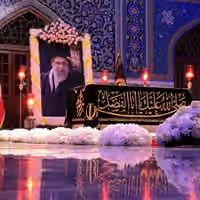
The coffin of Iranian-German dissident Jamshid Sharmahd is covered with white flowers during his funeral service.
Six years after Iranian-German dissident Jamshid Sharmahd vanished during a trip to the United Arab Emirates, many questions surrounding his abduction, imprisonment and death in the custody of the Islamic Republic remain unresolved.
Marking the anniversary of his disappearance, Iran International has released the investigative documentary I'm Fine, I'll Call You!, directed by Ardavan Roozbeh.
Drawing on official documents, digital evidence and interviews with Sharmahd's family, legal team, international officials and political figures, the film reconstructs one of the Islamic Republic's most controversial intelligence operations—from his disappearance in the UAE to his death in Iranian custody.
In August 2020, Sharmahd, an Iranian-German citizen and US resident, disappeared while traveling through the United Arab Emirates.
Days later, Iran's Ministry of Intelligence announced it had captured him in what it described as a "complex operation" and transferred him to Iran—an act his family, legal team and human rights organizations have described as an extraterritorial abduction and a violation of international law.
As spokesperson for the Kingdom Assembly of Iran (Anjoman-e Padeshahi Iran), Sharmahd was accused by the Islamic Republic of involvement in the 2008 bombing of the Seyyed al-Shohada Hosseiniyeh in Shiraz.
He and his family consistently denied the allegations.
During his detention, Iranian state television aired what it said were confessions by Sharmahd, while rights groups repeatedly warned they may have been obtained under torture or coercion.
His case quickly became one of the clearest examples of what human rights organizations describe as the Islamic Republic's campaign of transnational repression.
Iran International journalist Ardavan Roozbeh, director of the documentary I'm Fine, I'll Call You!, stands beside the coffin of Iranian-German dissident Jamshid Sharmahd during his funeral service.
Germany and the United States repeatedly called for his release, while the European Parliament condemned Iran's treatment of Sharmahd in several resolutions.
Diplomatic pressure, however, failed to prevent either his death sentence or his death in custody.
In October 2024, Iranian authorities announced Sharmahd's death. Conflicting official accounts, the lack of independent access to his case and unanswered questions surrounding his final months in prison have fueled continuing demands from his family and legal representatives for an independent investigation and accountability.
More broadly, the Sharmahd case has become emblematic of the Islamic Republic's use of cross-border intelligence operations, the targeting of political opponents abroad and the use of national security prosecutions as instruments of state policy.
By reconstructing the events leading from Sharmahd's disappearance to his death, I'm Fine, I'll Call You! examines how one of Iran's most consequential transnational operations unfolded, and why key questions surrounding the case remain unresolved.
Iran and Oman appear close to agreeing new navigation arrangements in the Strait of Hormuz, but Tehran insists any reopening must take place under a new post-war security framework rather than a return to the pre-war status quo.
Iranian officials have sought to temper expectations that technical talks with Oman will lead to the immediate reopening of the strategic waterway, stressing that any agreement would be bilateral, exclude the United States and preserve what they describe as Iran's new security role in the Strait.
Foreign Ministry spokesman Esmaeil Baghaei said on Wednesday that Iran and Oman had agreed on the geographical coordinates of proposed transit routes and were finalizing a joint statement.
But he stressed that the understanding "cannot, by itself, mean that the Strait will become safe for passing vessels," arguing that the US naval blockade and other "aggressive and threatening actions" against Iran remained the principal obstacles.
Deputy Foreign Minister Kazem Gharibabadi later said a proposed transit arrangement under discussion with Oman could remain in place for between two and four months. He added that although a US return to its commitments under the Islamabad memorandum was a prerequisite for reopening the Strait, it would not by itself be sufficient.
The same message was echoed by Iran's security establishment.
Fars News, which is affiliated with the Revolutionary Guards, quoted a source close to Iran's negotiating team as saying the Strait would reopen only after Washington took concrete steps to implement its commitments.
The source accused the United States of derailing the normalization of shipping through military strikes, the naval blockade and the suspension of waivers for Iranian oil and petrochemical exports.
‘No return to pre-war order’
Iranian officials have repeatedly argued that the negotiations are intended to establish a new framework for managing traffic through the Strait rather than simply restore previous arrangements.
Saeed Ajorlou, a member of the Iranian negotiating team's media committee, said Article 5 of the Islamabad memorandum envisages "Iranian arrangements" governing the Strait, under which security, mine clearance, maritime services and other operational matters would be administered by Tehran.
Those arrangements, he said, could remain in force for "one, two or three months," depending on the progress of wider negotiations.
"The transit regime in the Strait of Hormuz should not return to its pre-war status," Ajorlou said. "This principle must be consolidated both on the ground and in official documents and agreements."
Nour News, a media outlet closely associated with Iran's Supreme National Security Council, echoed that position, describing the talks with Oman as technical negotiations over vessel traffic management that "do not necessarily amount to an agreement to reopen Hormuz."
The outlet said broader political issues remained unresolved, including implementation of commitments under the Islamabad memorandum, the release of Iranian financial assets and arrangements concerning the future security and management of the Strait.
‘The sole rule-maker’
Members of parliament reinforced the government's position.
Hassan Ghashghavi, spokesman for parliament's National Security and Foreign Policy Committee, said Tehran would reject any southern shipping corridor that the United States sought to impose "through pressure and threats."
"Conditions in the Strait of Hormuz will absolutely not return to what they were before the war," he said.
Other lawmakers likewise argued that preserving Iran's authority over the Strait was a matter of national sovereignty and security, warning that no agreement undermining those principles would be accepted.
Hardline commentators broadly welcomed the tougher position.
Former IRIB presenter Masoud Barati wrote on X that Iranian management of the Strait meant Tehran should remain "the sole rule-maker," maintain full intelligence oversight over shipping and retain the authority to act against violators.
Others questioned whether turning Hormuz into another long-term confrontation would ultimately serve Iran's interests.
One user argued that "the Strait of Hormuz, like the nuclear programme and other policies, will become another lever working against the interests of the Iranian people."
Another wrote: "You kept the country waiting for 30 years over nuclear energy. In the end the facilities were bombed and not even enough electricity was generated for a single village. Is it the Strait of Hormuz's turn as a pretext to confront the world now?"
A banner with a threat against President Trump's life is displayed beneath missiles during a state-organized event in Tehran's Azadi Square, Iran, July 30, 2026
A return to the pre-war status quo between Iran and the United States now appears out of reach for both sides, despite their competing claims of victory.
The negotiations under way are no longer about restoring the relationship that existed before the war, but about finding a new equilibrium that neither side fully trusts.
After two months of naval confrontation, Washington wants Iran to reopen the Strait of Hormuz, while Tehran wants the United States to lift restrictions on its commercial shipping. Neither side publicly acknowledges why they fought so long against what increasingly appear to have been their own strategic and economic interests.
That mutual recognition has created an opportunity for diplomacy, but not necessarily confidence in it.
Iran and Oman announced Wednesday that they had agreed on the geographical coordinates of a proposed commercial shipping corridor through the Strait of Hormuz and were finalizing a joint statement.
The Associated Press, citing two regional officials, reported that Iranian and Omani negotiators had completed a draft agreement and were awaiting final approval from Supreme Leader Mojtaba Khamenei.
CNN, citing a senior Persian Gulf official familiar with the talks, said the chances of reaching a broader US-Iran agreement by Friday remained only "50:50," despite President Donald Trump's repeated predictions that a breakthrough was imminent.
Diplomacy without trust
The fragility of the process is increasingly reflected inside Iran itself.
A member of Iran's negotiating team told reporters in Oman on Wednesday that one of the remaining obstacles was Trump's repeated threats to attack Iran if diplomacy failed.
Accepting a compromise under those circumstances, Iranian officials argue, would expose negotiators to accusations from domestic rivals that they had capitulated under military pressure.
Former chairman of parliament's Foreign Relations and National Security Committee, Heshmatollah Falahatpisheh, warned the same day that the current pause in hostilities had created only a narrow diplomatic window.
If negotiations collapse or stall, he argued, the confrontation is likely to spread beyond the military sphere into the region's civilian economy, trade and security infrastructure.
Former foreign minister Mohammad Javad Zarif echoed those concerns, warning that continued closure of the Strait of Hormuz risked creating a broader regional and international consensus against Tehran, turning one of Iran's principal sources of leverage into a growing strategic liability.
Temporary pause
The debate inside Iran suggests that neither supporters nor opponents of diplomacy expect the current process to produce a durable settlement.
Across state media and security-aligned outlets, the negotiations are presented less as the beginning of a new relationship with Washington than as a tactical pause made possible by regional mediation, particularly Oman, and the temporary framework established under the Islamabad memorandum.
Official messaging continues to reject any suggestion of direct bargaining or political concession to Washington. I
nside Iran's political establishment, resistance to negotiations extends across ultra-hardline factions, conservative clerical institutions and parts of the Revolutionary Guards, all deeply skeptical of engagement with the United States.
For those groups, flexibility over Hormuz or Iran's nuclear program risks weakening deterrence rather than strengthening security.
That institutional skepticism helps explain why every sign of diplomatic progress is accompanied by warnings that the process could quickly unravel.
For both Washington and Tehran, the talks increasingly appear driven less by renewed trust than by recognition that neither side can afford another prolonged confrontation. Whether that recognition proves strong enough to overcome deep political distrust remains the central question.
Lawmakers raise their hands to express opinion in a parliamentary debate, in Tehran, Iran, undated file photo
Iran's parliament has become all but irrelevant since the war, as power has shifted further toward the Revolutionary Guards and decision-making has moved ever deeper behind closed doors amid the unresolved leadership transition.
The shift has left lawmakers arguing over soaring inflation, corruption and economic policy while increasingly questioning what authority the Majles still retains.
Two interviews published Tuesday by moderate Khabar Online and pro-reform Rouydad24 offered sharply different diagnoses of Iran's economic crisis, but together painted a picture of a legislature struggling to remain relevant.
The interviews came after months of complaints from MPs that parliament has been sidelined, with Speaker Mohammad Bagher Ghalibaf limiting its work to sporadic online sessions while assuming an increasingly prominent role in high-level diplomacy.
"If you ask lawmakers at the parliament door how much a kilo of chicken, meat or bread costs, I swear to God most of them cannot tell you," outspoken former MP Gholamali Jafarzadeh Imenabadi told Khabar Online.
"This is because a massive gap has formed between our officials and the people."
Citing Parliamentary Research Center data, Imanabadi said less than seven percent of the Majles' resolutions over the past two years had addressed economic issues despite soaring inflation and the rising cost of basic goods.
‘Don’t weep, resign!’
Responding to a current MP who publicly wept over women's non-compliance with compulsory hijab laws, Jafarzadeh said officials should instead feel shame—or resign—over inflation, unemployment and empty stomachs.
"For the empty stomachs of the people, officials should ask for death, not just weep. For the state of inflation, they should resign," he said.
He also criticized what he described as parliament's misplaced priorities, questioning why Ghalibaf had become one of Iran's chief negotiators while lawmakers neglected their core duty of overseeing the government and tackling corruption and inflation.
Former conservative MP Hamidreza Taraghi offered a sharply different assessment in an interview with Rouydad24, blaming President Masoud Pezeshkian's administration rather than parliament for the country's economic turmoil.
"Regarding inflation and rising prices, the government follows methods that lack the necessary efficiency to control inflation," he said, arguing that weak oversight by the administration and the Central Bank lay behind many of the country's economic problems.
Taraghi also rejected suggestions that hardline MPs represented parliament as a whole: "The positions of 10 to 15 MPs should not be generalized to the entire parliament.”
He further defended the Majles against accusations of economic inaction, arguing that under Iran's constitution parliament could not introduce spending measures without identifying funding sources, leaving many economic decisions in the government's hands.
Elected bodies sidelined
The competing accounts reflect a broader debate over who bears responsibility for Iran's economic crisis. Moderates portray parliament as increasingly detached from both public concerns and the country's most pressing challenges, while hardliners argue its powers are constrained and responsibility rests primarily with the executive.
Yet the interviews also point to a deeper shift in Iran's political system.
Under former Supreme Leader Ali Khamenei, institutions including parliament, the Expediency Discernment Council, the Assembly of Experts and even the presidency steadily lost influence as authority became concentrated in the leader's office.
Since the five-month war with Israel and the United States, critics say that trend has accelerated, with the Revolutionary Guards and the power center surrounding Mojtaba Khamenei increasingly eclipsing the Islamic Republic's formal institutions.
Whether lawmakers blame the government, Ghalibaf or one another, the interviews suggest they are debating problems in a parliament many believe no longer has a role in decision-making..
Students walk on a school campus in Iran. Officials say easy access to nas, a smokeless tobacco product sold legally in many shops, is contributing to rising nicotine use among schoolchildren.
Schoolchildren in Iran are getting hooked on nas, a cheap smokeless tobacco sold openly within steps of their classrooms, an official warned on Tuesday, as social media users asked why a product this addictive is hawked to children in plain sight.
The use of nas has become increasingly common among students, particularly in middle school, said Mostafa Mohammadpour, head of the state Welfare Organization office in the northeastern city of Kashmar. In some cases, he added, children in the upper years of primary school have begun using it.
"What has now become common among students and paves the way for drug dependence starts with the use of nas," Mohammadpour said. "Unfortunately, children have very easy access to it because selling it is not considered a crime and it is not recognized as a narcotic."
Nas, known across the region as naswar, is a moist green tobacco mixture held under the lip or tongue. It is a centuries-old habit in eastern Iran, Afghanistan and Central Asia, and because it produces no smoke, a child can use it in a classroom without anyone noticing.
'Why don't they stop it?'
The warning drew a wave of responses from users reacting to Iran International's coverage, many asking why the product remains on open sale despite years of warnings about its risks.
"Why don't they stop it from being distributed?" one commenter asked.
Packets of nas, a smokeless tobacco product, are prepared for sale at a market.
Another argued the answer lies in giving children somewhere else to go. "Municipalities should build at least three sports complexes for students in every district and make them free. School facilities should also be improved so students stay occupied and don't turn to it," the commenter wrote.
Others aimed their frustration at official indifference. "Do they even care what happens to young people?" one wrote.
Some tied the issue to wider political grievances. One X user alleged that the authorities allow addiction to spread among the young to blunt political activism, and wrote that nas "causes addiction quickly," "causes cancer in the mouth" and "damages teeth," adding a claim, which could not be independently verified, that products sold in Iran contain arsenic.
Because nas is not classified as an illegal narcotic, it sits on the shelves of small shops, and students obtain it with little difficulty, according to Mohammadpour.
The habit is most entrenched in the northeastern province of Razavi Khorasan, he said, but is no longer confined to one region, with nas now readily available across much of the country.
Tehran is no exception. Iranian media have reported vendors openly selling nas in and around the capital's Molavi market, the green tobacco displayed in packages large and small under a variety of brands.
The market draws buyers with lower prices and a wider selection, though the product is also sold through herbal shops across the city.
For children, the attraction is obvious: it is cheap, easy to hide and everywhere.
Nas, a smokeless tobacco product, is shown in a plastic bag. Iranian officials say its widespread availability has made it increasingly accessible to children and teenagers.
More than a tobacco habit
Doctors warn the risks run well beyond nicotine.
Research has linked nas to cancers of the mouth, esophagus and pancreas, as well as cardiovascular disease. Health experts also reject the belief that smokeless tobacco is a safe alternative to cigarettes, warning that no tobacco product is without risk.
The spread among students carries a further danger: early exposure to nicotine can leave children more vulnerable to addiction of every kind later in life, the concern at the heart of Mohammadpour's "gateway" warning.
A small packet of nas, a smokeless tobacco product, is exchanged between two people.
A country's changing addictions
The warning lands against a wider shift in substance use in Iran.
More than 4.4 million people in Iran use narcotics regularly or occasionally, according to a report last year in the daily Shargh, which estimated that, counting their families, some 15 million people live with the consequences of drug use.
Officials and health experts have also pointed to rising use of synthetic drugs, a falling age of first use, and growing numbers of women and young people among users, signs that addiction in Iran is getting younger.
The children with green packs in their pockets, on this reading, are not an anomaly but the leading edge.