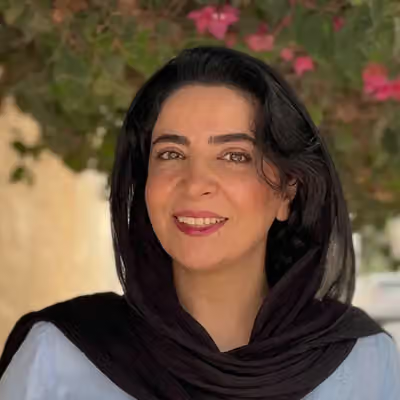
Sixteen-year old Yalda Mohammadkhani was shot dead as she fled with her parents and younger sister from masked security forces on motorcycles during protests in Tehran on January 9, informed sources told Iran International.
Hours earlier, she was at the front of the crowd, chanting “Long live the Shah,” kicking away a tear-gas canister and urging fellow protesters not to be afraid.
It was Yalda's second consecutive day protesting. On January 8, she had joined demonstrations in the Kanal area of Fardis, west of the Iranian capital, with her father and younger sister before returning home after heavy tear gas left her father's eyes burning.
At 4 p.m. the following day, Yalda told her family it was time to go back.
“We have to get ready and return to the streets,” she said. “We have to join the protests.”
This time, all four members of the family went together.
The demonstrations were part of nationwide protests that began in late December, during which state security forces killed tens of thousands of protesters across Iran.
At the protest, Yalda moved towards the front of the crowd.
“Don't be afraid,” she told fellow protesters as tear gas was fired at them. “There aren't many of them.”
Masked security forces then arrived on motorcycles and opened fire. A bullet struck Yalda's leg.
“My leg is burning. I can't walk,” she told her father.
He put an arm around her and tried to help her keep moving.
“Try to go a little further so they don't do anything to you,” he said.
As the security forces continued firing, Yalda's father tried to shield his family with his body. When he looked back, he saw her face covered in blood.
According to her family, eight bullets had struck her from behind, across her back and shoulder.
Her father carried her to hospital, but she died at the scene. Her body was transferred to Behesht-e Sakineh cemetery and mortuary complex near Karaj before being returned to the family five days later.
The family was warned not to hold a memorial ceremony and pressured to say that protesters, rather than security forces, had killed her — an account they rejected.
The phone case
Behind Yalda's phone case was a photograph she had carried since 2022: Nika Shakarami.
Nika, also 16, became one of the defining symbols of Iran's Woman, Life, Freedom movement after she was killed during the 2022 protests sparked by the death in custody of Mahsa Amini following her detention for an alleged violation of Iran's mandatory hijab laws.
As Yalda prepared to return to the streets that January, Nika's story remained on her mind.
When her parents asked how they were supposed to cope if anything happened to her, Yalda pointed to the photograph.
“What did Nika's parents do?” she replied. “You should do the same. I am going to the streets to fight for freedom and a better future.”
Amirhossein Safari (right) and Abolfazl Sepahi (left), who were executed in Isfahan on July 28, 2026 after being convicted in the Alikhani Square case.
The execution of two more protesters early Tuesday triggered widespread grief, anger and defiance across Iran, with many saying the hangings had strengthened, rather than broken, their resolve to oppose the Islamic Republic.
People in Isfahan and cities across Iran described staying awake through the night in the hope that the executions would be halted, mourning the two men after dawn and praising those who gathered despite a heavy security presence around the execution site.
Amirhossein Safari and Abolfazl Sepahi were among 12 young men sentenced to death in what became known as the Alikhani Square case, stemming from clashes during nationwide protests in Isfahan on January 8.
Iranian authorities accuse the defendants of killing four security personnel, as well as arson and vandalism. Rights groups and United Nations experts have questioned the fairness of the proceedings, citing allegations of coerced confessions, closed court hearings and the defendants' young ages.
Iran's judiciary news agency Mizan said Safari and Sepahi were executed early Tuesday, bringing the number of people put to death in the case to four after Golmohammad Mohammadi and Erfan Esfandiari were executed on July 19. Eight other defendants remain under sentence of death.
"They chased people through the alleyways of Isfahan last night," one witness said. "People were running through the streets, and the officers followed them. They did not even spare a thought for those mothers."
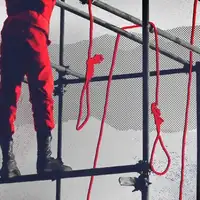
Witnesses said security forces maintained a heavy presence around Alikhani Square throughout Monday night after reports that an iron scaffold had been erected there. Social media accounts described confrontations between officers and people who had gathered in the hope of preventing the executions.
Iranians in London also gathered outside the Iranian embassy Monday night to protest the executions, extending demonstrations over the hangings beyond Iran's borders.
'We stayed awake until morning'
Many of the messages focused on the hours before dawn, describing a night spent waiting for news from Isfahan.
"We wished until sunrise that morning would never come to Isfahan," one person wrote.
Another summed up the night in historical terms: "Write in history that people in Iran fought with their bare hands until 5 a.m. to save two of their fellow citizens."
Messages from Bandar Abbas, Pardis, Khomein and other cities suggested many people viewed the gatherings in Isfahan as a sign that opposition to the executions had spread well beyond the city.
"The people of Isfahan showed that when the next call comes, millions across the country will return to the streets," one resident of Bandar Abbas said. "We fight for freedom even with empty hands."
Another resident of Bandar Abbas added: "Thank you to the people of Isfahan for gathering and showing that we are still standing together and still remember everyone who has been executed."
One student said news of the executions overshadowed an examination.
"I did not even know what I was writing during my exam," the student said. "All I could think about were the young men who were executed in Isfahan last night."
Grief turns to defiance
Many reactions expressed sympathy for the families of the two men while arguing the executions would intensify rather than suppress dissent.
"My heart breaks for the families of those two young men who watched them being executed," one message said.
Others said the executions had strengthened their determination.
"We are saddened by these executions, but we are not afraid," one resident of Pardis, near Tehran said. "We have become angrier. We will return to the streets soon."
Another reaction echoed that sentiment: "Did you think executing our brothers and sisters would make us retreat or become afraid? It has only made us more determined."
Several people criticized governments engaged in diplomacy with Tehran for failing to do more to stop the executions.
"Countries that have influence over the authorities, why do they do nothing to stop these executions?" one message asked.
Others addressed US President Donald Trump directly, questioning why preventing executions had not featured more prominently in negotiations with Iran.
International pressure
The public reaction followed an appeal by United Nations experts led by Special Rapporteur Mai Sato, who urged Iranian authorities on Monday to halt the executions of the remaining defendants.
"Sentencing 12 people to death in one hearing, in a closed courtroom and without clarity as to each defendant's individual responsibility violates established fair trial standards," the experts said.
The experts said the convictions relied heavily on confessions broadcast on state television, while Revolutionary Court hearings were held behind closed doors and the judgments were never made public.
They also said several defendants had reportedly been subjected to arbitrary detention, enforced disappearance and, in some cases, ill-treatment.
A screen grab from a video that appears to show security forces at Isfahan's Alikhani Square shortly before the execution of two protesters, early hours of Tuesday July 28, 2026
Two protesters were executed early Tuesday amid heavy security deployment around Isfahan's Alikhani Square, where an scaffold had been erected and witnesses reported clashes between guards and people who gathered overnight amid fears of further executions.
Iran's judiciary news agency Mizan identified the men as Amirhossein Safari and Abolfazl Sepahi, saying the sentences were carried out early Tuesday local time.
The executions followed hours of growing concern after reports that an iron scaffold had been erected in Alikhani Square, where protests erupted on January 8.
Witness accounts circulating on social media described the area as being under heavy security throughout Monday night, with some reporting brief confrontations between security forces and people gathered near the square. Iran International could not independently verify the reports.
Twelve young men convicted in what became known as the Alikhani Square case were sentenced to death. Two of them—Golmohammad Mohammadi and Erfan Esfandiari—were executed on July 19.
Before the executions, a source close to Safari's family told Iran International that relatives had been summoned to Isfahan Central Prison for what they believed could be a final visit.
Iranian authorities accuse the defendants of involvement in the killing of four security personnel, as well as arson and vandalism during the January protests. Officials say four members of the Basij militia and Special Unit forces were killed during clashes in the area.
UN had urged halt to executions
Earlier on Monday, UN experts led by Mai Sato, the UN Special Rapporteur on the situation of human rights in Iran, urged the authorities to halt the executions of the ten remaining defendants.
"Sentencing 12 people to death in one hearing, in a closed courtroom and without clarity as to each defendant's individual responsibility violates established fair trial standards," the experts said.
They said the defendants, aged from their late teens to their early twenties, were reportedly subjected to arbitrary detention, enforced disappearance and, in some cases, ill-treatment.
According to the experts, the convictions relied heavily on confessions broadcast on state television, while Revolutionary Court hearings were held behind closed doors and the judgments were never made public.
Among those still facing execution is Shervin Bagherian Jebeli, who turned 18 only days before his arrest.
Iran's state television broadcast footage of Jebeli confessing to violence against security officers within a week of his detention and before any trial, the experts said.
The executions bring the number of people put to death in the Alikhani Square case to four, leaving eight others still under sentence of death despite mounting international calls for Iran to halt the executions.
Amirhossein Safari and cousins Alireza and Abolfazl Sepahi (right to left) have been sentenced to death following their arrest during the widespread protests in Iran in January
An iron scaffold erected Monday in the central Iranian city of Isfahan has raised fears that authorities are preparing to publicly execute more protesters arrested during January's nationwide unrest, sources told Iran International.
The scaffold was installed in Alikhani Square, where protests erupted on January 8.
Twelve young men convicted in what became known as the Alikhani Square case were sentenced to death. Two of them—Golmohammad Mohammadi and Erfan Esfandiari—were executed on July 19.
Witness accounts circulating on social media described Alikhani Square as being under heavy security on Monday night.
A source close to the family of Amirhossein Safari, another defendant in the case, told Iran International that relatives had been summoned to Isfahan Central Prison for what they believed could be a final visit.
The concerns were echoed by prominent Iranian activist Mehdi Mahmoudian, who wrote on X that several families of the ten remaining death-row prisoners in the Alikhani Square case had also been instructed to report to the prison for final visits.
Mahmoudian identified cousins Alireza Sepahi and Abolfazl Sepahi among those facing what he described as an imminent risk of execution. He also noted that two other defendants in the case had already been executed.
The visible deployment of security forces around the scaffold has further fuelled fears that additional executions could be carried out publicly.
Iranian authorities accuse the defendants of involvement in the killing of four security personnel, as well as arson and vandalism during the January protests. Officials say four members of the Basij militia and Special Unit forces were killed during clashes in the area.
UN condemns death sentences
Earlier on Monday, UN experts led by Mai Sato, the UN Special Rapporteur on the situation of human rights in Iran, urged the authorities to halt the executions of the ten remaining defendants.
"Sentencing 12 people to death in one hearing, in a closed courtroom and without clarity as to each defendant's individual responsibility violates established fair trial standards," the experts said.
They said the defendants, aged from their late teens to their early twenties, were reportedly subjected to arbitrary detention, enforced disappearance and, in some cases, ill-treatment.
According to the experts, the convictions relied heavily on confessions broadcast on state television, while Revolutionary Court hearings were held behind closed doors and the judgments were never made public.
Among those still facing execution is Shervin Bagherian Jebeli, who turned 18 only days before his arrest.
Iran’s state television broadcast footage of Jebeli confessing to violence against security officers within a week of his detention and before any trial, the experts said.
They added that Jebeli appeared unaware of the meaning of the capital charge against him—moharebeh, or "enmity against God"—raising concerns that he had not had access to legal counsel of his own choosing.
"Confessions obtained under coercion must never be admitted as evidence, and broadcasting them before trial violates the presumption of innocence," the experts said.
Mahmoudian said the Alikhani Square case, like many other political and security prosecutions in Iran, had been marked by serious legal irregularities, denial of fair trial guarantees and widespread humanitarian concerns.
With a scaffold now standing in Alikhani Square and families reporting final prison visits, relatives fear the remaining death sentences could soon be carried out despite mounting international pressure.
A group of Iranians living in Australia planted a Persian Cypress to mark the 47th anniversary of Mohammad Reza Shah Pahlavi and his father Reza Shah on July 26, 2026.
Iranians gathered in dozens of cities worldwide over the weekend to mark the anniversaries of the deaths of Reza Shah and Mohammad Reza Shah Pahlavi, voicing support for exiled Prince Reza Pahlavi and calling for an end to the Islamic Republic.
Rallies were held on July 25-27 in cities across Germany, the United States, Britain, Sweden, Canada, Australia, Spain, Portugal, Switzerland, Finland, Greece and New Zealand. Participants commemorated the Pahlavi dynasty, waved Iran's pre-1979 lion-and-sun flag and chanted slogans against the Islamic Republic.
In Berlin, demonstrators endorsed Prince Reza Pahlavi as a leader for a political transition and called on the international community to support Iranians' demands for freedom, democracy and change.
Similar gatherings took place in Frankfurt, Cologne, Hamburg and Hanover, where participants chanted "King Reza Pahlavi" and "The lion-and-sun flag shines across the world."
Rallies across Europe and North America
In London, Iranians held a memorial in the city center, highlighting what participants described as the legacy of Reza Shah and Mohammad Reza Shah.
Events were also held in several US cities. Los Angeles hosted a ceremony honoring the Pahlavi monarchs, while New York held a gathering attended by Iranian cultural, political and social figures to commemorate the last Shah of Iran.
In Sweden, demonstrators marched through central Stockholm chanting "No to the Islamic Republic" and expressing support for a democratic transition. Similar events took place in Malmö and Gothenburg, where participants sang the patriotic song Ey Iran.
Events span
In Melbourne, Iranians marked the 47th anniversary of Mohammad Reza Shah's death by planting a Persian cypress tree, which organizers described as a symbol of resilience. Similar commemorations were held in Perth.
In Canada, participants in Calgary praised the Pahlavi dynasty's role in Iran's modernization and expressed support for Prince Reza Pahlavi during a transition from the Islamic Republic.
Additional gatherings were reported in Bern, Helsinki, Lisbon, Athens, Madrid and Auckland, underscoring the continued visibility of monarchist supporters within the Iranian diaspora.
A view the panel at Iran International town hall in Washington, DC (July 2026)
The US may be peeling away layers of Iran's leadership, but without a plan for what comes next, bombing the coast and seizing islands cannot reach the problem in Tehran, and risk delivering an IRGC takeover rather than real change, experts said at an Iran International town hall.
The panel, held at Iran International's Washington headquarters and moderated by Fardad Farahzad, brought together Michael Rubin of the American Enterprise Institute, Ilan Berman of the American Foreign Policy Council, and Iranian-American analyst Fereshteh Pezeshk.
The discussion came amid renewed US strikes, with attacks tearing through bridges and infrastructure across Iran's south.
Is Washington heading for a ground operation?
The question hanging over the room was whether the air campaign is a prelude to something larger. Rubin framed the choice in stark terms.
"When you have a hornet's nest, you have two good options. One is to leave it alone. The other one is to get rid of it," he said. "The last thing you want to do is sit underneath it lightly tapping it with a stick, and we're getting to the point where that stick tapping is over."
The open question, he added, is "are we heading to boots on the ground? And if we're heading to boots on the ground, are we simply talking about the islands in the Persian Gulf, or are we talking about some of the ports?"
Pezeshk talked about the risks. A move onto Iranian soil, she argued, would be "disastrous," and not only in military terms. "A very good population of Iranians, unlike the rest of the Middle East, are pro-American," she said, describing "a chasm between the people and the Islamic Republic" after the killing on Iran's streets.
Michael Rubin of the American Enterprise Institute at Iran International town hall in Washington
An occupation, she warned, could close that chasm rather than widen it. "The solution is in Tehran, not on the coasts. You've got to resolve that problem."
Berman placed the same question inside American politics, noting that gasoline prices and looming midterm elections are shaping every decision the administration makes.
The task now, he said, is to establish what military planners call escalation dominance, "to show the Iranian regime that they have more firepower and they have politically more will to stay and to fight."
Regime change or transformation?
The most contested idea of the evening came from Berman, who argued that a quieter transformation has already taken place inside the Islamic Republic.
The current rulers, he said, "have a different DNA. They behave differently, they negotiate differently," a shift he traced in part to a war that opened at the very top of the escalation ladder with the killing of the supreme leader.
However, he pointed out that the change has not produced true regime change. “The Trump administration hasn’t dug deep enough... “You haven’t had regime change as most of us have historically thought about it – a transition from the Islamic Republic to a fundamentally different governing system.”
Rubin pushed the logic toward the machinery of power, describing an effort to peel away the leadership layer by layer. With the Revolutionary Guards numbering well over 100,000, he argued, "somewhere along those ranks there is someone who wants to enrich himself" and would deal with Washington.
But he cautioned that the administration may not know who actually runs the country, comparing its approach to "negotiating with the doorman in a skyscraper rather than negotiating with the owner."
Both men returned to a warning that any transition badly managed could produce something worse.
Iranian-American analyst Fereshteh Pezeshk at Iran International town hall
Pezeshk offered the strongest caution against treating decapitation strikes as a complete regime-change strategy. “You have to resolve the political issue in Tehran, not the manifestation.”
She pressed the point harder: removing the leadership without a plan for the day after risks chaos. "How do you ensure it's not going to be a Taliban-like power that comes in? Are you working with the opposition? Are you inclusive enough?" She saw little sign of that groundwork.
"The guy sitting in Tehran is going to be there forever until they die. The US president, two and a half years from now, is gone."
The next uprising, and a fumbled chance
If there was a shared conviction, it was that Iran's streets, not its negotiators, will decide the outcome, and that Washington keeps missing its moments there.
Berman described unrest in Iran as a cyclical force, erupting roughly every two and a half years and accelerating. The lesson of the past six months, he said, is that the US was caught flat-footed when it mattered.
When the internet went dark in January, he recounted, the administration assumed it could "just pierce that veil" with Starlink units and VPNs. Instead it found the jamming, aided by Russia and China, far more robust than expected, and its own tools not prepositioned.
"One of the most important lessons that this last half year has brought is we should be thinking now about the next round of protests, because the next protest is going to start."
Pezeshk argued it already had. She credited the January protests, set off in part by an opposition call to the streets, as "one of the biggest protests ever in Iranian history," met with a killing she put at around 40,000. Her frustration was that such a force draws so little attention in Washington.
The Kurds, the islands, and a mafia state
Asked whether the US might arm Kurdish or other groups to open a ground front, the panel was wary. Rubin noted Washington's long reluctance to back separatist movements in the region, and Pezeshk attributed the on-again, off-again talk to "the chaos of the Trump administration."
Berman said officials he had spoken to were "very nervous about the steadfastness and the resolve of these elements."
Ilan Berman of the American Foreign Policy Council
Rubin, speaking "as an analyst rather than advocate," sketched where a limited campaign might fall: not the ports, but strategic islands, from Abu Musa and the Tunbs to Kish and Qeshm, "the gateway to Bandar Abbas."
He warned that seizing Iranian territory could backfire by rallying a fiercely nationalist public. The Islamic Republic, he argued, would not be moved by the loss of land the way a normal state would.
"They act like a mafia. They don't care if part of the country is gone as long as they're still in power."
Pezeshk’s argument was that territorial occupation – whether by US forces, Kurdish groups or another regional actor – could unite Iranians around national sovereignty.
Can an ideological system make a lasting deal?
Rubin argued that the Islamic Republic’s political identity limits its ability to reach the kind of pragmatic agreement sought by the Trump administration. Rubin argued that the Islamic Republic’s political identity limits its ability to reach the kind of pragmatic agreement sought by the Trump administration.
Pezeshk was skeptical any lasting deal is possible with a system she sees as ideological to its core.
Persian Gulf states, she said, want development, not confrontation, "they do not want to go back to the 18th century," while the Islamic Republic "has a tolerance for absorbing a lot of pain just because they don't care about their people."
Whether the war ends at the table or on the coast, the panel's consensus held that its true resolution lies elsewhere.
As Rubin put it, the nuclear file, the missiles and the proxies are all "the manifestation of the root cause, which is the Islamic Republic."