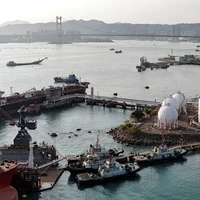
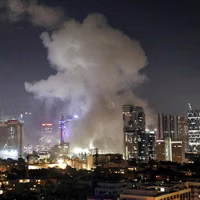
One sailor was killed and three others wounded when the vessel was struck on Saturday near Russia’s Astrakhan port in the Volga Delta.
While Iranian officials condemned the strike as an act of aggression and vowed it “will not go unanswered,” commentators remain divided over how Tehran should respond and whether opening a new front would strengthen or further strain Iran’s position.
Conservative newspapers portrayed the attack as part of a coordinated Western and Israeli effort to widen the conflict and divert Iran’s attention from the Strait of Hormuz.
The hardline daily Kayhan described the strike as a “strategic warning,” arguing that its purpose was to draw Iran into a new northern front.
“It is not impossible that Ukraine’s serious entry into this arena could ignite another world war, because all the signs of a global war are visible,” the newspaper warned.
Farhikhtegan argued that Zelensky would not have authorized the operation without European backing.
“Tehran knows Kyiv is not the principal actor but Europe’s and NATO’s proxy for testing the battlefield,” the conservative newspaper wrote, adding that the attack could not have taken place without Washington’s knowledge.
Military analyst Nima Akbarkhani went further, arguing that Tehran should retaliate against Ukraine’s European supporters rather than Kyiv itself.
“The strategic and precise response is to target European interests, not an emotional action,” he told state broadcaster IRIB. “The only people who can restrain Zelensky are those financing his war.”
Tehran-based journalist Afifeh Abedi also called for a “proportionate response,” describing the strike as an attempt to expand both the geography and nature of the Russia-Ukraine war.
She suggested Ukraine may be acting under Israeli pressure to bring European and US positions closer together and “merge the two wars” against Iran and Russia.
“Ukraine’s action against Iran was entirely deliberate and intended to raise tensions,” she told ISNA.
Warnings against a new northern front
Other Iranian commentators warned that retaliation could bring far greater risks than benefits.
Conservative political activist Ali Gholhaki, who is close to Parliament Speaker Mohammad-Bagher Ghalibaf, cautioned that direct action against Ukraine could mobilize European governments alongside the United States.
“Iran must ensure that any response to Ukraine does not mobilize all of Europe alongside America against Iran,” he said.
Former diplomat Kourosh Ahmadi warned that the emergence of a northern front could force Iran to redeploy military assets toward the Caspian region, creating new vulnerabilities elsewhere.
He also questioned how the United States, Europe, Turkey and Russia would react if Iran attacked targets in the Black Sea region or inside Ukraine.
Military analyst Mohsen Reyhani highlighted the practical obstacles facing Tehran. In a post on X, he said drone strikes on Odesa from the Caspian would require Russian cooperation, while missiles launched from northwestern Iran could have to cross Turkish airspace, risking NATO involvement.
He said strikes on cities such as Kyiv would require missiles with ranges of about 1,700 to 2,500 kilometers.
Political analyst Maziar Aghazadeh argued that missile or drone attacks on Ukraine would offer little deterrent value while exposing Iran to a prolonged conflict.
Such retaliation, he wrote in Asr-e Iran, could open “a futile and exhausting new front” in which Iran would bear far greater costs than Ukraine.
Diplomats try to de-escalate
The Iranian and Ukrainian foreign ministers spoke on Tuesday in an effort to contain tensions. Abbas Araghchi said Andrii Sybiha had assured him the strike was unintentional and that Kyiv did not seek escalation.
Araghchi said Iran also sought to avoid escalation but demanded restitution for the loss of life and damage.
Sybiha said in a post on X that Ukraine had not intended to target civilians or civilian vessels and urged Tehran to refrain from escalating and end its support for Russia’s war.
Hostile ties shaped by the Russia war
Relations between Tehran and Kyiv were already deeply strained before the ship attack.
The Revolutionary Guards’ downing of a Ukrainian passenger jet over Tehran in 2020 caused a lasting rupture. Tensions later deepened over Iran’s transfer of Shahed drones and production technology to Russia.
Kyiv considers Tehran a direct contributor to Moscow’s war effort. Zelensky has argued that Iran effectively entered the conflict by supplying drones, transferring technology and enabling their production inside Russia.
Tehran denies being a formal military ally of Moscow, although Iranian officials have acknowledged earlier drone transfers and technology cooperation. The two countries’ comprehensive strategic partnership, signed in January 2025, does not include a mutual defense clause.
The relationship deteriorated further after Ukraine offered to help counter Iranian drones during Iran’s confrontation with Israel and the United States, reinforcing Tehran’s perception that Kyiv had aligned itself with Iran’s regional adversaries.
Russia, meanwhile, strongly backed Tehran after the ship strike.
Foreign Ministry spokeswoman Maria Zakharova said the incident demonstrated “the clear threat Ukraine poses to the regional security of Caspian littoral states,” while Kremlin spokesman Dmitry Peskov said an attack on the Iranian vessel was “like an attack on Iran itself.”
The debate in Tehran now centers less on whether the attack requires a response than on what form that response could take without pulling Iran into an expanding conflict stretching from the Persian Gulf to the Black Sea.