Iran receives Chinese satellite intelligence, lawmaker says
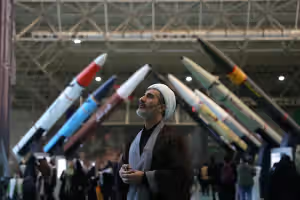
Iran receives intelligence support from China, including assistance from Chinese satellites, a parliament national security committee member said on Monday.
“We do not buy weapons from China. Instead, we receive intelligence systems from them. Their satellites help us,” Ahmad Bakhshayesh Ardestani said. “It is natural for China and Russia to say they do not help Iran, but in reality, they do.”
He added that Tehran had helped Moscow in the war on Ukraine by providing it with drones.
An elderly patient sits in a hospital ward in Iran.
A growing number of Iranians are financing healthcare with debt as medical costs rise beyond household incomes, a new Eghtesad Online report found, while authorities prioritize medical preparations for the Shiite pilgrimage, Arbaeen.
Iranians are increasingly borrowing money, delaying treatment and bargaining over medical bills as healthcare costs outpace household incomes, according to a new report by Eghtesad Online, while authorities say medicines and medical supplies are fully secured for Arbaeen, the annual pilgrimage commemorating the 40th day after the death of third Shiite imam.
The report describes a healthcare system where treatment increasingly begins not with a doctor's diagnosis but with offers to activate credit, pay in installments or use discount codes. From dental care and physiotherapy to psychotherapy, prescription drugs and online consultations, households are increasingly financing healthcare with future income.
"The issue is not just the growth of a few startups or advertisements by a few clinics; the issue is the shrinking liquidity of households, where a patient is forced to borrow from next month's income to pay for today's pain," the report said.
When treatment depends on payday
Conversations in doctors' offices, the report said, increasingly focus on affordability rather than treatment. Patients ask whether insurance will cover consultation fees or whether doctors can charge less, while physicians report seeing people who postpone laboratory tests, imaging scans and prescriptions after paying for the initial visit.
"Is this charged at the private rate? Doesn't insurance cover it? Can't you charge a little less?" are now common questions at reception desks, according to the report, which said patients bargain "not out of habit, but out of necessity."
Long-term treatment is particularly vulnerable. Patients stop physiotherapy midway, discontinue psychotherapy after only a few sessions or ration medication so it lasts longer, turning what the report called "a shortage of cash into a shortage of treatment."
Official figures for the current Iranian year have not yet been released, but the latest available data showed healthcare accounted for 8.7% of urban household spending and 9.8% of rural household spending in 2024.
Mental health becomes a luxury
Financial pressures are especially visible in mental healthcare, where patients increasingly align appointments with payday.
A therapist meets with a patient in Iran, where rising treatment costs are making mental healthcare less affordable.
"Can I pay for this session at the end of the month?" is among the requests therapists now hear regularly, according to the report. Others ask, "My salary is deposited on the 10th. Can I pay for two sessions together?" or explain, "I can't come every week for now. I'll come twice a month."
The report said psychotherapy is intended to help people cope with anxiety, exhaustion and the pressures of daily life, yet "the cost of the session itself has become one of those anxieties." Social media users quoted in the report described calculating rent, loan payments, medicine and food costs before deciding whether they could afford therapy.
Dental care has become another symbol of the trend. Clinics increasingly advertise installment plans for implants, orthodontics and root canals, while online pharmacies and health platforms now offer credit for medicines and health-related products.
"Toothache does not wait for next month's paycheck," the report said, describing installment payments as both an opportunity to obtain treatment and a warning that essential healthcare costs are increasingly becoming future debt.
Officials warn of shortages
The financial pressures coincide with warnings from lawmakers about Iran's pharmaceutical sector.
Salman Es’haqi, spokesperson for parliament's Health and Treatment Committee, described medicine shortages as a "serious and critical" issue, citing sanctions, the recent war and disruptions to imports of pharmaceutical raw materials. He warned that unstable access to medicines could cost lives.
Other lawmakers have linked shortages to delays in foreign currency allocations and cash shortages affecting imports, while pharmacists have said weak oversight has allowed some medicines to be diverted from official distribution channels into the unofficial market.
Medical support for Arbaeen
Despite those concerns, officials have repeatedly emphasized that healthcare resources for Arbaeen will be fully available.
Medical supplies and pharmaceuticals are loaded for shipment from Iran to Iraq ahead of the Arbaeen pilgrimage in 2019.
Jafar Miadfar, head of Iran's Emergency Organization, said authorities had no concerns about supplying medicines and intravenous fluids for pilgrims. He said around 300,000 units of intravenous fluids had been allocated and medicine stocks positioned at six border crossings ahead of the pilgrimage.
Earlier, Iranian Red Crescent chief Pirhossein Kolivand said medicines and medical equipment had been dispatched for Arbaeen and that five hospitals in Iraq along the Najaf-Karbala route would provide care for Iranian pilgrims.
U.S. President Donald Trump delivers remarks at the White House Correspondents' Association (WHCA) Dinner, July 24, 2026
Voices against the United States' military campaign against Iran grew louder over the weekend as Republican and Democratic lawmakers argued it was leaving Americans to bear mounting military, economic and human costs.
Leading the Republican criticism was Representative Thomas Massie of Kentucky, one of the few Republicans to openly challenge President Donald Trump's handling of the conflict.
"The U.S. has been significantly weakened by the war with Iran," Massie wrote on X.
"This administration depleted our missile defenses, drained our oil reserves, sacrificed our men & women, inflated the price of consumer goods, increased our debt, and neglected our domestic needs... all for Israel."
The Wall Street Journal and CBS News reported this week that senior military officials had warned the White House about declining inventories of air defence interceptors and precision-guided munitions, raising fresh questions about the campaign's longer-term cost.
Trump rejected those reports.
"We have far more munitions than anyone in the world, and far more than we need," he told The Wall Street Journal on Sunday.
Democrats, meanwhile, sharpened their own attacks, portraying the campaign as both illegal and increasingly costly for American taxpayers.
Representative Becca Balint of Vermont criticised House Republicans' latest budget bill, saying it allocated more than $70 billion for what she described as Trump's "illegal war of choice in Iran."
"Does it do anything to lower your costs? Nope!" she wrote.
Representative Nanette Barragán of California argued that Americans should not have to "foot the bill for Trump's war on Iran or billionaires' tax cuts."
The United States and Iran have now gone three consecutive nights without direct strikes against one another, while diplomatic efforts involving regional mediators have gathered momentum.
Few officials, however, appear convinced the lull will prove durable. Trump has repeatedly said the United States remains prepared to resume military operations if negotiations fail, while Tehran has continued to warn of retaliation should attacks restart.
Representative Frank Pallone of New Jersey linked the conflict to rising fuel prices and growing pressure on US military resources.
"Gas is at $4 a gallon, our military resources are depleted, and none of Trump's stated goals have been achieved," Pallone wrote after voting in favour of a War Powers Resolution seeking to end the conflict.
"Our vote sent Trump a clear message: the American people are FED UP with this illegal war."
Workers operate an offshore drilling rig in the Iranian sector of the Caspian Sea, undated file photo
A widening scandal over the secret network used to move Iran's oil revenues around international sanctions has triggered growing criticism after senior officials acknowledged that intermediaries misappropriated at least $1.6 billion, with some fleeing the country.
The controversy has exposed the unofficial network of so-called trusties: companies and intermediaries entrusted with receiving and transferring oil revenues outside the international banking system.
Speaking on state television on Sunday, the head of Iran's State Inspection Organization, Zabihollah Khodaeian, said one intermediary alone had failed to return $200 million in state funds before leaving the country.
Khodaeian added that judicial authorities had opened 59 criminal cases against managers of trustee companies. Some suspects have been arrested, while others have fled abroad.
Iranian media also reported that prosecutors had sought Interpol Red Notices for 15 fugitives linked to the network.
The disclosures prompted unusually blunt criticism from Majid Reza Hariri, head of the Iran-China Chamber of Commerce.
In a public message addressed to Tehran's prosecutor, Hariri said the Interpol requests meant at least 15 trusted intermediaries had escaped with "billions of dollars" in national wealth.
"Who introduced these trusties? Who guaranteed them? And why is no action being taken against those who backed them?" he asked.
Although Hariri's estimate has not been independently verified, his comments echoed questions increasingly being raised in Iranian media over how individuals entrusted with handling billions of dollars in oil revenues could allegedly abscond without serious failures in oversight.
A product of sanctions
The trustee system emerged as international sanctions largely cut Iranian banks off from the global financial system.
Unable to receive oil payments through conventional banking channels, Tehran increasingly relied on trusted intermediaries with access to foreign companies and bank accounts to collect, hold and transfer export revenues.
Many of these intermediaries operate through countries including the United Arab Emirates, Turkey and Oman.
The arrangement became indispensable to sustaining Iranian oil exports under sanctions. But it also created a largely opaque financial architecture operating outside many of the transparency, auditing and compliance mechanisms that govern formal banking systems.
Trusties have never been clearly defined under Iranian law. Little is publicly known about how they are selected, what commissions they receive, what guarantees they provide or how their activities are supervised.
Critics say the structure also creates an inherent conflict of interest. Oil revenues can remain in intermediary accounts for days or even weeks before reaching Iran, allowing trusties to profit from holding large balances while the state bears the financial risk.
Questions over oversight
The growing scandal has also drawn attention to who ultimately oversees the network.
Oil Minister Mohsen Paknejad has previously said the Oil Ministry's responsibility ends with marketing and selling crude, while the Central Bank determines where export revenues are deposited and supervises their transfer.
The issue is especially sensitive because trusties are not ordinary commercial intermediaries. They are selected precisely because they are considered sufficiently reliable to handle some of the state's most strategically important financial transactions.
Officials maintain that such intermediaries remain indispensable as long as sanctions keep Iran largely excluded from the international banking system.
The expanding investigation, however, has transformed what was once a largely hidden mechanism of sanctions evasion into yet another damaging scandal for the Islamic Republic, raising difficult questions about both the alleged abuse and the system that allowed it to occur.
For the first time in nearly two weeks, Iran passed two nights without new US strikes, creating the first real pause in a campaign that appears to have evolved well beyond protecting shipping through the Strait of Hormuz.
Analysts increasingly see a broader effort to erode Tehran's military, economic and political capacity until negotiations become the less costly option.
President Donald Trump has oscillated between threatening "massive attacks" and calling for renewed negotiations with Tehran. According to Axios, he decided against another round of strikes on Friday despite military plans being ready to execute.
Whether the lull marks the beginning of diplomacy or merely an operational pause remains unclear. What appears more significant is how the campaign itself has evolved.
Military analyst and retired US Army officer John Spencer believes Washington's objectives now extend well beyond degrading Iran's immediate military capabilities.
Rather than seeking immediate regime change, he argues, the campaign is designed to convince Tehran's leadership that continuing the conflict will steadily erode its ability to govern, project military power and preserve the strategic leverage it has spent decades building, ultimately forcing Iran to negotiate from a position of growing weakness.
"The United States could do a lot more," Spencer told Eye for Iran. "This is about changing the regime's behavior."
The evolution is visible in the targets themselves. Early strikes focused overwhelmingly on Iran's ability to threaten shipping through the Strait of Hormuz, hitting coastal radar installations, anti-ship missile batteries, drone facilities and command-and-control centres.
More recently, however, the campaign has shifted inland toward bridges, railways, communications infrastructure and military logistics networks, particularly around Bandar Abbas.
Iran's largest commercial port and a key naval hub overlooking the Strait of Hormuz, Bandar Abbas has become increasingly isolated as transportation links and logistics infrastructure come under repeated attack.
For Spencer, that shift reflects an effort not simply to destroy weapons but to restrict Iran's ability to move forces, sustain military operations and eventually rebuild damaged capabilities.
"It could be beyond the battle of Hormuz," Spencer said. "It could be setting the conditions for future operations."
He argues the United States still retains considerable military, economic and cyber capabilities that have yet to be fully employed should Washington decide to intensify pressure further.
Regional balance shifts
Former Kuwaiti Information Minister Saad bin Tefla Al Ajmi believes the campaign has also altered Iran's wider strategic position.
He argues Tehran's regional network has suffered setbacks on multiple fronts. Hezbollah has been severely weakened, Syria no longer provides the strategic corridor it once did following Bashar al-Assad's fall, and repeated attacks have degraded Iran's nuclear infrastructure.
"Iran is now between two choices," Al Ajmi said. "The chalice of poison or suicide."
He also questioned whether Iran's increasingly fragmented decision-making structure could complicate any future negotiations.
"There is a fragmentation in the leadership in Iran now," he said. "Sometimes we have a problem of who to communicate with."
Military pressure has also coincided with a tightening domestic crackdown, with human rights groups reporting an increase in executions of protesters and political prisoners during the conflict.
Whether the two-night pause marks the beginning of diplomacy or simply the interval before another wave of strikes remains uncertain.
What the past fortnight has already revealed, however, is that Washington's objectives now appear to extend far beyond the Strait of Hormuz, towards reshaping the military and political calculations of Iran's leadership itself.
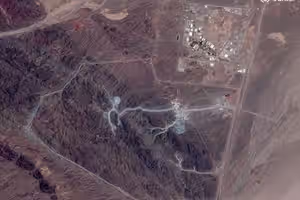
A satellite view shows tunnel entrances at Pickaxe Mountain, of the Natanz nuclear facility, near Natanz, Iran, June 30, 2026. Vantor handout via Reuters
If President Donald Trump expands US strikes on Iran, Washington could target several remaining nuclear facilities beyond Pickaxe Mountain, the Wall Street Journal reported on Saturday, citing former officials and nuclear experts.
The report said Iran's nuclear infrastructure had already been heavily damaged by Israeli strikes and the US "Midnight Hammer" operation against its main enrichment sites, but that several facilities could still be considered targets.
"It appears that the bulk of the sites that were needed to make nuclear weapons have been hit," David Albright, president of the Institute for Science and International Security and a former UN weapons inspector, told the newspaper.
"But Israel may know of new sites through intelligence, and there may be reason to strike old sites that are being rebuilt," he said.
The Journal said Pickaxe Mountain, known in Iran as Mount Kolang, remains the most likely target because Israeli intelligence believes Iran moved thousands of uranium-enrichment centrifuges into tunnels there after last year's 12-day war.
According to the report, the underground complex lies hundreds of feet beneath granite, making it difficult to destroy even with US bunker-busting bombs. Experts cited by the newspaper said Washington could instead strike tunnel entrances or other access points.
"Washington's clearest nonproliferation wins against Iran in the war were stopping all uranium enrichment at declared facilities and entombing enriched uranium stockpiles," Behnam Ben Taleblu of the Foundation for Defense of Democracies told the Journal.
"The more time elapses, however, the more crucial Pickaxe mountain appears to Iran's reconstitution effort," he said.
The Journal said other potential targets include the Taleghan 2 facility at the Parchin military complex, which satellite imagery suggests Iran has been rebuilding, although experts differ over how much of the site survived previous Israeli strikes.
It also identified support facilities at Fordow, where above-ground buildings housing centrifuges and isotope-production equipment remain, as well as parts of the Isfahan Nuclear Technology Center, where satellite imagery has shown continued vehicle activity despite previous US missile strikes.
The report added that remaining buildings at Iran's Natanz uranium enrichment plant could also be targeted if Washington expands its air campaign.