US Senate blocks resolution to curb Trump’s Iran war powers
The US Senate on Thursday voted 49-47 against advancing a Democratic-led resolution that would have required congressional authorization for President Donald Trump to continue hostilities against Iran.
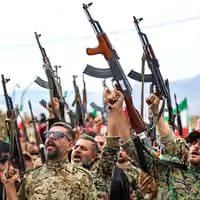
An Iranian cleric visiting the Islamic Revolutionary Guard Corps Aerospace Force Museum in Tehran, November 2025
President Donald Trump’s threat to strike Iran’s Pickaxe Mountain nuclear-linked facility has intensified hardline calls for Tehran to withdraw from the Nuclear Non-Proliferation Treaty and develop a nuclear weapon.
The debate gained fresh momentum after Trump warned Tuesday that the United States would target the deeply buried facility, known in Persian as Mount Kolang Gaz La, if Iran sought to restore its nuclear program there.
Advocates of this view argue that the recent wars demonstrated that conventional military capabilities alone no longer provide sufficient deterrence, making a nuclear option increasingly necessary. Others stop short of openly advocating nuclear weapons but argue that Iran should at least leave the NPT in response to growing US threats.
The arguments echo comments made by Fereydoun Abbasi, the former head of the Atomic Energy Organization of Iran and a politician closely associated with Saeed Jalili’s hardline camp, months before he was killed in Israeli strikes during the 12-day war in June 2025.
In January 2025, Abbasi argued that under the new security environment, “the dangers of not building a bomb and lacking strong deterrence are far greater than the costs of acquiring it,” warning that weak deterrence would only encourage direct aggression.
Abbasi also maintained that Iran had long ago crossed the scientific and technical threshold required to build a nuclear weapon, arguing that the remaining obstacle was no longer technical but rather “a strategic decision.”
In his view, when threats from Israel and its allies become existential, missile deterrence and reliance on regional allies are no longer sufficient, leaving the country increasingly vulnerable without a nuclear deterrent.
Social media campaign targets negotiating officials
Many hardline social media users now argue that Iran should build a nuclear bomb as quickly as possible. They have also criticized officials they describe as “eager for negotiations”—including President Masoud Pezeshkian, Parliament Speaker Mohammad-Bagher Ghalibaf and Foreign Minister Abbas Araghchi—for failing to put withdrawal from the NPT on the government’s agenda.
One X user writing under the name Ayyar reacted to Foreign Ministry spokesman Esmaeil Baghaei’s statement that Iran remained committed to the NPT.
“Just hours after Baghaei declared that Iran is still a member of the NPT, Trump threatened to bomb the Pickaxe Mountain nuclear facility,” the user wrote. “They killed the country’s leader along with thousands of Iranians and repeatedly struck our nuclear facilities. What exactly must the enemy do before we leave the NPT? Are you asleep?”
Another user, writing under the name Sam, argued: “Why are we afraid of leaving the NPT? Afraid of a global consensus against Iran? Staying in the treaty hasn’t prevented that. We have no choice but to build nuclear weapons for comprehensive deterrence. Nuclear weapons could be the final answer.”
Another account, Seyed Mehrdad, wrote: “The answer to a nuclear threat is not threatening regional infrastructure. Deterrence lies in leaving the NPT and conducting a live nuclear test.”
Other users argued that Iran should not remain without nuclear weapons if countries such as Turkey or Saudi Arabia eventually acquire them, insisting that “missile power alone cannot guarantee deterrence.”
Another post claimed that nuclear-capable bombers would not threaten Iran if the country already possessed nuclear weapons, reflecting a broader argument among hardliners that only an atomic arsenal could prevent further US or Israeli attacks.
Debate spreads beyond social media
The discussion has also spread into conservative media. On June 28, the IRGC-affiliated Fars News Agency published an opinion piece titled “There Is No Alternative but to Build an Atomic Bomb,” arguing that Iran required nuclear deterrence to secure the “peace of mind” necessary to resolve other disputes through negotiations.
Fars later clarified that the article had appeared in its interactive opinion section and did not represent the agency’s official editorial position.
Other conservative outlets, including Kayhan, and hardline members of parliament have generally avoided explicitly endorsing nuclear weapons. They have, however, increasingly referred to concepts such as “redefining deterrence,” “reviewing nuclear commitments” and “revising the country’s defense doctrine.”
Calls for NPT withdrawal intensify
Trump’s latest warning against Pickaxe Mountain has also prompted some conservative figures to publicly raise the possibility of leaving the NPT.
Political analyst Mohammad Hossein Khoshvaght, who has close ties to the late supreme leader’s family, questioned whether conventional responses to US attacks would simply encourage further aggression, asking whether such a cycle could continue “until Iran is brought down.”
Former senior Revolutionary Guards commander Ghorbanali Salavatian urged Iranian authorities to formally notify international organizations that Iran would withdraw from the NPT if the United States attacked Pickaxe Mountain.
He added that such a withdrawal should occur “without delay” if an attack took place.
Khamenei’s fatwa returns to focus
The debate has also reopened questions surrounding the religious prohibition on nuclear weapons issued by the late Supreme Leader Ali Khamenei.
Following Khamenei’s death, some social media users argued that Mojtaba Khamenei, as the new supreme leader, should revoke or revise his father’s fatwa declaring nuclear weapons religiously forbidden in light of the changed security environment.
One user wrote in March that because Ali Khamenei was no longer a living source of emulation, his fatwa was no longer binding. The user described the pursuit of nuclear deterrence as “a national demand and the right of the Iranian people.”
The issue had already surfaced in September 2025, when 70 members of parliament argued that Khamenei’s previous ruling should be changed or reinterpreted and demanded authorization for the development and possession of an atomic bomb to establish “nuclear deterrence.”
The lawmakers argued that while the use of nuclear weapons could remain religiously forbidden, producing and possessing them solely for deterrence should be treated differently.
Official position remains unchanged
Before Ali Khamenei’s death, Iranian officials and nuclear negotiators consistently maintained that his fatwa was a permanent religious ruling rather than a temporary political decision.
According to their interpretation, not only the production and use of nuclear weapons but even their possession solely for deterrence is forbidden under Islamic law. They argued that Iran’s deterrence should instead rest on missile capabilities, technological advances and human capital.
Under Shiite jurisprudence, however, a new marja, or source of emulation, may issue rulings that differ from those of his predecessors.
Araghchi acknowledged this possibility in an interview with Al Jazeera in April, saying any change to the nuclear fatwa would depend on the position adopted by Iran’s new supreme leader.
For now, the government’s formal position remains unchanged. Baghaei said Monday that Iran remained a member of the NPT and recognized its obligations under the treaty, although he added that Tehran continually reviewed its foreign policy and national security options.
Baghaei also said Wednesday that no nuclear activity was taking place at Pickaxe Mountain, accusing Washington of using the site as a “fabricated pretext” for further attacks and sabotage.
File photo shows Iranian miners resting after work at a mine.
Iranian workers who have gone months without pay may have only two months of financial resilience left without government intervention, a labor representative warned on Thursday, as wage arrears mount following conflict between the United States and the Islamic Republic.
"The country will certainly face significant unrest among workers by the end of the summer if the current trend continues," Akbar Shokat, executive secretary of the Workers' House in Qom province, told the ILNA news agency.
Many workers, according to ILNA, who were temporarily laid off during the conflict and turned to jobs such as ride-hailing to make ends meet have since been recalled to factories, only to find that wages for June and July remain unpaid. Having returned to work, they are also no longer eligible for unemployment benefits.
Most Iranian workers, Shokat said, already live below the poverty line after years of wage suppression, leaving them with little capacity to absorb further economic pressure.
Employers accused of withholding wages
Shokat accused some employers of exploiting the current economic conditions by reducing production and delaying wage payments despite having sufficient raw materials and finished goods in storage.
"Some employers are taking advantage of the current situation," he said, adding that businesses which accumulated wealth over previous decades had a moral responsibility not to shift the burden of the crisis onto workers.
He urged the government to introduce emergency economic measures, including customs exemptions for imported raw materials and bank financing for manufacturers, to help companies continue operations and prevent further wage delays.
Shokat also called for legal action against employers who withhold workers' wages while stockpiling goods.
Strikes spread across sectors
ILNA has reported a growing number of labor protests in recent weeks.
On June 23, the agency reported that 1,600 workers at Tabriz Machinery Group stopped work after two months without pay, demanding payment of wages owed for May and June.
Earlier, healthcare workers in Islam-Abad-e Gharb of Kermanshah province gathered to protest low wages, delayed payments and worsening living conditions, criticizing what they described as unequal pay across Iran's health system and incomes that remain well below the poverty line.
Economic pressures deepen
The labor concerns come as Iran's economy faces mounting pressure following the conflict with the United States. The rial has weakened sharply against foreign currencies in the open market, with the US dollar trading above 1.91 million rials.
Separately, Saeed Shojaei, deputy planning minister at the Ministry of Industry, Mine and Trade, told the Ettelaat newspaper on July 15 that financial losses from electricity shortages affecting industry are expected to increase from about 3,030 trillion rials in the 2024 to 4,730 trillion rials in 2025.
US Secretary of State Marco Rubio attends the 33rd ASEAN Regional Forum (ARF), part of the ASEAN Foreign Ministers' Meeting, at the Philippine International Convention Center on July 23, 2026 in Pasay, Metro Manila, Philippines.
US Secretary of State Marco Rubio said President Donald Trump’s policy toward Iran was “a head for an eye,” warning Tehran it would pay a heavy price for attacks on Americans and US interests.
Rubio made the remark when asked about Iranian Foreign Minister Abbas Araghchi invoking the principle of “an eye for an eye.”
“The president’s policy is a head for an eye,” Rubio told reporters at an ASEAN summit in Manila.
“They will pay a very heavy price for the things they’re doing. They’re already paying a very heavy price,” he said.
Rubio said Iran’s industrial and defense industrial bases had been “decimated” and that Tehran was continuing to lose missile launchers and radar systems.
“They’re losing launchers. They’re losing radars every single night. They are suffering billions of dollars in damage, and their economy is a disaster,” he said.
Despite Iran’s rhetoric, Rubio said, “they are suffering tremendously, and they’re going to suffer more until they come to their senses.”
US goal is denuclearized Iran
Rubio said the Trump administration’s goal was a denuclearized Iran, not regime change.
“I think the US is seeking a denuclearized Iran that will never have a nuclear weapon,” Rubio said.
“Our issue and our concern and our focus is denuclearizing Iran. They can never have a nuclear weapon.”
Asked whether Washington was comfortable leaving Iran’s current leadership in power, Rubio replied: “They can’t have a nuclear weapon.”
He also rejected suggestions that Trump had made regime change an objective of the conflict.
“He never said regime change was a goal,” Rubio said.
“From day one of the operation, it was very clear that we were going to degrade their missile launchers, their drones, and their factories and their navy.”
Rubio said Trump had argued that the Iranian people deserved better leadership, but added that Washington’s national interest was ensuring Iran never acquired a nuclear weapon.
Iran not ready for a deal
Rubio said he did not believe Iran was ready to reach an agreement with Washington despite repeated indirect messages seeking talks.
"These people are calling us every day, begging, let's do a deal. They send us messages through other countries, third countries," Rubio said.
"The problem is, every time these people do a deal, they either break it or after they make it, they want to change the deal."
"I don't think they're serious about making a deal," he said, adding: "I think they'll be ready soon because the price they're paying is very high."
Rubio said Iran had suffered extensive military and economic damage.
"They're losing launchers. They're losing radars every single night. They are suffering billions of dollars in damage, and their economy is a disaster," he said.
Despite Iran's rhetoric, Rubio said, "they are suffering tremendously, and they're going to suffer more until they come to their senses."
Warning to Iran
Asked about Iranian Foreign Minister Abbas Araghchi's remarks invoking "an eye for an eye," Rubio responded: "The president's policy is a head for an eye."
"They will pay a very heavy price for the things they're doing. They're already paying a very heavy price," Rubio said.
He said Iran's industrial and defense industrial bases had been "decimated" and said Tehran would continue to pay a price for its actions.
Russia question
Asked about a report that US intelligence analysts were investigating whether Russia had assisted Iranian drone strikes on CIA facilities in the Persian Gulf, Rubio declined to comment on the specific allegation.
"Let's imagine that were true. I certainly wouldn't discuss it in the press," he said.
Rubio said Iran had spent years building up the military capabilities it was now using.
"Nothing that Iran is doing, nothing that anyone's doing to help Iran is in any way increasing their ability to target Americans," he said.
"Iran has spent the better part of 20 years not just sponsoring terrorism, but building long-range rockets, short-range missiles and drones."
He said Tehran had intended to double its stockpile and use its missiles and drones to deter action against a nuclear weapons programme.
"The world will be a safer place because we addressed it," Rubio said, referring to US military action against Iran's capabilities.
US federal prosecutors said the man convicted of stabbing author Salman Rushdie contacted a person in Iran before the 2022 attack to confirm that the fatwa calling for Rushdie's death remained valid, the New York Times reported, as his federal terrorism trial opened on Wednesday.
The trial in federal court in Buffalo will determine whether Hadi Matar acted independently out of religious anger or carried out the attack in response to the fatwa issued by Iran’s first Supreme Leader Ruhollah Khomeini and in service of Lebanon's Hezbollah, according to the New York Times.
"He wanted everyone to know he was doing this in the service of Hezbollah," federal prosecutor Timothy C. Lynch said in his opening statement. "He wanted to do it so he could be perceived as an Islamic martyr."
Matar, 28, faces charges of providing material support to a designated terrorist organization and committing an act of terrorism transcending national boundaries. If convicted on all counts, he could spend the rest of his life in prison.
He was convicted last year in a separate New York state case of attempted murder and sentenced to 25 years in prison for the August 2022 attack.
Prosecutors point to Iran contact
According to the New York Times, federal prosecutors say Matar contacted a person identified as Kamyar in Iran in May 2022, about three months before the attack.
Prosecutors say Matar wrote that he knew where to find Rushdie but was unsure "how to do it." They said he then asked whether the fatwa against the author remained valid and proceeded with the attack after receiving confirmation.
Hadi Matar, who stabbed author Salman Rushdie, appears in court.
Ruhollah Khomeini, issued the fatwa in 1989 after the publication of The Satanic Verses, a novel that prompted protests from many Muslims over its depiction of a fictionalized version of the Prophet Muhammad.
Hezbollah evidence disputed
Prosecutors, Lynch said, will present text messages, notebook entries, propaganda videos and other evidence that they argue shows Matar was motivated by Hezbollah and Iranian leaders.
Matar, according to prosecutors, compiled propaganda videos titled "Rushdie Fatwa 1.6" that included a 2006 speech by former Hezbollah leader Hassan Nasrallah condemning cartoons depicting the Prophet Muhammad. They also said Matar sent the videos to others.
Prosecutors further say Matar used the name and birth date of a Hezbollah fighter on a fake identification card and kept notes weighing the advantages and disadvantages of killing Rushdie.
Defense lawyer Nathaniel L. Barone II rejected that his client acted on behalf of Iran or Hezbollah.
"The government didn't know what Hadi Matar's mental state was at that time," Barone told the court.
Before the trial, Barone described Matar as a religious man angered by The Satanic Verses, arguing the attack stemmed from personal outrage rather than direction from a foreign government or militant group.
Rushdie expected to testify
Rushdie is expected to testify this week about the attack, as he did during the state trial last year.
The author was stabbed more than a dozen times while preparing to speak at the Chautauqua Institution in western New York about writers living in political exile. He suffered severe nerve damage and lost sight in one eye.
Prosecutors must persuade jurors that Matar did more than act on personal religious conviction and instead knowingly provided support to Hezbollah, a key legal distinction that could determine whether the terrorism charges succeed.
People talk and work at Nook Cafe in Tehran, Iran in this file photo from September 2024
The latest round of café closures in Tehran is a reminder to ordinary Iranians that wartime or otherwise, those in power still decide how much space they are allowed to occupy.
On Sunday morning, authorities sealed several well-known cafés on Sanaei Street in central Tehran, with reports of similar closures in nearby Iranshahr. Among them were Dobar, 1401, Sam Café, Jo Café and Café Man.
The website Emtedad reported that each café was given a different explanation. Some were told it was because of hijab. Others because they served sandwiches. Others because they had chairs on the pavement.
The variety of reasons almost felt more revealing than any single one.
Hamed, who manages one of the affected cafés, says staff had already been warned that officials would come to seal the premises before inspectors even arrived.
"They told us they were coming," he says. "Now I'm trying to work out how we're supposed to pay wages, rent and everything else. First there was the war. Now this. Every few weeks there's another blow for small businesses and ordinary people."
The official explanations seemed almost secondary. The decision, many felt, had already been made.
Sanaei has become a familiar place in these dispatches because it represents something increasingly scarce in Tehran: a refuge. Its cafés are not cheap, often more expensive than many young people can comfortably afford. Yet they remain full. Students spend hours over a single coffee. Couples linger. Friends argue about politics, music and migration.
After weeks of war, blackouts and an internet that barely functioned, the street had slowly begun to feel alive again. For a few weeks, Sanaei almost felt like itself again. That, many people now believe, was precisely the problem.
Shiva, 33, who regularly meets friends there, says cafés are more than businesses. They are among the last places where the city still feels like a city.
"The war could have brought people together," she says. "Instead, it feels as though they're using its aftermath to settle scores with people they don't see as loyal."
Whether that is the authorities' intention is impossible to know. What is striking is how many people independently reached almost the same conclusion.
Many believe the authorities fear respite almost as much as dissent. When a city begins to relax, people gather, talk, laugh and slowly reclaim public life. Moments like Sunday's, they believe, are periodic reminders that no part of that life exists beyond the state's reach.
Ladan, a 28-year-old nurse who rarely visits Sanaei anymore because cafés have become too expensive, nevertheless took the closures personally.
"It almost feels as though someone decided the war hadn't put enough pressure on people," she says. "So they went after the places where people still gathered. It's difficult not to feel that ordinary life itself has become the target."
That helps explain why the closures provoked such bitterness. It was not the inconvenience, but the contempt. Many people felt that after months of war, inflation, blackouts and uncertainty, the authorities' instinct was still not to ask what society needed, but to remind society who remained in charge.
The Islamic Republic has already lost many of the social battles it once fought so fiercely, at least in Tehran. Compulsory hijab is openly challenged. Young men and women mix freely. Cafés remain among the few places where a generation battered by protests, repression and war can still carve out something resembling an ordinary life.
But losing the social argument is not the same as losing the power to enforce it. That may be the real message behind Sunday's closures: not that chairs on the pavement or sandwiches suddenly became intolerable, but that almost any pretext can be enough to take away a business, a meeting place or simply somewhere people had begun to feel at ease.
Hamed shrugs when asked whether the cafés will eventually reopen.
"They probably will," he says. "But that's not really the point anymore."
Perhaps he is right. After everything people have lived through, the instinct of those in power still seems to be not to give society a little more room to breathe, but to remind it that even breathing remains a privilege, not a right.