On the ground in Hormozgan province, the damage has fallen heavily on the civilian road network, and the tally has grown by the day.
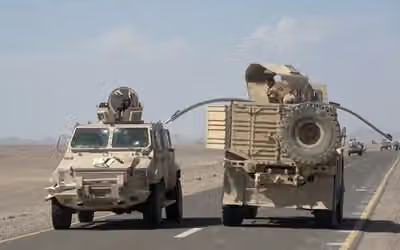
On Friday the provincial governor's office said six bridges had been struck in Khamir county alone, cutting the Bandar Abbas to Lar highway; its list ran from the Gariveh bridge to spans near the villages of Latidan and Maru, with residents told to keep off the routes and leave them clear for rescue teams.
Within a day, officials were adding to it. The Shahid Mirzaei road tunnel was reported damaged in both directions, the Roudkhaneh Shour bridge was hit on the Bandar Abbas to Sirjan route, and two more bridges were damaged on the road from the Minab junction toward Roudan. With attacks continuing nightly, no official list has stayed final for long.
The attacks have also reached utilities. Iranian media reported missile strikes on power facilities and desalination pumps in the coastal city of Jask, leaving some 10,000 people in 20 villages without water, according to the Tasnim news agency. The maritime control tower at Chabahar, which the Tehran daily Etemad described as civilian infrastructure that guides shipping and coordinates sea rescues, was hit for the third time in a week.
A port city going quiet
The cumulative effect is visible in Bandar Abbas, the provincial capital and Iran's main commercial gateway on the strait. Iran International has learned that the city has gone semi-dormant under the naval blockade and the severing of its road links, with activity at Shahid Rajaee, the country's largest container port, reduced to a minimum.
Half of the port's workforce has been laid off in recent weeks, according to the information received, and those still employed are working for minimum pay. More than 4,000 containers are stranded in the port's yards. The blockade closed the sea route weeks ago; the strikes on bridges are now closing the roads.
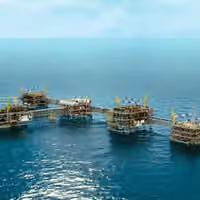
The Strait of Hormuz, which normally carries a fifth of the world's oil, has been shut to Iranian exports and contested for a week, with US Marines boarding a tanker, the Revolutionary Guards saying they stopped four vessels with missile and drone fire, and Washington enforcing what it calls a naval blockade. The Guards say that until US attacks end, not a drop of oil or gas will leave the region.
Talk of a ground campaign
Trump has made no secret of the targeting. He told Fox News this week that the United States would knock out Iran's power plants and bridges unless Tehran returned to negotiations, and said the strikes would continue "until I say it's enough."
Asked in the same interview about sending ground troops, the president declined to rule it out. "Sometimes you need a ground campaign," he said, adding, "we have other people who will do the ground campaign for us." He said American forces had already struck Kharg Island, the hub of Iran's oil exports, two or three times, with instructions to spare the oil terminals themselves.
Vice President JD Vance has said the United States does not intend to send ground troops to Iran, leaving the administration's position less than settled. US officials, for their part, have said the attacks on southern Iran are designed in part to give Trump options.
In Tehran, some of the loudest voices in the Islamic Republic's establishment are reading the map the same way. Amir-Hossein Sabeti, a hardline lawmaker from Tehran, wrote on social media that the destruction of the south's transport links was most likely the prelude to a ground attack, arguing that damaged roads and bridges would hamper the movement of Iranian forces ahead of any attempt to seize islands or key points on the coast.
Sabeti reserved part of his message for his own government, demanding that President Masoud Pezeshkian and Parliament Speaker Mohammad Bagher Ghalibaf either deliver on their promise that the agreement with Washington would end the war or admit their judgment had failed.
The swipe pointed to a widening argument inside the establishment over who bears responsibility for the ceasefire's collapse.
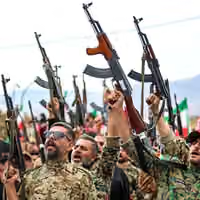
Mohsen Rezaei, an adviser to Iran's supreme leader and a former Revolutionary Guards commander, warned that if US strikes continue for several more days, Iran will move into what he called full-scale offensive operations.
Analysts note that a week of air strikes has not reopened the strait, and that controlling it durably may ultimately require forces on the coast or islands that command it, a step no amount of bombing substitutes for.
The targeting of bridges, power stations and water plants, on both sides, has drawn warnings beyond the region.
UN Secretary-General Antonio Guterres said he was concerned by attacks on civilian infrastructure in Iran and across the Persian Gulf, where Kuwait's desalination plants have been hit twice in two days by Iranian strikes.
The 1949 Geneva Conventions prohibit attacks on sites essential to civilian survival, and American legal scholars warned earlier this year, after Trump first threatened Iran's infrastructure, that such strikes could amount to war crimes.
Oil prices climbed more than 4 percent on Friday to their highest level in over a month, a third straight weekly gain that adds pressure on Trump ahead of November's congressional elections.