• العربية
  • فارسی
Brand
  • Iran Insight
  • Politics
  • Economy
  • Analysis
  • Special Report
  • Opinion
  • Podcast
  • Live TV
  • Iran Insight
  • Politics
  • Economy
  • Analysis
  • Special Report
  • Opinion
  • Podcast
  • Live TV
  • Theme
  • Language
    • العربية
    • فارسی
  • Iran Insight
  • Politics
  • Economy
  • Analysis
  • Special Report
  • Opinion
  • Podcast
  • Live TV
All rights reserved for Volant Media UK Limited
volant media logo

Hegseth urges Iraq to disarm Iran-aligned militias after meeting PM

Jul 15, 2026, 01:14 GMT+1

US Secretary of War Pete Hegseth said on Tuesday that Iraq must assert its sovereignty and disarm Iran-aligned militias that he blamed for more than 600 attacks on US personnel this spring.

“I hosted Iraqi PM Ali al-Zaidi at the Pentagon today. To deepen our partnership, Iraq must assert its sovereignty and disarm the Iran-aligned militias responsible for 600+ attacks on US personnel this spring,” Hegseth posted on X.

“The US is also looking to the Iraqi Security Forces, including the Peshmerga and other Iraqi Kurdistan Region security forces, to lead in D-ISIS efforts as the OIR military missions winds down. A secure Iraq opens the door to strong commercial and defense cooperation,” he added.

Most Viewed

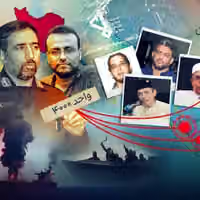
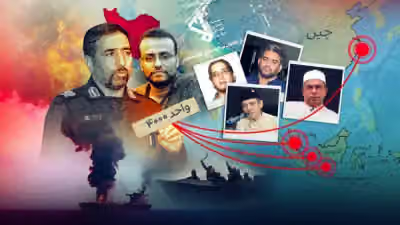
IRGC Unit 4000 plans attacks on shipping in East Asia, sources say
1
EXCLUSIVE

IRGC Unit 4000 plans attacks on shipping in East Asia, sources say

2
INSIGHT

Actor dropped from play after pro-Palestine stance in rare reversal for Iran

3
ANALYSIS

Iran loses ground on trade as war hits oil and non-oil exports

4
ANALYSIS

Iran fires back, but can missiles ease economic pain?

5

Jobs protests met with gunfire in southwestern Iran

Banner
Banner
Banner

Spotlight

  •  Hackers without borders: serving Tehran, stealing on the side
    SPECIAL REPORT

    Hackers without borders: serving Tehran, stealing on the side

  • The republic of magic: How Iran turned the unseen into an instrument of rule
    ANALYSIS

    The republic of magic: How Iran turned the unseen into an instrument of rule

  • President's son questions enrichment, ignites fierce debate in Tehran

    President's son questions enrichment, ignites fierce debate in Tehran

  • Iran fires back, but can missiles ease economic pain?
    ANALYSIS

    Iran fires back, but can missiles ease economic pain?

  • IRGC Unit 4000 plans attacks on shipping in East Asia, sources say
    EXCLUSIVE

    IRGC Unit 4000 plans attacks on shipping in East Asia, sources say

  • Iran loses ground on trade as war hits oil and non-oil exports
    ANALYSIS

    Iran loses ground on trade as war hits oil and non-oil exports

  • Iranians hit back at VP's case for pricier gasoline as dollar passes 2.1m rials
    VOICES FROM IRAN

    Iranians hit back at VP's case for pricier gasoline as dollar passes 2.1m rials

•
•
•

More Stories

US-Iran conflict converges on Hormuz

Jul 15, 2026, 00:46 GMT+1
100%
A projectile is fired during what the US Central Command (CENTCOM) said were strikes on Iran, in this screen grab taken from a handout video released on July 12, 2026

The war between the United States and Iran is increasingly being fought over control of the Strait of Hormuz, with both sides using the strategic waterway as a source of military and political leverage.

CENTCOM said its forces began another round of strikes at 3 p.m. ET against Iranian military assets it said had been used to attack commercial shipping in the strait. It added that US forces were preparing to resume the blockade of Iranian ports and coastal areas at 4 p.m. ET.

The IRGC responded by explicitly threatening regional energy exports, saying that as long as US “evil actions” continued, “not a single drop of oil and gas” would leave the region. It added that further US attacks would delay any reopening of the Strait of Hormuz.

Washington says the strikes are intended to protect commercial shipping and restrict Iranian maritime activity, while Tehran portrays control of the strait as a sovereign right and links its reopening to broader political and military conditions.

The latest operation followed a five-hour wave of US strikes on military sites in Bushehr, Chabahar, Jask, Konarak, Abu Musa and Bandar Abbas, according to CENTCOM.

Iranian media later reported explosions across southern Iran, including Bandar Abbas, Sirik, Ahvaz and Qeshm, while authorities said part of a power plant on Kish Island had been damaged.

At least three people were killed in a US strike in Hormozgan province, according to local officials after an environmental protection post and a fodder warehouse were hit.

As US strikes expanded along Iran’s coastline, Iranian attacks spread across the Persian Gulf.

Kuwait said an Iranian strike hit one of its naval vessels, injuring four service members. Its armed forces also reported intercepting one ballistic missile, five cruise missiles and 33 drones, while falling debris damaged civilian and critical infrastructure.

Bahrain sounded warning sirens after its air defenses intercepted Iranian aerial attacks. The IRGC claimed it had struck US military infrastructure in Bahrain and Kuwait and said it had also targeted a US air base in Jordan with ballistic missiles.

The maritime front widened in parallel. Two crude tankers operated by ADNOC Logistics and Services were hit by projectiles while transiting the Strait of Hormuz.

One Indian crew member was killed and several others were injured, prompting India to summon Iran’s deputy ambassador and lodge a formal protest.

A separate tanker reported being hit by a missile off Oman, while Stolt Tankers said one of its vessels was struck by an unidentified external device, causing a fire in its engine room.

Iranian leaders reinforced the military message with competing claims over the strait. Vice President Mohammad Reza Aref said it was natural for Iran to administer Hormuz while other countries retained the right to use it.

An army spokesperson said the waterway would reopen only under arrangements acceptable to Iran’s armed forces.

Washington, meanwhile, framed the blockade and strikes as measures to keep Hormuz open to non-Iranian shipping.

President Donald Trump said no country or entity should charge vessels for passage and declared the strait open to all traffic except ships traveling to or from Iranian ports or carrying Iranian cargo.

The growing confrontation triggered diplomatic and economic alarm.

Oman called for respect for international law and freedom of navigation, while India and New Zealand summoned senior Iranian diplomats. The Gulf Cooperation Council and several Arab states condemned attacks on commercial vessels and regional countries.

Oil prices climbed as markets assessed the risk of prolonged disruption through the waterway, which carries a significant share of global energy exports. Major shipping companies also rejected proposals for transit fees or restrictions in international waters.

The war that began over Iran’s nuclear program is increasingly being fought over control of the world’s most important shipping lane.

Telegram channels turn women’s private photos into tools of extortion across Iran

Jul 14, 2026, 14:57 GMT+1
100%

Private photos of women posted on Telegram channels in Iran's western Lorestan province have triggered widespread fear and prompted more than 200 complaints, with authorities saying three people accused of running the channels have been arrested on Tuesday.

“The scope of this case is extensive, and more than 200 complaints have so far been filed with the provincial prosecutor's office,” Lorestan prosecutor Ali Hassanvand said.

Three of the channels' main operators had been identified and detained, Hassanvand said.

Police in Lorestan had announced a day earlier that Telegram channels were publishing citizens' private photos with "immoral" content to attract followers and, in some cases, extorting victims and their families by demanding cryptocurrency payments.

Fears over women's safety

Shargh newspaper reported that the channels had attracted tens of thousands of members by publishing women's photos alongside insults, defamatory content and extortion demands.

  • Beyond the hijab: discrimination against women pervades Iranian law

    Beyond the hijab: discrimination against women pervades Iranian law

The newspaper cited social media posts alleging that five girls had died by suicide and another had been killed by her father after their images were circulated. Those reports have not been officially confirmed.

An unnamed women's rights activist in Lorestan told Shargh the incident had heightened fears among women in the province.

“You have to live here and know the families to understand the consequences,” the activist said. “Some women in our province have become so frightened that they have removed their photos even from domestic and foreign messaging apps. Publishing a woman's picture in our city could cost her life.”

Women's rights advocates have long warned that weak legal protections and the persistence of so-called honor killings leave women exposed to violence in parts of Iran.

100%

Extortion spreads beyond Lorestan

Saeed Sozangar, a network security instructor, told Shargh the channels appeared to be motivated by extortion and revenge, warning that some victims' lives could be at risk.

He said similar networks had also been identified in the cities of Malayer, Bukan and Kermanshah, suggesting the activity extended beyond Lorestan.

  • At least 110 women killed in Iran over past year, rights group says

    At least 110 women killed in Iran over past year, rights group says

A citizen who contacted Iran International said the channels copied publicly available profile pictures of women without mandatory hijab from social media accounts and reposted them with highly insulting captions. The source added that anonymous submission links encouraged users to send photos of other women.

Similar channels, according to the citizen, have also appeared in Khuzestan, Kermanshah, Hamedan and Tehran provinces.

Persian Gulf startup hubs hold firm despite Iran war - Bloomberg

Jul 14, 2026, 11:45 GMT+1
100%

The Iran war has yet to trigger an exodus of entrepreneurs from the Persian Gulf, but falling investment, rising costs and slower funding are beginning to test the region’s heavily financed startup strategy, Bloomberg reported on Tuesday.

Abu Dhabi, Dubai, Riyadh and Doha have spent years trying to build globally competitive technology sectors through sovereign wealth, tax incentives, accelerator programs and direct investment.

Despite attacks in the region and renewed fighting between the United States and Iran, founders have largely remained in the region and government-backed programs continue to attract applicants.

None of the 27 companies selected for the February intake of Hub71, Abu Dhabi’s startup program, withdrew after the conflict began, according to Bloomberg. The program’s latest cohort also received a similar number of applications and was the first made up entirely of companies from outside the United Arab Emirates.

The financial effects, however, may not yet be fully visible. Middle East and North African startups raised $1.35 billion in the first half of 2026, down more than 20% from a year earlier, according to data platform Magnitt. The number of deals fell even more sharply to 214, while second-quarter activity dropped to its lowest level in at least two years.

“I don’t believe that the impact of the war has come into the numbers yet, that will come in Q3 and Q4,” Magnitt chief executive Philip Bahoshy told Bloomberg TV, adding that investors were already shifting their attention from early-stage companies toward more established businesses.

Some startups are also facing higher fuel, shipping and insurance costs, worsening cash flow and longer delays in receiving payments. Bloomberg cited one investor as saying that a sovereign investor withdrew a $1 million commitment from a funding round when the war began.

Regional governments are continuing to spend heavily. Hub71 offers successful applicants $140,000 in investment and incentives, while Qatar expanded its Fund of Funds program from $1 billion to $3 billion before the conflict. Startup Qatar has awarded more than $51 million to 45 companies, including 11 since the fighting began.

The Persian Gulf’s startup markets remain smaller than established centers in the United States, Europe and Asia, with limited late-stage financing, technology listings and specialist talent. But founders and investors told Bloomberg that access to capital, lower costs and government support continued to outweigh the risks for many companies.

Iran parliament drops two hardline critics of US talks from security panel posts

Jul 14, 2026, 11:14 GMT+1
•
Niloufar Goudarzi
100%
Iranian lawmakers attend a parliament session in Tehran on July 13, the first plenary meeting in more than four months, chaired by Deputy Speaker Hamidreza Hajibabaei.

Iran's parliament voted two outspoken critics of negotiations with the United States out of senior posts on its National Security and Foreign Policy Committee on Tuesday, a day after lawmakers returned to the chamber for the first time in more than four months.

Mahmoud Nabavian lost his position as the committee's first deputy chairman, while Ebrahim Rezaei was replaced as the committee's spokesperson, according to the committee's annual leadership vote.

Ebrahim Azizi was elected committee chairman, Abbas Moghtadaei and Amir Hayat-Moghaddam were chosen as first and second deputy chairmen, Hassan Ghashghavi was elected spokesperson, and Behnam Saeedi and Yaghoub Rezazadeh became the committee's secretaries.

Critics of US negotiations

Nabavian and Rezaei had emerged as two of parliament's most vocal opponents of negotiations with Washington during and after the conflict with the United States and Israel.

  • Can Tehran seek revenge and negotiate with Washington?

    Can Tehran seek revenge and negotiate with Washington?

Nabavian repeatedly argued that any agreement with Washington would amount to an "absolute loss" for Iran and said the country's experience of negotiations had only brought "broken promises, deception and benefits for the enemy."

He also criticized Parliament Speaker Mohammad Bagher Ghalibaf and Foreign Minister Abbas Araghchi.

Earlier this month, Nabavian also vowed to oppose what he described as a "coup," accusing unnamed political rivals of trying to sideline hardline forces.

Rezaei also said Iran was not intimidated by what he described as threats from US President Donald Trump and that the country was "ready to fight any evil."

In a separate post, he praised the Revolutionary Guards for what he described as asserting Iran's authority over the Strait of Hormuz.

Leak controversy

Nabavian also came under scrutiny after reading excerpts on state television from what he described as secret correspondence from Supreme Leader Mojtaba Khamenei on negotiations with the United States. The broadcast was cut off as he continued speaking.

Nabavian said Khamenei had repeatedly objected to the course of the talks and set conditions that were not reflected in the Iran-US memorandum of understanding, including securing compensation from the United States, preserving Iran's uranium enrichment program and maintaining exclusive Iranian control over the Strait of Hormuz. He also said Khamenei wanted Iran to begin charging some ships to transit the waterway.

State broadcaster IRIB later said Nabavian's references to classified correspondence could warrant legal action. Ghalibaf adviser Amir Ebrahim Rasouli subsequently called on authorities to identify the source of what he described as confidential state information provided to Nabavian.

  • Iran parliament cries censorship after Ghalibaf interview cut short

    Iran parliament cries censorship after Ghalibaf interview cut short

Parliament returns after months

The committee reshuffle came a day after parliament returned to session, with Deputy Speaker Hamidreza Hajibabaei presiding instead of Ghalibaf.

More than 250 lawmakers attended the session, during which legislators chanted slogans calling for revenge for the killing of former supreme leader Ali Khamenei and other senior officials killed in US and Israeli strikes.

Hardline lawmakers affiliated with the Paydari Front had spent months criticizing Ghalibaf for parliament's inactivity, accusing him of preventing lawmakers from meeting in order to avoid parliamentary action against negotiations with the United States. They also repeatedly called for Araghchi's resignation over the talks.

Ghalibaf's office said at the time that the suspension of parliamentary sessions had followed instructions from security authorities.

US personnel faced phone-tracking campaign during Iran war – FT

Jul 14, 2026, 10:09 GMT+1
100%

US military personnel and contractors in the Middle East were targeted in a coordinated phone-tracking campaign before and during the Iran war, the Financial Times reported on Tuesday, citing telecom data, cybersecurity experts and officials familiar with the matter.

“Iran absolutely has capabilities to get real-time, immediate, and continuous location information,” Gary Miller, a senior research fellow at cybersecurity watchdog Citizen Lab, told the FT.

“It would surprise me very much if Iran were not using SS7, or mobile network access in the region, to track US users.”

Telecom networks under pressure

Middle Eastern telecom networks, according to the report, blocked repeated requests known as SS7 pings, which can reveal the approximate location of phones roaming outside their home networks.

Two cybersecurity experts who reviewed the data told the FT the activity appeared to be part of a coordinated effort to locate specific devices.

The tracking attempts came in the build-up to the US-Israeli attack on Iran in late February and continued during the early days of the conflict, when Iran launched missile and drone attacks on US forces and military installations across the region.

100%

A person familiar with the matter told the FT that Persian Gulf officials suspected Iran or allied groups had exploited roaming agreements with regional mobile operators to track US personnel.

Separately, a US official speaking anonymously said actors linked to Iran were also believed to have used commercial advertising databases to locate phones in Iraqi Kurdistan.

US lawmakers renew security concerns

US Central Command told Congress in April that it had received multiple threat reports about adversaries exploiting commercial location data to monitor or target US personnel deployed in the region.

However, Centcom said it had taken force-protection measures to safeguard its forces, while a US official told the FT there was no evidence that data tracking had played a significant role in attacks.

At least some blocked tracking attempts could be linked to an Iranian mobile operator based on a shared technical fingerprint.

“This appears to be very specific user targeting,” Miller told the FT. “They are targeting specific devices.”

The Iranian embassy in London did not immediately respond to the newspaper's request for comment.

The report also said Iran was suspected of using commercially available advertising technology to identify hotels housing US government employees and contractors.

Advertising identifiers assigned to smartphones can enable devices to be tracked without directly compromising the phones themselves.

US lawmakers cited by the FT said the findings underscored longstanding concerns about the military's exposure through commercial location data.

Ron Wyden, a Democratic senator, said he had warned successive administrations for years about the national security risks, while Republican Representative Pat Harrigan said legislation was needed to prevent technology companies from selling location data linked to government employees.