• العربية
  • فارسی
Brand
  • Iran Insight
  • Politics
  • Economy
  • Analysis
  • Special Report
  • Opinion
  • Podcast
  • Iran Insight
  • Politics
  • Economy
  • Analysis
  • Special Report
  • Opinion
  • Podcast
  • Theme
  • Language
    • العربية
    • فارسی
  • Iran Insight
  • Politics
  • Economy
  • Analysis
  • Special Report
  • Opinion
  • Podcast
All rights reserved for Volant Media UK Limited
volant media logo

Iran MP accuses Ghalibaf of shielding Araghchi from parliament

Jul 11, 2026, 11:58 GMT+1

Hardline Iranian lawmaker Hamid Rasaei accused Parliament Speaker Mohammad Bagher Ghalibaf of preventing Foreign Minister Abbas Araghchi from answering lawmakers’ questions during more than four months of war, ceasefire and negotiations.

Rasaei wrote on Telegram that Ghalibaf had kept parliament out of session for four and a half months and had not allowed Araghchi to face even half an hour of questioning.

He contrasted this with a US congressional hearing involving Democratic Representative Seth Moulton and CENTCOM commander Admiral Brad Cooper, saying Iran’s parliament had held no oversight session on the war, ceasefire or memorandum signed with Washington.

Most Viewed

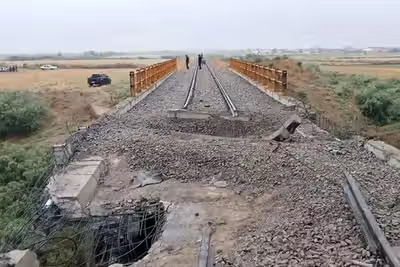
A remote bridge shows how US-Iran war is expanding
1
ANALYSIS

A remote bridge shows how US-Iran war is expanding

2
INSIGHT

US strikes, Hormuz clashes push Iran deal to brink

3

Ali Khamenei buried in Mashhad after days-long funeral

4
INSIGHT

Tehran torn between war and deal as Khamenei is buried

5

Iran turns Friday prayers into nationwide campaign for revenge

Banner
Banner
Banner

Spotlight

  • Iran faces region’s harshest mix of wartime contraction and inflation

    Iran faces region’s harshest mix of wartime contraction and inflation

  • Is the Iran-US MoU dead – or are we asking the wrong question?
    PODCAST

    Is the Iran-US MoU dead – or are we asking the wrong question?

  • For many Iranians, paychecks now barely cover food
    INSIGHT

    For many Iranians, paychecks now barely cover food

  • Iran’s economic pain deepens as factions trade blame
    INSIGHT

    Iran’s economic pain deepens as factions trade blame

  • Tehran torn between war and deal as Khamenei is buried
    INSIGHT

    Tehran torn between war and deal as Khamenei is buried

  • A remote bridge shows how US-Iran war is expanding
    ANALYSIS

    A remote bridge shows how US-Iran war is expanding

  • Trump's rhetoric U-turn leaves Iranians between dread, hope and memes
    VOICES FROM IRAN

    Trump's rhetoric U-turn leaves Iranians between dread, hope and memes

  • We live through decisions we don't make
    TEHRAN INSIDER

    We live through decisions we don't make

•
•
•

More Stories

Iran will not enter talks until US retreats from positions – IRGC media

Jul 11, 2026, 11:31 GMT+1

Tehran will not enter negotiations with the United States unless Washington retreats from its current positions, the IRGC-affiliated Fars News Agency reported Saturday, citing a source close to Iran’s negotiating team.

The source said the Islamic Republic had not requested talks with Washington and would judge any US retreat by whether previously agreed arrangements were implemented.

Those conditions include establishing a special working group on Lebanon aimed at ending the war and securing a withdrawal, resolving navigation through the Strait of Hormuz under arrangements sought by Tehran, and restoring oil exports and flows to normal levels, Fars reported.

Iran hardliner says negotiations are a tool, not a goal

Jul 11, 2026, 11:09 GMT+1
100%

Influential hardline politician Saeed Jalili said negotiations should be judged solely by whether they strengthen Iran, describing diplomacy as a tool rather than an objective.

“Negotiation is a tool, not a goal. It may be effective at one point and ineffective at another,” Jalili, the Supreme Leader’s representative to the Supreme National Security Council, wrote on X.

“If it consolidates and increases the country’s power, it is valuable. If it weakens the country’s power, it is harmful,” he added.

Iran judiciary chief vows punishment, compensation over US-Israeli attacks

Jul 11, 2026, 10:30 GMT+1

Iran’s judiciary chief Gholamhossein Mohseni-Ejei said Saturday that Tehran would pursue those it holds responsible for alleged war crimes during the two recent conflicts and seek compensation for the damage caused.

“War criminals must be punished in proportion to the crimes they committed, and they must also pay compensation,” Ejei said at a meeting with international lawyers involved in pursuing cases against Israeli officials.

He said Iran’s prosecutor-general, the judiciary’s international affairs office and its lawyers’ center were gathering evidence against the United States and Israel, including material related to Ali Khamenei’s killing and attacks on a school in Minab.

US official says no Iran deal without handover of buried enriched uranium

Jul 11, 2026, 09:32 GMT+1

A US official told ABC News that any agreement with Iran would depend on Tehran handing over highly enriched uranium buried under rubble after US airstrikes, referring to the material as “nuclear dust.”

“Either they’re going to give us the nuclear dust or we have very low-cost military options to ensure that it remains buried underground forever,” the official said.

The official said Washington retained military, diplomatic and economic leverage if Iran refused.

“We have a lot of options if they resist giving the dust,” the official said. “The United States fundamentally has the cards. We want the dust.”

“But I want to be clear here that if we don’t get the dust, we do not have a deal with Iran,” the official added.

Iran FM in Oman as fight over Hormuz shipping threatens ceasefire

Jul 11, 2026, 08:29 GMT+1
100%

Iranian Foreign Minister Abbas Araghchi arrived in Oman on Saturday for talks on the Strait of Hormuz and efforts to prevent the renewed US-Iran confrontation from widening.

The latest escalation followed attacks on three commercial vessels using the shipping lane on the Omani side of the Strait of Hormuz. Washington blamed Iranian forces and struck Iranian coastal and naval targets. Tehran disputed responsibility but warned that ships using routes not coordinated with it faced danger.

After the June ceasefire, commercial vessels increasingly used an Oman-backed southern corridor rather than Iran-designated routes.

The shift angered hardliners who feared it could weaken the Islamic Republic’s claim to control shipping through the strait.

The roughly 167-km waterway separates Iran from Oman’s Musandam Peninsula. At its narrowest it is about 54 km wide, with Iranian and Omani territorial waters covering the passage.

The established two-mile shipping lanes run mainly through Omani waters, but international law protects transit through straits used for global navigation.