Iran cleric says Friday prayers will from now on carry calls for revenge
A senior Iranian cleric said Friday prayers across the country would from now on include calls for revenge over the killing of the country's slain supreme leader.
"From now on, every Friday, with the holding of Friday prayers, we will raise the call for revenge and blood vengeance," Shahr-e Kord Friday prayer leader Abolhassan Fatemi said.
Fatemi said "revenge against the oppressors must remain at the forefront of the Islamic Republic's actions," according to the ISNA news agency.
The European Association of Nuclear Medicine (EANM) has barred Iranian citizens from attending its congresses, regardless of where they live, citing European Union sanctions, according to a letter obtained by Iran International.
The letter, sent by the association's head of international customer relations and seen by Iran International, said Iranian nationals cannot be accepted because of "international sanctions and legal requirements."
"This decision is not based on personal considerations but has been taken to comply with the binding legal framework of the European Union," the letter said.
The EANM is a Europe-wide professional organization representing physicians, scientists and healthcare professionals working in nuclear medicine. It organizes one of the field's largest annual scientific congresses and promotes research, education and clinical standards in nuclear medicine.
The association said EU restrictive measures against Iran include sanctions targeting individuals and entities, adding that admitting participants who could fall under those rules could expose the organization to legal and sanctions risks.
To ensure full compliance with EU law, the letter said, registration and participation by all Iranian nationals would not be accepted, regardless of their current country of residence.
The policy makes no distinction between Iranian citizens living in Iran and those residing or holding permanent residence abroad, making Iranian nationality alone the basis for exclusion from the congress.
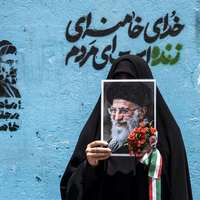
A senior Iranian cleric said the funeral for the country's slain supreme leader reflected the "collective patience" of the Iranian and Iraqi people and strengthened the Muslim world.
"This great, historic and transformative event created by the great nation of Iran and the nation of Iraq was a manifestation of collective patience," Tehran's interim Friday prayer leader Mohammad Hassan Aboutorabi Fard said.
He also said the Muslim world was stronger after the funeral than before it, adding that "this power is the result of collective patience," according to the Fars news agency.
The Revolutionary Guards commander said the killing of the country's slain supreme leader would not weaken the network of Iran-backed armed groups across the Middle East that Tehran calls the "resistance front" and vowed to continue his path.
"Criminal leaders of America and all enemies of the Islamic Revolution and the resistance front should know that by assassinating this divine leader, they will never be able to extinguish the divine light, weaken the will of believing nations, or bring down the banner of resistance," Ahmad Vahidi said in a message.
He added that "the blood of the martyred leader" had become "a flowing spring of awakening, dignity, power and unity for the Islamic nation" and said seeking punishment for those responsible would remain "a definite, legitimate and unforgettable demand."
File photo shows a shopkeeper using a gas-powered lantern inside a darkened store during a power outage in Iran.
Power and water outages have returned to several parts of Iran, residents across the country told Iran International on Friday, describing hours-long blackouts during intense summer heat despite official assurances the electricity network remains stable.
The complaints came as the energy ministry called for consumers to reduce electricity use by at least 10%, warning that high temperatures are expected to push demand above 75,500 megawatts in the coming days.
"Electricity has been out since 2 a.m. and it's now 5 a.m. We still don't have power," one resident in Islamshahr, near Tehran wrote.
Average temperatures, the ministry said, are forecast to reach around 41 degrees Celsius between July 14 and July 18 and remain unusually high through the following week. It urged households to set air conditioners to 25 degrees Celsius, switch off unnecessary electrical appliances and move heavy electricity use outside peak hours to preserve grid stability.
The outages come against the backdrop of a widening structural energy deficit. The latest Statistical Review of World Energy by the Energy Institute found Iran's electricity generation increased by only 1% last year and natural gas production by 1.3%, a sharp slowdown from the previous decade and well below the pace needed to meet rising demand.
Years of underinvestment, delayed infrastructure projects and international sanctions have left the country increasingly unable to meet its own energy needs despite holding some of the world's largest oil and gas reserves.
Residents report outages across Iran
Accounts shared pointed to repeated outages in Tehran province, Alborz, Khuzestan and Fars, with many residents saying electricity was cut for two to three hours at a time.
"Power in Fardis of Karaj went out twice on Thursday – first from 7 a.m. to 7:50 a.m. and then again from 10 until 12:10 p.m.," one resident wrote.
Another in Shiraz said electricity was cut shortly after 1 a.m. on Thursday, while residents in Karaj, in the vicinity of Tehran, also reported another evening blackout.
Several messages came from the southern Khuzestan province, where temperatures regularly climb well above 40 degrees Celsius during the summer.
"They've started the two-hour power cuts again in this unbearable heat," one citizen wrote. "Then they ask what we're supposed to do if power plants are hit."
Another resident questioned why shortages persist despite the province's energy resources.
"With this intense heat in Khuzestan, why should a country this rich suffer shortages of water and electricity?" the resident wrote. "They've started cutting both for at least three hours a day again. Inflation has already broken people's backs."
One person in Masjed Soleyman, Khuzestan province, described losing both electricity and water for three hours, ending the message with a call for public protests.
Food, water and daily life affected
Several said the outages were disrupting everyday life beyond the inconvenience of losing air conditioning.
File photo shows a patient lying on a hospital stretcher during a power outage at a medical facility in Iran.
"I went through so much hardship and debt to buy meat and fish," one resident wrote. "By the time I got home, the electricity went out and we've been without power for three hours. The meat I struggled to buy is spoiling."
Another wrote: "Every day it's either the water or the electricity, or they dig up the streets and take forever to fix them. We live in a city with abundant oil, yet there's poverty and unemployment."
The energy ministry said climate studies show the southern provinces of Hormozgan, Bushehr, Khuzestan, Sistan and Baluchestan and Ilam experience the country's longest periods of extreme heat, placing the greatest strain on the electricity network during the summer.
Officials said reducing air-conditioner settings by one degree and improving energy efficiency could significantly lower demand, urging consumers to conserve electricity to help maintain supplies during the prolonged heatwave.
Messages from Shiraz and Mashhad also described overnight or daytime power cuts, while another resident complained that either electricity or water was being interrupted almost daily.
Officials say prolonged high temperatures have sharply increased electricity demand, particularly in southern provinces, where cooling accounts for a large share of consumption.
Energy experts cited by state media say raising air-conditioner settings by one degree Celsius could reduce cooling demand by roughly 2.5%, while improving the efficiency of cooling equipment and buildings could further lower electricity consumption.
Marine insurers are pricing war risk coverage for ships transiting the Strait of Hormuz just six hours before voyages because of the conflict involving Iran, David Smith, head of marine at London broker McGill and Partners, told CNN.
"Following a period of relative stability and recovering transit volumes, recent events in the Strait of Hormuz have once again shifted the risk landscape," Smith said.
War insurance premiums now "track exactly what is happening geopolitically... almost on an hourly basis," he said, adding that underwriters wanted to price policies six hours before a transit, down from the usual 24 to 48 hours.