• العربية
  • فارسی
BrandBrand
  • Iran Insight
  • Politics
  • Economy
  • Analysis
  • Special Report
  • Opinion
  • Podcast
  • Live TV
  • Iran Insight
  • Politics
  • Economy
  • Analysis
  • Special Report
  • Opinion
  • Podcast
  • Live TV
  • Theme
  • Language
    • العربية
    • فارسی
  • Iran Insight
  • Politics
  • Economy
  • Analysis
  • Special Report
  • Opinion
  • Podcast
  • Live TV
All rights reserved for Volant Media UK Limited
volant media logo
INSIGHT

Khamenei funeral struggles to stay on script

Behrouz Turani
Behrouz Turani

Iran International

Jul 7, 2026, 04:14 GMT+1
A child places a picture of Ali Khamenei among handwritten messages left by mourners on a memorial wall set up during funeral ceremonies in Tehran, July 5, 2026

The weeklong funeral ceremonies for Iran’s slain Supreme Leader Ali Khamenei have been mired in chaotic planning, last-minute changes and political controversy.

Even state-aligned media hinted at organizational problems during one of the Islamic Republic’s most significant public ceremonies in decades, while social media reflected sharp divisions over the scale and meaning of the events.

The problems began almost immediately. Although state media had repeatedly announced that ceremonies would begin on Saturday, July 4, organizers abruptly moved the start forward by one day after realizing that foreign dignitaries had already arrived in Tehran on July 3 because of confusion over invitations.

A major disruption involved the movement of the coffins.

IRGC commander Hassan Hassanzadeh, who oversaw parts of the ceremony, initially announced that designated trucks would carry them from the east toward the west of Tehran, where they would be airlifted to Qom and later transferred to Iraq.

Hours after the scheduled start, state television reported that the plan had been reversed and the coffins would instead move from west to east.

Hassanzadeh later apologized to people who had gathered in eastern Tehran, according to IRGC-linked Fars News, explaining that the change was necessary because the “very large and early presence of people” and the closure of roads made the original route impossible.

Earlier reports also cited concerns that some bridges along the route might not withstand the weight of the crowds, potentially causing a catastrophe.

Hundreds of users on X and Telegram complained that they had arrived in eastern Tehran as early as 5 a.m. on organized tours, unaware of the change.

Critics noted that such logistical issues could have been assessed before the ceremony.

Questions were also raised about official crowd estimates, with social-media users comparing images of gatherings at Tehran’s Grand Mosalla with historic mass events such as the 72,000-person Freddie Mercury concert at Wembley Stadium in 1985.

Some questioned official claims that “millions” had attended the funeral.

Online narratives on X and Telegram were sharply divided.

Pro-government accounts and some Western commentators amplified footage showing a “festival-like” atmosphere outside the Grand Mosalla, with electronic religious music and free drinks.

Others inside Iran expressed frustration over state-mandated disruptions to daily life, rising economic concerns and heavy security measures during a period of national uncertainty.

Reports also emerged of pressure to mobilize participation.

Tehran residents described receiving orders from trade and real-estate unions requiring businesses including gyms, offices and parts of the Grand Bazaar to remain closed.

Basij members reportedly warned some shopkeepers that failing to comply could result in their stores being sealed.

In provinces such as Hamedan, charitable organizations were allegedly pressured to contribute funds, while restaurants in industrial towns near Tehran were reportedly ordered to prepare thousands of free meals for mourners or face closure.

Despite these pressures, videos circulated online appearing to show government officials—including Tehran’s mayor—being served expensive meals from well-known restaurants, while many participants received simple lunches such as egg sandwiches.

Media outlets also noted that the 12-hour procession through Tehran to Mehrabad Airport—and the subsequent transfer of the body to Qom, Najaf, Karbala and finally Mashhad for burial—created immense logistical challenges.

Analysts have compared the extreme caution surrounding Khamenei’s burial to memories of Ayatollah Khomeini’s chaotic 1989 funeral, when crowds overwhelmed security, tore the burial shroud and forced officials to remove the body by helicopter.

But for many observers, the most striking aspect of the ceremonies has been the political messaging.

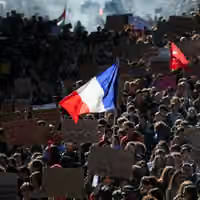
Aggressive slogans, posters targeting US officials and widespread displays of red flags symbolizing revenge have dominated parts of the funeral.

Critics said the tone appeared at odds with Tehran’s diplomatic calendar, with Iranian officials expected to meet US counterparts next week for talks aimed at reaching a broader agreement and easing Iran’s economic crisis.

Most Viewed

Iran looks for escape routes as US sanctions close in
1
INSIGHT

Iran looks for escape routes as US sanctions close in

2
ANALYSIS

From talks to war: Tehran sees the gap narrowing

3
VOICES FROM IRAN

Iran's reported $200 million Hezbollah aid angers cash-strapped citizens

4
ANALYSIS

Three years after October 7, Iran pays the price of miscalculation

5
EXCLUSIVE

Hezbollah recruitment network in Iran exposed, four safe houses identified

Banner
Banner

Spotlight

  • J’Accuse! Tehran defends French students, silences Iranian youth
    OPINION

    J’Accuse! Tehran defends French students, silences Iranian youth

  • Iran turns on Pakistan as Saudi defense pact takes effect

    Iran turns on Pakistan as Saudi defense pact takes effect

  • US pressure hits Iranians harder than rulers, 68% in poll say
    VOICES FROM IRAN

    US pressure hits Iranians harder than rulers, 68% in poll say

  • Saudi Aramco hires US firm to upgrade shared oil field as Iran lags behind

    Saudi Aramco hires US firm to upgrade shared oil field as Iran lags behind

  • Iran looks for escape routes as US sanctions close in
    INSIGHT

    Iran looks for escape routes as US sanctions close in

  • China shifts to Iraqi oil: is Iran using old workaround to beat US blockade?
    ANALYSIS

    China shifts to Iraqi oil: is Iran using old workaround to beat US blockade?

Banner
Banner
•
•
•

More Stories

Khamenei to end Eje'i’s judiciary tenure after one term

Jun 30, 2026, 20:48 GMT+1
100%

Iran's Supreme Leader Mojtaba Khamenei plans to remove judiciary chief Gholam-Hossein Mohseni Eje'i at the end of his first five-year term and appoint a new figure to lead the judiciary, sources familiar with the matter told Iran International.

Sources inside Iran told Iran International that Khamenei does not intend to extend Eje'i’s term for another five years, breaking with a practice followed for nearly four decades in which judiciary chiefs have usually served two consecutive five-year terms.

The sources, who spoke on condition of anonymity, said the decision is not aimed at judicial reform but is part of a broader reshaping of power after the recent war.

They said the new supreme leader is seeking to replace key officials in major state institutions with figures more closely aligned with him.

Eje'i’s expected removal could mark one of the first major signs of Khamenei’s effort to rebuild control over the Islamic Republic’s judicial, security and political apparatus after the transfer of power.

Hardliners step up pressure on Eje'i

The decision comes amid growing criticism of Eje'i from hardline figures after the names of Supreme National Security Council members who voted in favor of a memorandum of understanding with the United States were disclosed.

Critics say Eje'i’s vote was at odds with Khamenei’s stated position, after the leader said in a letter that he had, in principle, held a different view on the memorandum of understanding.

Signs of dissatisfaction with Eje'i’s five-year record have also appeared in recent official and semi-official commentary close to the power structure.

In a message marking Judiciary Week, Khamenei did not clearly endorse Eje'i’s continuation in office. Instead, he addressed the judiciary as an institution and called for the “actualization” of demands previously made by former Supreme Leader Ali Khamenei.

The message repeated calls for the implementation of the judicial transformation document, fighting corruption inside the judiciary, reviving public rights, blocking the use of recommendations and lobbying, and improving communication with the public.

Eje'i seeks to defend his record

A day later, Eje'i published a letter to Khamenei in deferential language, defending the judiciary’s performance and pledging to continue the path of “judicial transformation.”

“I and all components of the judiciary consider ourselves obliged to carry out Your Excellency’s binding commands precisely, swiftly and without any reduction,” Eje'i wrote.

Media outlets and figures close to the establishment criticized Eje'i for not publishing such a letter before Khamenei’s message. Some also described the new leader’s renewed emphasis on his father’s demands as a negative assessment of Eje'i’s record, arguing that their repetition showed the judiciary had failed to deliver practical results under him.

Rival factions inside the establishment have also stepped up attacks on Eje'i, accusing him of distancing himself from the leadership’s demands.

Media close to Parliament Speaker Mohammad Bagher Ghalibaf and President Masoud Pezeshkian have described the attacks as part of an effort by the faction aligned with Saeed Jalili, a member of Iran’s Supreme National Security Council, and the Paydari Front to create divisions among senior officials and weaken the postwar political path.

Media close to the judiciary and Eje'i’s supporters have sought to portray his five-year record as successful, citing reduced imprisonment, electronic court proceedings, shorter trials, anti-corruption efforts and public outreach.

Rights groups point to record of repression

Human rights groups and activists say Eje'i is not a reformist figure but a long-standing part of the Islamic Republic’s repressive judicial and security apparatus.

They point to his record in the Special Clerical Court, the Ministry of Intelligence, and later as first deputy and head of the judiciary, saying his tenure has been marked by continued heavy sentences against protesters, political activists, journalists, prisoners of conscience and minorities.

Rights advocates say the judiciary under Eje'i has continued to act as the legal and executive arm of security institutions in political and security cases.

They also argue that replacing Eje'i alone would not bring meaningful change without structural reform, an end to security interference in judicial cases, guaranteed access to lawyers, a halt to forced confessions, the annulment of political verdicts and respect for fair trial standards.