Lebanese president says country will not be tied to Iran-US track
Lebanese President Joseph Aoun said Lebanon had taken a sovereign decision to keep its course separate from the Iran-US track, according to remarks carried by LBC Group on Friday.
"Our sovereign decision to separate our path from the Iranian-American path is a problem for some people who are used to being under a guardianship that controls us, decides for us and negotiates on our behalf," Aoun was quoted as saying.
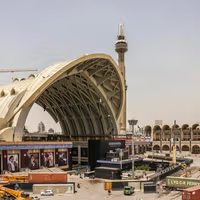
Preparations at Tehran's Grand Prayer Ground, on Thursday, July 2, 2026, where extensive state resources and infrastructure have been deployed ahead of funeral ceremonies for slain Supreme Leader Ali Khamenei.
Funeral spending for former Supreme Leader Ali Khamenei has fueled public anger, with messages to Iran International saying authorities are forcing businesses and state employees to fund ceremonies, provide services or attend events before his burial.
More than four months after Khamenei's death on February 28, authorities say he will be buried on July 9 following five days of ceremonies across Iran and Iraq. Officials have attributed the unusually long delay to wartime conditions and security concerns.
Messages sent to Iran International from people across the country describe what was a broad campaign to mobilize resources for the funeral, even as many Iranians struggle with inflation and declining living standards.
"We work at the terminal, and they told us we are not allowed to sell tickets for three days," one person wrote. "Every shop inside the terminal has also been ordered to close, and they are not even reducing our rent."
Businesses told to shoulder costs
Another message from Semnan said industrial companies had been instructed to finance roadside service stations for mourners.
Tehran Grand Prayer Ground is being prepared on July 2, 2026 for funeral ceremonies of former Supreme Leader Ali Khamenei, with state facilities deployed at significant public expense.
"They forced companies in the industrial zone to set up booths and provide soup, tea, juice and dates at their own expense," the person wrote. "This is a government order for all organizations."
Another message said companies in Tehran had been compelled to contribute large sums for the funeral.
"The Islamic Republic and the Revolutionary Guards have forced all companies in Tehran to pay for booths and food for the funeral," the message said. "More than 1,000 billion rials (over $570,000) has been taken from automobile manufacturers, while workers are struggling to make ends meet."
People identifying themselves as employees of Iran's Civil Registration Organization also said staff had been offered incentives to attend the ceremonies.
"Today we were each given 20 kilograms of rice so we would participate in the ceremony," a citizen said. "But we are going to northern Iran instead (for fun)."
The reported pressure comes as the average monthly income is around $150, according to independent estimates, well below a poverty line estimated at roughly $350 for a family, leaving many households struggling to meet basic needs.
Economic hardship fuels backlash
Several also criticized the cost of the funeral during a period of economic hardship.
"People are being destroyed by poverty and inflation, while those in power are spending the nation's wealth on the funeral," one person wrote.
Another said bread prices had been raised before the ceremonies, but they are distributing free bread.
"They increased bread prices just before the funeral," the message read. "Now they want to hand out free bread along the procession routes so more people will attend."
A large number of messages urged people to wear bright-colored clothing instead of black during the official mourning period, saying they would mark the occasion by celebrating rather than mourning. Several also described Khamenei's burial as symbolizing the eventual end of the Islamic Republic.
Iran has announced funeral processions beginning in Tehran before continuing through Qom, Iraqi cities of Najaf and Karbala ahead of Khamenei's burial in Mashhad on July 9.
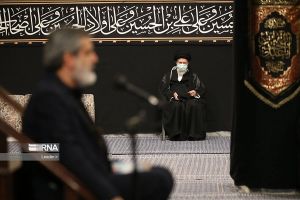
An interior view of Tehran's Grand Prayer Ground on July 2, 2026 shows black mourning decorations and seating arrangements prepared for funeral ceremonies of slain Supreme Leader Ali Khamenei.
Images published by state media on Friday showed foreign delegations attending a ceremony in Tehran where the coffins of Khamenei and members of his family were on display.
Authorities have also announced heightened security measures, including temporary airspace restrictions over Tehran and Mashhad during the ceremonies.
Iranian authorities began receiving foreign delegations to view the coffin of former Supreme Leader Ali Khamenei earlier than originally scheduled on Friday, state media reported.
State news agency IRNA said the coffin of Khamenei and those of several members of his family were placed at Tehran's Imam Khomeini Grand Mosalla before dawn, allowing foreign guests already in the capital to attend farewell ceremonies.
IRNA said the ceremonies had initially been scheduled to begin later on Friday but were brought forward to help manage the programme. Foreign delegations, including representatives of religious minorities and members of what Iran calls the "Axis of Resistance", were among the first to attend, it said.
Israeli prosecutors have charged a 21-year-old Jerusalem man with carrying out alleged espionage tasks for Iranian intelligence in exchange for hundreds of dollars in cryptocurrency, Israeli media reported on Friday.
The Times of Israel, citing an indictment filed in the Jerusalem District Court, said Eli Levon was accused of photographing sites including Jerusalem's Central Bus Station and passing information to two alleged Iranian handlers.
He was charged with contact with a foreign agent and providing information that could benefit an enemy, the report said.
File photo shows an addict woman smoking a cigarette while gathered with others in an outdoor area in Iran.
Counterfeit and adulterated illicit drugs kill around 7,000 people in Iran each year, a senior anti-narcotics official said on Thursday, warning that dangerous impurities in illegal drugs have become a major public health concern.
The comments, published by the Iranian Students' News Agency (ISNA), came as officials highlighted the growing presence of new psychoactive substances that they say are not covered by Iran's current anti-drug legislation.
"Seven thousand people die every year because of consuming counterfeit narcotics," Amirhossein Yavari, deputy for prevention and treatment at Iran's Drug Control Headquarters, said.
"These deaths occur because of impurities and dangerous compounds found in illicit narcotics and psychotropic substances, and accurate public awareness can play an important role in reducing the harm."
Contaminants and hazardous additives in illegal narcotics and psychotropic substances have made them increasingly dangerous, Yavari said.
File photo shows a man using drugs with the assistance of another man.
Iran has one of the world’s most serious drug-use problems, driven by its proximity to Afghanistan and the long-standing availability of opium and heroin.
Official and expert estimates vary, but Iran is generally believed to have around 2.8 million regular drug users, while broader estimates including occasional users can reach 4 million or more.
Last week, Soleiman Abbasi, Director General of Treatment at Iran's Drug Control Headquarters, warned of the rapid spread of synthetic narcotics and new psychoactive substances in Iran, announcing that the number of people with substance use disorders in the country has reached approximately 3.8 million.
Opium remains the most common drug, though heroin, methamphetamine and synthetic drugs have also become major concerns.
Hundreds of substances outside legal framework
In separate comments, Mohammad Tarahomi, legal and parliamentary affairs director at Iran's Drug Control Headquarters, said around 409 narcotic, psychotropic and new psychoactive substances identified in Iran are not included in the country's official list of controlled drugs.
Updating the list is one of the most urgent priorities in proposed amendments to Iran's anti-drug law because it has not been revised since 2011, Tarahomi said.
"In the past we generally classified drugs into three main groups: narcotics, psychotropic substances and stimulants," Tarahomi added. "Today, not only in Iran but around the world, we are facing a phenomenon known as new psychoactive substances."
Many of the newer compounds, he said, have more severe effects than traditional narcotics or previously known synthetic drugs and differ in how they affect users.
A study using Iran’s Forensic Medicine Organization data by Lancaster University of the United Kingdom recorded 11,944 drug-related deaths between March 2022 and March 2024, with the average age of death around 37 and men accounting for the overwhelming majority.
Older official data showed about 3,000 drug-abuse deaths a year, suggesting the annual toll has risen sharply in recent years.
File photo shows two people with substance use disorders preparing drugs together in an outdoor area in Iran.
Not all of the substances are entirely new, Tarahomi added. Some, including so-called magic mushrooms, have existed for years but have become subject to tighter restrictions as evidence of their medical and social consequences has grown.
Most newly identified substances, however, are synthetic chemicals created by combining existing compounds to produce drugs with different effects.
Tarahomi said some new psychoactive substances can have even more severe consequences than established narcotics and stimulants, citing cases in which methamphetamine-induced psychosis has led users to lose touch with reality and commit violent crimes.
Manufacturers, he added, can rapidly create new substances by making minor chemical changes, making quicker legal updates essential to keep pace with the evolving drug market.
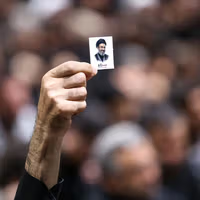
A man holding a photo of Supreme Leader Mojtaba Khamenei during a religious ceremony in Tehran
A senior aide to President Masoud Pezeshkian has turned Iran’s dispute over the US memorandum into a fight over authority, arguing that Supreme Leader’s views are subject to expert review within the state’s decision-making bodies rather than implemented automatically.
Vice President Mohammad-Jafar Ghaempanah came under fierce criticism from ultra-hardliners after saying Khamenei’s recent message on the memorandum showed respect for the Islamic Republic’s institutional decision-making process, not opposition to the agreement.
The dispute follows the publication of a written message attributed to Khamenei, in which he said he had “a different view in principle” about the memorandum but approved it after receiving assurances from the Supreme National Security Council and its chairman, Pezeshkian, that Iran’s national interests and those of the so-called Axis of Resistance would be protected.
That phrase has become the center of an increasingly bitter dispute.
Ultra-hardliners argue that Khamenei’s statement proves he had serious reservations about the agreement and accepted it only under pressure.
Some conservative figures and media outlets, including the hardline daily Kayhan, have warned that portraying the Supreme Leader as being at odds with the SNSC risks deepening political polarization.
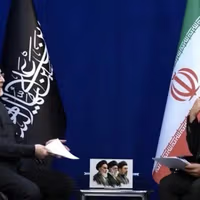
Vice President Mohammad-Jafar Ghaempanah (left) and Iranian President Masoud Pezeshkian
A message read two ways
According to Ghaempanah, Khamenei had instructed that the memorandum be discussed at an SNSC meeting attended by senior military commanders, and had said the agreement should be accepted if three-quarters of members approved it.
“If every opinion expressed by the Leader were implemented without question, there would be no need for institutions such as parliament or the SNSC. The Leader expresses his views, and those views are examined by experts,” he added.
Ghaempanah said all but one member voted in favor of signing the memorandum, after which Khamenei authorized it while warning that “Iran must not retreat in the face of excessive American demands.”
He also said Khamenei’s reported remark that he had “a different view in principle” did not mean opposition to the memorandum, but instead strengthened Iran’s bargaining position with the United States.
Authority at the center of backlash
Ultra-hardliners interpreted Ghaempanah’s remarks as diminishing the doctrine of Velayat-e Faqih, or Guardianship of the Islamic Jurist, arguing that he had implied the Supreme Leader’s view could be subordinated to decisions taken by the SNSC.
Reza Narimani, a prominent eulogist or maddah (religious singer) associated with the ultra-hardline camp, accused Ghaempanah of misunderstanding the concept of Velayat-e Faqih.
Writing on the hardline Raja News website, Narimani said Ghaempanah should not hold office if he believed “not everything the Leader says is binding,” arguing that practical commitment to the Leader’s directives is a prerequisite for serving in the Islamic Republic.
He further wrote that Ghaempanah “is not in a position to subject the Leader’s opinion to expert review because the Leader’s opinion itself is the expert judgment within the framework of divine law.”
Addressing Ghaempanah directly, Narimani added: “The problem is your understanding. Your understanding of the Guardianship of the Islamic Jurist is flawed, and that is why the country’s problems remain unresolved. Instead of negotiating with America and looking to the West to solve the country’s problems, improve your own understanding until it reaches that of the Leader.”
The comments were widely shared by ultra-hardline social media users.
One user, Hamid Khorasani, wrote: “This system is the system of the Guardianship of the Islamic Jurist. Either you do not understand the meaning of Absolute Guardianship of the Islamic Jurist, or you do understand and are acting on behalf of the enemy.”
Another user wrote: “You cannot consider your own opinion on par with the opinion of the Leader! According to the Constitution … the Leader’s opinion is the top priority of the entire system and governmental institutions.”
The 'coup' claim spreads
The controversy comes amid an escalating ultra-hardline campaign against the Pezeshkian administration over the US memorandum.
Hardline lawmaker Mahmoud Nabavian has already accused Pezeshkian and Parliament Speaker Mohammad Bagher Ghalibaf of carrying out a “coup” against the Supreme Leader by bypassing his authority to push through the agreement with Washington.
A hardline social media user, Shahram Rashidnia, wrote that “the time for advice and warnings to Pezeshkian’s government is over; the coup against the Leader is now open and explicit.”
He urged supporters to use Khamenei’s funeral ceremonies to defeat what he described as the conspiracy.
Government says remarks distorted
Supporters of the government argue that Ghaempanah was explaining Khamenei’s message, not challenging his authority.
They say the text shows that Khamenei initially held a different view but approved the memorandum after receiving guarantees from Pezeshkian on behalf of the SNSC, while making clear that implementation depended on the United States honoring its commitments and avoiding excessive demands.
The Executive Vice Presidency’s public relations office issued a statement on Wednesday rejecting criticism of Ghaempanah’s remarks, saying they had been taken out of context and distorted.
It said his comments “in no way conflict with the position of the Guardianship of the Islamic Jurist.”
The statement also warned that “in the current sensitive circumstances, taking officials’ remarks out of context and creating a false dichotomy between the Leader and the state’s institutions not only fails to protect the position of the Guardianship of the Islamic Jurist but could weaken national cohesion and distort understanding of governance in the Islamic Republic.”