• العربية
  • فارسی
Brand
  • Iran Insight
  • Politics
  • Economy
  • Analysis
  • Special Report
  • Opinion
  • Podcast
  • Iran Insight
  • Politics
  • Economy
  • Analysis
  • Special Report
  • Opinion
  • Podcast
  • Theme
  • Language
    • العربية
    • فارسی
  • Iran Insight
  • Politics
  • Economy
  • Analysis
  • Special Report
  • Opinion
  • Podcast
All rights reserved for Volant Media UK Limited
volant media logo

Iranians barely visible in US-Iran deal, UN rapporteur says

Jul 1, 2026, 06:16 GMT+1

The US-Iran memorandum of understanding failed to address human rights and risked leaving Iranians without accountability, UN Special Rapporteur on the situation of human rights in Iran Mai Sato said, according to a report by Geneva Solutions on Wednesday.

The US-Iran memorandum of understanding failed to address human rights and risked leaving Iranians without accountability, the UN Special Rapporteur on Iran Mai Sato said, according to a report by Geneva Solutions on Wednesday.

“The Iranian people are barely visible in the framework,” Sato said in the interview conducted last Friday. “It serves geopolitical interests while leaving the Iranian people behind.”

She warned that an agreement that excludes human rights could return Iran to its pre-war conditions or make repression worse.

Continue reading

Most Viewed

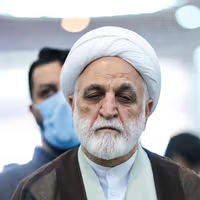
Khamenei to end Eje'i’s judiciary tenure after one term
1
EXCLUSIVE

Khamenei to end Eje'i’s judiciary tenure after one term

2
ANALYSIS

Is Tehran preparing to reinvent the IRGC?

3

Deadly attacks shake northwest Iran as IRGC reports new clashes

4

Iran bows out of World Cup amid flags, Pride and protest

5

How Trump decided to strike Iran, new book reveals final hours

Banner
Banner
Banner

Spotlight

  • How Trump decided to strike Iran, new book reveals final hours

    How Trump decided to strike Iran, new book reveals final hours

  • Khamenei to end Eje'i’s judiciary tenure after one term
    EXCLUSIVE

    Khamenei to end Eje'i’s judiciary tenure after one term

  • Iran among top foreign espionage threats to Germany, security report says

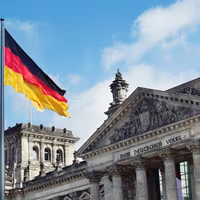
    Iran among top foreign espionage threats to Germany, security report says

  • Two-week banking disruption leaves Iranians struggling to access money
    VOICES FROM IRAN

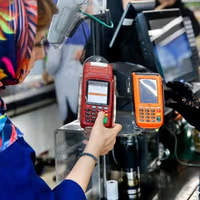
    Two-week banking disruption leaves Iranians struggling to access money

  • Every flare-up narrows space for diplomacy in Tehran
    INSIGHT

    Every flare-up narrows space for diplomacy in Tehran

  • Past funeral disasters cast a shadow over Khamenei's burial
    INSIGHT

    Past funeral disasters cast a shadow over Khamenei's burial

•
•
•

More Stories

Iranians barely visible in US-Iran deal, UN rapporteur says

Jul 1, 2026, 06:11 GMT+1
Iranians barely visible in US-Iran deal, UN rapporteur says
100%
UN Special Rapporteur on the situation of human rights in Iran Mai Sato attends a session of the Human Rights Council at the United Nations in Geneva, Switzerland, March 16, 2026.

The US-Iran memorandum of understanding failed to address human rights and risked leaving Iranians without accountability, UN Special Rapporteur on the situation of human rights in Iran Mai Sato said, according to a report by Geneva Solutions on Wednesday.

The US-Iran memorandum of understanding failed to address human rights and risked leaving Iranians without accountability, the UN Special Rapporteur on Iran Mai Sato said, according to a report by Geneva Solutions on Wednesday.

“The Iranian people are barely visible in the framework,” Sato said in the interview conducted last Friday. “It serves geopolitical interests while leaving the Iranian people behind.”

She also said the crackdown on Iran’s nationwide protests should not be forgotten as attention turns to the war and US-Iran diplomacy.

“The war started soon after the crackdown on the nationwide protests that began at the end of December 2025, when the Iranian people spoke up and asked for fundamental change – and I think that should not be forgotten,” Sato said.

She warned that an agreement that excludes human rights could return Iran to its pre-war conditions or make repression worse.

“An MoU, and the final agreement, that doesn't address the human rights situation risks simply reverting to how things were before or worse enabling further repression through a continued lack of accountability,” she said.

Sato said the MoU focused almost entirely on military withdrawal, reopening the Strait of Hormuz and nuclear commitments, with only a reconstruction fund pointing indirectly to the public’s needs.

“It’s worth noting, though, that not all of the economic hardship stems from the war or sanctions; domestic policy decisions have also played a part,” she said.

Sato said she wanted any final deal to include a halt to executions, the release of people arbitrarily detained, a guarantee of open internet access and protection of civic space.

She also said she had contacted US authorities about alleged rights violations during the war but had not received a response.

“I have indeed reached out, but haven't received a response,” she said.

Hardline cleric urges retaliation for Khamenei killing

Jul 1, 2026, 04:02 GMT+1

Hardline cleric Mohsen Ghanbarian called for retaliation over the killing of Iran's Supreme Leader Ali Khamenei, saying senior officials would remain under threat unless those responsible were punished.

Speaking to a crowd gathered in Tehran on Tuesday, Ghanbarian said that without retaliation, "the current leader and other leaders of the Islamic Republic will always have to live in hiding."

"If we do not exact retaliation for the killing of our leader, then there is no doubt that the current leader and other leaders of the Islamic Republic will always have to live in hiding. That much is obvious. Those officials who went to Geneva probably saw the same tweet we did: if you do not make a deal, you will not return to your country. Mr. Ghalibaf is now on Netanyahu’s assassination list," Ghanbarian said.

IRGC moves to seize historic Protestant church in Tehran

Jul 1, 2026, 03:47 GMT+1
IRGC moves to seize historic Protestant church in Tehran
100%
The Saint Peter Evangelical Church - Tehran

Iranian authorities have stepped up pressure on one of the country’s few surviving Protestant churches, threatening to confiscate its valuable central Tehran compound and evict residents, in what church leaders describe as the latest assault on Christian worship sites.

The Saint Peter Evangelical Church, widely referred to locally as the Qavam church after its location on Si-e-Tir Street (formerly Qavam-ol-Saltaneh Street), has served Tehran’s small Protestant community for nearly 150 years.

“Six security forces went into the church and sat through a session, saying they wanted to ‘identify’ people,” said Sasan Tavassoli, a US-based minister with the Presbyterian Church in Iran. “They said they’ll return later to evacuate those living on the premises and take over.”

Established in 1876 by American missionaries on land granted by the Qajar monarch Naser al-Din Shah, the church has long been a focal point for Armenians and Assyrians in Iran - whose numbers have dramatically declined under the Islamic Republic.

Tavassoli noted the property’s significant value: “It’s worth tens of millions of dollars,” describing it as spanning “several hectares” of prime real estate in central Tehran.

The Evangelical Church of Iran has issued an urgent appeal to the international community to intervene.

In a letter signed by the Executive Secretary of the Synod of the Evangelical Church of Iran in Diaspora (SECID), church leaders expressed “severe distress” and accused the regime of becoming increasingly emboldened since negotiations towards a potential US-Iran deal began. “The regime is no longer afraid of the international community,” the letter states.

The authorities have already seized a 10,000 sq m garden belonging to the church, now reportedly occupied by four IRGC officials. A new deed has been issued in the IRGC’s name, with church employees and members now deemed trespassers on what was historically their own property.

Tehran claims the church had improperly rented parts of the premises to members.

Church leaders say the move fits a broader pattern of pressure on Iran’s tiny Protestant community. The latest threats follow the destruction of the Evangelical Church of Mashhad on 4 June.

The synod’s letter warns: “It is clear that without a swift response to this crisis, we may be deprived of our last remaining church centres in the country.” It calls for international action to halt “the ongoing process of expelling Christians from their places of worship and the occupation and destruction of these properties.”

Iran’s Christian communities, particularly Protestants who conduct services in Persian, have faced increasing restrictions since the 1979 Islamic Revolution.

While recognised religious minorities such as Armenian and Assyrian Christians have some protected status, evangelical and Protestant groups have repeatedly reported surveillance, forced closures and property seizures. St Peter’s itself was earlier ordered to stop Persian-language services.

As one of the last functioning Protestant sites in the capital, the fate of the Qavam church has become a symbol of the shrinking space for minority religious practice in the Islamic Republic.


Trump urged to reverse Iran's long record of negotiating gains

Jul 1, 2026, 03:37 GMT+1

Clifford D. May, president of the Foundation for Defense of Democracies (FDD), said in a Washington Times commentary published on Tuesday that US President Donald Trump should prevent Iran from continuing what he described as its decades-long success in negotiations with Washington.

May wrote that while recent US military operations had significantly weakened Iran's nuclear and conventional capabilities, Tehran had historically gained leverage in diplomacy through tactics including hostage-taking and by exploiting what he described as repeated US restraint and misjudgment.

The commentary said Trump had an opportunity to break what May described as Iran's long-standing advantage at the negotiating table.

Commentator calls for retaliation over threats against Iran’s leader

Jul 1, 2026, 02:58 GMT+1

A hardline media figure said senior clerics supported fatwas authorizing retaliation against individuals responsible for threats against Iran’s leader, but the government did not take it seriously or treat it as official policy.

Mohsen Maghsoudi said in a TV segment on Tuesday that the overwhelming majority of members of the Assembly of Experts — about 70 members — signed a fatwa calling for retributive justice against those he described as the perpetrators of the assassination of the “martyred leader.”

“When our officials were asked about such rulings, the president described them as a ‘personal opinion’ and not state policy.”

The comments were followed by hardline cleric Mohsen Ghanbarian, who said that, thanks to state TV, viewers saw a segment saying Trump would be in Turkey for a NATO summit, and he called on supporters in Turkey and Iran to follow orders for retaliatory punishment.