Any deal with US would be tactical, not strategic, Tehran Friday prayer Imam says
Iran makes no distinction between different US administrations and sees the United States and Israel as "two sides of the same coin," Tehran's Friday prayer imam said, insisting the Islamic Republic had no trust in Washington's commitments.
Mohammad Javad Ali Akbari said Iran had "no trust in America's promises and commitments" and that any agreement reached because of regional or international considerations, or out of respect for neighboring countries, "does not mean a strategic understanding."
"It is only a contingent agreement," he said.
Ali Akbari also said the Iranian people still regarded themselves as "the avengers of the blood" of Supreme Leader Ali Khamenei and others killed on what he called the "path of truth."
Billboards showing Iran’s new Supreme Leader Mojtaba Khamenei and his late father, Ali Khamenei, on the road to Beirut’s airport (June 2026)
Lebanon has ordered the removal of billboards showing Iran’s new Supreme Leader Mojtaba Khamenei and his late father from the road to Beirut’s airport, turning a dispute over public posters into a test of who gets to define the country’s fragile post-ceasefire moment.
The billboards, installed this week along the route to Beirut-Rafic Hariri International Airport, carried the slogan “Thank you to loyal Iran.” They appeared days after a ceasefire was announced between Israel and Hezbollah as part of wider US-Iran negotiations, and as Lebanese and Israeli officials continued direct US-mediated talks over southern Lebanon.
Interior Minister Ahmad Hajjar said Thursday he had ordered the banners and posters removed within two days. Speaking on the sidelines of a Cabinet meeting, he said the decision was part of efforts to regulate public spaces and enforce existing laws.
But the timing gave the order wider political weight. Hezbollah and its allies have portrayed the ceasefire as proof of Iran-backed “resistance” leverage, while Lebanon’s government is trying to show that decisions over the country’s territory, security and public space still belong to the Lebanese state.
The airport road is one of Lebanon’s most visible political corridors. For years, posters and banners linked to Hezbollah, Amal and Iran-aligned figures have lined parts of the route into Beirut.
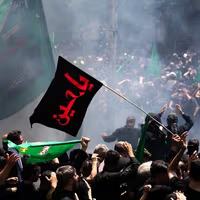
Shiite mourners walk past a banner depicting Iran's late Supreme leader Ali Khamenei as they mark Ashura, the holiest day on the Shiite Muslim calendar, in the southern suburbs of Beirut, Lebanon, June 26, 2026.
In 2022, Lebanon’s Tourism Ministry asked Hezbollah and Amal to remove billboards showing religious and political figures from the same road and replace them with signs promoting tourism.
The latest posters carried a sharper message. By thanking Iran days after the ceasefire, they presented Tehran not as an outside power in Lebanon’s war but as the loyal patron whose support helped shape the outcome.
That message comes as the ceasefire itself remains unsettled. Lebanese and Israeli officials have been engaged in US-mediated talks over southern Lebanon, including proposals for Israeli forces to hand some areas to the Lebanese army and for Hezbollah to be kept out of those zones.
Israel, however, has signaled it does not intend to leave southern Lebanon quickly. Prime Minister Benjamin Netanyahu has said Israel will remain in a southern security zone as long as required, while Defense Minister Israel Katz has said Israeli troops will not withdraw even under US pressure.
The ceasefire has also been strained by continued violence. Local and international reports have described Israeli strikes and gunfire in southern Lebanon since the truce was announced, while Hezbollah has accused Israel of violating the agreement.
Hezbollah, for its part, has rejected any settlement that resembles normalization with Israel. In a televised Ashura address on Friday, Hezbollah leader Naim Qassem said Israel must leave Lebanon “unconditionally” and said the group would accept no normalization, no end to hostility with Israel, no gains for Israel and no partial Israeli presence on Lebanese soil.
His remarks placed Hezbollah on a collision course with the logic of the US-mediated talks, which depend on a negotiated security arrangement in the south. They also reinforced the message carried by the airport road billboards: that Iran and Hezbollah see the ceasefire as part of a wider regional struggle, not merely a Lebanese border arrangement.
For Lebanon’s government, the posters created an immediate sovereignty problem. Leaving them in place would allow an Iran-Hezbollah victory message to dominate the country’s main international gateway at the very moment Beirut is trying to negotiate under its own authority.
Removing them, however, exposes the limits of that authority. The Lebanese state can clear a road, but it cannot easily resolve the deeper conflict behind the posters: Hezbollah’s weapons, Israel’s presence in the south, Iran’s role in the ceasefire and Washington’s attempt to keep Lebanon’s track separate from its broader deal with Tehran.
An Iranian state television correspondent said on Friday that three foreign oil tankers changed course after the Islamic Revolutionary Guard Corps (IRGC) Navy warned ships not to use what it described as an unauthorized route through the Strait of Hormuz.
According to the correspondent, the IRGC Navy issued a warning at around 4 a.m. on Thursday, saying a new transit route announced by some authorities without coordination with Iran was "illegal, unacceptable and highly dangerous."
The correspondent said three foreign tankers that had intended to use the southern corridor through the strait "were stopped and changed their course toward the Persian Gulf."
He also said ships must coordinate passage through the Strait of Hormuz with the IRGC Navy via marine radio Channel 16 and warned that vessels using routes other than those designated by Iran could face "legal and severe" action.
The report further said ships transiting through unauthorized routes could lose insurance coverage and that any consequences would be the responsibility of vessel owners, operators and captains.
Iran will not allow UN nuclear inspectors into key sites such as Fordow, Natanz and Isfahan before a final nuclear agreement is reached, the IRGC-affiliated Fars news agency reported on Friday, citing people familiar with the contents of the US-Iran memorandum of understanding.
According to the sources cited by Fars, the International Atomic Energy Agency's role is defined only for the period after a final agreement.
The report said Article 8 of the memorandum lists one possible option for handling nuclear material as dilution inside Iran under IAEA supervision, but only after four issues are resolved: the full lifting of sanctions, details of Iran's economic reconstruction, the scope and framework for the withdrawal of US forces from the region, and closure of the nuclear file.
Fars cited "informed sources" as saying that Article 9 states Iran will make no change to its nuclear program before a final agreement is reached.
It said the "implicit interpretation" of that article was that current levels of IAEA monitoring would continue unchanged. Under that arrangement, Fars said, Iran would continue to allow limited access to sites in Bushehr and Tehran but would not allow inspectors into other facilities, including Fordow, Natanz and Isfahan.
The report said diplomats familiar with the talks believed IAEA chief Rafael Grossi was seeking to define a larger role for the agency before a final deal, but that Tehran's position was to keep the current process and reject any expanded demands before an agreement.
A Friday prayer Imam in Iran said the country's hostility toward the United States was "deep-rooted, fundamental and endless," adding that Tehran had "no trust" in Washington despite ongoing negotiations.
Omran Hosseininasab, the Friday prayer leader of Soltaniyeh in Zanjan province, said Iran entered talks with the United States as "the plaintiff, the creditor and the avenger of blood."
"We have no trust in the enemy," he said.
Hosseininasab also said that reports suggesting chants of "Death to America" had been discouraged were false, describing the slogan as the "permanent slogan of the Iranian nation."
He further said that killing Supreme Leader Ali Khamenei was "America's greatest crime" and that the "stain of that crime would remain on the forehead of the United States forever."
Mohammadnabi Mousavifard, the Supreme Leader's representative in Khuzestan and Friday prayer Imam in Ahvaz, warned that any future "mistake" by Iran's enemies would draw a decisive response.
"The remaining US bases in the region and Israel are within range of the Islamic Republic's missiles," Mousavifard said.
He also said Iran's negotiating team in Switzerland had been tasked with pursuing conditions set by Mojtaba Khamenei.
"The mission of the negotiating team in Switzerland is to pursue Mojtaba Khamenei's conditions," he said.
Mousavifard added that if the other parties did not honor their commitments, "the Islamic Republic will also return to the previous conditions."