• العربية
  • فارسی
Brand
  • Iran Insight
  • Politics
  • Economy
  • Analysis
  • Special Report
  • Opinion
  • Podcast
  • Iran Insight
  • Politics
  • Economy
  • Analysis
  • Special Report
  • Opinion
  • Podcast
  • Theme
  • Language
    • العربية
    • فارسی
  • Iran Insight
  • Politics
  • Economy
  • Analysis
  • Special Report
  • Opinion
  • Podcast
All rights reserved for Volant Media UK Limited
volant media logo

UN says Lebanon ceasefire largely holds

Jun 25, 2026, 23:59 GMT+1

The ceasefire in southern Lebanon has “continued to largely hold” despite ongoing Israeli military activity, the United Nations said on Thursday, as peacekeepers continued to report airspace violations and limited ground operations.

UN spokesperson Stephane Dujarric told reporters in New York that the UN Interim Force in Lebanon (UNIFIL) had not detected any new trajectories or air strikes since two were observed on Tuesday.

However, he said peacekeepers continued to observe Israeli military activity by air, land and sea.

Most Viewed

IRGC personnel sheltered in Shiraz lodging complex were target of deadly strike
1
EXCLUSIVE

IRGC personnel sheltered in Shiraz lodging complex were target of deadly strike

2
EXCLUSIVE

Sources detail Ali Khamenei bunker with blast-resistant room

3
INSIGHT

President's economic reality check fuels Iran's US deal debate

4

North Korea received $25 million for Iran tunnel technology, ex-diplomat says

5

Lufthansa rebuts Iran report suggesting return of flights

Banner
Banner
Banner

Spotlight

  • Investigation traces January protest deaths to Gharazi Hospital in Isfahan
    SPECIAL REPORT

    Investigation traces January protest deaths to Gharazi Hospital in Isfahan

  • US-Iran MoU pauses conflict but leaves nuclear dispute unresolved

    US-Iran MoU pauses conflict but leaves nuclear dispute unresolved

  • Iran economists warn recovery needs reform not just relief
    INSIGHT

    Iran economists warn recovery needs reform not just relief

  • Rival visions of Iran take to the streets during Ashura
    INSIGHT

    Rival visions of Iran take to the streets during Ashura

  • Iran’s negotiators have 60 days; its factories may not
    ANALYSIS

    Iran’s negotiators have 60 days; its factories may not

  • Sources detail Ali Khamenei bunker with blast-resistant room
    EXCLUSIVE

    Sources detail Ali Khamenei bunker with blast-resistant room

  • US sanctions waiver could bring Iran's oil trade out of the shadows
    ANALYSIS

    US sanctions waiver could bring Iran's oil trade out of the shadows

  • IRGC personnel sheltered in Shiraz lodging complex were target of deadly strike
    EXCLUSIVE

    IRGC personnel sheltered in Shiraz lodging complex were target of deadly strike

•
•
•

More Stories

Rival visions of Iran take to the streets during Ashura

Jun 25, 2026, 23:52 GMT+1
•
Maryam Sinaiee
Rival visions of Iran take to the streets during Ashura
100%
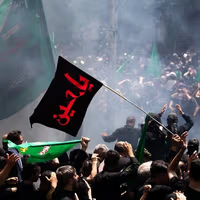
Mourners at an Ashura procession in Tehran. June 24, 2026.

Iran's Ashura commemorations have again become a stage for competing political narratives, with government supporters and opponents alike using Shi'ite mourning rituals to advance sharply different messages.

Every year during the Islamic month of Muharram, millions of Shi'ite Muslims across Iran commemorate the martyrdom of Imam Hussein, the grandson of the Prophet Muhammad who was killed in 680 AD.

Hardliners often invoke his example to argue Iran should continue confronting the United States, while government critics use the same symbolism to condemn injustice at home.

Political messaging also comes through speeches by eulogists (maddahs), who preside over ceremonies recounting Hussein's sacrifice and heroism.

At one ceremony, well-known maddah Reza Narimani criticized President Masoud Pezeshkian for disclosing in a recent speech that funds equivalent to the value of 20 million barrels of oil had been allocated to the Revolutionary Guards' Aerospace Force during the war.

Narimani also claimed Supreme Leader Mojtaba Khamenei opposed negotiations and an agreement with Washington and had merely observed the government's recent diplomatic efforts.

Another eulogist, Mohammad Reza Bazri, criticized officials he accused of ignoring "the ten conditions of the Imam"—a reference to slain leader Ali Khamenei—while pursuing an agreement with Washington and failing to respond to what he described as US violations of the ceasefire.

"The Iranian people would never consent to an agreement with the United States," he claimed.

Opposition mourning

Government critics have likewise used Ashura ceremonies to express dissent, often through traditional mourning chants or carefully worded speeches condemning injustice without directly naming officials.

Religious gatherings in Yazd and Bushehr have become known for incorporating such politically charged poetry.

One widely performed lament, heard again this year, calls on people to rise up and "bring down the idols and palaces of tyrannical rulers."

Another popular mourning chant, which has gained prominence among religious opponents of the government in recent years, criticizes what it portrays as state-sponsored religion.

"In your religion, there is God's name, but God is absent," the lyrics say.

The poem's author, Shahabeddin Mousavi, was detained for a period after it became widely known.

Remembering those killed

While many ceremonies are organized or supported by the state, independent local communities also hold mourning processions that sometimes become venues for political expression.

According to social media posts, some Ashura gatherings this year included performances of the patriotic song Az Khoon-e Javanan-e Vatan ("From the Blood of the Nation's Youth") in memory of thousands of young people killed during the January unrest.

Originally composed during Iran's Constitutional Revolution more than a century ago, the song likens the blood of fallen youth to red tulips blooming from the earth.

At some ceremonies, eulogists reportedly read aloud the names of those killed.

In the central city of Arak, the mother of Mohammad Radmannia, a 29-year-old who was fatally shot in the back of the head with live ammunition in Tehran, urged mourners to continue her son's path.

In a village in the northern province of Gilan, mourners attached a photograph of Mani Safarpour, an 18-year-old from Lahijan who was also killed in Tehran, to a ceremonial drum and cymbals before gathering at his grave to perform chest-beating rituals.

Some opposition activists criticized fellow government opponents for attending Ashura ceremonies, arguing that the events are widely viewed because of state promotion as expressions of support for the Islamic Republic.

"The massacre of protesters in January was carried out on the direct orders of the leader of Shi'ites (Ali Khamenei), while other senior clerics remained silent," one user wrote on X. "A couple of Yazdi or Bushehri mourning chants cannot erase that crime from our society's memory."

Another user wrote: "The blood that was unjustly spilled will never be washed away. No lament or elegy can diminish the scale of this tragedy in our collective memory."

Others defended participation in the ceremonies.

"These mourning chants serve to remind people of those tragedies," one user argued.

Another wrote that participating in Ashura ceremonies was "part of the struggle to reclaim religious symbols" from the government.

A further comment added: "When will people understand that many ordinary religious Iranians have nothing to do with the government or its hardline supporters?"


Iran food inflation hits 130% amid policy criticism, MP says

Jun 25, 2026, 23:20 GMT+1

Iranian lawmaker Meisam Zohurian said food inflation sharply accelerated in recent months, adding that previous declines were reversed by what he described as “wrong” currency and trade policies.

In a post on X, he said food inflation which had fallen to 24% in September 2024, rose to 105% before the war and is now approaching 130%, describing it as a fivefold increase in the pace of food price growth.

Zohurian accused senior officials of using the war as a “cover” to deflect from policy failures.

Iran briefing dispute led to war powers vote reversal, Senator Cassidy says

Jun 25, 2026, 22:57 GMT+1

US Senator Bill Cassidy said Special Envoy Steve Witkoff helped arrange a classified briefing on Iran after a heated exchange over congressional access to information, following his vote on a war powers resolution.

Speaking to CBS’s Face the Nation, Cassidy said he passed a note to Witkoff requesting a briefing, after which he was invited to follow up within an hour, adding his earlier vote on the resolution was driven by frustration over a lack of briefings on Iran diplomacy and military developments.

Italy says it has not allowed use of bases for strikes on Iran

Jun 25, 2026, 22:45 GMT+1

Italian Foreign Minister Antonio Tajani said on Thursday that Italy has not taken part in any military action against Iran and has not authorized the use of its bases for such operations, in comments following a call with Iranian Foreign Minister Abbas Araghchi.

"Italy has never taken part in any military initiative and has never authorized the use of bases for war actions against Iran, in the strictest respect of the treaties with the United States. I requested a return to full opening of the Strait of Hormuz, facilitating the passage of all Italian cargo ships still blocked. The reopening of the Italian embassy in Tehran is a strong signal of dialogue, also in view of the resumption of economic and cultural relations," he posed on X.

Iran maritime authority warns ships outside Gulf routes risk losing protection

Jun 25, 2026, 22:38 GMT+1

The Persian Gulf Seaway Authority (PGSA) said on Thursday that vessels transiting outside designated shipping routes in the Gulf would not be covered by its Safe Passage Guarantee, insurance, or related liability protections.

"Any consequences arising from unauthorized routing would be the sole responsibility of the vessel owner, charterer and master," The authority said on X.