Any fee on Strait of Hormuz unacceptable, Trump says
US President Donald Trump said on Wednesday that any fee imposed by Iran on ships transiting the Strait of Hormuz would be "unacceptable."
US President Donald Trump said on Wednesday that any fee imposed by Iran on ships transiting the Strait of Hormuz would be "unacceptable."






Prime Minister Benjamin Netanyahu said he did not ask President Donald Trump for permission before Israel’s June 2025 campaign against Iran, saying he only informed the US president of Israel’s plan.
“I did not ask for permission. I simply informed him of our plan,” Netanyahu said at the Muni Expo conference in Tel Aviv, adding that he was pleased Trump “ultimately joined in toward the end of this very important action.”
Netanyahu defended Israel’s preemptive security doctrine, saying Israel had to “initiate” and “attack” rather than wait for enemies to act, and said one of its most important achievements in recent conflicts was to “break the barrier of fear.”
IRGC personnel sheltering in a civilian lodging complex in Shiraz were the likely target of a strike that also killed nine civilians at a neighboring emergency center in the early days of the 2026 war, an Iran International investigation found.
The March 5 strike hit several buildings inside the Zibashahr emergency lodging complex, where members of the Islamic Revolutionary Guard Corps and affiliated forces had taken shelter during the war, according to images from the site, open-source data, Iranian media reports, witness accounts and an expert assessment reviewed by Iran International.
The evidence suggests the strike was not a simple miss aimed at a nearby IRGC facility, but an attack on the lodging complex itself.
The site sat inside a civilian area, beside a local ambulance station that is part of Iran’s 115 emergency medical service, as well as service buildings and residential homes.
No party has claimed responsibility for the strike.
Fars provincial authorities later said 20 people had been killed and 30 wounded. At an official memorial ceremony in Zibashahr, however, only 16 names and photographs were released: seven IRGC and Basij members and nine civilians.
The civilians included two emergency technicians, a health worker, municipal employees and contractors, and a local shopkeeper.
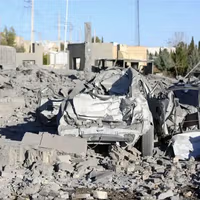
The strike destroyed the ambulance station, a neighboring building and a larger structure to the east that formed part of the municipal emergency lodging complex. Nearby residential buildings were also damaged.
Why the lodging complex was hit
The large destroyed building inside the Zibashahr complex was not an empty passenger facility or an unidentified structure.
The Student News Agency, linked to the Student Basij, published a video report from the site after the attack and said missiles had hit “dormitory and administrative buildings” in the complex. It also reported that military personnel had been killed and wounded.
The agency said the personnel were there for “training courses for border protection.”
But public mapping services, including Google Maps and the Iranian app Neshan, identify the site as an emergency lodging complex, not a military training facility.
Verified images and videos from the area also show the lodging complex sign at the entrance. Iran International found no publicly available evidence that the site had previously functioned as a military training center.
Less than 200 meters away, across the highway, sits a large IRGC Ground Forces training and military complex. Open-source mapping also links the area to the IRGC’s 19th Fajr Division and an IRGC Aerospace Force unit in Shiraz. One officer killed in the Zibashahr strike was linked to the 19th Fajr Division.
Yet post-strike imagery showed no sign that the nearby IRGC complex itself had been destroyed.
That pattern is central to the investigation. If the intended target had been the formal IRGC facility, a miss of about 200 meters across the highway would have to explain several impacts on separate buildings inside the civilian lodging complex.
Wes Bryant, a former head of a US Air Force special targeting team and former Pentagon civilian-casualty assessment official, reviewed visual evidence from the site.
He assessed that the strike involved about 1,350 kilograms of munitions, including a weapon comparable to a 900-kilogram bomb against the larger eastern building and smaller munitions, comparable to 220-kilogram bombs, against two western structures, including the ambulance station.
With modern precision-guided munitions, Bryant said, a 200-meter error across a highway would be highly unlikely, particularly in several separate impacts.
His assessment supports the conclusion drawn from the other evidence: the lodging complex itself, or specific buildings inside it, was the likely target.
A target among civilians
The evidence reviewed by Iran International points to a strike on a civilian lodging complex after IRGC personnel moved into it during the war.
That may explain why the Zibashahr complex, rather than the nearby formal IRGC facility, was hit. But the same evidence also shows that the targeted buildings stood inside a civilian setting, beside an ambulance station and near residential homes.
That leaves responsibility on the Iranian side.
By moving or allowing military personnel to shelter in a civilian lodging complex, next to an emergency medical site and homes, Iranian authorities placed civilians and medical workers in the path of a foreseeable strike.
It is not necessary to prove that civilians were intentionally used as shields to establish the consequence: the risk of war was shifted from a military facility into a place used by civilians.
That responsibility does not remove the attacker’s obligations.
Even if the presence of IRGC personnel made part of the lodging complex a military target, it did not automatically strip the neighboring ambulance station, surrounding buildings or nearby homes of protection.
A medical site loses its special protection only if it is itself used for acts harmful to the enemy; Iran International found no evidence in the material reviewed that the ambulance station was used in that way.
The strike therefore leaves two central facts in tension.
IRGC personnel appear to have taken shelter among civilians, turning part of the complex into a target. But the attack also destroyed an ambulance station and killed civilians in an area whose medical and residential character was visible in public maps and imagery.
In Zibashahr, the war moved from a military complex into a lodging site, an ambulance station and people’s homes.
Iran’s Foreign Ministry spokesman accused US officials of making contradictory statements about the memorandum to end the war, saying Washington’s remarks would only deepen Iranian mistrust and recall previous broken commitments.
The spokesman said on X that Iran had entered the diplomatic process in good faith despite what he called a long record of US dishonesty toward Iran, and had signed the war-ending MoU while remaining alert to “the experience of the past five decades,” especially developments over the past year and a half.
“Contradictory statements by US officials about the memorandum to end the imposed war will not reduce Iranians’ accumulated mistrust, and will only recall previous broken commitments.”
“The US governing establishment must bear in mind that the principle of ‘commitment for commitment’ requires both sides to fulfill their obligations and avoid interpretations that completely contradict the explicit text of the memorandum of understanding.”
Lufthansa Group pushed back against Iranian media claims that its airlines are preparing to return to Iran, saying flights to and from Tehran remain suspended until October 24 and any resumption depends on a security review.
Earlier on Wednesday, Mehr News Agency reported under the headline “Lufthansa returns to Iran” that a Lufthansa Group representative met Ramin Kashef-Azar, chairman and chief executive of Imam Khomeini Airport City, to discuss restoring flights and developing new routes.
The Iranian report said the representative had expressed interest by Lufthansa Group airlines, including Eurowings, Austrian Airlines and ITA Airways, in resuming flights to Iran. It also said Austrian Airlines would likely restart earlier than others and that Lufthansa was reviewing Iran flights for its winter schedule.
But in a written response to Iran International’s Germany correspondent Ahmad Samadi, Lufthansa described the meeting as a customary exchange and made clear that no return decision had been announced.
“The airlines of the Lufthansa Group have suspended all flights to and from Tehran up to and including October 24th, 2026,” the company said.
“We can confirm that a meeting with local representatives recently took place. Such exchanges are customary and form part of our ongoing assessment of operational and regulatory conditions,” Lufthansa added.
The company said any return to Iran would depend on a wider security review.
“Any decision regarding a resumption of services to Iran will be subject to a comprehensive security assessment and ongoing evaluation of the operational environment,” Lufthansa said. “The safety and security of our passengers and crews remain our highest priority.”
Lufthansa’s response did not confirm any restart date, winter schedule plan or specific return by any of its group airlines, sharply contrasting with the Iranian framing of the meeting as a sign of imminent normalization.
The exchange shows Tehran’s attempt to present routine aviation contacts as evidence that foreign carriers are returning after the war, while major airlines remain publicly cautious about security and operating conditions in Iran.
President Donald Trump said the war was going “very well” and added that Iran was making “very big concessions,” as he arrived on Capitol Hill for lunch with Senate Republicans on Wednesday.
“The war is going very well,” Trump said. “As you know, we’re winning by a lot. Iran is making very big concessions. We’ll see what happens – but it has been very, very, very powerful.”
The remarks were Trump’s latest effort to present the US campaign and subsequent talks with Tehran as a show of American leverage, as Washington and Iran continue to dispute the meaning and implementation of the US-Iran memorandum.