• العربية
  • فارسی
Brand
  • Iran Insight
  • Politics
  • Economy
  • Analysis
  • Special Report
  • Opinion
  • Podcast
  • Iran Insight
  • Politics
  • Economy
  • Analysis
  • Special Report
  • Opinion
  • Podcast
  • Theme
  • Language
    • العربية
    • فارسی
  • Iran Insight
  • Politics
  • Economy
  • Analysis
  • Special Report
  • Opinion
  • Podcast
All rights reserved for Volant Media UK Limited
volant media logo

Iran and US trade rival readings of MoU before 60-day talks mature

Jun 23, 2026, 14:17 GMT+1

The US-Iran memorandum is being implemented before Washington and Tehran have agreed what it means, turning the fragile deal into a battle over interpretation across the Strait of Hormuz, frozen funds, nuclear inspections, oil sanctions and Lebanon.

Less than a week after the two sides signed the MoU to end more than three months of war, its contradictions are already shaping the next phase of diplomacy: Hormuz is open, but ships may still need Iranian permission; funds are “available,” but Washington says they may be channeled toward wheat, corn and other approved purchases; inspectors are “back,” according to US officials, but Iran says there is no plan for UN inspectors to visit bombed nuclear sites; oil sales have been authorized, but Vice President JD Vance says Tehran will not benefit unless it changes behavior; Lebanon is written into the deal, but Israel is not a party to it.

For Iran, ambiguity has become leverage. Officials in Tehran are insisting that implementation of the MoU’s early provisions is a precondition for talks on more sensitive issues, while rejecting US descriptions of what the next stage should include.

Continue reading...

Most Viewed

Will the Islamic Republic trade with the 'Great Satan'?
1
INSIGHT

Will the Islamic Republic trade with the 'Great Satan'?

2
OPINION

MoU's forgotten casualty is the Iranian people

3
INSIGHT

Iran's postwar rallies become flashpoint in diplomacy debate

4

Lebanon 'deconfliction cell' emerges after intense Switzerland talks

5

Cyber campaign posing as Iran International staff continues

Banner
Banner
Banner

Spotlight

  • Tehran bread prices jump up to 100% in latest increase

    Tehran bread prices jump up to 100% in latest increase

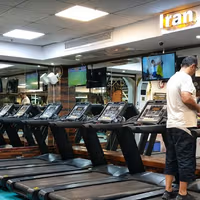
  • Rising gym fees push fitness beyond reach for many Iranians
    VOICES FROM IRAN

    Rising gym fees push fitness beyond reach for many Iranians

  • Relief or resistance? Tehran dailies offer diverging readings of talks
    INSIGHT

    Relief or resistance? Tehran dailies offer diverging readings of talks

  • Will the Islamic Republic trade with the 'Great Satan'?
    INSIGHT

    Will the Islamic Republic trade with the 'Great Satan'?

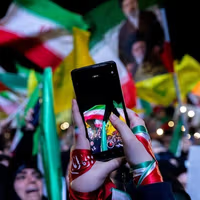
  • Iran's postwar rallies become flashpoint in diplomacy debate
    INSIGHT

    Iran's postwar rallies become flashpoint in diplomacy debate

  • MoU's forgotten casualty is the Iranian people
    OPINION

    MoU's forgotten casualty is the Iranian people

•
•
•

More Stories

Iran and US trade rival readings of MoU before 60-day talks mature

Jun 23, 2026, 13:48 GMT+1
•
Arash Sohrabi
Iran and US trade rival readings of MoU before 60-day talks mature
100%

The US-Iran memorandum is being implemented before Washington and Tehran have agreed what it means, turning the fragile deal into a battle over interpretation across the Strait of Hormuz, frozen funds, nuclear inspections, oil sanctions and Lebanon.

Less than a week after the two sides signed the MoU to end more than three months of war, its contradictions are already shaping the next phase of diplomacy: Hormuz is open, but ships may still need Iranian permission; funds are “available,” but Washington says they may be channeled toward wheat, corn and other approved purchases; inspectors are “back,” according to US officials, but Iran says there is no plan for UN inspectors to visit bombed nuclear sites; oil sales have been authorized, but Vice President JD Vance says Tehran will not benefit unless it changes behavior; Lebanon is written into the deal, but Israel is not a party to it.

For Iran, ambiguity has become leverage. Officials in Tehran are insisting that implementation of the MoU’s early provisions is a precondition for talks on more sensitive issues, while rejecting US descriptions of what the next stage should include.

Nuclear sites and missiles

Iranian Foreign Ministry spokesman Esmaeil Baghaei said on Tuesday that Tehran had not met International Atomic Energy Agency chief Rafael Grossi in Switzerland and had no plan for UN nuclear inspectors to visit facilities damaged in US and Israeli strikes.

“We have not had a meeting with the director general of the International Atomic Energy Agency, nor do we have any plans for an agency inspection of Iran’s nuclear facilities that were damaged as a result of the military attack by the United States and the Zionist regime,” Baghaei said. “Basically, there is no procedure at all in this regard.”

  • Iran says no plan for UN nuclear inspections at bombed sites

    Iran says no plan for UN nuclear inspections at bombed sites

That directly undercut Vance’s statement that talks on inspectors’ return could begin this week and President Donald Trump’s claim that Iran would agree to “major weapons inspections.”

Baghaei also ruled out talks on Iran’s missile program.

“Iran’s defensive and missile capabilities have never been part of our talks, nor will they ever be subject to negotiation with any party,” he said.

Money, oil and the first rewards

The dispute over money is just as sharp. Baghaei rejected the idea that Iran had agreed to spend released assets on US agricultural goods, after Vance said Washington wanted a mechanism to steer funds toward purchases such as soy, corn and wheat.

Baghaei said Iran would use its assets based on national needs, including price and quality.

“What is important for us is access to assets that have been unjustly blocked,” he said.

At the same time, the US Treasury has issued a 60-day license allowing Iran to produce, sell and deliver crude oil, petroleum products and petrochemicals, with related banking, insurance and transport services.

That gives both sides a political line. Washington says deeper benefits remain conditional. Tehran can point to immediate oil authorization and access to blocked assets as proof that pressure has begun to give way.

The same ambiguity surrounds the proposed $300 billion reconstruction framework. It exists in the text, but US officials have denied direct US or Qatari payments, leaving unclear whether it means grants, investment, credit facilities or future regional funding.

Hormuz is open, but under whose rules?

The Strait of Hormuz is the clearest practical test.

Ali Bahreini, Iran’s ambassador to the UN office in Geneva, said Tuesday that Hormuz was “completely open” to commercial vessels and that no charges would be collected during the 60-day period.

“Yes, the Strait of Hormuz is completely open, of course, for commercial vessels, according to the memorandum of understanding,” Bahreini said. “And it is without receiving any charges. After 60 days, it depends on the negotiations.”

  • Ships face conflicting Iran, US instructions in Strait of Hormuz - FT

    Ships face conflicting Iran, US instructions in Strait of Hormuz - FT

But the Financial Times reported that shipowners are in “deep confusion” over conflicting guidance. Iran has told vessels to seek permission from Tehran and use a route near the Iranian coast, while the US and some Western insurers advise ships to use a route on the Omani side under US air cover.

That leaves shipowners weighing the risk of Iranian interference against possible sanctions, insurance or compliance concerns.

The contradiction captures the MoU’s central problem: the US says Hormuz has reopened; Iran says reopening proves ships must deal with Tehran’s authority.

Lebanon still as the next flashpoint

Lebanon may be the deal’s most dangerous test.

Bahreini said Iran told the Switzerland talks that Lebanon is an “unquestionable part” of the MoU and that ending military operations must include respect for Lebanon’s territorial integrity, a halt to attacks and Israeli withdrawal.

“Iran’s red line is any attack against Lebanon, any more attack against Lebanon,” he said.

He warned that Iran would respond to any violation, including attacks on Lebanon or Hezbollah.

“If they are going to violate the MOU in any format, including by attacking Lebanon and Hezbollah in Lebanon, then Iran will respond,” he said.

Earlier on Tuesday, Reuters reported that Israeli gunfire killed two people in southern Lebanon, the first reported fatalities from Israeli fire there in three days. The Israeli military said it struck armed militants who posed an immediate threat.

A joint statement after US-Iran talks mediated by Pakistan and Qatar said the parties had agreed to create a deconfliction cell to monitor the termination of hostilities in Lebanon. But Israel is not a party to the US-Iran MoU, and Prime Minister Benjamin Netanyahu said this week that Israeli troops retain freedom of action against Hezbollah threats and will remain in Lebanon as long as necessary.

That leaves Washington responsible for restraining an ally outside the deal, while Tehran treats Lebanon as a condition for keeping talks alive.

A deal already under strain

Baghaei said talks on sanctions and nuclear issues depend on implementation of specific MoU provisions.

“The start of negotiations on these two issues is contingent on the implementation of specific provisions of the memorandum of understanding,” he said. “Part of it has been achieved, and part of it is being implemented.”

That is the emerging shape of the deal: each side is implementing the clauses it can sell, disputing the clauses it dislikes, and using unresolved language as leverage before the final agreement.

For now, the MoU has stopped a wider war and reopened commercial movement through Hormuz. But it has also created a new diplomatic battlefield in which every clause is being tested, stretched and weaponized before the 60-day clock has even fully begun.


Israel smuggled tens of thousands of Starlink systems into Iran, former PM says

Jun 23, 2026, 13:22 GMT+1
Israel smuggled tens of thousands of Starlink systems into Iran, former PM says
100%

Former Israeli Prime Minister Naftali Bennett said on Tuesday that Israel had smuggled tens of thousands of Starlink internet receivers into Iran to help anti-government protesters, but said Prime Minister Benjamin Netanyahu’s government did not complete the effort.

Bennett said he began a "process of acquiring and smuggling into Iran tens of thousands of Starlink receptors" to keep internet and social media access available during protests.

The systems were meant to help protesters organize and eventually bring down Iran’s government, he told the JNS International Policy Summit in Jerusalem.

"Unfortunately, the current incompetent Israeli government stopped doing that," Bennett said. "And when the protest happened, that infrastructure was not there."

Internet shutdowns

Iranian authorities have repeatedly cut public access to the internet during unrest and during the US-Israeli war with Iran that began in late February.

Iran has accused Israel and the US of bringing Starlink equipment into the country to undermine its security.

During nationwide protests in January, activists and engineers used thousands of smuggled Starlink terminals to send images of security forces and protesters abroad, according to a New York Times report in January.

Iran responded by using military-grade electronic equipment to disrupt the GPS signals on which Starlink terminals rely, the report said.

Tougher penalties

Iran’s parliament later considered a draft anti-espionage law that would increase penalties for using or possessing unauthorized satellite internet equipment.

The draft, published in October after the 12-day war with Israel and the US, set prison terms of six months to two years for personal use of Starlink or other unlicensed satellite internet services.

It also set the death penalty for people found to have used such systems for espionage or to act against the state.

Crackdown during war

Iran intensified its crackdown on satellite internet access during the latest war, seizing terminals, blocking bank accounts and detaining people accused of using, selling or sharing access to the service. Officials have linked some cases to contact with foreign media and activities they describe as threats to national security.

Authorities said the suspects had traded access to the service, shared information with foreign-based media and taken actions against national security.

NetBlocks said at the time that internet connectivity in Iran had dropped to about 1% of normal levels, leaving satellite services among the few ways to reach the global internet.

In May, a source familiar with the case told Iran International that Hesam Alaeddin, a 40-year-old man arrested in Tehran over his alleged use of Starlink equipment, died after security agents beat him.

Regional risks

Iran has also signaled that it could target assets linked to Musk’s companies in the Middle East.

The IRGC-affiliated Fars news agency reported in June that Iran was considering adding Starlink-related infrastructure in Israel, Qatar, Jordan, the United Arab Emirates and Oman to a new target list.

Fars said the review followed what it described as evidence that the US and Israeli militaries had used infrastructure managed by Musk, including Starlink.

Tehran bread prices jump up to 100% in latest increase

Jun 23, 2026, 13:13 GMT+1
•
Hooman Abedi
Tehran bread prices jump up to 100% in latest increase
100%
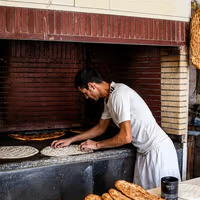
A baker prepares traditional flatbread Barbari at a bakery in Iran.

Bread prices across Tehran province have risen by as much as 100%, pushing the cost of one of the most important staple foods sharply higher and raising fresh concerns over government plans to overhaul the country's subsidy system.

Residents arriving at bakeries on Tuesday found new official prices in effect following an order issued by Tehran provincial authorities and announced by the Iran Chamber of Guilds' flour and bread working group. Under the new rates, lavash flatbread now costs 27,000 rials (2 cents), yeast-leavened barbari 100,000 rials (6 cents) and sangak 155,000 rials (10 cents).

The average monthly wage in Iran is estimated at around $150. A family relying solely on bread for its food consumption would spend roughly $8-$17 per month, depending on the type of bread purchased.

  • Bread shortages, soaring prices strain households in Iran, residents say

    Bread shortages, soaring prices strain households in Iran, residents say

The increase came only two days after Agriculture Minister Gholamreza Nouri Ghezeljeh said bread price rises were not under consideration and that the government was pursuing plans to transfer subsidies from bakeries to households through an expanded electronic voucher system.

The latest hike continues a trend that began during the presidency of the late Ebrahim Raisi and has accelerated under President Masoud Pezeshkian. Compared with less than a year ago, official price schedules show sangak prices have risen by 104%, barbari by 85% and lavash by 93%.

Freshly baked Sangak bread is displayed at a bakery in Iran (undated)
100%
Freshly baked Sangak bread is displayed at a bakery in Iran

Before September 2024, when the US dollar traded at around 600,000 rials on the free market, Lavash cost 5,000 rials ($0.008), while Barbari sold for 18,000 rials (3 cents) and Sangak for 30,000 rials (5 cents).

The increase follows similar price rises elsewhere in the country. Bread prices in West Azarbaijan province rose by 70% to 100% last month, while prices in Mashhad increased by an average of 49% in mid-June. Reports from other provinces have also pointed to either higher bread prices or reductions in dough weights, a practice some consumers and analysts describe as hidden inflation.

Card-based bread system

The latest increase comes as authorities continue to rely on the Nanino digital monitoring platform, introduced in 2022 to distribute subsidized flour based on bakery sales.

  • Rampant inflation may ignite bread riots in Iran, economist warns

    Rampant inflation may ignite bread riots in Iran, economist warns

Many bakers say technical problems and disputed calculations have reduced their flour allocations. Although authorities insist there are no limits on bread purchases, consumers in many areas report restrictions as bakeries attempt to stretch subsidized flour supplies.

Subsidy cuts spark concern

The Pezeshkian administration has steadily reduced support for wheat and flour subsidies since taking office and is examining plans to integrate bread subsidies into the electronic voucher program, a move that could effectively end the current subsidy structure.

The proposal has generated concern even among media outlets generally supportive of state policies. News website Khabar Online warned that public tolerance for rising prices was wearing thin and that additional pressure linked to a staple as widely consumed as bread could provoke a strong public reaction.

"Public tolerance for price increases has reached its limit, and society may face severe tension and shock from any new pressure, particularly over a product such as bread that is consumed extensively across cities, villages and lower-income households," the outlet wrote.

Freshly baked lavash bread is displayed at a bakery in Iran. (undated)
100%
Freshly baked lavash bread is displayed at a bakery in Iran.

Bakery owners say they face growing costs for labor, utilities and raw materials while operating under regulated prices and delayed subsidy payments. Economists and labor activists warn that repeated increases in bread prices disproportionately affect low-income families because bread remains a key component of household consumption.

The price rise comes as inflation remains elevated. According to Iran's Statistical Center, consumer prices in May were 83.9% higher than a year earlier, while annual inflation reached 57.7%.

As the government moves ahead with subsidy reforms, the price of bread is increasingly becoming a measure of the economic strain facing millions of families across the country.

Trump says record oil volume passed through Strait of Hormuz

Jun 23, 2026, 12:32 GMT+1

US President Donald Trump said on Tuesday that 19 million barrels of oil passed through the Strait of Hormuz on Monday, a record volume that he said had pushed oil prices lower and made the world safer.

"19 Millions Barrels of Oil flowed out of the Hormuz Strait yesterday, an all time RECORD," Trump wrote on Truth Social.

"Oil prices are tumbling down, and the World is a much safer place!!!" he wrote.

Trump says Iran agreed to long-term nuclear inspections

Jun 23, 2026, 12:23 GMT+1

US President Donald Trump said Iran had agreed to long-term, high-level nuclear inspections, adding that he would not allow further negotiations without such an agreement.

“Iran has fully and completely agreed to highest level Nuclear inspections long into the future (Infinity!!!). This will insure ‘Nuclear Honesty.’ If they did not agree to this, there would be no further negotiations,” he wrote in a post on Truth Social.

Trump said he had agreed to let the Strait of Hormuz remain open and avoid a further naval blockade, though he said US ships would remain in place in case the blockade needed to be restored.

He said funds and sanctions relief being released by the US Treasury would go into a US-controlled escrow account and be used only to buy food and medical supplies from the United States, including corn, wheat and soybeans.

“The Money and/or Sanctions that the U.S. Treasury is releasing goes into escrow, controlled by the U.S.A., and will be used for the purchase of food and medical supplies, exclusively from the United States, including Corn, Wheat, and Soybeans from our great American Farmers,” he said.