• العربية
  • فارسی
Brand
  • Iran Insight
  • Politics
  • Economy
  • Analysis
  • Special Report
  • Opinion
  • Podcast
  • Iran Insight
  • Politics
  • Economy
  • Analysis
  • Special Report
  • Opinion
  • Podcast
  • Theme
  • Language
    • العربية
    • فارسی
  • Iran Insight
  • Politics
  • Economy
  • Analysis
  • Special Report
  • Opinion
  • Podcast
All rights reserved for Volant Media UK Limited
volant media logo
INSIGHT

Iran's postwar rallies become flashpoint in diplomacy debate

Maryam Sinaiee
Maryam Sinaiee

Iran International

Jun 22, 2026, 03:27 GMT+1
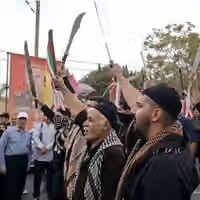
A participant records a nightly state-sponsored rally in Tehran as supporters wave Iranian and Hezbollah flags, June 9, 2026

Iranian hardliners have sharply criticized a government-linked report that warned prolonged nightly pro-state gatherings could obstruct diplomacy, exposing a growing dispute over the role of street mobilization in postwar Iran.

The controversy highlights tensions within Iran's political establishment over whether the rallies represent a source of national unity or an increasingly disruptive force in debates over diplomacy and relations with the United States.

The backlash was triggered by a document published by the presidential Strategic Affairs Office (SAO) following a conference titled "The Street Movement for Protecting Iran: Nature, Opportunities and Ways to Enhance It."

The report examined the nightly gatherings that have spread across Iranian cities since the war and argued that their continued presence could complicate decision-making and undermine diplomatic efforts.

Many of the nightly gatherings—known in Iran's political discourse simply as "the street"—began as public mourning ceremonies for Khamenei before evolving into organized political events.

It warned that the "continuation of gatherings would constitute a serious obstacle to adopting strategic and expedient decisions at sensitive moments." Left unchecked, the report said, the gatherings could "lead to obstruction in the path of diplomacy."

The report drew an immediate backlash from hardline media and politicians.

The website Jahan News criticized what it described as the report's "inappropriate and offensive" language, particularly its characterization of the gatherings as "emotional" rituals.

"This terminology is used despite the fact that the Supreme Leader repeatedly praised the nightly gatherings and even explicitly stated that people's chants in public squares influence the course of negotiations."

Initially encouraged by senior officials as demonstrations of national solidarity during wartime, the rallies attracted large crowds. Witnesses say attendance has since declined as the rhetoric has become more radical, with many gatherings now drawing between 100 and 200 participants.

Ali Khezriyan, a member of parliament's National Security and Foreign Policy Committee, criticized the Strategic Affairs Office for portraying the gatherings as an obstacle to diplomacy.

"While we speak about the role of the people, the SAO has described the people's gatherings as causing obstruction in diplomacy, whereas the Supreme Leader considers the people to be overseers," he told IRGC-linked Fars News.

"These same people brought themselves and their loved ones into the streets under enemy bombardment," he added.

The SAO report appeared to recommend gradually winding down the gatherings after the first ten days of Muharram or following the funeral of former Supreme Leader Ali Khamenei, scheduled for July 4-5.

Hardline political groups have increasingly used the events as platforms for speeches and mobilization. Speakers have addressed contentious issues including ceasefire terms and negotiations with the United States.

Some have targeted prominent political figures, particularly Parliament Speaker Mohammad Bagher Ghalibaf, who heads Iran's negotiating team, with crowds encouraged to chant slogans against him.

Fars News Agency, which is linked to the Revolutionary Guards (IRGC), published a photograph of a participant holding a banner that read: "Instead of deciding how to empty the streets, the government should think about the emptying of people's dinner tables."

One commenter wrote: "We did not gather on the orders of officials so that we would leave the streets based on their decisions."

Another wrote: "Why do you think you have the right to talk about these gatherings? People did not come into the streets with your permission for you to disperse them. Keep your mouth shut before we open ours."

Most Viewed

Hardliners accuse negotiating team of ignoring Supreme Leader's objections
1

Hardliners accuse negotiating team of ignoring Supreme Leader's objections

2

Hardliner reveals ‘top-secret’ Khamenei objections to US talks on state TV

3
ANALYSIS

Iran may get a lifeline, but major obstacles remain

4

Israel reveals Iranian-designed Hezbollah ‘terror tunnel’ with large drone cache

5

Iran’s legal drug market is being hollowed out as shortages feed illicit channels

Banner
Banner
Banner

Spotlight

  • Iran's postwar rallies become flashpoint in diplomacy debate
    INSIGHT

    Iran's postwar rallies become flashpoint in diplomacy debate

  • MoU's forgotten casualty is the Iranian people
    OPINION

    MoU's forgotten casualty is the Iranian people

  • Iran may get a lifeline, but major obstacles remain
    ANALYSIS

    Iran may get a lifeline, but major obstacles remain

  • Can Iran rebuild ties with Arab neighbours without a US deal?
    INSIGHT

    Can Iran rebuild ties with Arab neighbours without a US deal?

  • Trump says Iran is 'finished', experts say Tehran won big
    PODCAST

    Trump says Iran is 'finished', experts say Tehran won big

  • A US-Iran deal alone won't rescue Iran's oil economy
    ANALYSIS

    A US-Iran deal alone won't rescue Iran's oil economy

•
•
•

More Stories

MoU's forgotten casualty is the Iranian people

Jun 22, 2026, 01:16 GMT+1
•
Eric Mandel
MoU's forgotten casualty is the Iranian people
100%
Iranian demonstrators gather in a street during a protest over the collapse of the currency's value, in Tehran, Iran, January 8, 2026.

The Memorandum of Understanding between Iran and the United States may strengthen the Revolutionary Guards, weaken Persian Gulf security and deepen China's access to Iranian energy. Above all, however, it leaves Iranians to face the Islamic Republic on their own.

Paragraph 2 of the MOU effectively enshrines the abandonment of the Iranian people by committing both sides to "refrain from interfering in each other's internal affairs."

This clause stands in direct contrast to many of President Trump's previous statements regarding the Iranian people and his repeated condemnations of the regime's brutality.

In 2017, Trump described Iranians as "a proud people" forced to submit to extremist rule. In 2018, he tweeted: "Such respect for the people of Iran as they try to take back their corrupt government. You will see great support from the United States at the appropriate time!"

Following the June 2025 strikes on Iranian nuclear facilities, he posted: "If the current Iranian Regime is unable to MAKE IRAN GREAT AGAIN, why wouldn't there be a Regime change? MIGA."

In January 2026, he urged Iranians to continue protesting and "take over your institutions," adding that "help is on its way." The following month, during major opposition demonstrations, he again appealed directly to Iranians: "When we are finished, take over your government. It will be yours to take."

Today, however, the MOU represents a dramatic reversal of those positions. The agreement abandons a population Trump repeatedly encouraged to reclaim its country and signals that the United States is no longer willing to support internal pressure against the regime.

The contrast is particularly striking because it comes after a period in which Iran was arguably more vulnerable than at any point in decades.

Following military setbacks, economic pressure and growing domestic dissatisfaction, the regime faced mounting challenges both externally and internally. Yet rather than using that leverage to pursue broader political change, Washington appears to have chosen accommodation.

Trump now speaks of Iran's leaders as "very smart" and "strong," describing them as pragmatic negotiating partners. According to PBS NewsHour, a US official said Iran would be rewarded for "acting like a normal country."

That raises a fundamental question: after 47 years of repression, terrorism, hostage-taking, regional destabilization and the deaths of many Americans linked to Iran and its proxy network, is Tehran now being offered normalization without accountability?

The agreement appears poised to provide sanctions relief, access to frozen assets and expanded oil sales. Much of that oil is likely to flow to China. Additional revenue could strengthen the IRGC, reinforce domestic repression and increase support for armed allies such as Hezbollah and Hamas.

Supporters of the agreement argue that diplomacy is preferable to conflict and that negotiated limits are better than perpetual confrontation. Yet history suggests that agreements with the Islamic Republic are only as effective as the enforcement mechanisms behind them and the willingness to use them.

If substantial benefits are delivered before key obligations are fully verified, leverage disappears while risks increase.

This concern is not new. When President Obama declined to support Iran's Green Movement following the disputed 2009 election, many critics viewed the decision as both a betrayal of democratic values and a missed strategic opportunity to weaken the regime from within.

The current debate echoes many of the same arguments. But what Trump has done may prove even more consequential.

After authorizing actions that significantly degraded Iran's nuclear infrastructure, ballistic missile capabilities and military assets, he achieved what many previous administrations were unwilling or unable to attempt.

Yet by rapidly transitioning from maximum pressure to accommodation, he risks transforming a major tactical victory into a strategic mistake.

At the moment Iran appeared most vulnerable and many Iranians seemed most willing to challenge the regime, the United States chose not to prioritize support for opposition movements or increase pressure on the IRGC from within.

Whether such efforts would have succeeded is unknowable, but abandoning them entirely removed a source of leverage that would have, at the very least, strengthened America's negotiating position.

A different strategy would have required a sustained effort to explain to the American people why supporting the aspirations of ordinary Iranians serves both value-based American principles and long-term US security interests.

Genuine stability in the Middle East is unlikely to emerge solely from agreements with authoritarian rulers. Lasting stability comes when governments enjoy legitimacy among their own populations, especially populations that are likely to be among the most pro-American in the Muslim world.

Instead, the administration chose strategic impatience. In doing so, it not only disheartened many Iranians who hoped for greater international support, but also created uncertainty among Gulf allies and Israel.

Several regional and foreign-policy experts argue that Persian Gulf states may now reassess the reliability of American security guarantees and adapt accordingly.

The art of diplomacy is not surrendering hard-won leverage before a final agreement is fully negotiated and enforceable.

A 60-day ceasefire could easily become months of inconclusive negotiations while Iran replenishes its finances, strengthens the IRGC, suppresses domestic dissent and supports regional proxies.

But one thing is already clear: the agreement's most overlooked consequence is not what it says about centrifuges, missiles or sanctions. It is what it says about the people of Iran and American assurances.

For years, American leaders, including President Trump, spoke of supporting Iranians seeking freedom from Islamist authoritarian rule. The MOU signals a different set of priorities.

By pledging noninterference in Iran's internal affairs while offering the regime a pathway toward normalization and economic relief, Washington appears to have chosen engagement with Tehran over support for political change.

Whether that choice ultimately produces peace or merely postpones a larger confrontation remains to be seen. But for millions of Iranians who believed the United States stood with them against their oppressors, the message of this agreement is unmistakable: they are now largely on their own.

Hardliner reveals ‘top-secret’ Khamenei objections to US talks on state TV

Jun 20, 2026, 19:45 GMT+1
Hardliner reveals ‘top-secret’ Khamenei objections to US talks on state TV
100%
File photo shows hardline lawmaker Mahmoud Nabavian

A hardline lawmaker sparked a major backlash after reading excerpts from what were described as top-secret letters by Iran’s Supreme Leader on state TV, claiming he opposed US talks, before he was interrupted and the program was abruptly cut off.

Mahmoud Nabavian, a member of parliament’s National Security and Foreign Policy Committee, said Supreme Leader Mojtaba Khamenei had repeatedly objected to the course of negotiations with the United States and set conditions that were not reflected in the Iran-US memorandum of understanding.

His remarks came as Iran’s negotiating team travelled to Switzerland for a new round of technical talks with the United States, days after Tehran and Washington signed the MoU aimed at ending the war and opening the way for further negotiations.

“The Supreme Leader explicitly expresses his dissatisfaction,” Nabavian said on the program. “He says, ‘Why did you not observe the conditions?’”

He said Khamenei had written that Iran was “neither in a hurry nor under any compulsion to negotiate or reach an agreement,” adding that the talks should be aimed at “ending the war and securing compensation,” not the nuclear issue.

According to Nabavian, Khamenei had also told negotiators not to discuss what he called “the main issue," apparently referring to Tehran's nuclear program.

“I will read one sentence. There is no other choice,” Nabavian said, before quoting from what he described as Khamenei’s correspondence: “What has taken shape in the Pakistan negotiations is fundamentally different from what was supposed to happen and from what constituted the condition for the legitimacy of the negotiations.”

Nabavian said Khamenei then called for the negotiations to be stopped.

He also said Khamenei repeated his position on the nuclear file on April 4, April 18 and April 24, insisting that Iran should either achieve “victory” by forcing the other side to fully recognize its right to enrichment, or remove the nuclear issue from the agenda of negotiations “forever.”

On the Strait of Hormuz, Nabavian said Khamenei viewed the waterway as a key point of leverage against Washington.

“The Strait of Hormuz is a very important key,” Nabavian quoted him as saying. “If the Americans want pressure taken off their throat, they must first implement preconditions, foremost among them the payment of compensation and debts.”

Nabavian added that “none of these things” had appeared in the MoU.

He said Khamenei had insisted that management of the Strait of Hormuz must remain exclusively in Iran’s hands, “not even with Oman, let alone other countries.”

According to Nabavian, Khamenei had also divided ships into different categories, saying some vessels should be stopped altogether, some could pass after paying tolls, and others, including ships belonging to Iran’s allies, could pass without payment.

He said the instructions were included in a message dated March 12.

As Nabavian continued speaking, he was interrupted by the state TV's presenter and the program abruptly ended.

State TV vows legal action

Iran’s state broadcaster later called his remarks a legal violation warranting judicial action, saying his references to classified documents and correspondence by senior officials were punishable.

It also said one director at the organization had resigned over the incident and that disciplinary action would be taken.

The disclosure also drew criticism from conservative media circles. The editor-in-chief of Mashregh accused Nabavian of selectively reading from a wider set of correspondence.

“Why don’t you say these selective excerpts of yours were from about 20-something correspondences, and in fact from the earliest ones?” Hossein Soleimani wrote on X, addressing Nabavian. “Since you disclosed and published the system’s secret and top-secret documents, you should at least have disclosed them correctly and accurately.”

Nabavian and other figures close to the hardline Paydari Front have sharply criticized the Iran-US MoU in recent days, accusing President Masoud Pezeshkian, Parliament Speaker Mohammad Bagher Ghalibaf and Foreign Minister Abbas Araghchi of making dangerous concessions to Washington.

The criticisms come as a message attributed to Khamenei said he authorized the signing of the memorandum of understanding despite having “another view in principle,” after receiving assurances from Pezeshkian that Iran’s rights and those of the “Resistance Front” would be protected.

Iranian media have reported that the negotiating team, led by Ghalibaf and including Araghchi, Central Bank Governor Abdolnaser Hemmati and other senior officials, has left for Switzerland for technical talks with the United States.

The talks are being held as the Islamic Revolutionary Guard Corps (IRGC) Navy has once again closed the Strait of Hormuz over what Tehran describes as violations of the MoU in Lebanon.

On Saturday, Iran’s Supreme National Security Council, in a directive seen by Iran International, instructed media outlets not to portray the renewed closure of the Strait of Hormuz and Iran’s simultaneous participation in talks as a split between the “field” and diplomacy.

The directive said Iran was pursuing a single strategy combining military pressure and diplomacy, and urged media outlets to frame action in Hormuz not as an alternative to negotiations but as support for them.

Iran may get a lifeline, but major obstacles remain

Jun 20, 2026, 09:37 GMT+1
•
Dalga Khatinoglu
Iran may get a lifeline, but major obstacles remain
100%
Children and families enjoy the return of water to the Zayandeh Roud in Isfahan, where the river's revival drew crowds to its banks after years of recurring drought and shortages, June 16, 2026

The agreement between Tehran and Washington holds out the prospect of sanctions relief and potentially unprecedented foreign investment, but many of its economic promises remain uncertain and some may prove difficult to deliver even if negotiations succeed.

The relative strengthening of the Iranian rial suggests the agreement has already had a positive psychological impact.

The US dollar, which traded above 1.8 million rials during the recent conflict, has fallen to around 1.57 million. Even so, it remains roughly 18 percent higher than six months ago.

According to estimates by Kpler, Iran was exporting about 1.5 million barrels per day of crude oil and condensates before the recent conflict. Without sanctions, exports could eventually return to around 2.5 million barrels per day.

Iran would also no longer be forced to sell much of its crude to Chinese buyers at steep discounts.

Revenue boost

According to OPEC estimates, Iran earned $46.7 billion from exports of crude oil and petroleum products last year. If sanctions are lifted and oil prices remain relatively elevated, that figure could rise substantially.

A rapid recovery, however, should not be expected.

Iran's petrochemical and steel industries, which together generate roughly $17 billion in annual export revenue, have suffered extensive damage during the conflict.

As a result, Iran could temporarily become a net importer of some products it has traditionally exported.

Persian Gulf Holding, which accounts for 38 percent of Iran's petrochemical production, recently reported that output at six heavily damaged complexes fell to just 13 percent of levels recorded during the same period last year. Overall production across the holding's petrochemical subsidiaries declined by 75 percent.

According to Iran's Central Bank, oil, gas, steel and petrochemicals account for 73 percent of the country's total exports, underscoring the importance of rebuilding damaged industrial capacity.

Release of frozen assets

Iran is estimated to hold approximately $24 billion in frozen assets abroad, about half of which could be released within two months.

The Wall Street Journal reported on June 19 that, contingent upon what it described as appropriate Iranian behavior and the transfer of enriched uranium, Tehran could gain access to $6 billion in frozen funds currently held in Qatari banks for the purchase of humanitarian and agricultural goods from the United States.

The arrangement could benefit both countries. Iran imports approximately $17 billion worth of grain annually, while the United States remains the world's largest grain exporter.

Trade between the two countries has collapsed since the 1979 revolution. According to official US statistics, bilateral trade totaled $6.6 billion in 1978 but amounted to only $60 million last year, almost entirely consisting of US exports to Iran.

The reconstruction fund

One of the most ambitious — and least defined — elements of the agreement is a proposed $300 billion reconstruction fund involving foreign companies, including firms from Arab states, to support Iran's reconstruction.

Unlike historical reconstruction programs financed by governments, the proposed fund is expected to rely largely on private investment. That raises significant questions about how such a large sum could be mobilized and whether foreign companies would be willing to commit substantial capital to Iran after years of sanctions, regional tensions and political uncertainty.

Beyond political considerations, investors would also have to weigh sanctions risks, regulatory uncertainty and the long-term stability of the investment environment before committing significant capital.

Given Tehran's strained relations with many Arab states in recent years, enthusiasm among regional investors may remain limited, although countries such as Qatar and Oman could encourage some level of participation.

For now, the creation of a fund on the scale envisioned by the agreement appears unlikely in the medium term. More modest investment flows may be possible if Tehran complies with future commitments and continues improving ties with its neighbors.

The need for investment is undeniable. Iran's oil and gas sector alone is estimated to require at least $300 billion in capital to modernize infrastructure and expand production after decades of underinvestment.

Ultimately, the economic benefits outlined in the agreement depend not only on sanctions relief but also on Tehran's ability to reassure investors, rebuild damaged industries and maintain stable relations with regional and international partners.

For now, the agreement has boosted expectations. Whether it can deliver a lasting economic recovery remains an open question.

Can Iran rebuild ties with Arab neighbours without a US deal?

Jun 20, 2026, 04:55 GMT+1
•
Behrouz Turani
Can Iran rebuild ties with Arab neighbours without a US deal?
100%
Iranian President Masoud Pezeshkian is welcomed by Qatari officials upon his arrival at Doha's airport, in Doha, Qatar, October 2, 2024.

The recent war between Iran and the United States has left Tehran facing a diplomatic challenge that extends well beyond Washington: rebuilding trust with Arab neighbors unsettled by weeks of regional instability.

Former ambassador Mohammad Irani argues that effort will depend largely on the success of negotiations between Tehran and Washington.

Speaking to Shargh on Thursday, June 18, Irani said that "the restoration of Iran's damaged relations with its Arab neighbors is directly contingent upon the success and final quality of the broader Tehran-Washington agreement."

He argued that with hostilities paused and a tentative memorandum of understanding now on the table, "Iran must adopt an optimistic and rational diplomatic approach to break out of political and economic isolation."

Iran cannot repair relations with Arab and regional neighbors "in a vacuum," he said, insisting that regional diplomacy is inseparable from the outcome of negotiations with Washington.

His comments reflect a broader theme across Iran's press, where discussions of relations with Persian Gulf states have become increasingly tied to post-war diplomacy and the emerging Tehran-Washington understanding.

A recurring argument is that the conflict exposed the vulnerability of Iran's Arab neighbors and reinforced their interest in a durable understanding between Tehran and Washington. Many voices in Tehran argue that regional states now view a sustainable agreement as the best guarantee of their own economic and technological stability.

Irani also argued that a lasting regional order cannot be imported or built through symbolic agreements alone, as smaller states remain engaged in a constant balancing act between larger regional powers, particularly Iran and Saudi Arabia.

Many commentators have likewise suggested that Persian Gulf states are reassessing their security doctrines in the aftermath of the war, particularly regarding Israel's growing strategic and technological footprint across the region.

Several outlets, including Etemad, ISNA and Eghtesad News, have argued that Iran's long-term place in the regional order will ultimately depend on the fate of the nuclear file and the broader understanding taking shape between Tehran and Washington.

At the same time, analysts warn that if the current 60-day negotiation window fails to produce a more permanent framework, Iran's Arab neighbors are likely to deepen security, cybersecurity and defense partnerships with Western and other global powers, further marginalizing Tehran.

For the talks to succeed, Irani argued, the negotiating team needs strong domestic backing to convert wartime resilience into peacetime development.

"The negotiating team must feel that it enjoys the support of the nation," he said. "We must show that the steadfastness and resistance shown during recent conflicts is now gradually bearing fruit."

Ultimately, he concluded, a durable homegrown security framework will remain elusive as long as Persian Gulf states prioritize regime survival over collective security and fundamental disparities in regional power remain unresolved.

Tehran divided over what Khamenei MoU message really meant

Jun 20, 2026, 02:58 GMT+1
Tehran divided over what Khamenei MoU message really meant
100%

A message attributed to Iran’s Supreme Leader suggesting he had reservations about the agreement with the United States has sparked a fierce debate in Tehran, with hardliners and moderates offering sharply different interpretations of its meaning and implications.

Supporters of the government presented it as a roadmap for the next phase of diplomacy, while critics argued it showed the leader’s preferred approach had been sidelined during negotiations.

Hardline media outlets and political figures offered a starkly different reading, arguing that the message showed the leader’s views had not been fully reflected in the negotiation process.

Read the full article here.