• العربية
  • فارسی
Brand
  • Iran Insight
  • Politics
  • Economy
  • Analysis
  • Special Report
  • Opinion
  • Podcast
  • Iran Insight
  • Politics
  • Economy
  • Analysis
  • Special Report
  • Opinion
  • Podcast
  • Theme
  • Language
    • العربية
    • فارسی
  • Iran Insight
  • Politics
  • Economy
  • Analysis
  • Special Report
  • Opinion
  • Podcast
All rights reserved for Volant Media UK Limited
volant media logo

Tehran cleric says US and Israel understand force, not ceasefire talks

Jun 19, 2026, 12:34 GMT+1

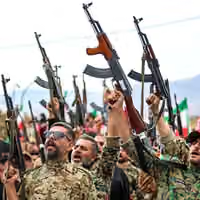
Tehran’s interim Friday prayer leader said Iran’s support for Hezbollah last week carried several messages, including what he described as a display of unity across the so-called “Resistance Front.”

Ahmad Khatami told worshippers at Friday prayers in Tehran that what Iranian officials say about war is not rhetoric and is implemented in practice.

He described the United States and Israel as untrustworthy, saying they do not understand negotiation or ceasefires and only understand force.
Most Viewed

US says Iran won't get funds upfront under MoU
1

US says Iran won't get funds upfront under MoU

2

Khamenei shifts responsibility for MoU as Iran, US implement Hormuz terms

3
INSIGHT

Tehran's familiar battle lines return over deal with US

4

US says Iran deal will end enrichment, destroy uranium stocks, cap missiles

5
VOICES FROM IRAN

Iranians say US deal leaves people out of the equation

Banner
Banner
Banner

Spotlight

  • A US-Iran deal alone won't rescue Iran's oil economy
    ANALYSIS

    A US-Iran deal alone won't rescue Iran's oil economy

  • Iran's Qatar power link exposes a deeper energy dilemma
    ANALYSIS

    Iran's Qatar power link exposes a deeper energy dilemma

  • Who in Tehran is opposing a deal with Washington?
    INSIGHT

    Who in Tehran is opposing a deal with Washington?

  • A fragile compact: ambiguities that could undermine US-Iran MoU
    ANALYSIS

    A fragile compact: ambiguities that could undermine US-Iran MoU

  • A thaw with the US won't fill Iranian tables overnight
    INSIGHT

    A thaw with the US won't fill Iranian tables overnight

  • Why some think a weakened Iran could emerge stronger
    ANALYSIS

    Why some think a weakened Iran could emerge stronger

•
•
•

More Stories

Iran parliament media chief says talks and battlefield share same command center

Jun 19, 2026, 12:32 GMT+1

The head of communications, media and cultural affairs at Iran’s parliament said the same strategic command guides both negotiations with the United States and the military field, after Supreme Leader Mojtaba Khamenei said he had approved the understanding despite opposing it.

Iman Shamsaei described Khamenei’s message as a sign of democracy, arguing that the decision showed political responsibility rather than one-man rule.

“The negotiation war room is the same as the battlefield war room,” he said, adding that any threat would face a rapid response.

Khamenei earlier said he had agreed to implement the understanding with Washington after President Masoud Pezeshkian accepted responsibility for safeguarding Iran’s rights.

Qom Friday prayer leader says Iran will not yield if US makes excessive demands

Jun 19, 2026, 12:27 GMT+1

Qom Friday prayer leader Mohammad Saeedi said Iranian officials would not accept what he called illegal US demands if Washington pursued excessive demands under the memorandum with Iran.

Speaking in Friday prayers in Qom, Saeedi said Supreme Leader Mojtaba Khamenei’s message had emphasized protecting the country’s rights and the so-called “Resistance Front,” adding that this would now shape public expectations and judgment of the agreement.

Saeedi said Iranians, despite their experience of what he described as US bad faith, were emphasizing unity out of respect for Khamenei’s position and hoped the other side would uphold its commitments.

Hezbollah says Iran tied US talks to full Lebanon ceasefire

Jun 19, 2026, 12:15 GMT+1

Hezbollah lawmaker Hassan Fadlallah told Reuters that Iran had informed the group that talks with the United States could not continue without a comprehensive ceasefire, tying the US-Iran diplomatic track to the fighting in Lebanon.

Fadlallah said Lebanon’s government should reject direct negotiations with Israel as long as Israeli attacks on Lebanon continue.

Iran says Hormuz transit fees suspended under US memorandum

Jun 19, 2026, 12:12 GMT+1

Iran will waive planned fees for ships using the Strait of Hormuz during the 60-day negotiation period under its memorandum with the United States, according to Iran’s Persian Gulf Strait Authority.

The authority said ships seeking passage while the interim agreement is in force must submit transit requests at least 48 hours before arrival.

Iran said it would suspend fees for security, safety, environmental services and related insurance during the period, while requiring vessels to coordinate routes and transit times in advance because of areas affected by mines and the need to ensure safe navigation.

Who in Tehran is opposing a deal with Washington?

Jun 19, 2026, 12:11 GMT+1

A message attributed to Iran's Supreme Leader Mojtaba Khamenei and the swift reactions from President Masoud Pezeshkian and chief negotiator Mohammad Bagher Ghalibaf highlighted the uneasy coalition behind the agreement with the United States and the lingering doubts about it.

The intervention comes after weeks of criticism from hardline media outlets, clerics and political factions that viewed the agreement as a dangerous concession to Washington.

While the ultraconservative Paydari Party is often portrayed as the main opponent of rapprochement with the United States, recent debate in Iran has highlighted a broader network of political, media and ideological actors resisting a Tehran-Washington understanding.

In a message issued after the signing of the memorandum, Mojtaba Khamenei warned that actions creating “pessimism among the people” effectively serve the enemy, language widely interpreted as a rebuke to hardline critics of the agreement.

Both Pezeshkian and Ghalibaf quickly issued statements pledging to follow the leader's guidance and defend the negotiating process.

The apparent effort to impose discipline on the debate has coincided with growing scrutiny of those opposing diplomacy.

Continue reading...